Guides
Gutter service opening requirements, explained
Gutter service opening requirements involve four compliance waves a gutter business hits, from first call to first winter, with license blanks you fill in.
What to take away
- Compliance arrives in four waves, not one. Each wave has a trigger you can see coming: first call, first address, first hire, first freeze.
- Wave two is the one missing from every licensing list. Where the water may go is a stormwater rule, not a licensing rule, and it decides what your standard scope can promise.
- The first helper you almost pay as a contractor is a classification question with real money attached. Ask an employment attorney or accountant in your state.
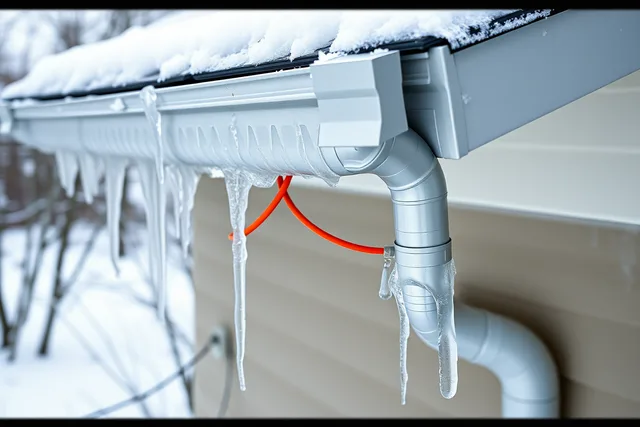
- Ice at the roof edge is usually an insulation and ventilation problem. Decide your answer before a crew improvises one on a ladder in January.
- No premium, threshold or fee appears below. Each is set locally and moves, so hold a dated note of who told you and when.
How to use this
Print it. Keep it as a working document, not a completion certificate. Every line is either done or dated, and a line with no date is not done.
Bracketed items are where you write your own answer. Contractor regulation is layered across state, county and city, and the layers disagree.
The method for finding each answer sits in the licensing and compliance guide. The taxonomy of what actually counts as a license is in what licenses this business needs.
Wave one: before you take the first call
- Entity formed and registered with the state [entity type, filing date, annual renewal date]
- Federal and state tax registrations completed [which apply here]
- Business license or tax certificate obtained in each city you will quote in [list them]
- Trade or contractor licensing question answered by the state board [classification, threshold, who told you, date]
- Bank account and bookkeeping set up separately from personal accounts
- General liability and, where required, workers' compensation bound [carrier, policy dates]
- Sales or use tax treatment of materials and labor confirmed for your state
The fourth line is the one to get in writing. Ask which classification covers exterior drainage work rather than asking about the word gutter. Ask whether any threshold is per project or per contract, and whether the license attaches to the entity or to a qualifying individual.
Wave two: before the first job at an address
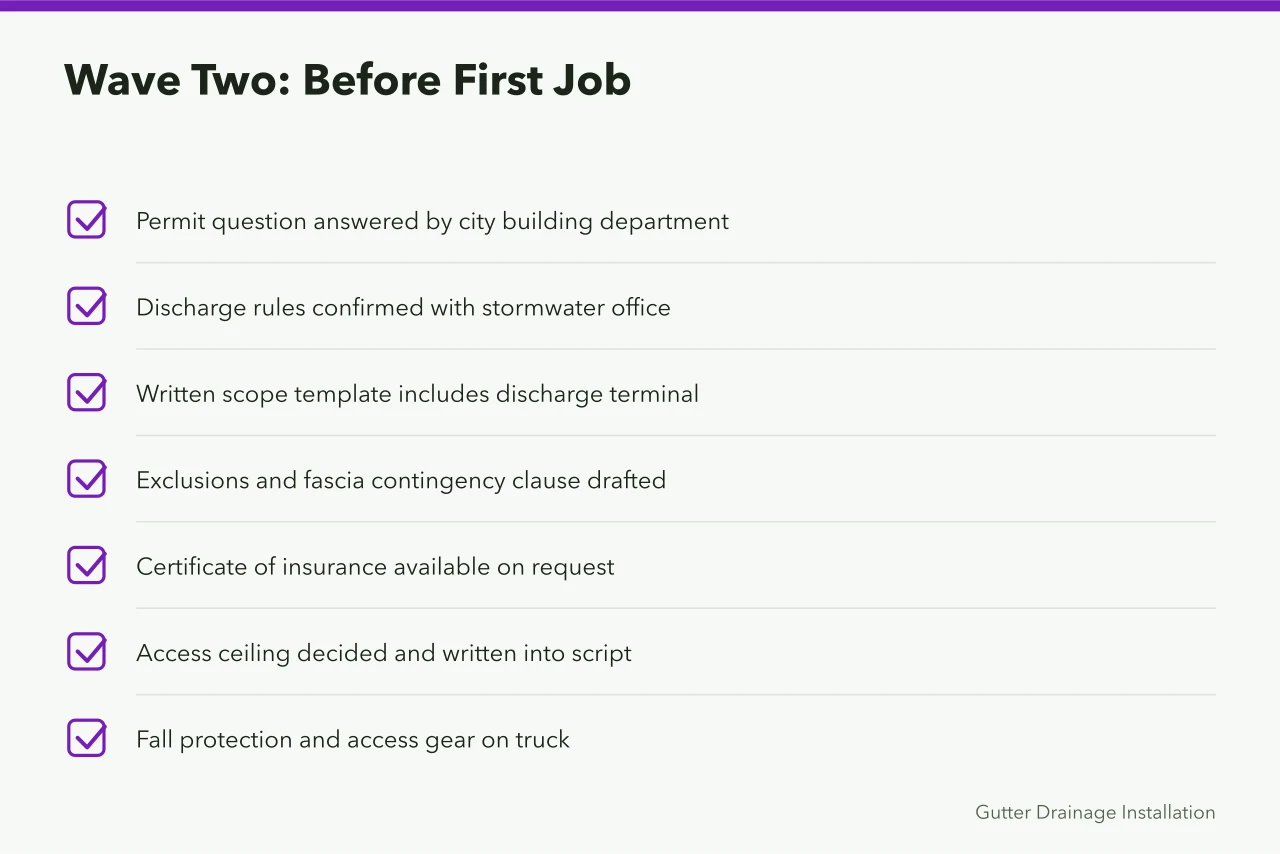
- Permit question answered by the city building department for each city [required for replacement? for a new connection? neither?]
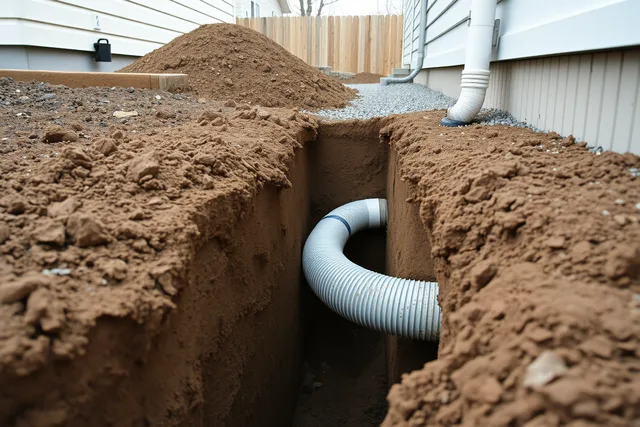
- Discharge rules confirmed with the municipal stormwater or public works office [may connect to storm sewer? prohibition on sanitary sewer? setback from property line?]
- Written scope template includes the discharge terminal
- Written exclusions and fascia contingency clause drafted
- Certificate of insurance available on request, sent by the carrier rather than by you
- Access ceiling decided and written into the intake script [tallest elevation you accept]
- Fall protection and access gear on the truck, with an inspection criterion
The discharge line is the one nobody expects to find on a compliance checklist. It is not a licensing question, so it appears on no licensing list, and it decides what your standard scope can promise. Where the water may go is set locally and it varies between neighboring towns.
The access ceiling is the other line with outsized consequences. It is a business decision, a safety decision and an underwriting answer at the same time. Decide it once, in the office, and hold to it.
Wave three: before the first hire
| Trigger | What arrives with it | Where to start |
|---|---|---|
| First employee on payroll | Wage and hour rules, recordkeeping, required postings | Your state labor agency and federal guidance |
| First employee on a roof | Training records, written safety rules, gear per person | A written safety and health program |
| First employee driving | Vehicle policy, license checks, insurance schedule | Your commercial auto carrier |
| First helper you almost call a contractor | Worker classification, which has real consequences | An employment attorney or accountant in your state |
Row four is where new owners lose money. Treating a regular helper as a contractor because it is administratively simpler is a classification question, not a preference, and the answer depends on the facts of the arrangement. Ask a professional in your state rather than copying a competitor.
Row two has no jurisdictional escape. OSHA's guidance for fall protection in residential construction lists the methods and makes the employer responsible for site-specific controls and the federal or state-plan rules that apply. Some states run approved plans, so confirm which governs you.
Build the program around that using OSHA's safety and health framework, which describes what a small employer is expected to maintain.
Wave four: before the first winter
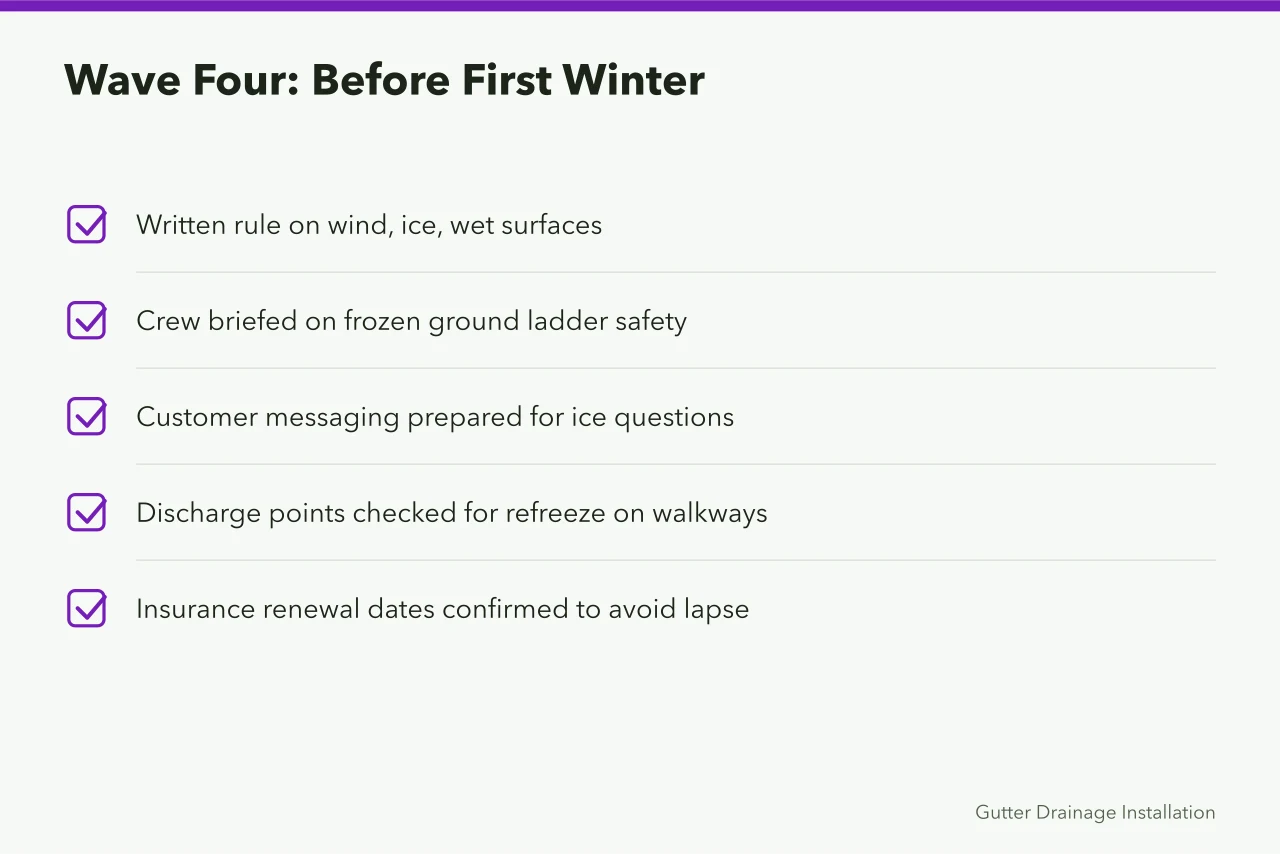
- Written rule on wind, ice and wet surfaces, and who has authority to stop a job
- Crew briefed on what changes when a ladder foot is on frozen or thawing ground
- Customer messaging prepared for ice questions, which will arrive
- Discharge points checked for where meltwater will refreeze on a walkway
- Insurance renewal dates confirmed so nothing lapses in the busy weeks
The customer messaging line matters more than it looks. Ice at the roof edge is usually a roof, insulation and ventilation question, not a gutter question, but the gutter company gets the call. Decide in advance what you will say, inspect, and refer elsewhere.
What this checklist leaves blank on purpose
Accessibility is one thing owners assume cannot apply to a trade business. It applies to your own premises where the public comes, not to the houses you work on.
The ADA guide for small businesses sets out those obligations. Read it once even if your office is a desk in a yard, then ask an attorney about anything specific.
The other deliberate blanks are the numbers. No premium, no threshold, no fee and no limit appears here, because each of those is set locally and moves. What you should hold instead is a dated note of who told you and when, re-checked annually and again whenever you take work in a new city.
Where this meets the rest of the setup
Compliance and equipment decisions interlock more than owners expect. Some requirements attach to vehicles and equipment, not the business. Check the jurisdiction before finalizing purchases from the equipment checklist for new owners.
Read what owning a forming machine does to your scheduling in the equipment and setup guide before committing capital that a licensing answer might redirect.
Insurance deserves its own audit rather than a checkbox, because coverage lives in the wording rather than in the name of the policy. The insurance coverage audit walks through what to read in the documents you already hold.
Common questions
Can I start work while a registration is pending?
Ask the issuing body, in those words, and get the answer in writing. Assuming yes is a common and expensive error.
Do I need to redo this in every city?
Waves one and two, yes, at least for the local layers. Growth into a neighboring metro area is the most common way a compliant company quietly stops being one.
What if my state has no contractor license for this trade?
Then that line is answered, and the other lines are not. City permits, business licenses, insurance conditions and customer-imposed credentials are all still live.
How often should I re-run the checklist?
Once a year as a whole, plus wave two whenever you enter a new city and wave three whenever the crew grows.