Guides
Gutter service equipment reviewed: what holds up and what does not
Gutter installation equipment and setup: what the forming machine does to your schedule, the height-work exposure, fascia checks, sizing, and asset records.
What to take away
- Gutter service equipment sorts into three jobs: the roll former that sets the day, the height-work gear that keeps crews alive, and the consumables you replace without a second thought.
- A gutter installation business is organized around one machine that has to travel to the job. The schedule bends to the roll former, not the other way around.
- Height work is the exposure that closes companies. The metal is cheap and the edge is not.
- Fascia condition decides whether a hanger holds. Look at it before you quote, not on the morning of the install.
- Size the system from contributing roof area and local rainfall, using the manufacturer's tables and whatever your building department has adopted. There is no national answer, so do not carry one from a previous market.
Most equipment lists for this trade read as a shopping list. That is the least useful way to look at it, because the items do not carry equal weight. One dictates how you schedule, two decide whether anyone gets hurt, and the rest are consumables you replace without thinking.
The equipment review: brands and models that hold up
The named gear below is what shows up in public spec sheets and supplier catalogs. None is perfect. The weak points below are the ones that cost money or safety, not cosmetic complaints.
| Equipment | What it is | Holds up | Fails when |
|---|---|---|---|
| New Tech Machinery SSQ II | Portable roll former for 5-inch and 6-inch K-style gutter, often trailer mounted. Typical new quotes run from about $30,000 to $60,000; used units list from about $15,000 to $35,000. | High-volume shops that keep a two-person crew on one trailer. Its frame and drive hold up to daily forming. | Low-volume shops. The payment continues in slow months, and the machine needs covered storage and coil control. |
| KWM Gutterman KWM-6 | US-made portable roll former for 6-inch K-style gutter, sold with trailer packages and lease options. | Shops that want 6-inch capacity and domestic parts support. | Buyers who cannot keep the machine busy enough to cover lease or purchase payments. |
| Englert 2000 | Portable on-site gutter machine for 5-inch and 6-inch profiles, supported by a gutter materials supplier. | Contractors who already buy Englert coil and want one parts channel. | Shops far from a service point when a bearing or drive part fails. |
| Werner MT-22 | 22-foot aluminum telescoping ladder with a 300-pound duty rating. Street price is often $200 to $300. | Service calls and fascia checks where a full extension ladder is overkill. | Repeated use on uneven ground without levelers, and one-person carries on windy days. |
| Little Giant King Kombo | Three-in-one ladder that converts among stepladder, extension and leaning modes. Typical price is $200 to $400. | Tight access, stairs and low roof edges. | Two-story elevations beyond its reach, and crews that leave it on the truck because it is heavy. |
| Louisville FE3228 | 28-foot fiberglass extension ladder, Type IA, 300-pound rating. Typical price is $400 to $650. | Non-conductive work near service drops and tall elevations. | Weight and length on small trucks, and any use without a leveler on sloped ground. |
| Guardian Fall Protection 10900 | Universal full-body harness, often sold for under $100. | Basic fall arrest for small crews that need compliant gear on a budget. | All-day comfort and fit across every body type, so crews stop wearing it. |
| 3M DBI-SALA ExoFit X200 | Full-body harness with padded shoulders and legs, often $200 to $400. | Daily wear and crews that complain about standard harnesses. | Budgets that buy the cheapest harness and then leave it in the truck. |
| Geocel 2300 Mastic | Gutter and roof sealant in 10-ounce tubes, typically $8 to $12. | Metal-to-metal joints, end caps and seams that stay wet. | Wet or dirty surfaces, and cold weather that slows cure. |
| OSI Quad Max | Exterior sealant for joints that will be painted, typically $8 to $12. | Visible joints and painter-friendly work. | Gutter seams under constant water, where a gutter-specific sealant fits better. |
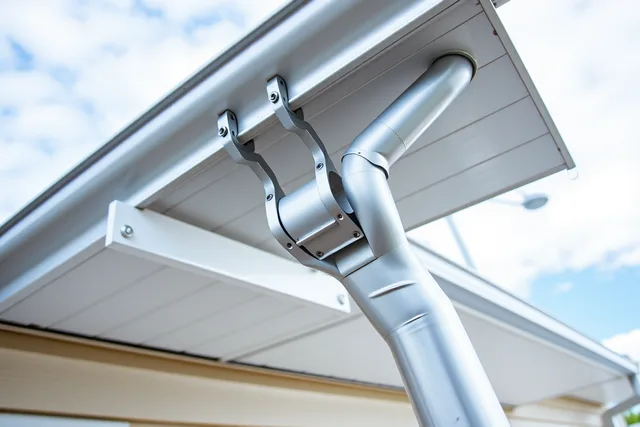
| Amerimax hidden hanger | Hidden hanger with screw for 5-inch and 6-inch K-style gutter, often $1 to $2 each. | Sound fascia and standard profiles. | Soft fascia and open rafter tails with no board to bite into. |
The forming machine sets the schedule
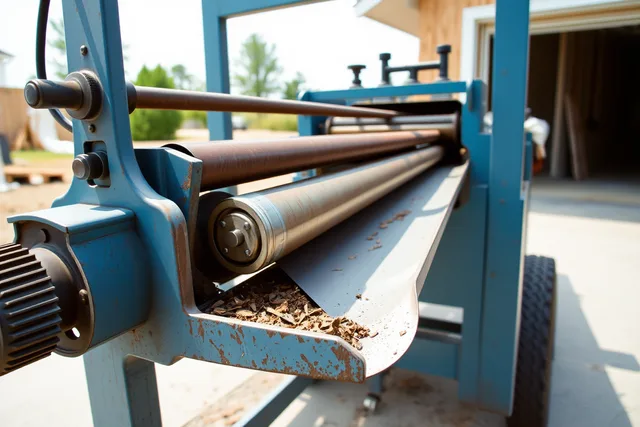
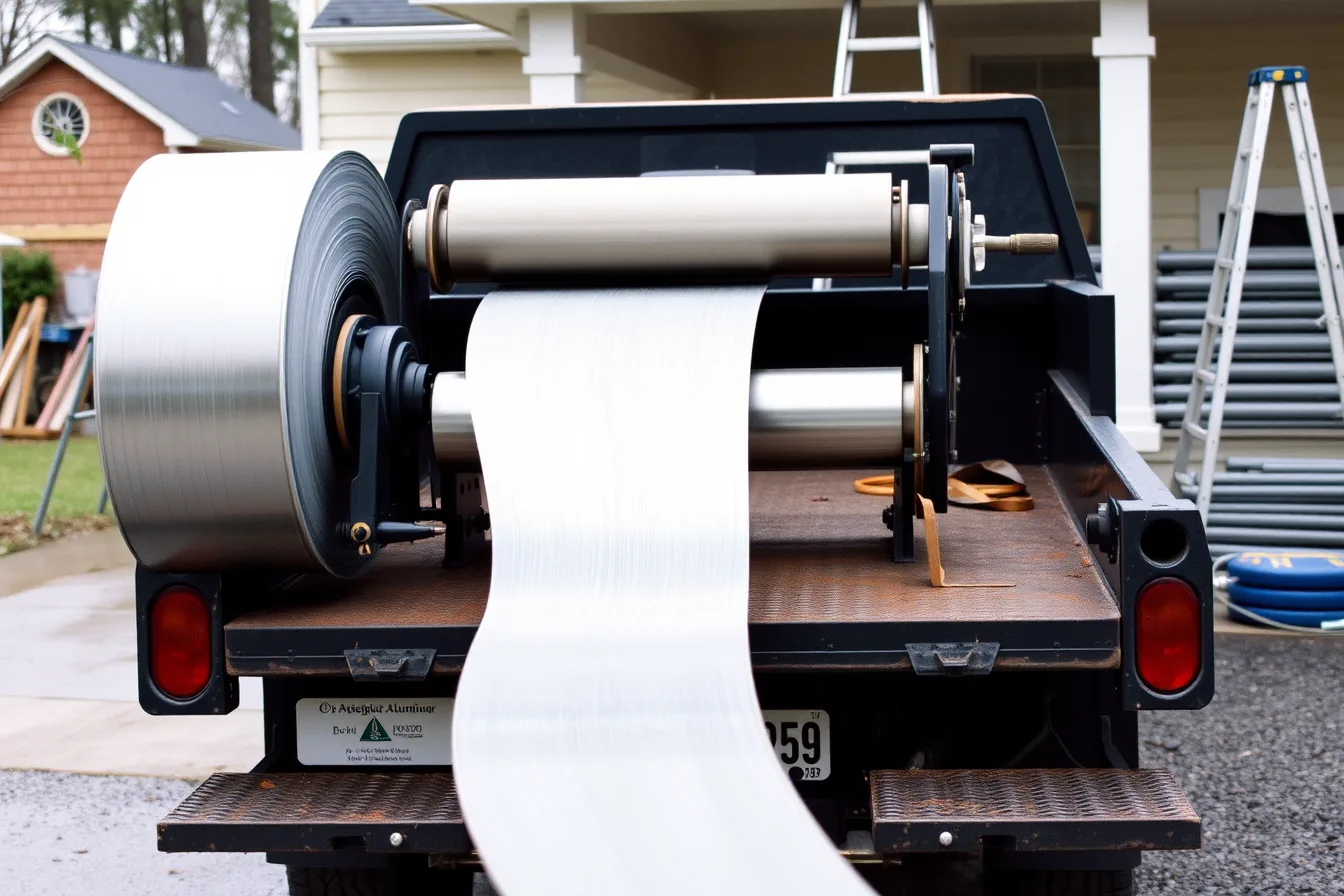
A run formed on site comes off a roll former fed from a coil. That single fact reorganizes the whole operating day.
The two common choices in small shops are the New Tech Machinery SSQ II and the KWM Gutterman KWM-6. Both form 5-inch and 6-inch K-style runs, and both need the same discipline: coil staged, color confirmed, power available.
The machine, coil, truck and crew travel as one unit. A two-person crew cannot split across two addresses like a cleaning-only outfit; half would stand by a trailer it cannot use.
A color change requires a coil change, so jobs cluster by color, not neighborhood. A route planned only by driving distance means swapping stock twice in a morning.
Formed runs are made to length on the ground, so the measurement has to be right before the metal exists. A remeasure is not a phone call. It is a return trip with the trailer.
That affects how the work is sold, which is why the way jobs are packaged and priced belongs in the same conversation as the equipment list rather than in a separate one.
A workable day looks like this:
- Confirm color and coil before the truck leaves the yard.
- Verify measurements at the property before forming anything.
- Check the fascia along the full run while the ladder is already up.
- Form, hang, seal and set outlets.
- Prove the discharge path with water before packing up.
- Photograph the finished run and the discharge point in the same visit.
Step five is the one crews skip, and it is the one that prevents the callback.
What the truck carries before it carries a machine
Order the list by what stops the job if it is missing:
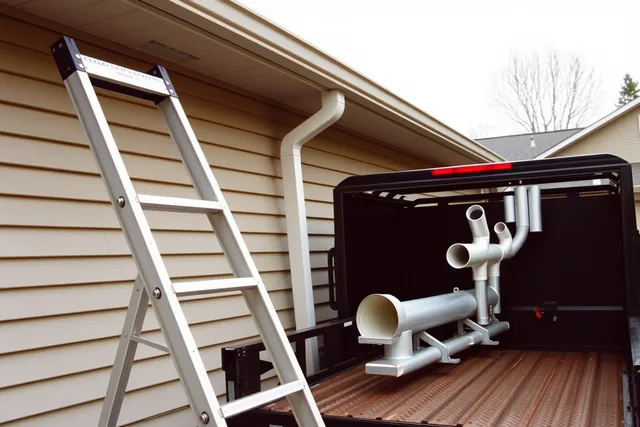
- ladders long enough for the tallest elevation you accept work on, plus standoffs and levelers. Werner MT-22 fits service calls, Little Giant King Kombo fits tight access, and Louisville FE3228 fits tall elevations.
- fall protection appropriate to the work, kept in the truck rather than in the shop. Guardian Fall Protection 10900 fits a tight budget; 3M DBI-SALA ExoFit X200 fits daily wear.
- hand seamers, crimpers, a rivet gun and an outlet punch. Malco AV6 hand seamers, Malco C5 crimpers and a Milwaukee M12 rivet tool cover most jobs.
- hangers and fasteners in the type the fascia will actually accept. Amerimax hidden hangers work on sound 5-inch and 6-inch K-style fascia; open rafter tails need a different hanger.
- sealant rated for the metal and the joint, not a general-purpose tube. Geocel 2300 Mastic is the default for wet seams; OSI Quad Max suits joints that will be painted.
- downspout stock, elbows, straps and whatever you use to extend discharge away from the wall. NDS pop-up emitters and Flex-Drain extensions are common terminal parts.
- tarps, buckets and something to catch debris on a cleaning call.
- a first aid kit and wheel chocks for the trailer.
The ordering matters because the first two lines decide whether you have a business next year.
Height work is the exposure, not the metal
Every other risk in this trade is a money risk. This one is not.
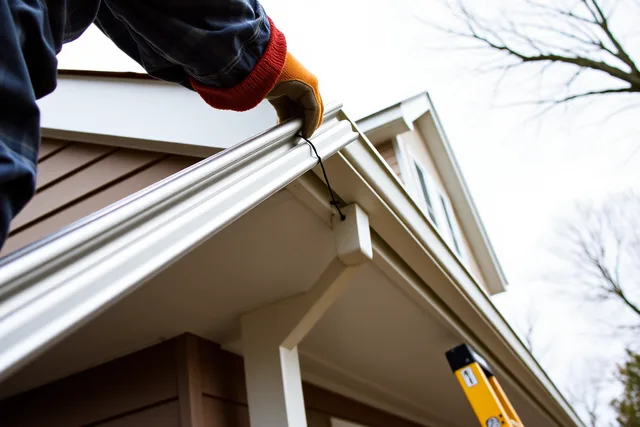
The work is almost entirely at the roof edge, on ladders, on surfaces wet earlier in the day, reaching sideways because moving the ladder is inconvenient.
OSHA's guidance for fall protection in residential construction lists the methods. It makes clear the employer stays responsible for site-specific controls and for whichever federal or state-plan requirements apply. Read it as the employer, not as the person on the ladder.
Treat that as the spine of a written program rather than a document you file. OSHA's framework for a safety and health program describes what a small employer is expected to build around it: management commitment, worker participation, hazard identification and a way of correcting what turns up.
Two habits do most of the work. Move the ladder rather than reach, and stop the job when the wind picks up. Neither costs anything and both are unpopular with crews paid by the job, which is a pricing problem before it is a safety problem.
A Guardian 10900 harness is better than none, but a 3M DBI-SALA ExoFit X200 or Malta Dynamics Warthog Comfort MAX stays on all day because it fits.
Fascia is the job behind the job
A hanger transfers the weight of the gutter, the water and, in some months, the ice into the fascia board. If that board is soft, nothing you screw into it holds.
Spike-and-ferrule installations leave a row of large holes. Older boards that sat behind a back-pitched run have been wet for years. A missing or badly lapped drip edge lets water wick behind the fascia where nobody sees it until the hanger pulls.
Check for it while the ladder is up during the estimate. Press the board at the low points of the run and near every downspout. Then quote the repair as a named contingency with a stated basis, so that finding rot is a priced outcome rather than an argument on the day.
Houses with open rafter tails and no fascia at all need a different hanger entirely. That is a design decision, not a substitution the crew makes at the truck.
Amerimax hidden hangers and Ply Gem hidden hangers both rely on a sound board. For open rafter tails, use strap hangers sized to the rafter spacing, not a hidden hanger.
Sizing is a calculation, not a catalog choice
The size of the house tells you almost nothing. What matters is how much roof drains into each run and how hard it rains where the house is.
The inputs are:
- the contributing roof area for each run, measured as horizontal projection rather than along the slope
- the local design rainfall intensity, which is a regional figure and not a preference
- the number and position of outlets, which often changes capacity more than changing profile does
- the downspout cross-section carrying each outlet
Every one of those has an authority behind it. The manufacturer publishes sizing tables for its own profiles. Your building department knows which code edition and local amendments it adopted.
Englert, Senox and Spectra Metals publish sizing tables for their K-style and half-round profiles. Use the table for the coil you actually buy, not a generic chart.
Ask both before standardizing on one profile across a market. A company that brings a drier region's habit into a wetter one will undersize quietly and blame the debris.
Where the water goes after the downspout
This is the failure most often blamed on the gutter, and it usually has nothing to do with the gutter.
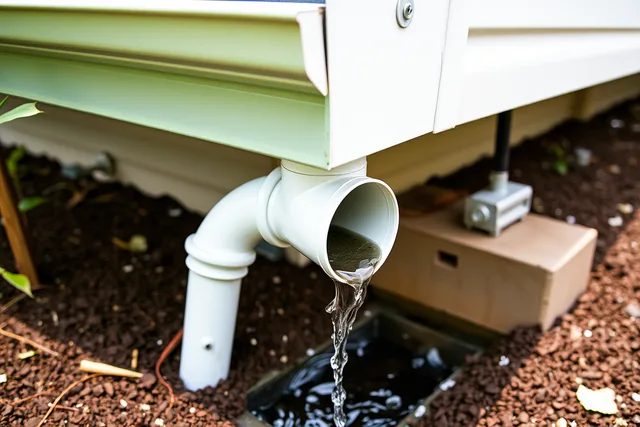
Water leaves the downspout and then does something. It splashes at the wall, runs back toward the foundation, ponds on a walkway, freezes there, or disappears into a buried line that nobody has opened in a decade. The customer sees a wet basement and calls the company whose name is on the gutter.
You control the terminal end. Extend the discharge, aim it at ground that falls away, and make sure the buried line has a cleanout you can reach.
You cannot decide alone whether the discharge may connect to a storm sewer, whether it must not connect to a sanitary sewer, or how far from a property line it has to land. Municipal stormwater rules where the house is set those limits.
Call the public works or stormwater office in each city you work in, and write the answer into your standard scope so estimators stop guessing.
NDS pop-up emitters and Flex-Drain extensions are common terminal parts. Both are cheap compared with a wet-basement callback.
Guards are a trade-off, not a solution
Guards reduce large debris. They do not end cleaning, and it is worth saying so in the quote rather than after the first fall.
Fine material still gets through and settles. Some designs shed water in heavy rain because the sheet runs past the opening instead of into it. Others make the trough harder to open when it does need clearing.
Where a guard is fastened under the roof covering, check the roofing manufacturer's own instructions first. The roof warranty is not yours to spend.
Sell them as a change in the maintenance interval, described honestly, and you will keep the customer. Sell them as the end of maintenance and you have written yourself a callback.
LeafGuard is a one-piece system that replaces the gutter, so it is not a drop-in screen. Gutterglove and Amerimax Lock-In guards fit existing 5-inch and 6-inch K-style runs and carry different cleaning intervals.
Choosing how to own the forming capacity
| Approach | What it ties up | What it buys | Where it breaks |
|---|---|---|---|
| Own a New Tech Machinery SSQ II or KWM Gutterman trailer | Capital and storage, plus maintenance you now schedule | Full control of timing, color changes and remeasures | Idle capital in the slow months |
| Rent per job from a local supplier | Nothing standing, but a booking dependency | A way to test demand before committing | Availability collapses in the busy weeks, which are the weeks you need it |
| Subcontract the forming to a local gutter shop | Margin on every run | Speed to start with no capital | Your schedule and your quality control now belong to someone else |
There is no right row. There is a right row for your cash position and your season. Write down which failure mode you can survive.
If you are still working out whether the demand supports any of them, start with the wider startup and market picture rather than with a machine quote.
What to record about every asset
Equipment records are not paperwork for its own sake. They decide what you can claim, what you can prove after a loss, and what a buyer will believe.
Keep the purchase document, date placed in service, serial number, insurer's schedule entry, and service history.
The IRS explains what records a small business is expected to keep and why the supporting document matters more than the summary.
For a particular purchase, ask a tax professional about your own year and structure rather than copying what another owner did.
The general small-business material is worth a pass too. The Small Business Administration's guidance and counseling pages point at free local advisers who will read your numbers with you, which is a better use of an evening than another equipment comparison.
Record the serial number on the New Tech or KWM machine, the coil gauge you run, and the date of every die or bearing service.
Common questions
Do I need the forming machine to start?
No. Plenty of companies begin on cleaning, repairs and downspout work, then add forming once the calendar justifies the trailer. Starting with a New Tech SSQ II or KWM Gutterman KWM-6 means starting with the payment.
How long should a ladder be?
Long enough for the tallest elevation you are willing to quote, which is a business decision you should make deliberately. Deciding it job by job is how crews end up reaching. The Louisville FE3228 reaches 28 feet; the Werner MT-22 does not.
Can I standardize on one gutter profile?
Within a market, often yes. Across markets, be careful. Rainfall intensity is regional and the sizing tables respond to it, so the profile that is generous in one state is marginal in another.
Is a guard ever the wrong sale?
Yes. Where the customer's real problem is a back-pitched run, a missing outlet or a blocked buried line, a guard changes nothing and you have taken money for it. LeafGuard replaces the gutter, so it is not a repair for those cases.
What should the estimate always include?
The fascia condition you observed, the discharge point you propose, and what happens to the price if the board turns out to be soft. Those three lines prevent most of the arguments this trade has.