Guides
The pricing side of a profitable gutter service for 2027
Gutter service pricing: why no national number exists, how to build a loaded hour, pricing the fascia contingency, and what an advertised price must survive.
What to take away
- There is no national price for a foot of gutter, and any page that gives you one is guessing on your behalf. What travels between markets is the method, not the number.
- Price the loaded hour first. Everything else in this trade is a quantity multiplied by it.
- The measurement is the risk. A run formed to the wrong length is not a correction, it is a return trip with a trailer.
- Put the fascia contingency in the quote with a stated basis. Discovering rot should be a priced outcome, not an argument on a ladder.
Why one national number cannot exist
Four things move the price of the same physical job across two towns, and none of them is under your control.
Rainfall intensity sets system size, and it varies by region. Labor cost changes by area and occupation, while access difficulty tracks housing stock: markets of single-story ranches and steep three-story houses are different trades with the same name.
Discharged water rules are local, so the scope that finishes the job differs by location.
That is why this guide gives you variables and a method. Fill them from your own quotes, your own payroll and your own municipality. For the wage side, the Bureau of Labor Statistics publishes occupational employment and wage estimates by area, a defensible starting point for what your local market pays a given occupation before you add your own loading.
The unit you price in
Most gutter work resolves to one of three units, and mixing them is where margin leaks.
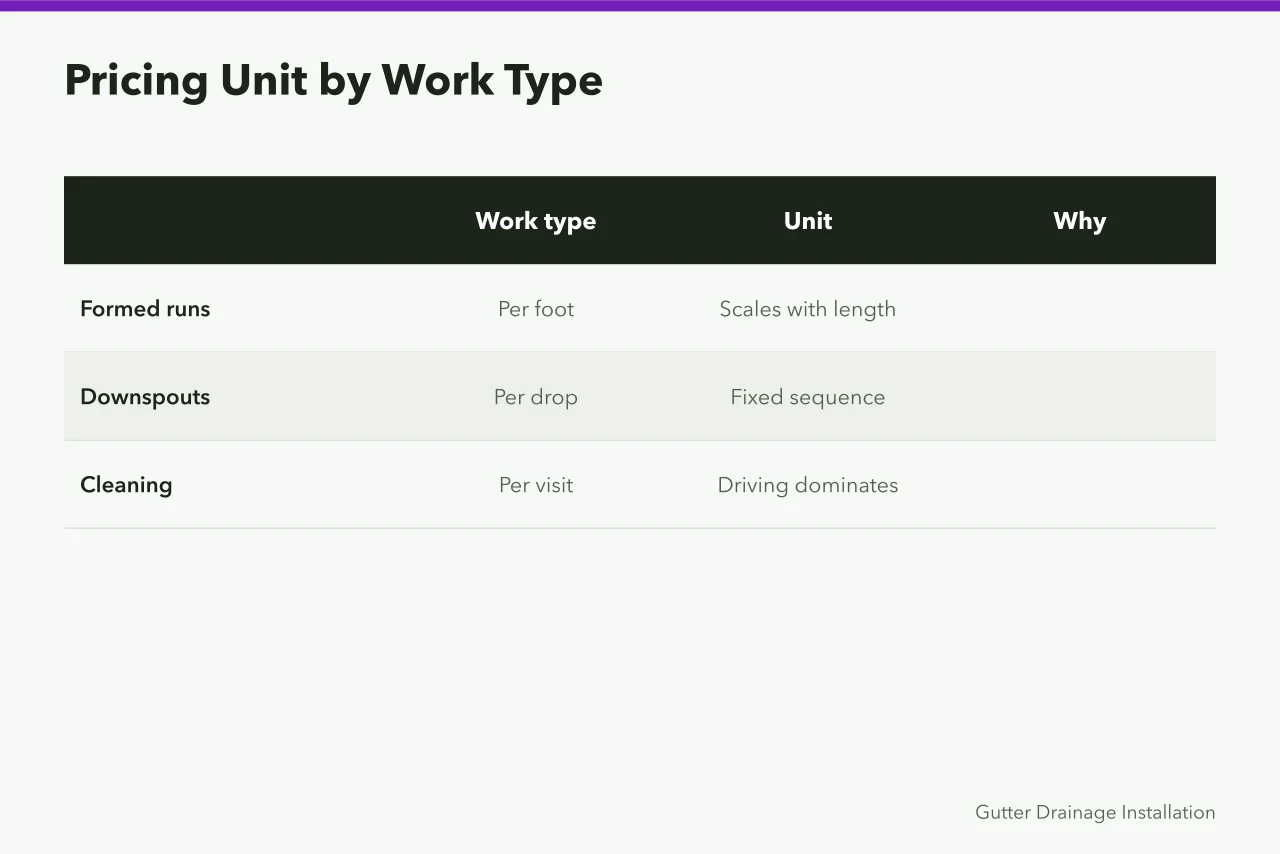
Formed runs price naturally per foot, because the coil, the forming time and the hanging time all scale with length. Downspouts price per drop, because a drop is a fixed sequence of operations regardless of the wall it goes on. Cleaning prices per property visit, because the driving and the setup dominate and the trough length barely moves the total.
Quote a cleaning job per foot and you will lose money on every small house. Quote an installation per visit and you will lose money on every large one. Decide the unit per work type and hold it.
Building the loaded hour
Write the hourly cost of a crew on the roof, not the hourly wage of a person.
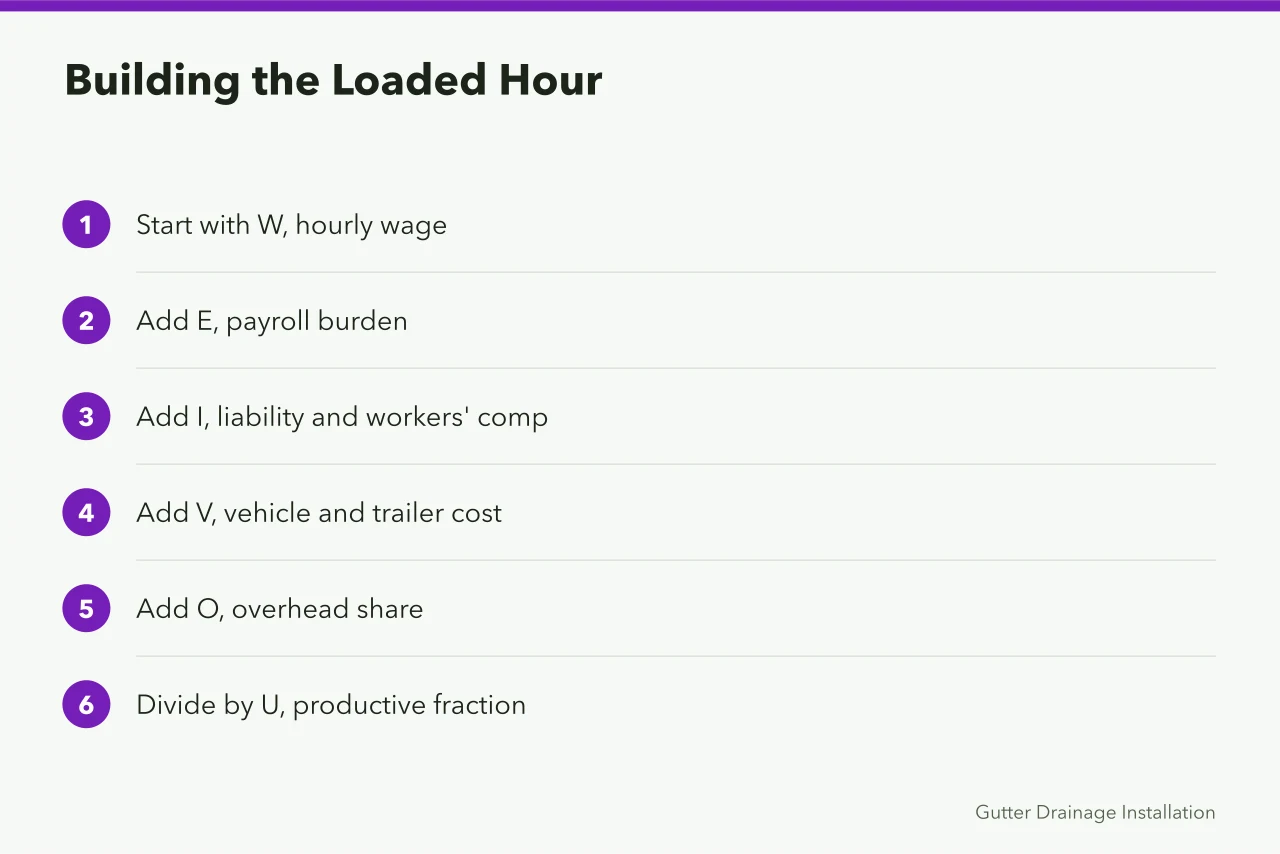
Start with W, the hourly wage. Add E, the employer's own payroll burden, which includes the taxes and insurance costs that attach to employment where you operate. Add I, the share of general liability and workers' compensation attributable to an hour of production. Add V, the vehicle and trailer cost per productive hour, including fuel, maintenance and depreciation.
Add O, the share of overhead each productive hour has to carry: office, software, phone, insurance premiums not already counted, and your own time selling and estimating. The sum, W plus E plus I plus V plus O, is the loaded hour. That is the number a price has to beat before there is any profit in it at all.
Apply the correction almost everyone forgets. Divide by U, the fraction of paid hours that are actually productive on a roof.
Travel, setup, teardown, the supply run and weather delays are all paid, and none of it is billable.
A business pricing against the raw loaded hour at a realistic U prices below cost and calls it competition.
The three job types, priced
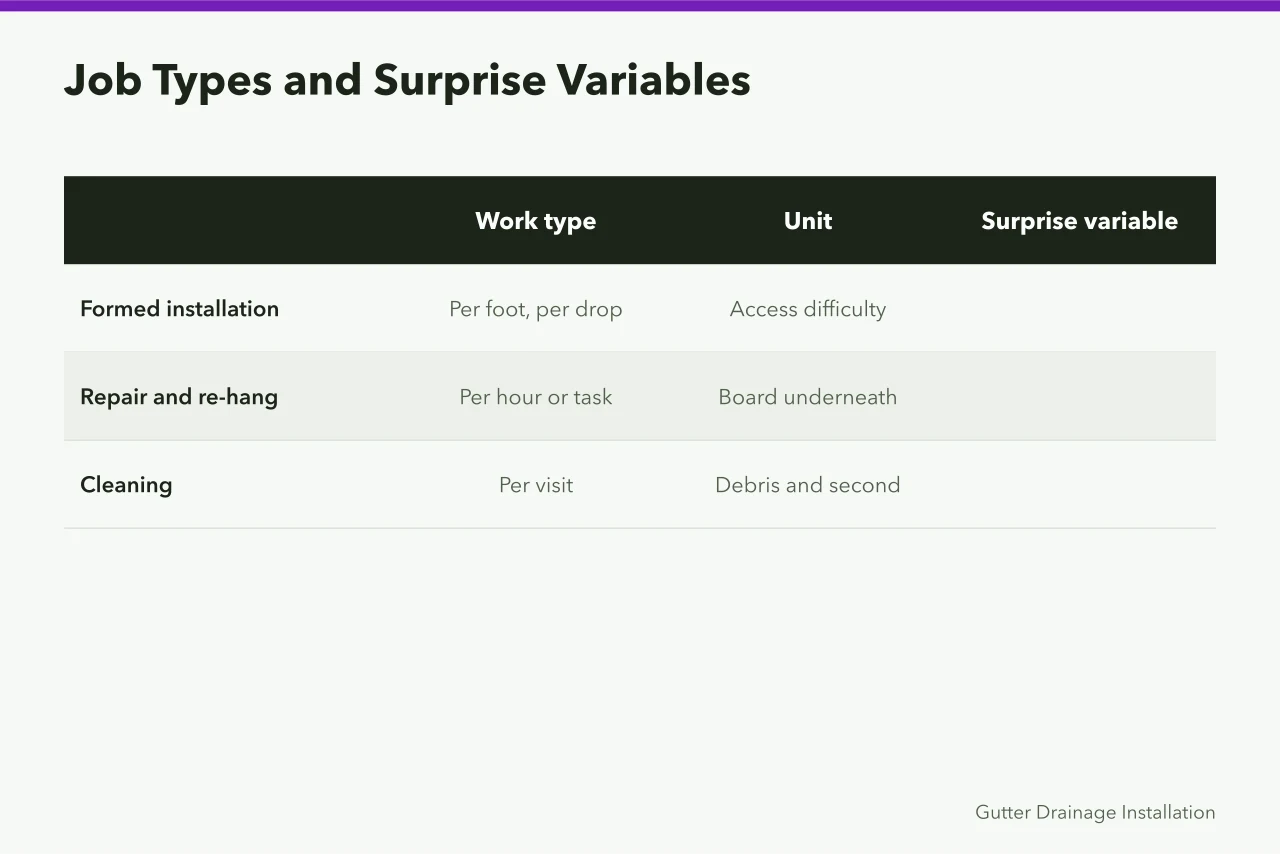
| Work type | Unit | What drives the quantity | The variable that surprises owners |
|---|---|---|---|
| Formed installation | Per foot, plus per drop | Run length, drop count, elevation, profile | Access difficulty, which changes hours more than length does |
| Repair and re-hang | Per hour or per named task | Fascia condition, hanger type, reach | The board underneath, which nobody quotes on |
| Cleaning | Per visit | Property, tree canopy, elevations | Debris disposal and the second visit customers assume is included |
The far-right column is where the year is decided. Each of those is a quantity you can observe at the estimate if you look, and each of them is a dispute if you do not.
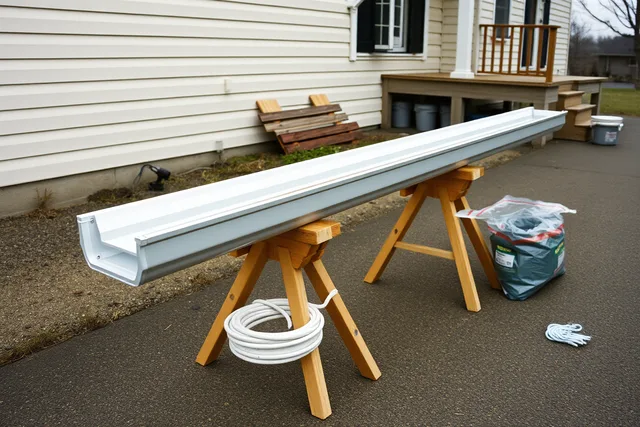
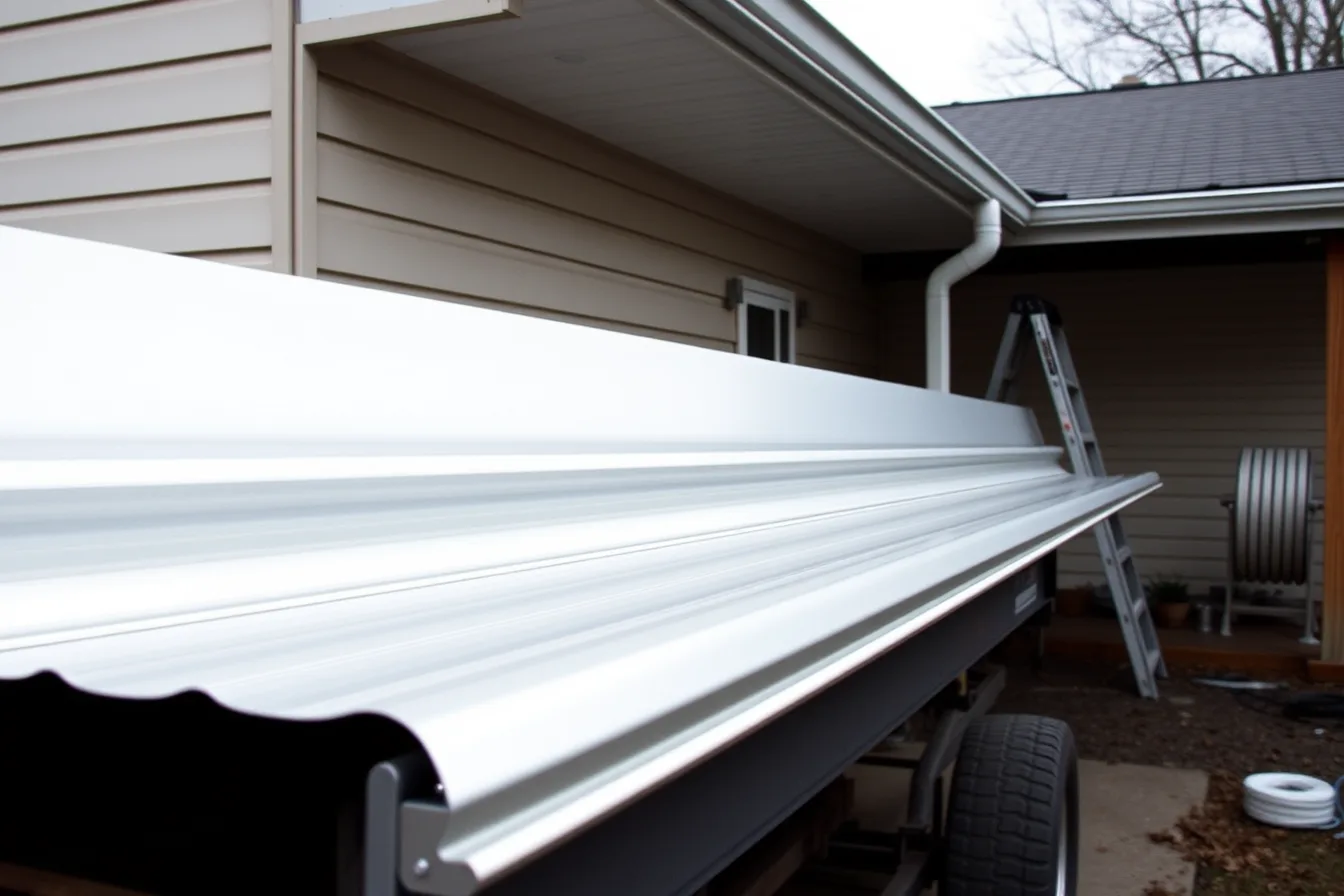
Formed installation carries one extra consideration that no other trade in this category has. The run is made to length on site, which means the crew, the trailer, the coil and the machine travel as one unit. What that does to your scheduling is a cost, and it belongs in V and U rather than being absorbed silently.
Pricing the measurement risk
The expensive mistake in this trade is not underpricing the foot. It is remeasuring.
A wrong length means metal that cannot be used, a crew standing still and a second trip with the trailer. Price it out of existence rather than into the quote: verify the measurement on site before anything is formed, and make that verification a paid step in the sequence rather than something the crew fits in.
Where the customer changes the scope after measurement, that is a change order with its own price. Where you changed it, that is your cost. Writing the distinction down before the season starts is worth more than any discount policy.
The fascia contingency
A hanger holds because the fascia holds. Soft board, old spike holes and a run that has been back-pitched for years are all common, and none of them can be fully assessed from the ground.

Do not guess or exclude it. Inspect what you can reach at the estimate, then state what you observed in the quote.
If more turns up, give a named basis for the repair, such as a rate per linear foot of replacement or a per-hour rate with a not-to-exceed the customer approves before work continues.
That single paragraph in a quote removes most of the arguments this trade has. It also makes your price look higher than a competitor who left it out, which is a conversation worth having openly rather than a race you quietly lose.
What the advertised price has to survive
A headline price is a claim, and claims have rules. If you advertise a starting price, the conditions that make it achievable have to be disclosed clearly enough that a reader understands them, and the offer has to be genuinely available. The Federal Trade Commission's advertising guidance for small businesses sets out the general expectation in plain terms.
In practice that means being careful with three habits: a per-foot number that excludes drops, a cleaning price that assumes a single-story property without saying so, and a promotional rate that no crew is ever scheduled to honor. Each of them wins a phone call and loses the sale at the door.
The way out is a package structure where what is included is stated rather than implied, which is the subject of the packages and pricing guide.
What compliance costs, and where it belongs
Registration, bonding, insurance and any local permit requirement are real costs, and they are not evenly distributed across jobs. Put them in O, the overhead share of the loaded hour, rather than adding a line to a quote, unless a specific permit is genuinely job-specific.
What those costs are depends entirely on where you operate. The licensing and compliance guide sets out how to establish the requirement in your own jurisdiction instead of assuming it matches a neighboring one. Get that wrong and you have priced a business that is not legal to run.
Proving the price after the fact
A price is a hypothesis. Job costing is the test.
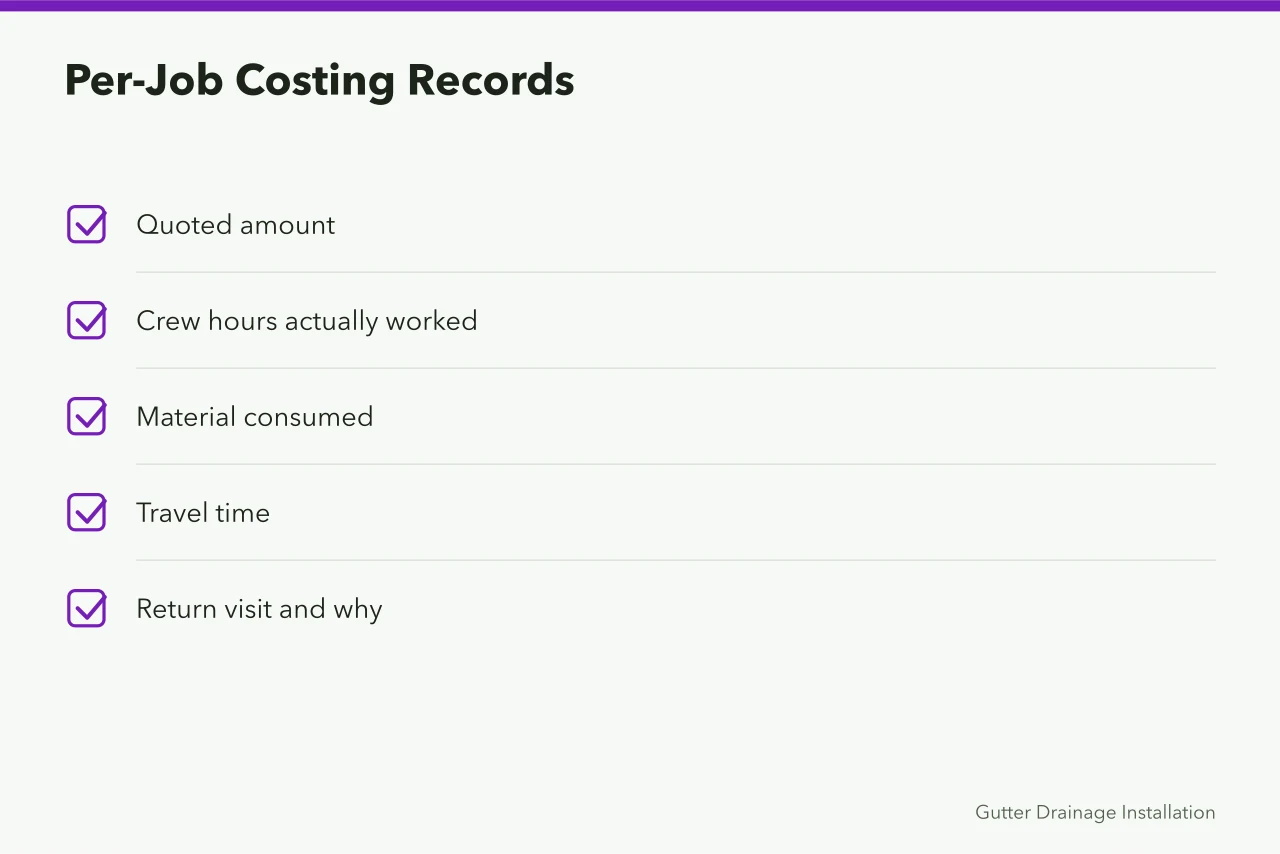
Record, per job: quoted amount, crew hours actually worked, material consumed, travel time, any return visit and why. Compare the realized loaded hour against the one you priced with. Do it monthly, not annually, because a season is over before an annual review notices.
The IRS explains what records a business is expected to keep, and the same discipline that satisfies a tax record produces the data your pricing needs. If you would rather have someone read the numbers with you, the Small Business Administration's guidance and counseling pages point at free local advisers.
Owners early enough to still be choosing a market will get more from the startup and market guide than from refining a rate for work they have not sold yet.
Common questions
What margin should I target?
Nobody can answer that for you from a page, and anyone who does is inventing a number. What is answerable is the floor: your loaded hour divided by your productive fraction. Everything above that is a market decision you make with your own quote win rate.
Should I match a lower competitor?
Only once you know what they included. Most of the gap in this trade is scope rather than rate, and the two most common omissions are drops and the fascia contingency.
How do I price steep or high access?
As a separate factor on hours, not on feet. Access changes how long a foot takes, so loading it onto the linear rate distorts every quote where the elevation is ordinary.
Do guards change the price of cleaning?
They change the interval and sometimes the difficulty, and honest pricing says which. Selling a guard as the end of maintenance is a refund waiting to happen.
When should I re-price?
Whenever wage, insurance or material inputs move, and at least once before the busy season. Re-pricing mid-season, with a backlog booked at the old rate, is how a good year turns into a break-even one.