Guides
The short version of gutter service complaint handling
Gutter service complaint handling: the five complaints this trade actually gets, how to diagnose each one, and deciding who pays without guessing.
What to take away
- Five complaints account for almost everything. Learn to tell them apart on the phone and the rest of the process gets much easier.
- Diagnose before you decide fault. Most complaints in this trade are about water that was never yours to move.
- Decide who pays using a written rule, not the tone of the call. The loudest customer should not get the best outcome.
- The review is a separate problem from the repair, and it is handled after the repair, never as a condition of it.
The five complaints
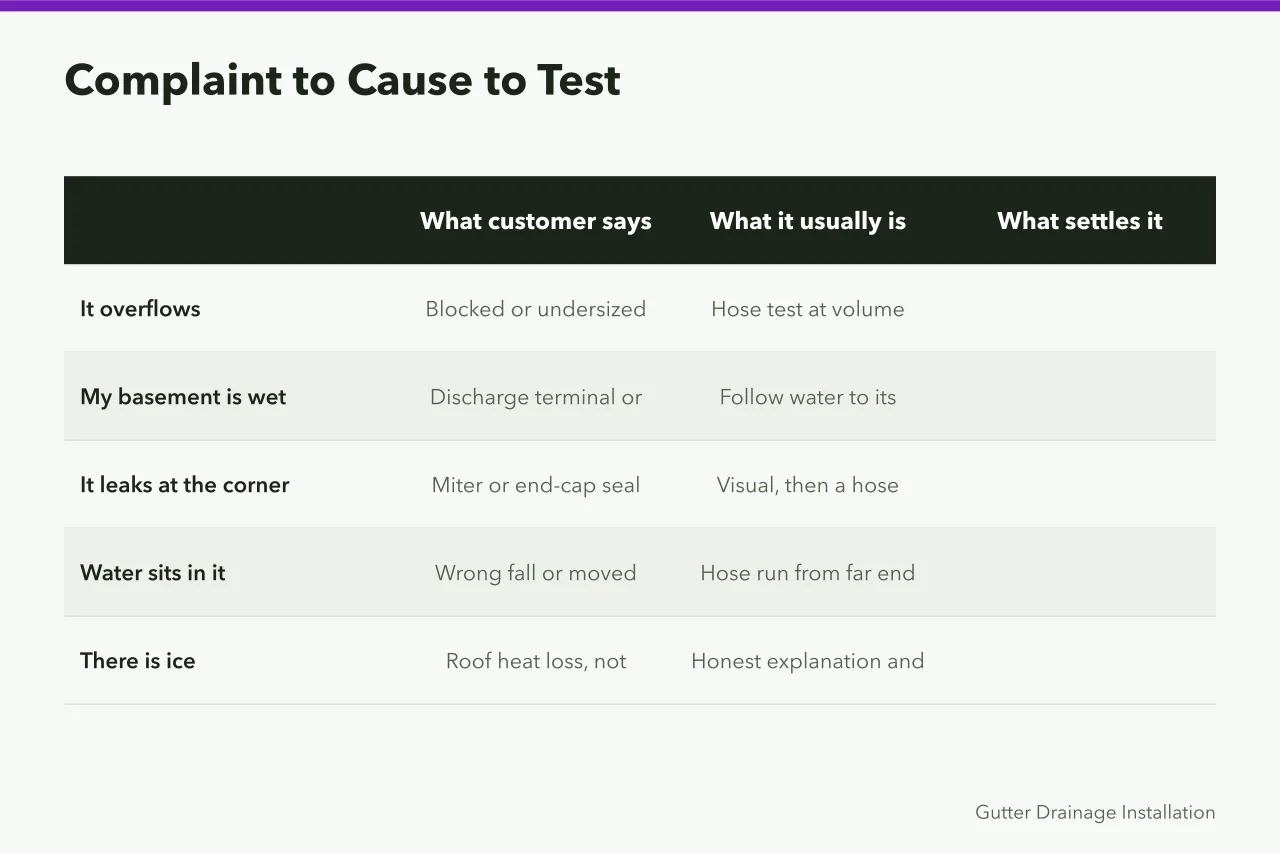
| What the customer says | What it usually is | What settles it |
|---|---|---|
| It overflows | Blocked outlet, undersized outlet, a missing drop, or a run that was never sized for this roof | Watching it in rain, or a hose test at volume |
| My basement is wet | Discharge terminal, grading, or a failed buried line | Following the water from the downspout to where it ends |
| It leaks at the corner | A miter or end-cap seal, which is the most common leak point on a sound run | Visual, then a hose |
| Water sits in it | Fall is wrong, or a hanger has moved and created a reverse section | A hose run from the far end |
| There is ice | Usually a roof, insulation and ventilation condition rather than a gutter fault | An honest explanation and a referral |
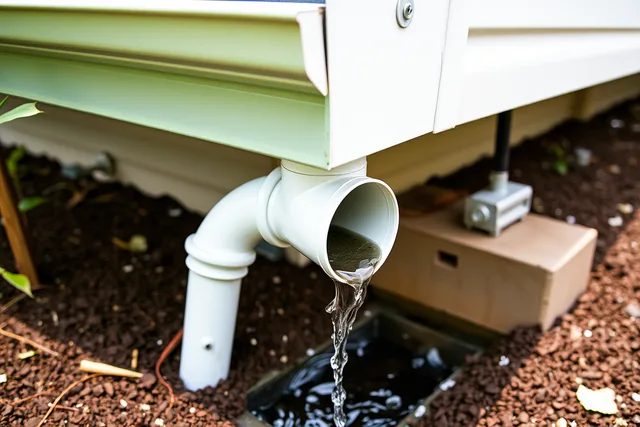
The middle row of that table is where the money is. The customer sees a wet basement and calls whoever installed the gutter, and the cause is frequently ground that slopes back at the foundation or a buried line nobody has opened in a decade.
The ice row needs a policy decided in advance. Ice at the roof edge is generally driven by heat loss through the roof and the resulting melt-refreeze cycle. This is a roofing and building envelope subject.
Deciding in January what you will inspect, what you will explain and what you will refer out is a poor use of a crew's time on a ladder.
The first call
Establish four things before you agree to anything.
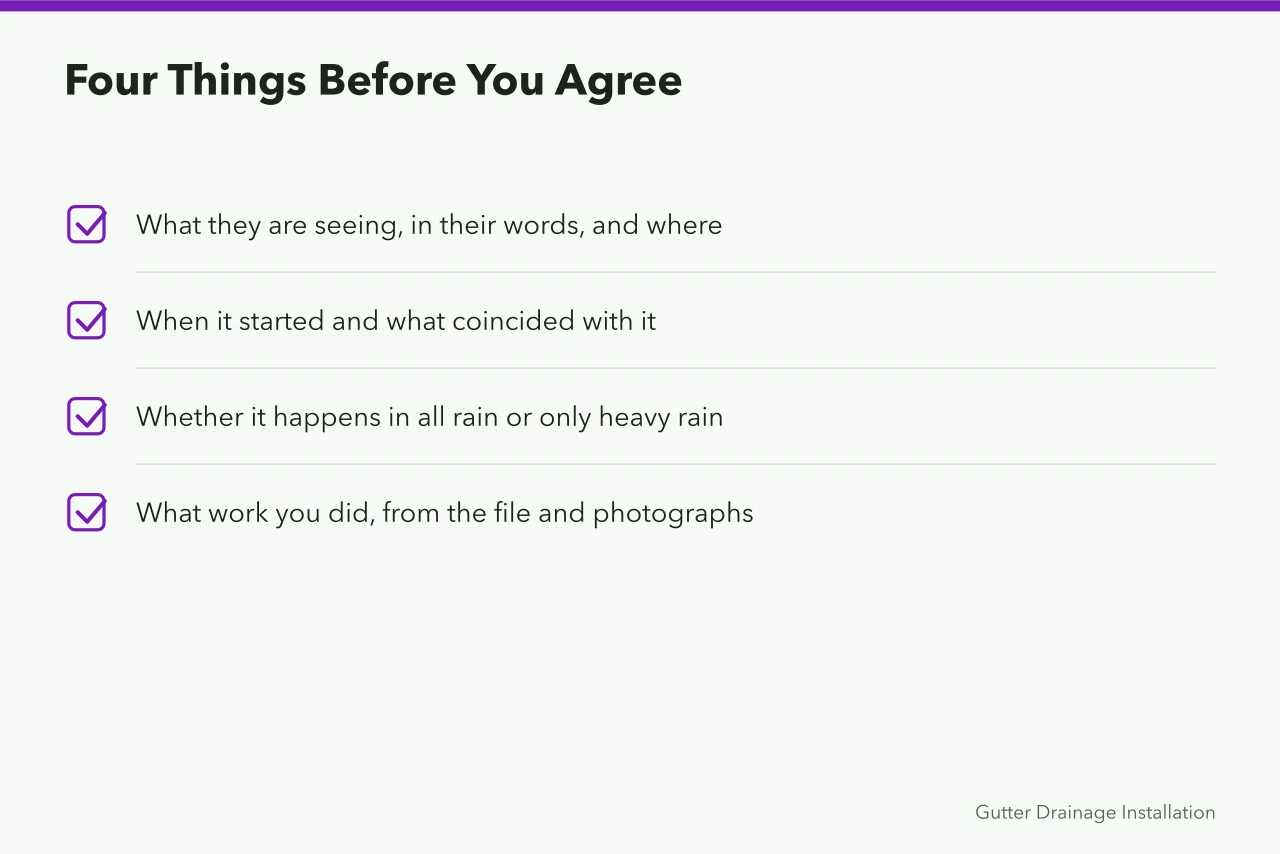
Then say what happens next and when, and do not diagnose on the phone. A cause offered from a desk becomes the thing you have to walk back at the property.
Point four is why the file matters. A company with a photograph of the fascia before it touched anything and a photograph of the finished terminal is having a different conversation from one working off memory. That habit comes out of the quality assurance checklist.
The site visit
Diagnose in this order, and resist the urge to agree with the customer's theory before you have looked.
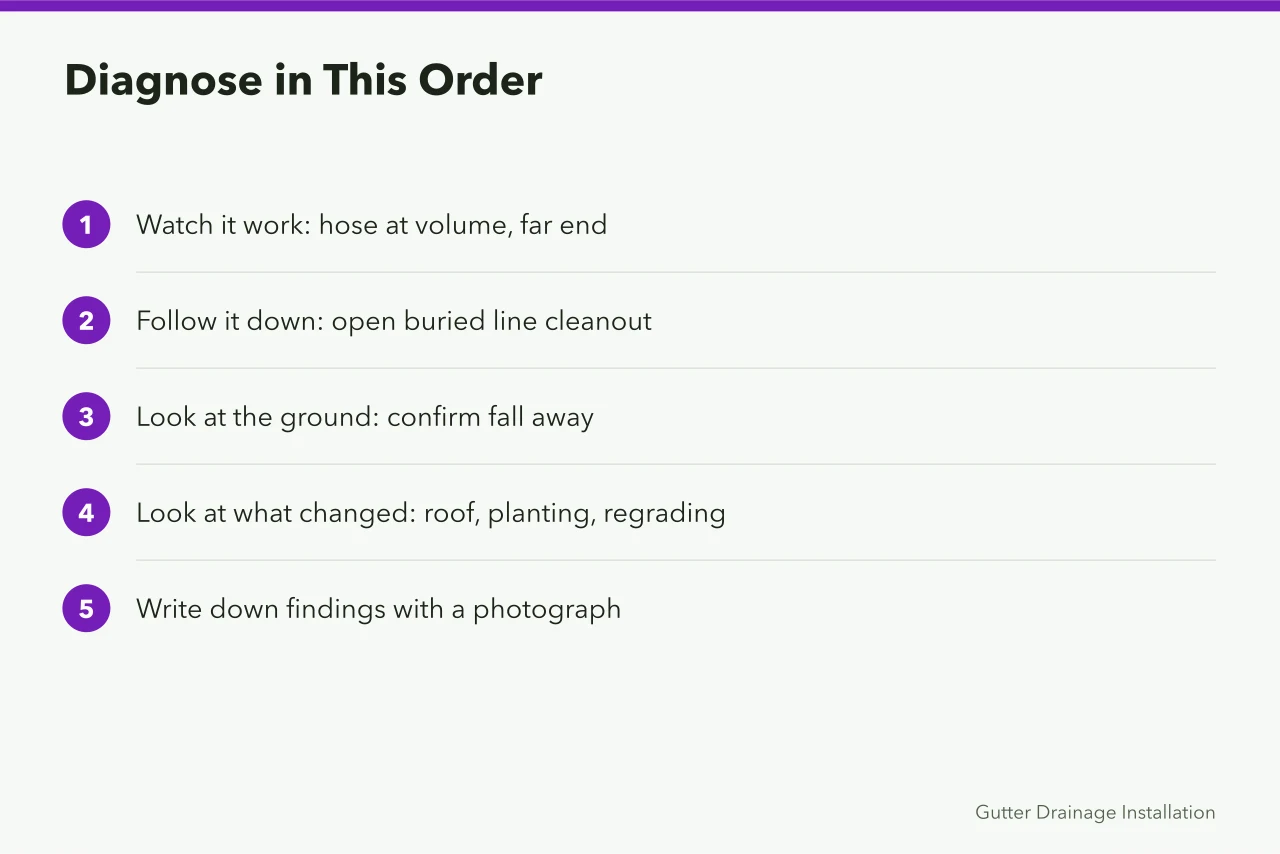
Watch it work. Run a hose at the far end of the affected run and at volume, not a trickle. Look for standing water, for a reverse section, and for whether the water reaches the outlet.
Follow it down. Confirm the downspout discharges where the quote said, open the cleanout on any buried line and watch the level rather than the first few seconds. A silted line will accept a hose and refuse a storm.
Look at the ground. Confirm the receiving ground still falls away from the building. Landscaping, a new patio or settled soil can undo a correct installation months later.
Look at what changed. A roof replaced after you left can alter the edge detail so water runs behind the trough. New planting can change what falls into it. A neighbor's regrading can change where your discharge goes.
Then write down what you found, with a photograph, before you talk about money.
Deciding who pays
Write the rule before you need it, and apply it the same way to everyone.
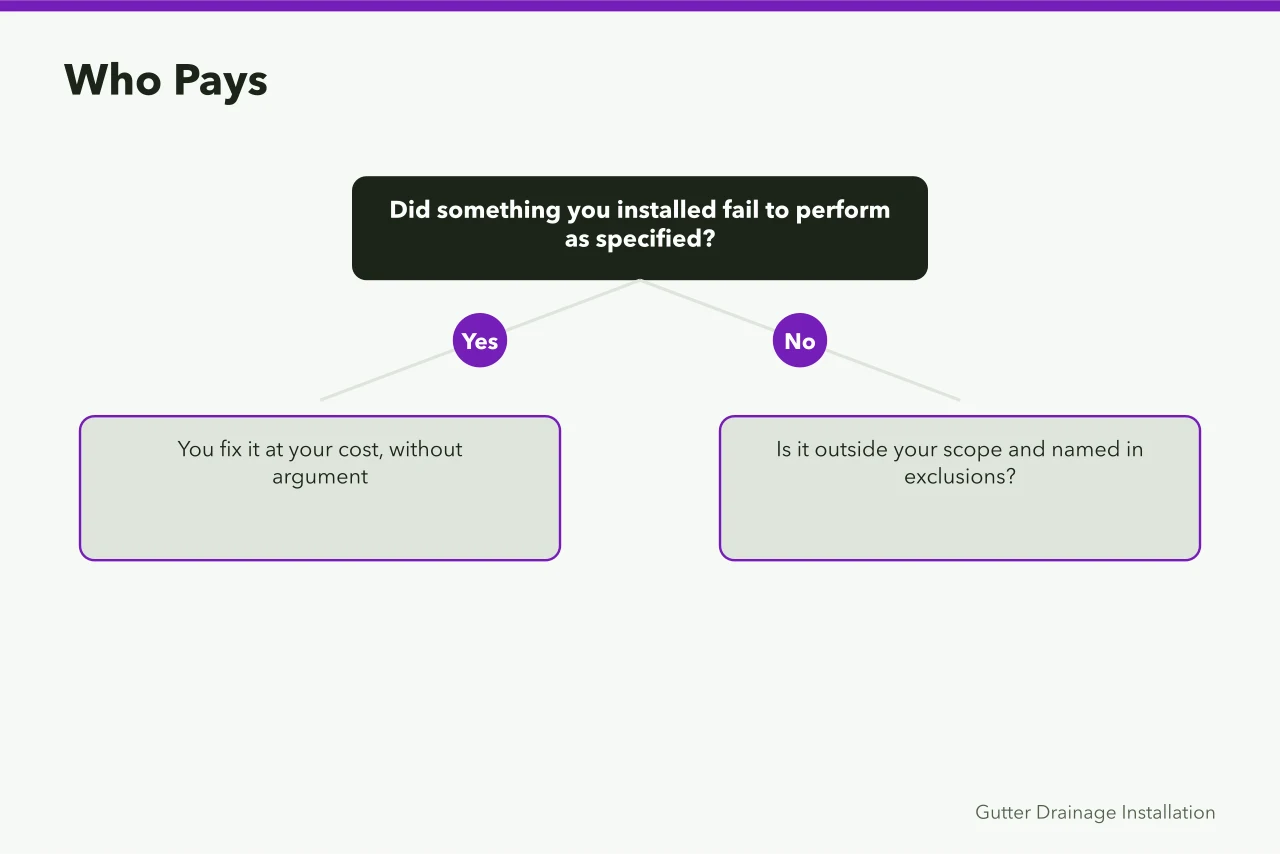
Something you installed does not perform as specified: you fix it, at your cost, without argument.
Something outside your scope, and named in your exclusions, has failed: you quote it, and you show the customer the exclusion in the document they signed rather than reciting it.
A condition you documented at the estimate and they declined to address: you show them the note and the photograph. This is why the deferral note exists.
Genuinely ambiguous: decide by the size of the fix rather than by the strength of the argument. A small correction bought outright is cheaper than a dispute, and saying so plainly is more honest than pretending you agree.
The one rule with no discretion: nothing above your stated access ceiling gets done to placate a complaint. This trade's severe exposure is at the roof edge.
OSHA's guidance on fall protection in residential construction puts responsibility for site-specific controls on the employer, regardless of how the visit started. The access ceiling and fall protection controls belong in the written safety section of a gutter service business plan.
The response that keeps the customer
Speed matters more than generosity. A same-day acknowledgment with a named date beats a discount offered a week later.
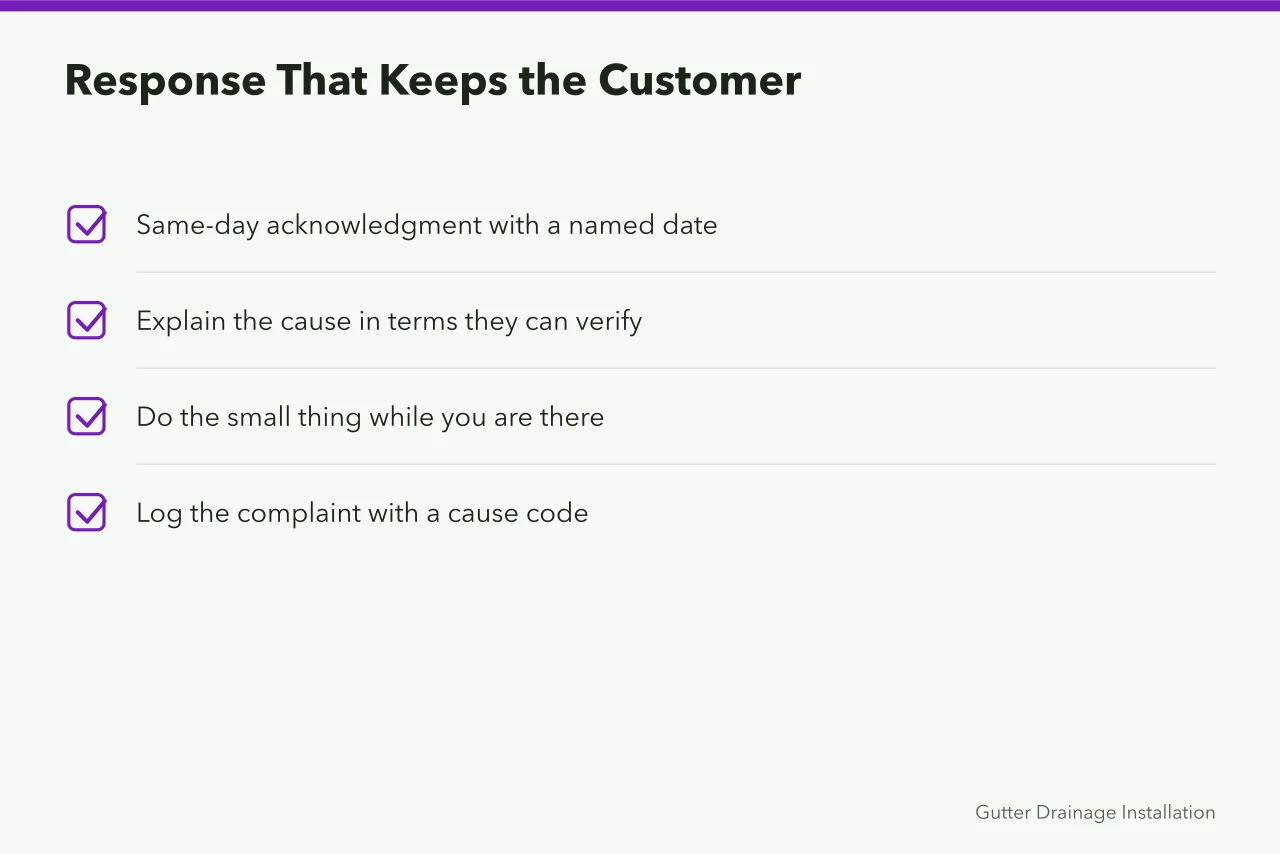
Explain the cause in terms the customer can verify. Show them the standing water. Show them where the ground slopes back. People accept an unwelcome answer they can see far more readily than a favorable one they have to take on trust.
Do the small thing while you are there. If clearing an outlet or resetting one hanger resolves it, resolving it in the visit is worth more than any credit.
And record it. Log the complaint against the original job with a cause: measurement, part, pitch, discharge, sizing, or not our work. Counting causes monthly is what turns complaints into a fix rather than a mood, and the standards that make each cause less likely are set out in the operating standards piece.
Then, and only then, the review
Handle the repair first. A review request attached to a repair reads as a transaction, and customers notice.
Once the work is resolved, ask the same way you ask everyone.
The Federal Trade Commission's guidance on soliciting and paying for online reviews sets out what marketers are expected to do. The two habits worth holding are asking every customer rather than those you expect to be pleased, and disclosing any material connection.
Where a negative review is already posted, reply once, briefly, factually, and without disputing details in public. Offer to continue offline. A calm reply is read by everyone who arrives later, which is who it is actually for.
What complaints should change
A complaint log with causes attached is the cheapest process improvement available.
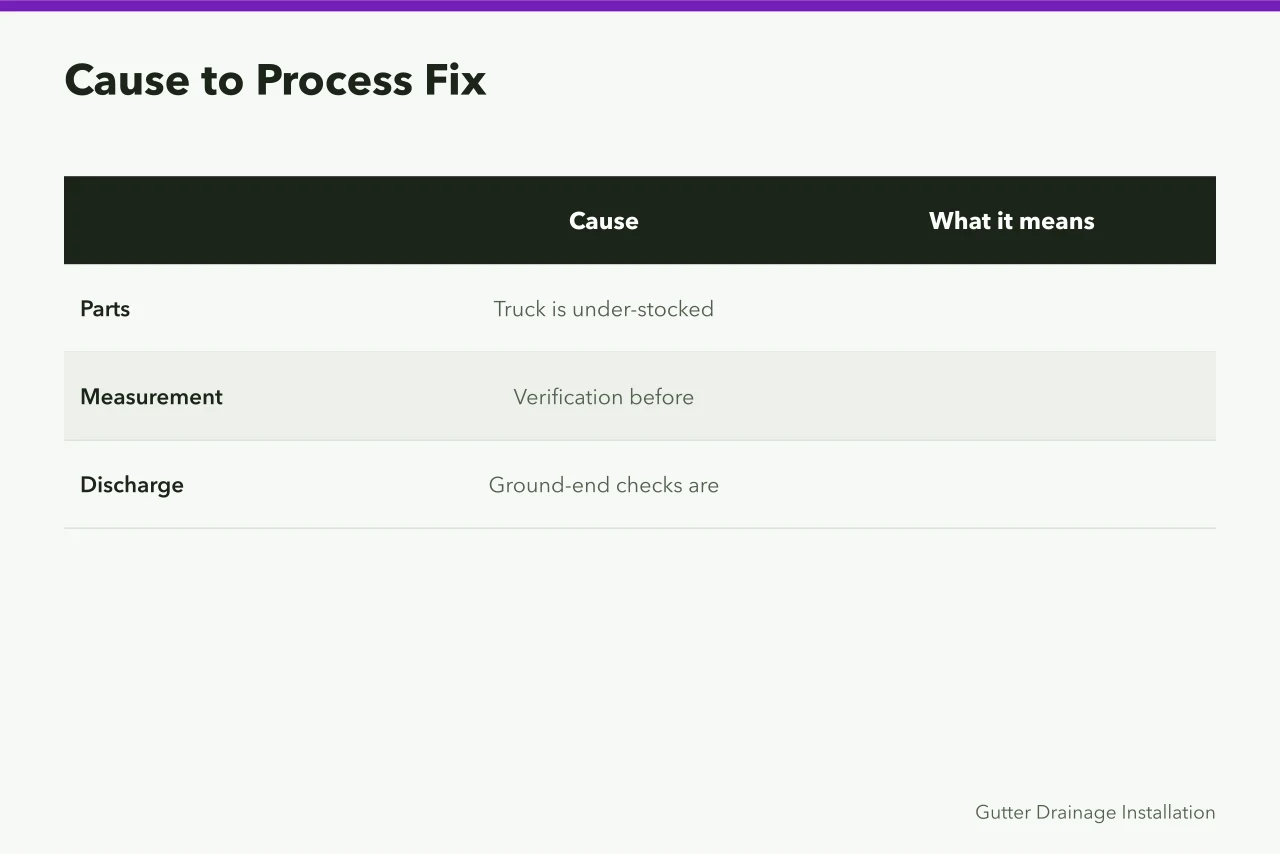
Parts causes mean the truck is under-stocked, a list problem covered in the equipment checklist for new owners.
Measurement causes mean the verification step before forming is being skipped, and it is expensive here because a formed run is made on site with the machine and coil traveling as one unit, explained in the equipment and setup guide.
Discharge causes mean the ground-end checks are not happening, the subject of the quality assurance guide.
Keep the records where they can be searched. The IRS explains what records a business is expected to keep, and a job file that carries the quote, the photographs and the complaint history serves the tax record and the dispute at the same time.
Common questions
How fast should we respond?
Acknowledge the same day with a named date for the visit. Speed of acknowledgment does more for the outcome than the speed of the repair.
Should I ever refund rather than repair?
Sometimes, where the relationship is beyond repair or the fix is disproportionate. Decide it as a rule rather than in the moment, and record which rule you applied.
What if the customer is wrong but insistent?
Show them, do not tell them. A hose and a walk to the discharge point resolves more of these than any explanation.
Do I have to fix something outside my scope?
No, and quoting it fairly is a better response than declining flatly. The customer still has a problem and you are still the person standing there.
How do I stop the same complaint recurring?
Attribute causes and fix the largest one. Companies that count complaints get worried; companies that count causes get better.