Guides
GST/HST and payroll for a Canadian gutter business, explained
A Canadian gutter business registers for GST/HST at the 30,000 dollar threshold, charges tax by job location, and runs payroll once it hires.
What to take away
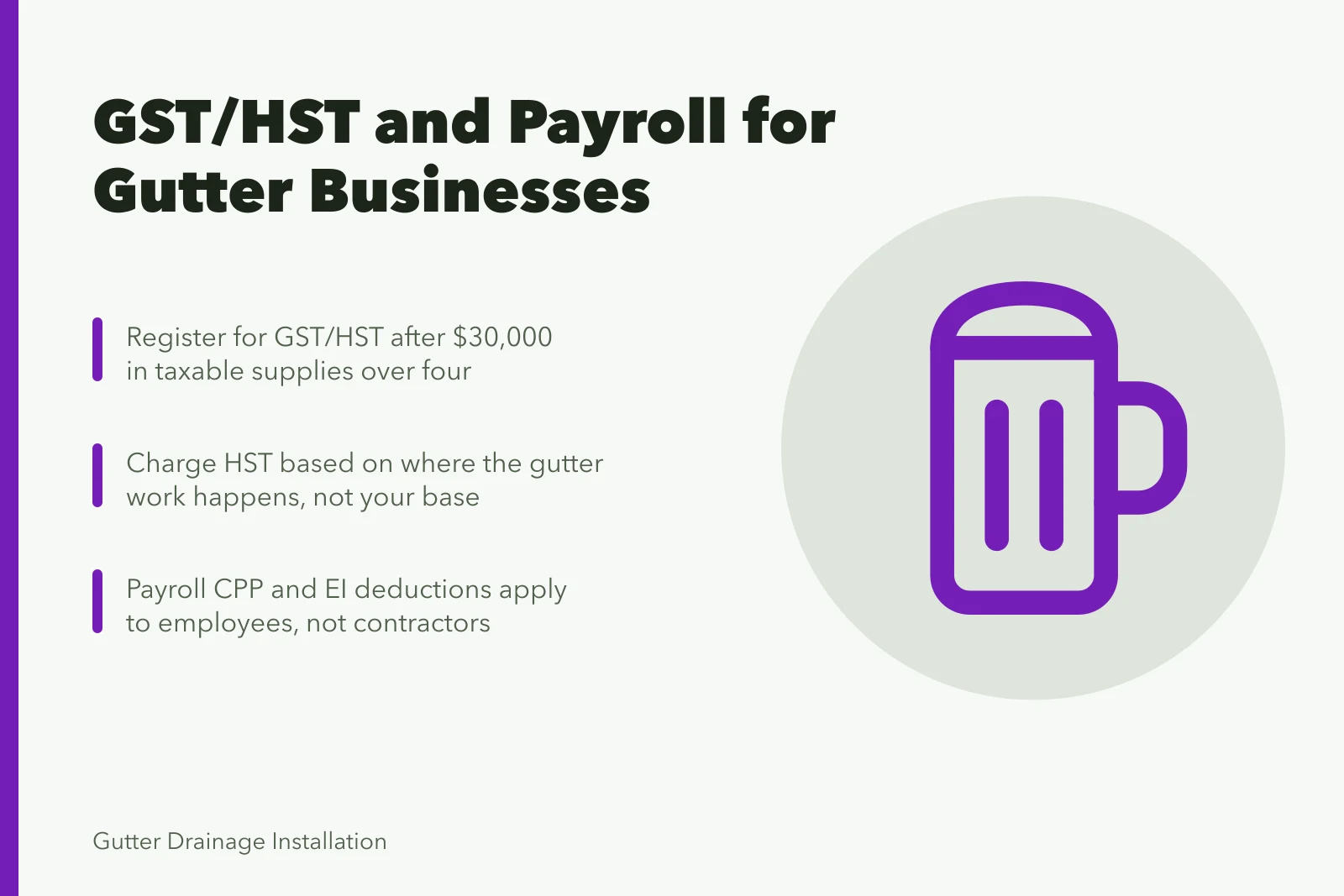
- A gutter installation and cleaning business must register for GST/HST once taxable revenue passes 30,000 dollars over four consecutive calendar quarters, and may register voluntarily before that.
- Tax is charged at the rate of the province where the work happens, not where the truck is parked. Ontario HST is 13 percent.
- Collected tax is held in trust. Spending it on fuel or payroll turns a filing date into a debt.
- Payroll deductions for CPP and EI begin with the first employee, and the employer matches both.
- The contractor versus employee test turns on control, tools, financial risk and integration, not on the words in a contract.
Registering a gutter installation and cleaning business with the CRA
A business number comes first. The CRA issues one per legal entity, and program accounts hang off it: GST/HST, payroll, corporate income tax, import/export. A sole proprietor registers under their own name and may add a trading name.
Register online through My Business Account, by phone, by mail, or through a service provider. Have your legal name, address, social insurance number if you are a sole proprietor, and a description of the main activity. Describe it as gutter installation and cleaning. Not roofing, not general contracting.
Early registration lets you claim input tax credits on startup purchases. Ladders, a truck, a leaf blower, harnesses and a trailer all carry GST/HST, and a registered business recovers it. An unregistered one does not.
Opening a program account costs nothing and needs no renewal. The cost sits in the work afterwards: bookkeeping, filing, remittance. Owners who plan for that spend less on catch-up.
If you incorporate, the corporation registers. A partnership registers and files as a partnership. Choosing the wrong entity means re-registering later, with new numbers, a new filing history and fresh remitter accounts.
What the CRA asks for
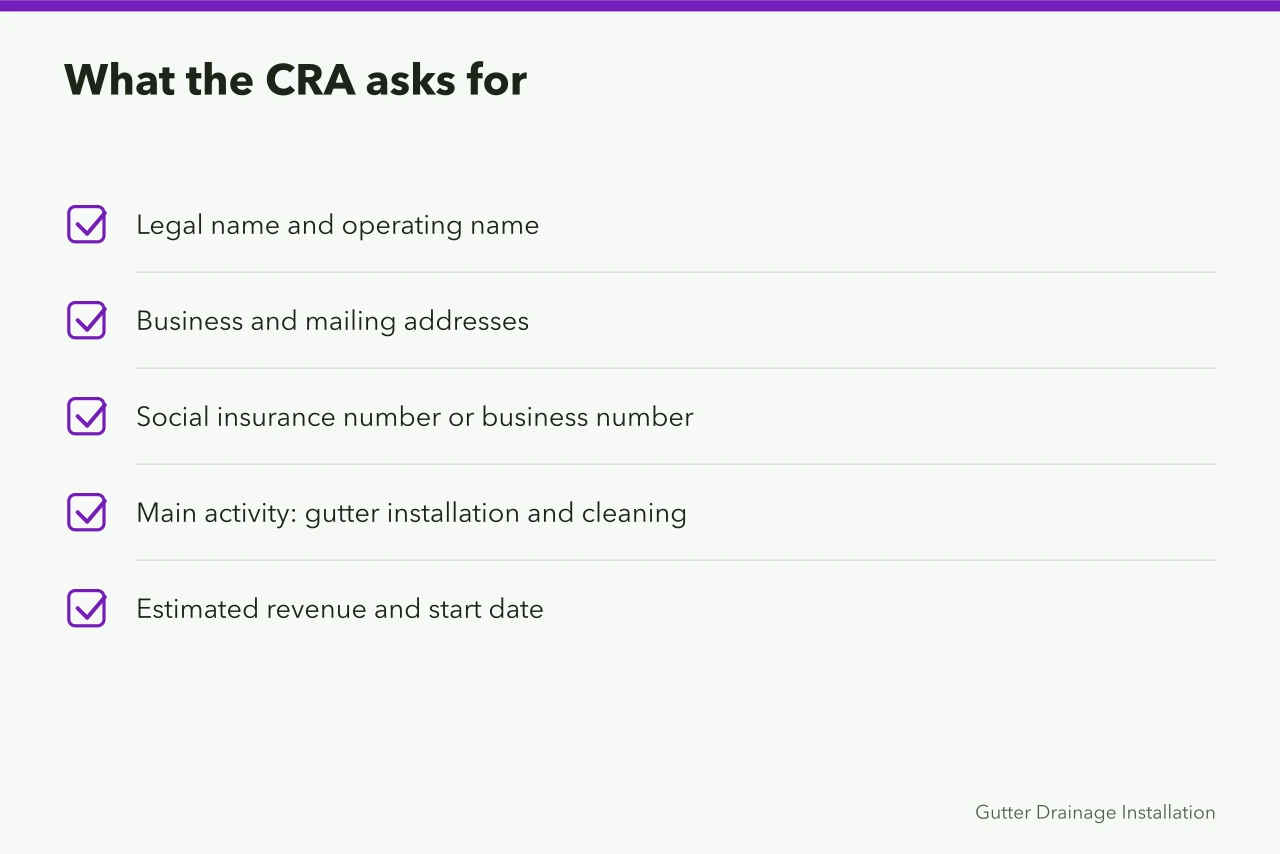
Keep the confirmation. Banks, suppliers and insurers ask for the business number when you open trade accounts, and some municipal licensing offices ask too.
The small-supplier threshold and when registration becomes mandatory
The threshold is 30,000 dollars in taxable supplies over four consecutive calendar quarters. Below it you are a small supplier and registration is voluntary. Above it, registration is required.
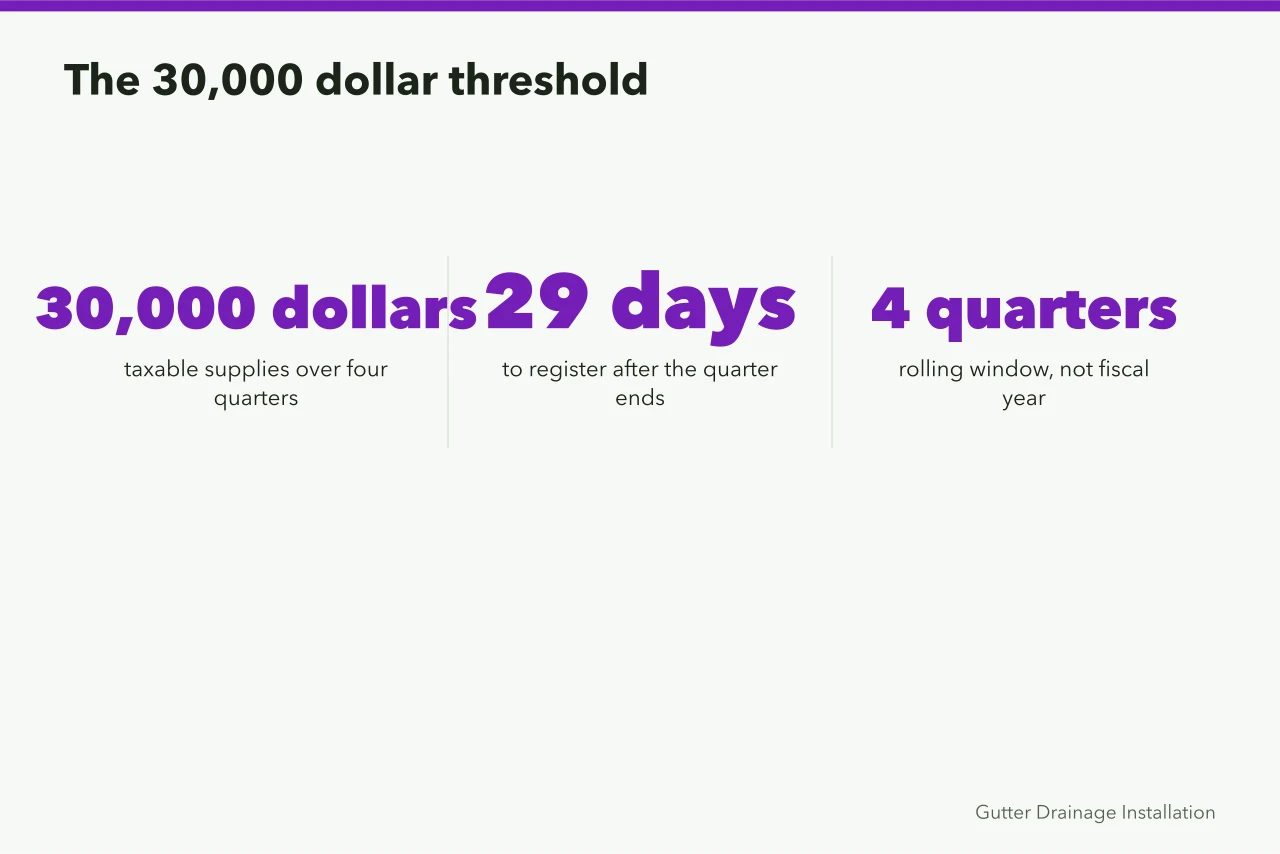
The clock is a rolling four-quarter window, not your fiscal year. A strong spring and a heavy fall can carry you over without a single price change.
Gutter work is seasonal across most of Canada. Ice and freeze-thaw push installations into late spring through early fall, and cleaning into spring and autumn. One busy season can double a quarter.
Charities and public service bodies use different thresholds. A gutter company does not qualify, so 30,000 dollars is the number that applies to you.
Cross the line and the CRA expects registration within 29 days of the quarter's end. Miss it and you owe tax you never collected, plus interest.
Voluntary registration buys input tax credits on equipment and costs you filing duties from day one. Large startup purchases usually make it worth doing. Small ones make waiting simpler. Decide on purpose.
The rolling test, worked through
A gutter business bills in four quarters. The amounts are:
- 8,000 dollars in one quarter
- 6,000 in the next
- 9,000 in the third
- 8,000 in the fourth Taxable supplies total 31,000 dollars. Registration is mandatory, though no single quarter came near the line.
Collecting and remitting GST/HST on gutter work
GST and HST are the same tax at different rates. GST applies where a province kept its own sales tax. HST applies where the federal and provincial portions are blended.
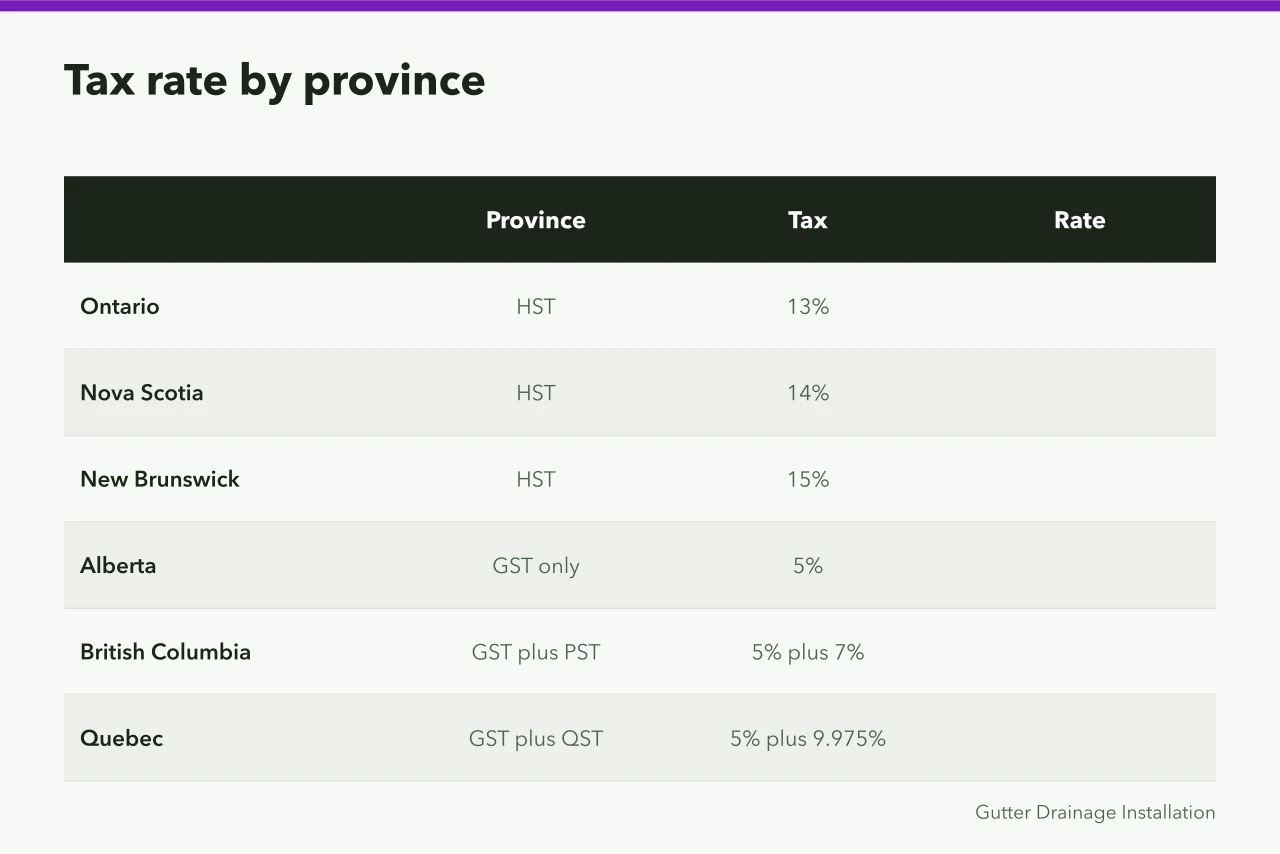
Charge the rate of the province where the work happens. A Manitoba crew installing in Ontario charges Ontario HST. An Ontario crew working in Alberta charges 5 percent GST.
| Province or territory | Tax on gutter work | Rate |
|---|---|---|
| Ontario | HST | 13% |
| Nova Scotia | HST | 14% |
| New Brunswick | HST | 15% |
| Newfoundland and Labrador | HST | 15% |
| Prince Edward Island | HST | 15% |
| British Columbia | GST plus PST | 5% plus 7% |
| Alberta | GST only | 5% |
| Saskatchewan | GST plus PST | 5% plus 6% |
| Manitoba | GST plus RST | 5% plus 7% |
| Quebec | GST plus QST | 5% plus 9.975% |
| Yukon, Northwest Territories, Nunavut | GST only | 5% |
In British Columbia, Saskatchewan and Manitoba the provincial tax falls mainly on goods and specified services, so most gutter labour is outside it. Materials you supply may not be. Check the provincial rule before bundling labour and materials into one price.
Quebec runs its own administration. A business with a Quebec establishment registers with Revenu Quebec for QST as well as with the CRA for GST. Confirm which registration applies before invoicing a cross-border job.
Collecting is arithmetic. Remitting is where owners get caught. The tax is not your money. It is held in trust, and spending it on payroll or fuel creates a debt that follows the business.
Filing frequency follows revenue. Smaller businesses file annually or quarterly, larger ones monthly. The CRA assigns the period at registration and adjusts it as revenue grows. Each filing method is set out on the CRA page on how to file your GST/HST return.
Move the tax out the day it arrives. A separate savings account does it. So does a weekly bookkeeping routine that flags the balance. Owners who spend it end up on instalments or in collections.
Setting up collection and remittance
- List the provinces you actually work in, and register in each one that requires it.
- Set invoicing software to apply the rate by job location, not by office address.
- Open a separate account and move collected tax there as payments land.
- Record the tax on every invoice, including deposits and progress payments.
- File by the due date, claim input tax credits on business purchases, remit the balance.
Ontario HST and provincial sales tax in gutter pricing
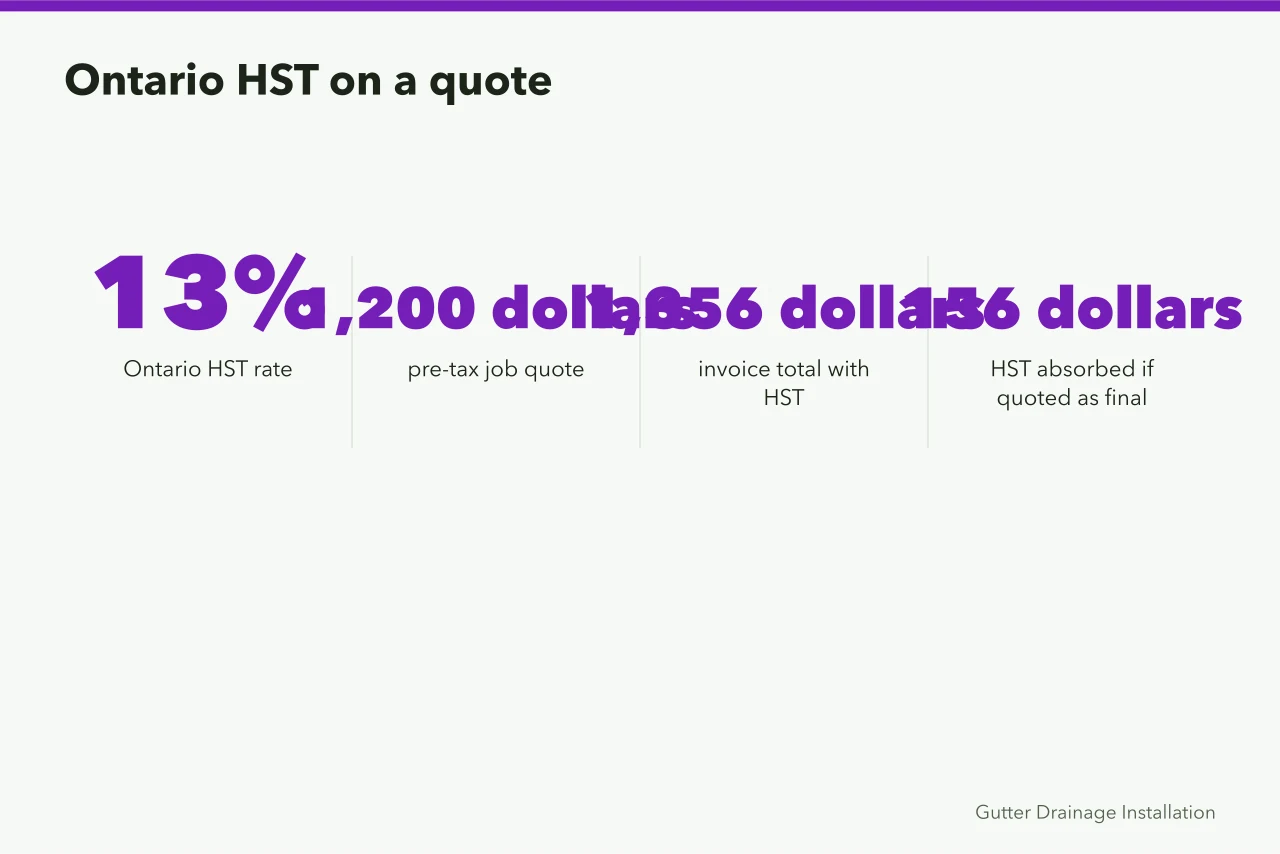
Ontario HST is 13 percent: 5 percent federal, 8 percent provincial. The province sets out what it covers on its Harmonized Sales Tax page.
Gutter installation and cleaning are services supplied in Ontario, so HST applies to labour and to most materials supplied with it. No separate Ontario retail sales tax sits on top. That is the difference from British Columbia, Saskatchewan and Manitoba, where a second provincial tax can reach materials.
Pricing is where this bites. A job quoted at 1,200 dollars plus HST bills at 1,356 dollars. Quote 1,200 as a final number and you either absorb 156 dollars or call the customer back.
Quote before tax and show the tax. Residential customers compare totals, so a quote that hides tax looks cheaper until the invoice. Commercial customers expect a pre-tax figure and want the tax broken out for their own input tax credits.
Deposits follow the same rule. HST applies when you take the deposit if it is payment for the supply, not when the job finishes. Progress billing on a long installation works the same way.
Municipal stormwater and drainage fees are separate from your invoice. They are not tax you collect and not revenue you earn. If a customer asks you to pass one through, get accounting advice before agreeing.
Your own purchases carry HST too. Materials, fuel, vehicle costs and insurance costs all include it, and a registered business recovers that tax as an input tax credit. An unregistered one carries it as a permanent cost that shrinks margin on every job.
Payroll deductions: CPP, EI and reporting for gutter crews
Pay someone to work in the business and payroll rules start. The CRA administers source deductions, and the obligations sit on its payroll page.
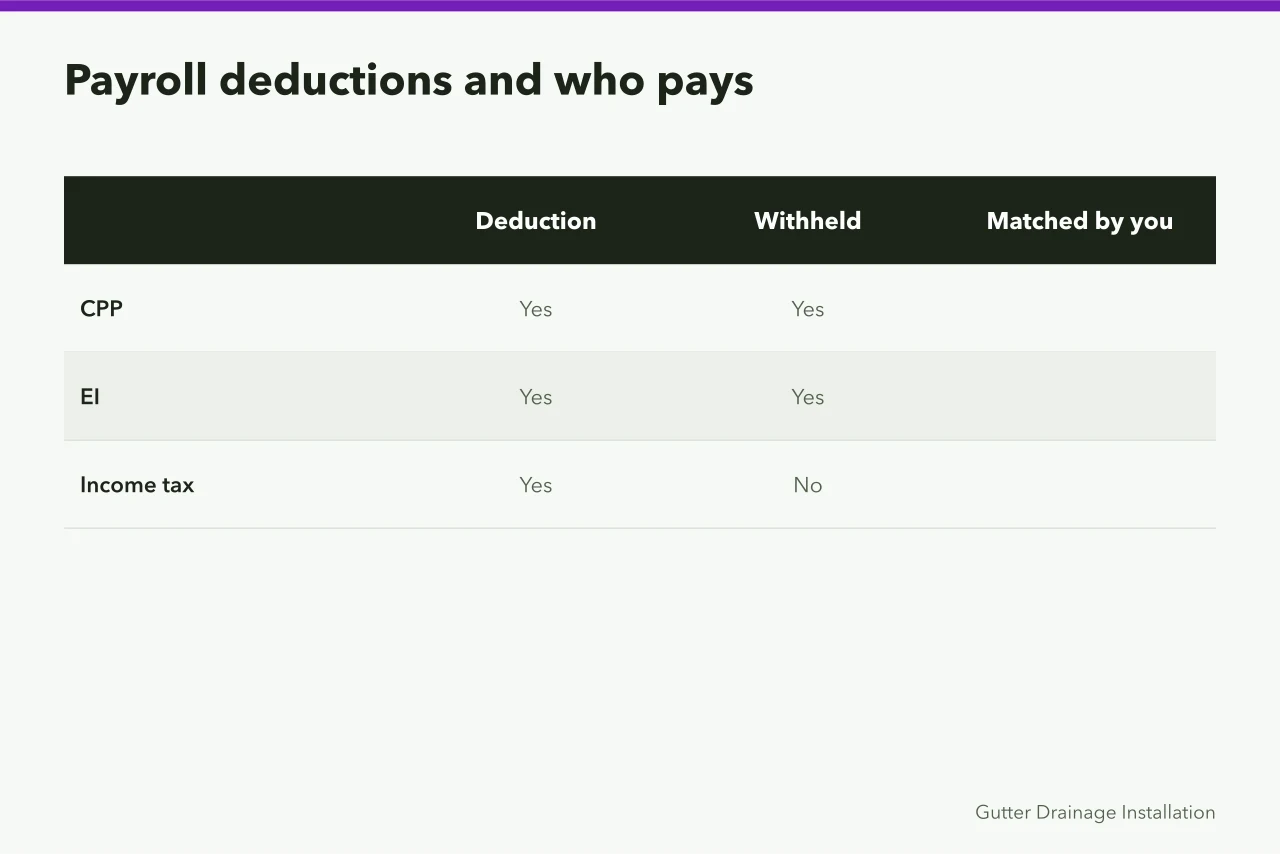
Open a payroll program account before the first payday. Report each pay period after that. Most small employers remit monthly or quarterly depending on the withholding amount, and the CRA sets the schedule when the account opens.
Year end brings T4 slips and a summary return. Penalties apply per slip when the deadline passes. The slips must match what you reported all year, which is why running payroll by hand and reconciling in February is a poor habit.
Quebec employers carry an extra layer. They register with Revenu Quebec for provincial income tax withholding and report through that system as well as the federal one.
Workers' compensation is separate from CRA payroll. Provincial boards run it: WSIB in Ontario, WorkSafeBC in British Columbia, WCB Alberta, CNESST in Quebec, and equivalents elsewhere. Gutter work means ladders, heights and power tools, so coverage is rarely optional.
Budget the true cost before you hire. Wages plus the employer share of CPP and EI plus workers' compensation premiums plus benefits add a real percentage on top of the hourly rate. Our breakdown of pay rates shows how those on-costs stack up.
Before the first payday
- Open a payroll program account under your business number.
- Collect a social insurance number and federal TD1 from each employee, plus a provincial form where one exists.
- Set up payroll software or a bookkeeper that calculates CPP, EI and tax.
- Diarise the remittance due date and the T4 deadline.
- Register with your provincial workers' compensation board.
Contractor versus employee for gutter installers
This test decides whether you withhold. Get it wrong and the CRA can assess your business for unremitted CPP, EI, penalties and interest years later.
What you call the person does not decide it. Neither does a contract that says contractor. The working relationship decides, judged on factors the CRA and the courts apply.
Control comes first. Who sets the start time, picks the next job, chooses the method and inspects the work? More control points to employment.
Tools come second. An installer who brings their own ladders, harnesses, blower and hand tools looks like a contractor. One who uses your truck and your equipment looks like an employee.
Financial risk comes third. A contractor can profit or lose on a job, carries liability insurance, and can work for other companies. An employee is paid for time or output and carries none of that.
Integration comes fourth. Someone essential to your business, working only for you, full time, points to employment. Someone running their own gutter business and taking your jobs among others points the other way.
Written terms matter but do not settle it. A contract calling someone a contractor while you control their day, supply their tools and pay by the hour will not survive a review.
Build a genuine contractor relationship on purpose: let them set their own schedule, use their own equipment, invoice for completed work rather than hours, carry their own insurance and workers' compensation coverage, and take other clients. If you need to direct someone daily, hire them and run payroll.
The stakes go past tax. A misclassified worker injured on a ladder may sit outside your workers' compensation coverage, which puts the claim and the liability on you. Settle the status before the first job, not after an incident.
Keeping CRA program accounts clean as the crew grows
Growth adds accounts and deadlines. Businesses that stay out of trouble treat compliance as routine rather than a project.
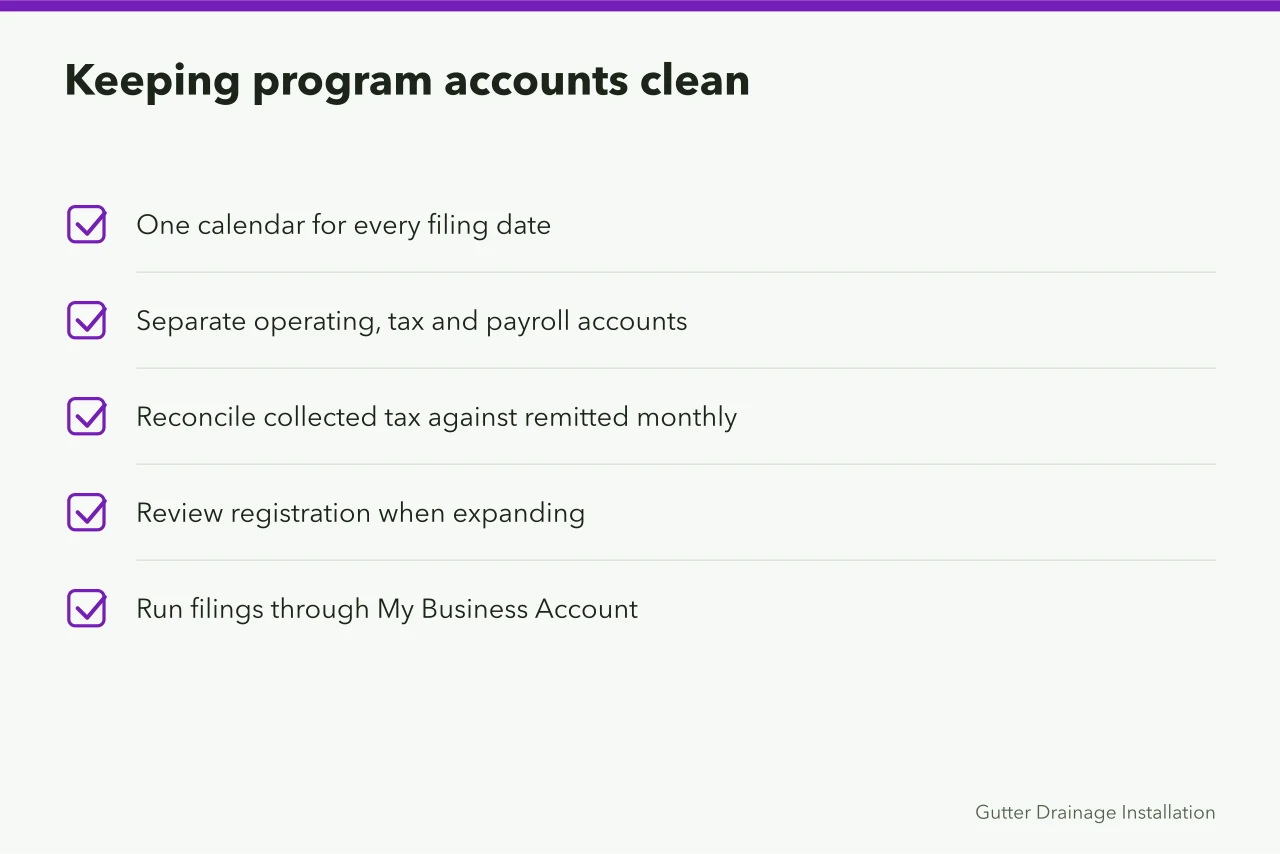
Keep one calendar for every date: GST/HST returns, payroll remittances, T4s, corporate filings, workers' compensation reporting. A missed payroll remittance carries some of the sharpest penalties in the system, because the money was never yours.
Separate the bank accounts. One for operating, one for tax collected, one for payroll. That single habit turns a CRA review into printing statements instead of rebuilding a year.
Reconcile monthly. Compare what your invoicing system says you collected against what you remitted. Differences are usually timing, but they can be a rate applied to the wrong province, which is worth catching early.
Review your registration as you expand. A second province, a first employee, incorporation, or selling materials alongside labour can each trigger a new account or change an existing one. The CRA guidance on registering your business covers adding and changing program accounts.
Run filings and notices through My Business Account. Filing history, balances and correspondence sit in one place, which beats paper mail for a seasonal business that may be on a job site for weeks.
Get help before problems compound. A bookkeeper who knows construction costs less than interest and penalties on a missed remittance, and far less than a reassessment. The same logic holds for licensing and compliance, where a missed municipal or provincial requirement can stop work outright.
Plan the money side as carefully as the work. Knowing your startup costs alongside your ongoing tax obligations is what carries a growing gutter business through a Canadian winter, when revenue slows and fixed costs do not.
Choosing where to operate matters just as much, and our guide to the markets for gutter service sets out what to weigh before you add a second territory.
The full set of obligations, registration through filing, sits on the CRA's GST/HST for businesses pages. Read them once at registration, then keep them bookmarked for the year you cross the threshold.
Common questions
Do I have to register if I only clean gutters and never install?
Yes, once taxable revenue from cleaning alone passes 30,000 dollars over four consecutive calendar quarters. Cleaning is a taxable service, and the threshold counts all your taxable supplies together.
Can I charge GST/HST before I am registered?
No. You cannot collect tax without a GST/HST account. If you crossed the threshold and kept billing, you still owe the tax on those invoices, plus interest and penalties.
Does the rate follow my business address or the job site?
The job site. A crew working in Ontario charges 13 percent HST no matter where the company is headquartered, and a crew working in Alberta charges 5 percent GST.
Is an installer with their own tools automatically a contractor?
No. Tool ownership is one factor among several. Control over the work, financial risk and integration into your business all count, and the CRA weighs the whole relationship.
What happens if I misclassify an employee as a contractor?
The CRA can assess your business for unremitted CPP, EI and income tax, plus penalties and interest. The worker may also fall outside your workers' compensation coverage, which shifts injury liability onto you.