Guides
What gutter service insurance costs, and what it covers
Gutter service insurance costs run from about 1,200 dollars a year for a solo operator to 9,000 dollars or more for a crewed outfit with trucks.
What to take away
- Gutter service insurance for a solo installer with no employees typically costs 1,200 to 2,400 dollars a year for general liability. Add workers' compensation and a crewed payroll and the same trade pays 6,000 to 15,000 dollars.
- Workers' compensation is priced per 100 dollars of payroll. In most states gutter work classifies near roofing, at roughly 8 to 25 dollars per 100 dollars of payroll, and height drives the rate.
- Commercial auto with a scheduled trailer adds 1,800 to 4,500 dollars a year per vehicle, depending on the state and the driver record.
- Completed operations coverage is the line that pays for a wet basement discovered eight months after you left. Confirm the period and that it survives renewal.
- A certificate of insurance proves a policy existed on the day it was printed. Ask for the actual wording before you compare two quotes.
What the coverage actually costs
Three figures decide your premium: payroll, the height of work you accept, and your loss history. Everything else is a modifier.
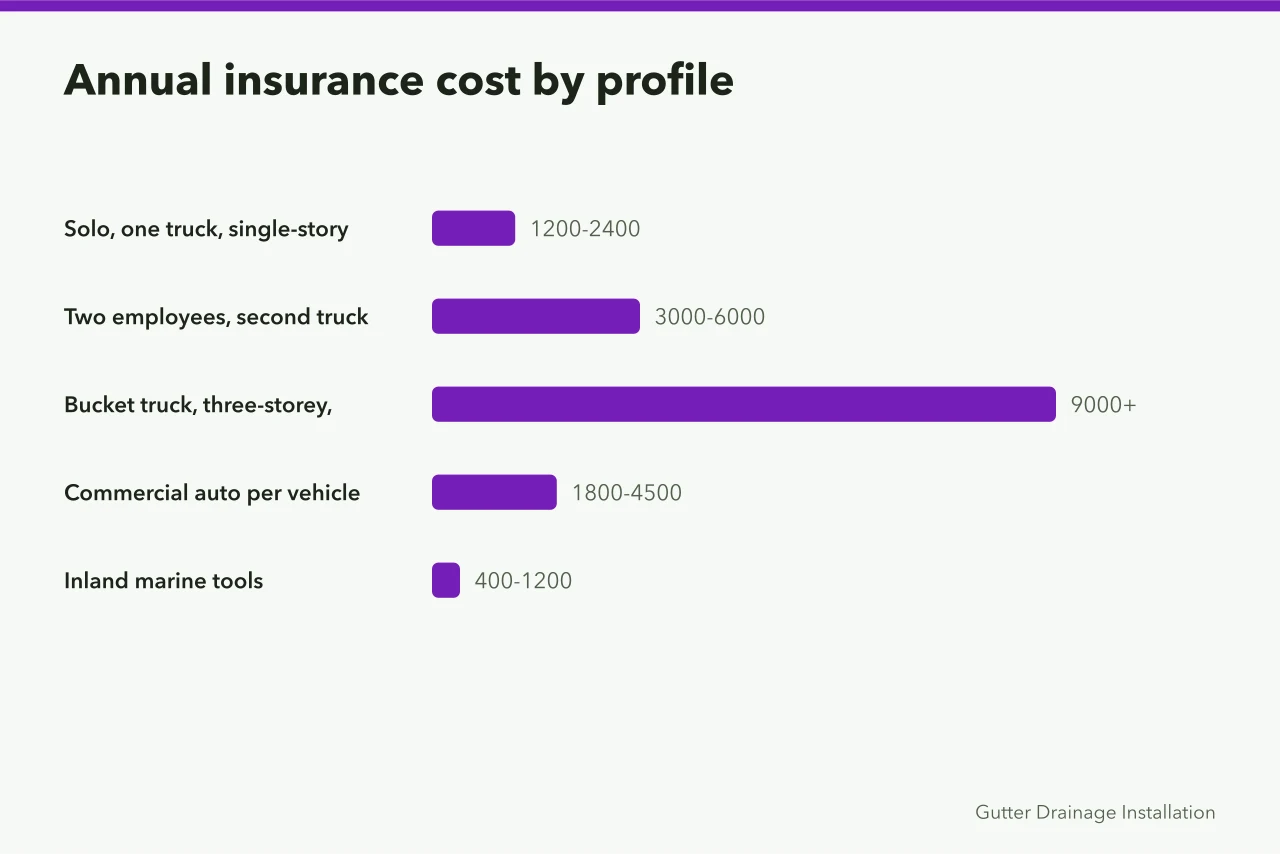
A solo operator running one truck, no employees, and single-story residential work is the cheapest profile in this trade. General liability for that business generally falls between 1,200 and 2,400 dollars a year for a 1 million dollar per-occurrence limit.
Add two employees and a second truck, and the general liability line moves to 3,000 to 6,000 dollars. Add a bucket truck, three-story work, or commercial contracts, and it climbs past 9,000 dollars.
Workers' compensation is separate and priced per 100 dollars of payroll. Gutter work usually classifies near roofing, at roughly 8 to 25 dollars per 100 dollars of payroll depending on the state. A crew carrying 120,000 dollars of payroll at 15 dollars per 100 pays 18,000 dollars a year.
Commercial auto with a scheduled trailer runs 1,800 to 4,500 dollars a year per vehicle. Inland marine for tools and equipment away from the premises is usually the cheapest line on the sheet, often 400 to 1,200 dollars a year.
These are illustrative ranges, not quotes. Rates move by state, by carrier and by year. Your broker prices your business, not this page.
Who writes gutter service policies
General liability for small contractors is sold online by Next Insurance and Hiscox, both of which quote from a few questions about revenue, payroll and trade. Thimble and Simply Business act as online marketplaces that place small-contractor policies with several carriers.
Workers' compensation is often written by a state fund or a specialist. Examples include the State Compensation Insurance Fund in California, SAIF in Oregon and Texas Mutual in Texas. biBERK, part of Berkshire Hathaway, sells workers' comp direct to small businesses, and EMPLOYERS writes it for small contractors.
Commercial auto for a truck and trailer is usually placed by an independent agent with a regional carrier, because trailer and driver details change the rate. National carriers that write small commercial auto include The Hartford, Travelers and Nationwide.
Ask each one for the completed operations wording as well as the price. Your state's department of insurance lists who is licensed to write in your state.
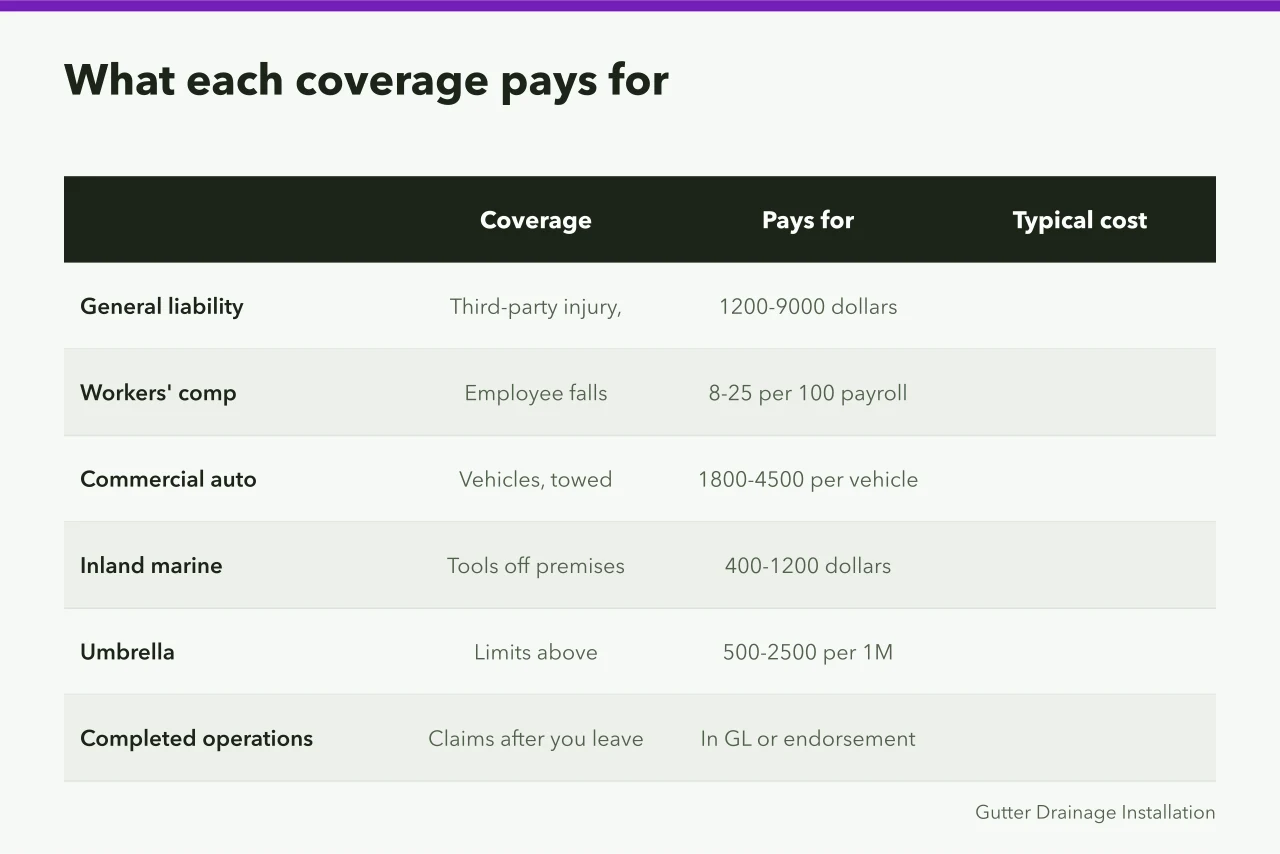
What each coverage pays for
| Coverage | What it pays for in this trade | Typical annual cost |
|---|---|---|
| General liability | Third-party injury and property damage from the work | 1,200 to 9,000 dollars |
| Workers' compensation | Employee injury, which here means falls | 8 to 25 dollars per 100 dollars of payroll |
| Commercial auto | Vehicles and a towed trailer | 1,800 to 4,500 dollars per vehicle |
| Inland marine | Tools and equipment away from the premises | 400 to 1,200 dollars |
| Umbrella or excess | Limits above the underlying policies | 500 to 2,500 dollars per 1 million dollars |
| Completed operations | Claims arising after you leave the site | Included in GL, or a separate endorsement |
Completed operations is the row owners skip. Water damage from a bad installation rarely shows up on the day. It shows up at the first heavy rain of the next season.
Workers' compensation rules, including who must carry it and from what point, are set by each state. Ask your state's authority rather than assuming.
Reading the policy you already hold
Work through your own documents, not the summary your broker emailed.
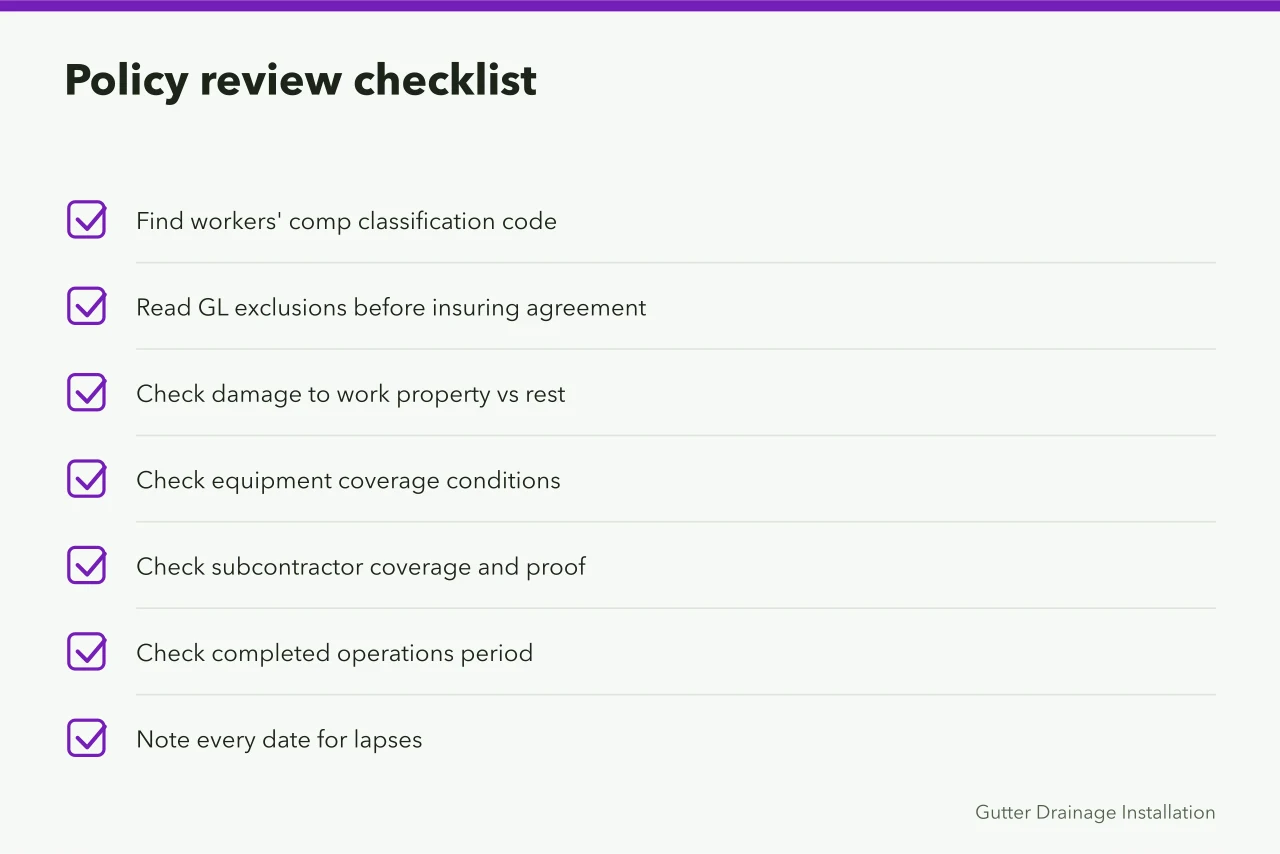
Step one is the one that voids claims. If you told an underwriter you work single-story residential and your crew is on a three-story house, that gap is the whole problem. Decide your access ceiling deliberately, tell the underwriter the truth, and hold your intake to it.
The certificate is not the policy
A certificate of insurance is a summary produced for someone else. It proves a policy existed on the day it was issued and almost nothing else.
Ask your carrier to send certificates directly to whoever requires them. Ask for the actual wording when you are evaluating a policy. When a property manager or association sets minimums, treat those as contract terms rather than law, because no regulator will warn you when you fall below them.
Requirements to carry insurance are often tied to registration in the first place, which is one reason the licensing and compliance guide and this article belong on the same calendar. The taxonomy of what actually counts as a credential is set out in what licenses this business needs.
What insurance does not transfer
Two things stay yours no matter what you buy.
The first is your duty at the roof edge. OSHA's guidance for fall protection in residential construction puts responsibility on the employer for site-specific controls and for whichever federal or state-plan requirements apply. A policy does not change that.
The program described in OSHA's safety and health framework reduces exposure: commitment, worker participation, hazard identification, correction and training.
The second is regulatory compliance generally. Accessibility obligations at your own premises are a good example, because owners assume the subject cannot touch a trade business. The ADA guide for small businesses explains where the obligations fall, and no insurer will make a non-compliant counter compliant.
What moves the cost
Underwriters price history and controls. Both are things you build rather than negotiate.
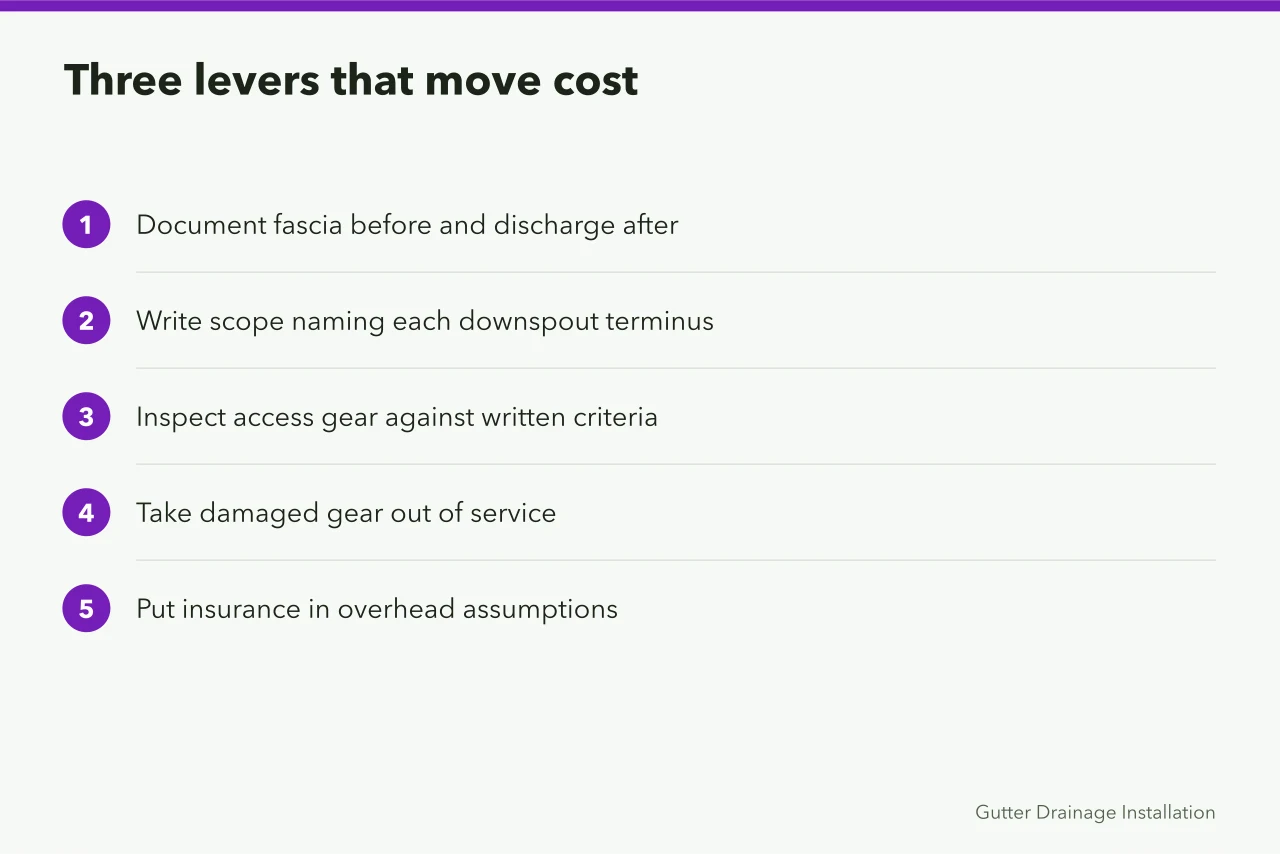
Documentation is the shortest lever. Photographs of the fascia before you touch it and of the discharge point after you finish resolve many water-damage claims that would otherwise be argued.
A written scope saying where each downspout terminates does the same. The process in the equipment and setup guide builds that habit. Proof of the discharge path becomes a job step rather than an afterthought.
The second lever is the equipment itself. Access gear in good condition, inspected against a written criterion, with a rule for taking it out of service, is both a safety control and a claims defense. Build the inspection into the list in the equipment checklist for new owners.
The third is planning. Insurance is one of the few costs that is genuinely fixed and unavoidable, so it belongs in the overhead assumptions of the business plan rather than being discovered in month two.
Common questions
How much does gutter service insurance cost?
A solo operator with one truck and no employees typically pays 1,200 to 2,400 dollars a year for general liability. With two employees and a second truck, that line runs 3,000 to 6,000 dollars.
A crew with a bucket truck and commercial contracts can pay 9,000 dollars or more. Workers' compensation, commercial auto and tools coverage sit on top of that.
How much coverage should I carry?
Enough to satisfy your state, your customers and the size of the loss you could not survive. A broker who knows your payroll and your work can answer this. A page cannot.
Do I need workers' compensation if it is just me?
The rules differ by state and by entity type. Some owners are exempt while others are not. Ask your state authority directly.
Will my policy cover a subcontractor's mistake?
Read the subcontractor conditions in your own wording. Most policies require you to hold proof of their coverage, and failing to collect it is a common and expensive oversight.
Does a claim always raise my premium?
Not automatically, and the pattern matters more than a single event. Frequency of small claims often affects renewal more than one larger loss.