Guides
How a gutter service business expands sensibly
Gutter service expansion planning: density before distance, what a second crew really costs, and the unknowns that make a second market expensive.
What to take away
- Route density beats territory. Growing outward before growing denser raises your unbillable hours faster than your revenue.
- A second crew is not twice one crew. It costs you a supervisor, a second set of everything, and the estimating time you were doing yourself.
- A second market resets the answers you thought you had: licensing, permits, discharge rules, wages and housing stock all change at a boundary.
- The constraint on growth here is not demand. It is crews and the number of days the weather allows.
The three ways a gutter company grows
Only three, and they behave very differently.
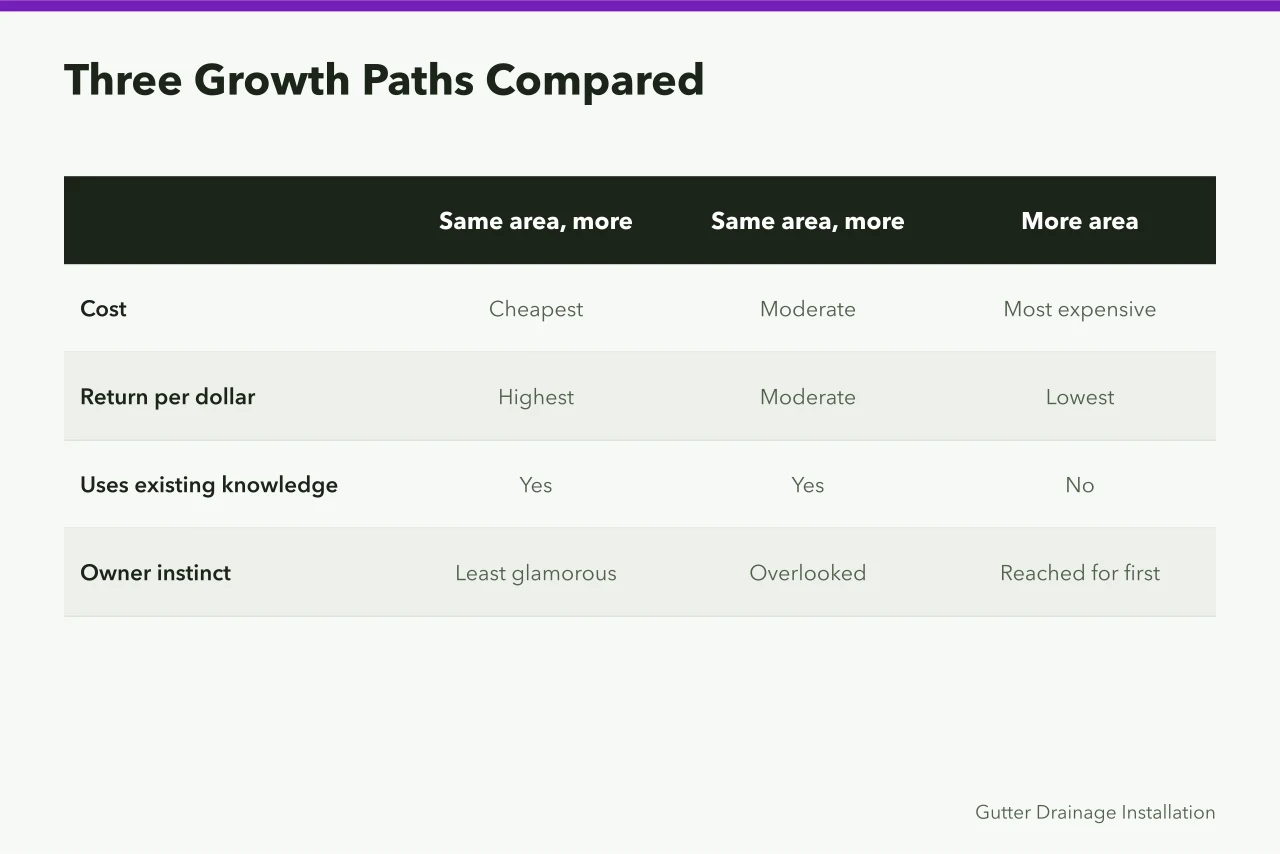
More work in the same area. Higher density on the same routes, more recurring maintenance, more of the neighborhoods you already know. Cheapest, least glamorous, and almost always the right first move.
More services in the same area. Adding repair, discharge work, buried line clearing or forming capability to a customer base that already trusts you. Moderate cost, and it uses knowledge you already have.
More area. A second market, a second crew based elsewhere, a second set of local rules. The most expensive, and the one owners reach for first because it feels like growth.
The order above is the order of return per dollar for almost every company in this trade.
Density before distance
Driving time is paid and unbillable. That single fact decides most expansion questions in this business.
A crew doing several properties in one neighborhood spends its day working. The same crew doing the same number of properties scattered across a metro area spends a large share of the day in a truck, at the same prices. The revenue looks similar and the contribution per crew hour does not.
Formed installation work makes it sharper still. The machine, the coil and the crew travel as one unit, so a distant job is a whole trailer trip that cannot be shared with anything else, which is set out in the equipment and setup guide.
So the first expansion question is always the same: can you sell more work inside the area you already cover? Recurring maintenance is usually the answer, because it compounds density rather than diluting it, and it puts you at the property before the installation is needed.
What a second crew actually costs
Owners budget for wages and a vehicle. The real list is longer.
| Cost | Often forgotten? | Why it appears |
|---|---|---|
| Wages and payroll burden | No | Obvious |
| Vehicle, trailer, insurance | No | Obvious |
| A second set of access gear | Sometimes | Gear cannot be shared across simultaneous jobs |
| Supervision | Almost always | Somebody has to check work you can no longer see |
| Estimating capacity | Almost always | You were the estimator, and now you are managing |
| Training time | Usually | Paid hours that never appear on an invoice |
| Slack for weather | Usually | Two crews idle in a storm cost twice as much |
The two rows marked almost always are what break second crews. The owner who was doing every estimate is now supervising, and estimates start being rushed, which damages the exact activity that wins work in this trade.
Plan for that before hiring, not after. The training and progression side is covered in the hiring and training guide, and the labor cost arithmetic belongs with the pricing and profit guide.
A second market resets your answers
Crossing a municipal or state boundary invalidates a surprising amount of what you know.
Licensing and registration can differ at state, county and city level, and a company fully compliant in one metro area can be operating unregistered in the next one. The method for establishing what applies is in the licensing and compliance guide, and it has to be re-run per market rather than assumed.
Permit requirements differ, including whether one is needed for a like-for-like replacement as against a new drainage connection.
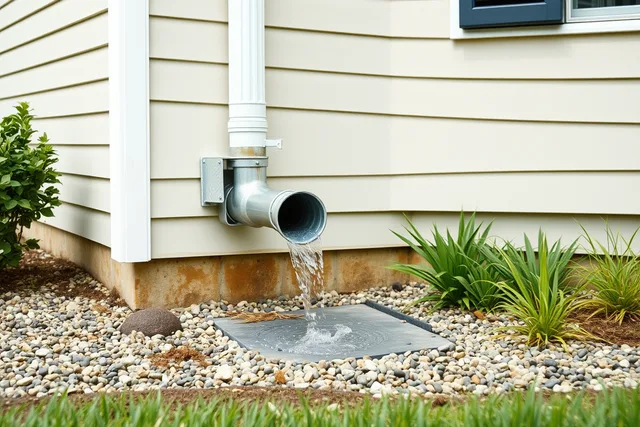
Discharge rules differ. What you may do with water after the downspout is set locally, and it shapes your standard scope. A scope written for one city can promise something the next city prohibits.
Wages differ, and they are lookupable: the Bureau of Labor Statistics publishes occupational employment and wage estimates by area, so compare metro areas before assuming your rate card travels.
Housing stock differs, which changes the work mix and the access classes. A market of steep three-story houses is a different business from a market of ranches, with different crews and different risk.
Rainfall intensity differs, which changes system sizing. A habit carried from a drier market will undersize quietly, and the customer will not discover it until a storm.
Adding a service line instead
Frequently the better move, and much cheaper to reverse.
Cleaning and inspection work fills the shoulder months, needs little capital and produces the estimate appointments that justify larger work later. Discharge and buried line work addresses what customers are actually complaining about and has less competition than trough replacement. Repair and re-hang work has high contribution per crew hour and short visits.
Each of those is a change to your service definitions rather than to your geography, and the structure for writing them is in the packages and pricing guide.
Two adjacent categories should be decided deliberately rather than drifted into. Roof work is a different trade with different licensing and different risk. Grading and foundation drainage is where much of the customer's real problem lives and it needs either a partner or a clear referral policy.
The order of operations for a second market
If you do go outward, go in this order rather than all at once.
- Drive the market on an ordinary weekday. Look at rooflines, canopy, elevations and where downspouts currently terminate.
- Make the five compliance calls: state board, state tax authority, county, city building department, and the municipal stormwater office.
- Compare local wages for the trades you hire from, and check whether your rate card survives them.
- Take work there with your existing crew and a longer drive, and record the hours honestly, including the travel.
- Re-derive your hours per job for the local access classes, because they will not match.
- Only then consider a locally based crew, and only when the recorded work justifies it.
Step four is the one owners skip. Testing a market with your own crew costs you some unbillable driving and tells you what a year of research cannot: whether the properties are what you thought, and whether the customers behave the way yours do.
Step five is the one that catches the confident. A market of steep three-story houses will produce hours that make your existing rate card look generous and your margin look imaginary.
The constraints that do not scale
Three things do not get easier with size, and pretending otherwise is how growth goes wrong.
Weather. You cannot buy more workable days. A plan that needs every peak week to go perfectly is a plan with no margin.
Supervision at the roof edge. More crews means more people working where you cannot see them, and this trade's severe exposure sits exactly there. OSHA's guidance on fall protection in residential construction places responsibility for site-specific controls on the employer, and that responsibility scales with headcount while your attention does not.
Reputation. Selling more work than you can deliver produces late jobs, and late jobs produce the reviews that suppress next season. Growth has to follow capacity rather than lead it, which is the sequencing argument in the marketing and growth guide.
When not to expand
Do not expand while one-visit completion is poor. You will replicate the fault.
Do not expand while you are still the only estimator. You are the constraint, and adding crews makes the constraint tighter.
Do not expand into a market you have not driven. An afternoon looking at rooflines, canopy and downspout terminations tells you more than any dataset, and it is free.
Do not expand on the strength of a good season. Two seasons of records is the minimum honest basis, because one year of weather is not a pattern.
Free help exists for testing the plan before you commit. The Small Business Administration's guidance and counseling pages point at local advisers who will read a forecast and argue with your assumptions at no charge.
Common questions
How do I know I am dense enough to expand outward?
When your crews are working most of a day rather than driving, and you are turning down work inside the existing area for two weeks running.
Should the second market be adjacent?
Usually, because adjacency shares suppliers, labor pools and often the same rules. Adjacent is also easier to supervise, which is the real constraint.
Is acquiring a small competitor sensible?
It can be, and what you are buying is a customer list and possibly a crew. Check whether the customers are recurring or one-time, and whether the crew stays. Ask a professional about the structure before agreeing anything.
How long before a second crew pays?
That depends on your season, your market and how much supervision it consumes, and any figure offered without those is invented. Model it against your own slowest month.
What is the most common expansion mistake?
Adding territory to fix a density problem. It usually makes the density problem worse while adding a second set of unknowns.