Guides
How a gutter service business hires and trains
Gutter service hiring and training: what the job asks of a person, what cannot be trained, and how to prove competence before anyone works alone.
What to take away
- Hire for comfort at height and for judgment about stopping. Almost everything else in this trade can be taught.
- Train in the order the work happens, on the ground first, and let nobody work alone until competence has been observed rather than assumed.
- Pay structure changes behavior at the roof edge. Paying by the job rewards exactly the shortcuts you want to prevent.
- Retention is the real quality control. A crew that stays learns your properties, and your properties are most of the work.
What the job actually asks of a person
Written as a job description this trade sounds simple and it is not.
The work is outdoors, in the weather that generates the demand. It is at height, on ladders, on surfaces wet earlier in the day.
Often one person alone or a pair with nobody watching, the work is physically repetitive and demands precise measurement.
A run formed to the wrong length is a return trip with the trailer, not a correction.
It also involves talking to homeowners at their own houses, frequently about a problem that has annoyed them for a year. A person who can do all the physical parts and none of that last part will cost you customers.
Write the description that way when you advertise. Candidates who are wrong for the job filter themselves out, which is cheaper for both of you than discovering it on a third-story elevation.
What cannot be trained
Two things, and both are worth screening for directly.
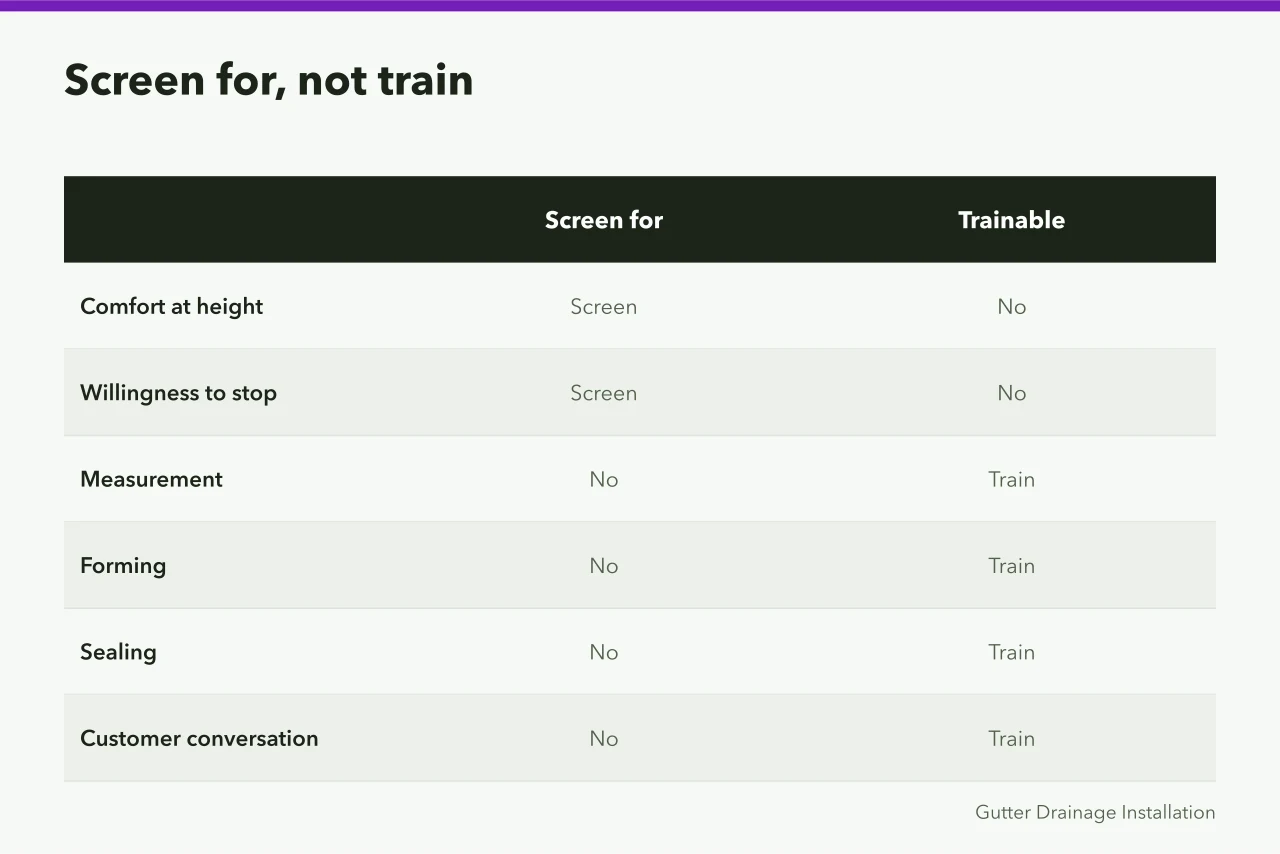
Comfort at height. Not bravado, which is worse than fear. What you want is somebody who is calm on a ladder, moves it rather than reaching from it, and does not need to prove anything. You will learn more from a single supervised session on a low elevation than from any interview question.
Willingness to stop. The person who calls off a job because the wind picked up is the person you want, and companies routinely select against them without noticing. If your process rewards the candidate who says they never let weather slow them down, your process is selecting for your worst incident.
Everything else, including measurement, forming, sealing and customer conversation, is teachable to somebody who wants to learn it.
Where the candidates are
Roofing, siding, painting and general exterior trades share the physical skills and the height tolerance. Landscaping and tree work share the seasonality and the outdoor tolerance. Both pools understand what the calendar looks like, which removes a common source of early departures.
Your own cleaning crews are the best pool of all, which is an argument for having them. Cleaning and repair work needs very little capital, it puts a new person at many properties quickly, and it lets you watch someone on a ladder for weeks before you decide anything.
What you can pay determines who is available, and that is knowable. The Bureau of Labor Statistics publishes occupational employment and wage estimates by area.
Compare your market's rates for related occupations before you decide what to advertise. Advertising below the local rate for equivalent physical work is a slow way to learn the local rate.
The lawful parts of the process
Small employers get this wrong by improvising rather than by intending anything.
Job requirements should describe what the work needs rather than what a candidate looks like, and the same questions should go to everyone. The Equal Employment Opportunity Commission maintains a resource center for small businesses covering hiring practices, what may be asked, and the obligations that attach as a business grows.
The second body of rules arrives with the first paycheck: wage and hour obligations, recordkeeping and required postings. The Department of Labor publishes compliance assistance aimed at new and small businesses, which is the plainest entry point. Read it before payroll runs rather than after a complaint.
One question in this trade deserves professional advice, not a web page: whether a regular helper is an employee or a contractor. The answer depends on the facts. It has real consequences.
Copying a competitor is not a defense. Ask an employment attorney or accountant licensed in your state. The wider compliance calendar this sits on is set out in the licensing and compliance guide.
Training in the order the work happens
Teach it in the sequence the job runs, not in the sequence a manual is organized.
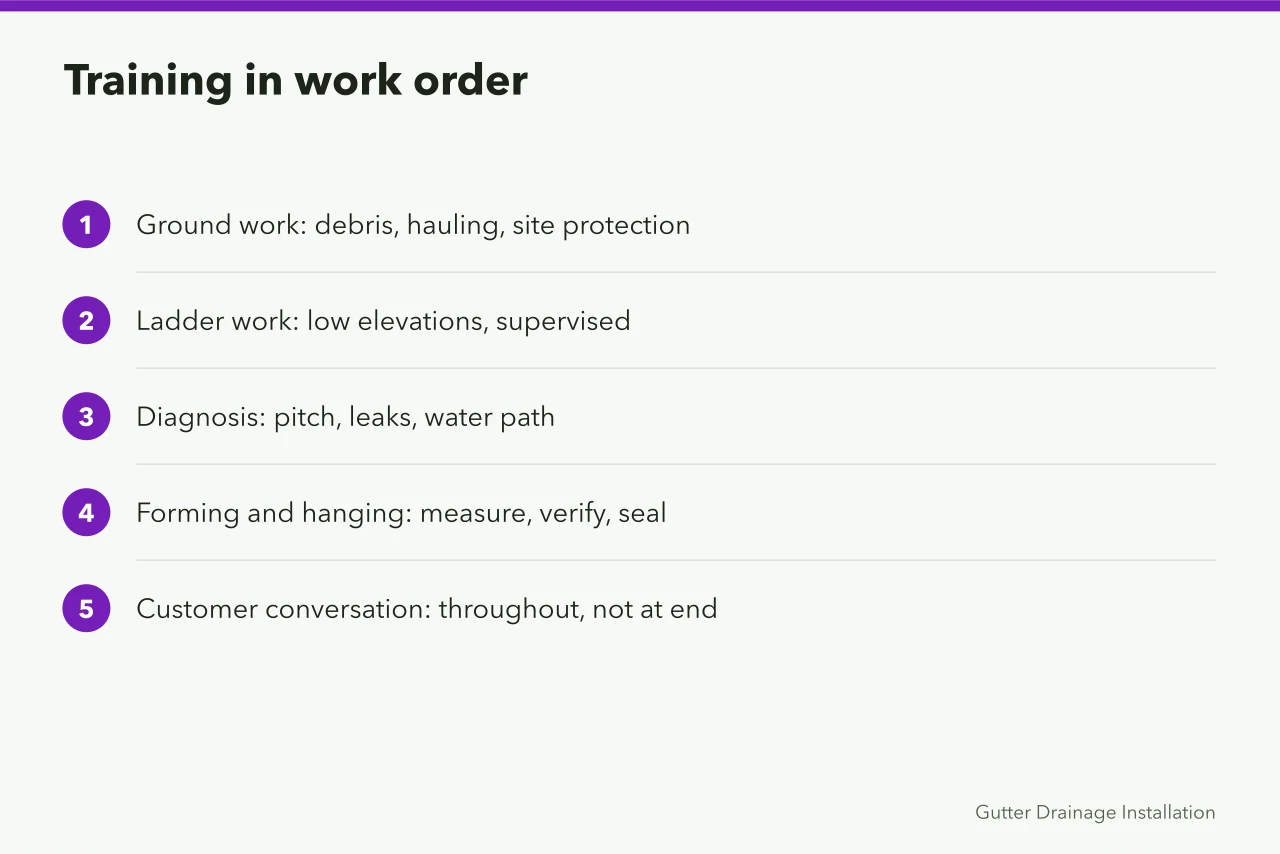
Ground work first. Debris, hauling, site protection, spotting for a ladder, loading and unloading. A new person can be useful on day one doing this, and you can watch them.
Ladder work second, on low elevations, supervised. Setting up on uneven ground, using levelers and standoffs, moving rather than reaching, and the wind and wet rule. This stage should take as long as it takes.
Diagnosis third. What a back-pitched run looks like, why a corner leaks, how to tell an outlet problem from a sizing problem, and how to follow water to its terminal end. This is the stage that turns a laborer into an estimator eventually.
Forming and hanging fourth. Measurement discipline, verification before anything is formed, hanger selection for the fascia in front of them, sealing at miters.
Customer conversation throughout, not at the end. What to say, what not to promise, and when to stop and call the office.
| Stage | What is being taught | How you know it landed | Until it is signed |
|---|---|---|---|
| Ground work | Loading, site protection, debris, spotting | Truck loaded to the list without prompting | Works with the crew, never alone |
| Ladders and access | Setup on uneven ground, moving rather than reaching | Observed repeatedly, unprompted | No solo work at any height |
| Diagnosis | Pitch, outlets, seals, fascia, where water goes | Can demonstrate a fault with a hose | Reports findings, does not decide them |
| Forming and hanging | Measurement, hanger choice, sealing | Verifies before forming, every time | Somebody checks the measurement |
| Customer conversation | What to say, what not to promise | Handover heard and not corrected | Office handles anything technical |
The right-hand column is the part that makes the table a policy rather than a plan. A stage that has not been signed still carries a restriction, and the restriction is what keeps somebody safe while they learn.
The whole thing sits inside a written safety program rather than beside it. OSHA's framework for a safety and health program describes what a small employer builds: management commitment, worker participation, hazard identification, correction of what turns up, and training with records to show for it.
Proving competence
Assumed competence is how people get hurt and how callbacks happen.
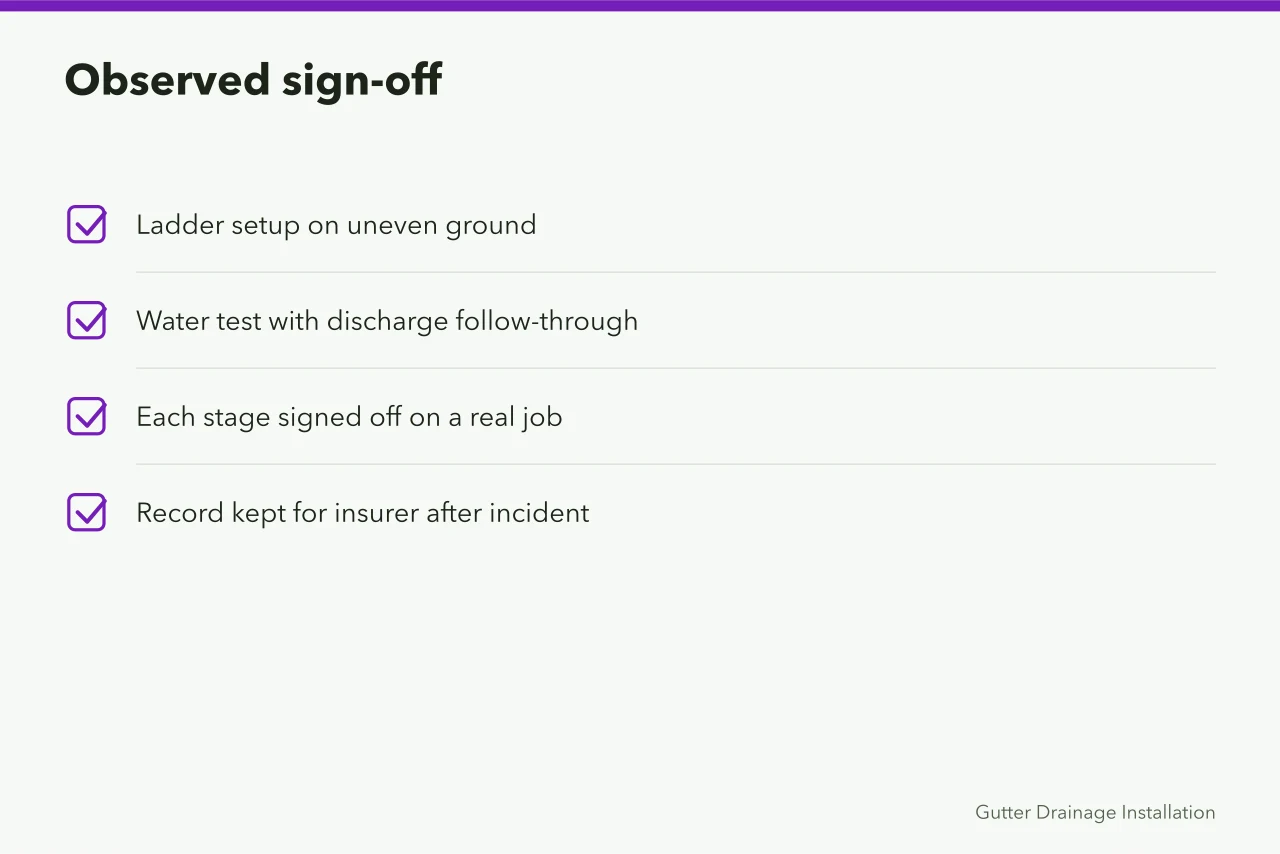
Use a short observed sign-off for each stage. Somebody watches the person do the thing, on a real job, and records that they did. Not a quiz, and not a certificate. The record is what tells you who can be sent where, and it is what an insurer will ask about after an incident.
Two sign-offs matter most: ladder setup on uneven ground, where severe risk lies, and the water test with discharge follow-through.
That check prevents the trade's most common complaint and is the first thing dropped by someone who does not understand why it exists. Physical detail is in the quality assurance guide.
Pay structure, and what it quietly buys
This is the part owners think is a finance question and is actually a safety and quality question.
Paying by the job rewards speed at the exact moments where speed is dangerous: reaching from a ladder rather than moving it, skipping the water test, leaving before the discharge is confirmed. You can write a stop-work policy on top of that structure and it will not be used, because using it costs the worker money.
Whatever structure you choose, make sure stopping is free to the person who stops. Put the checks you care about inside paid time.
That means the checks must be in the price. This links the pricing and profit guide to this article. It also means the scope you sell must be deliverable by your actual crew. That is why the packages and pricing guide belongs in this conversation.
Retention over a season
This trade loses people to two things: the winter gap and the third bad week in a row.
The winter gap is structural. A company that only sells installation has nothing for a crew in the quiet months, and a crew with nothing to do finds other work and does not come back. Cleaning, repair and discharge work is the answer, and it is the same argument that makes those services worth carrying commercially.
The third bad week is manageable. Weather, equipment failure and a run of difficult properties compound, and people leave in the middle of it rather than at the end. Equipment reliability is a retention factor for exactly this reason, which is one of the less obvious arguments in the equipment and setup guide.
Retention also compounds commercially. A crew that has worked a market for two seasons knows which streets have mature canopy, which houses have back-pitched runs, and which owners answer the phone. That is a map you cannot buy, and it is part of why market choice and staffing interact, as set out in the startup and market guide.
Common questions
How many people should the first crew be?
Two, for almost all installation work, because ladder work with nobody else present is a different risk profile. Cleaning can be done alone, and even then somebody should know where the person is.
Should I hire experienced people or train from nothing?
Both work. Experienced hires arrive with habits, some of which you will have to undo. People trained from nothing take longer and end up doing it your way, which matters more than it sounds when your way includes the water test.
How long before someone works alone?
Until the sign-offs are complete, which is a competence question rather than a calendar one. Anyone who cannot be told apart from a competent person in your presence still needs to be observed away from it.
What do I do in the slow season?
Sell the services that fill it, and use the quiet weeks for training that cannot be done in the peak. Training in October does not happen.
What is the most expensive hiring mistake?
Putting somebody on a roof edge before you have watched them on a low one. Everything else can be corrected.