Guides
6 answers on profitable gutter service packages, in order
Six gutter service packages ranked by contribution per crew hour, from dense-route cleaning to full replacement, with the inputs that move each one.
What to take away
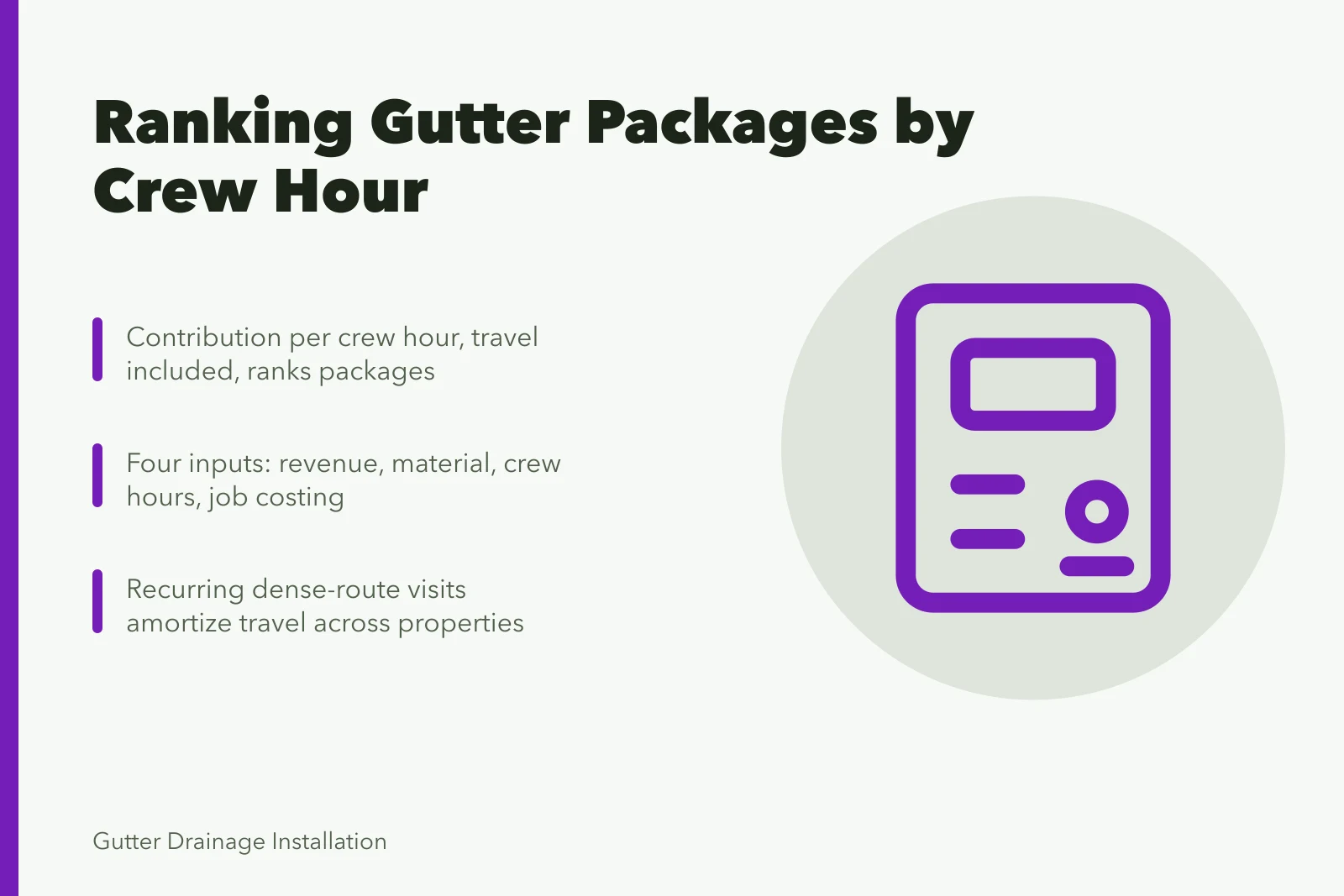
- Contribution per crew hour, travel included, is the only measure that ranks gutter service packages honestly. Revenue ranks big jobs first; margin percentage ranks whatever uses the least material.
- The six packages below are ranked on that measure for a typical two-crew company working dense suburban routes. Your order will differ, and the arithmetic to re-rank it sits further down.
- Three inputs decide the order: crew hours recorded honestly, return visits attributed to the original job, and material costed consistently rather than precisely.
- Most packages that rank badly do so because of an undefined boundary, not a bad price. Fix the definition before you retire the package.
- No package is profitable if it promises work above your access limit. Fall protection duties sit with the employer, and the authority is OSHA or your provincial regulator.
Six profitable gutter service packages, ranked in order
Contribution per crew hour is revenue minus material and direct labor, divided by every hour the job consumed. Travel, setup, teardown and return visits all count.
Revenue puts full replacement first every time. Margin percentage puts a hanger swap first. Neither tells you what to sell next week, because neither counts the hours you cannot buy more of in a short season.
Ranked below for a two-crew company on dense suburban routes:
- Recurring cleaning contracts on a dense route. Highest contribution per hour when four or more properties sit within a short drive. Travel spreads across the day and material is close to zero. A two-story clean typically bills $250 to $500, and six homes on one street become a single fuel bill. On a sparse rural route the same package ranks last.
- Repair and re-hang work. Short visits, low material, and the customer has already decided to spend. A re-hang with new hangers and sealant usually bills $150 to $400 and takes under two hours. It falls when diagnosis outruns the fix, which happens most on older homes with failing hangers.
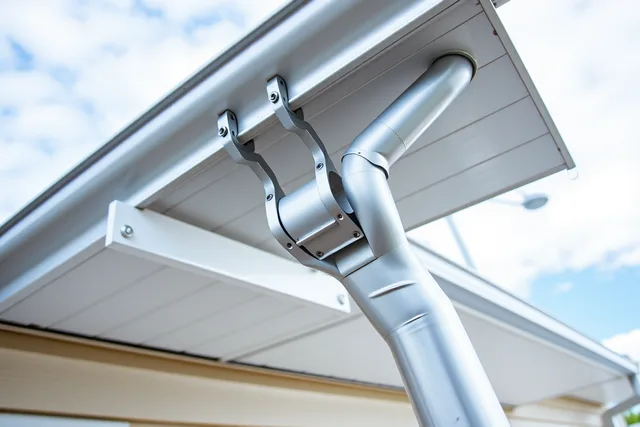
- Downspout and discharge work. Solves the problem customers actually call about, and few competitors quote it as a standalone package. Clearing and resealing a downspout typically bills $100 to $250 as an add-on. Buried lines turn it into an excavation, so price the visible portion and quote the buried run separately.
- Gutter guard installation. LeafFilter's stainless micromesh, GutterGlove's Pro line and Amerimax's snap-in screens sold at Home Depot sit at three price points. Installed guard typically runs $8 to $30 per linear foot. Footage that takes a day on a straight single-story run can take two days on a steep, three-story roof.
- Seasonal cleaning with a documented before-and-after. Bills above a plain clean, typically $50 to $100 more, and the photo record cuts callbacks. The extra time sits in the documentation, so it ranks well only when the crew photographs as they work. Jobber and Housecall Pro attach photos to the job record, with entry plans typically $40 to $80 per user monthly as of 2026.
- Full replacement installation. The largest invoice and usually not the highest contribution per hour. Roll-formed aluminum gutters installed on site typically run $4 to $10 per linear foot, and copper sits far above that. A 200-foot job prices near $1,200 to $2,000 before downspouts. Long hours, weather risk, and a remeasure costs a whole trip with the trailer.
That order is a hypothesis about your routes, not a conclusion about your business.
The four inputs that set the order
- Revenue per job, by package. Possible if your invoicing separates packages, impossible if it does not. That is the first fix, and it is an invoicing change rather than a software project.
- Material consumed per job. Coil, hangers, fasteners, sealant and outlets top the list, with elbows, straps and extensions behind them. Estimate consistently rather than precisely; the ranking survives approximation but not inconsistency.
- Crew hours per job, honestly. Leave time, arrive time, working time, return time. Owners record only working time, which flatters the driving-heavy packages. The IRS explains what records a business is expected to keep, and most of these inputs fall out of that discipline. The hours do not, and they must come from the crew without making people feel watched.
- Return visits, with causes. A missing part, a remeasure, a callback about water. Attribute the hours to the original job, or a package that generates one return in five will look better than it is.
Run the measure across a full season. A single month ranks whatever the weather allowed you to sell.
Three leaks that hide inside a package
Undefined inclusion language. "Minor repairs included" converts a profitable agreement into unpaid work when nobody has defined minor. Define it by time, by materials, or by a named task list.
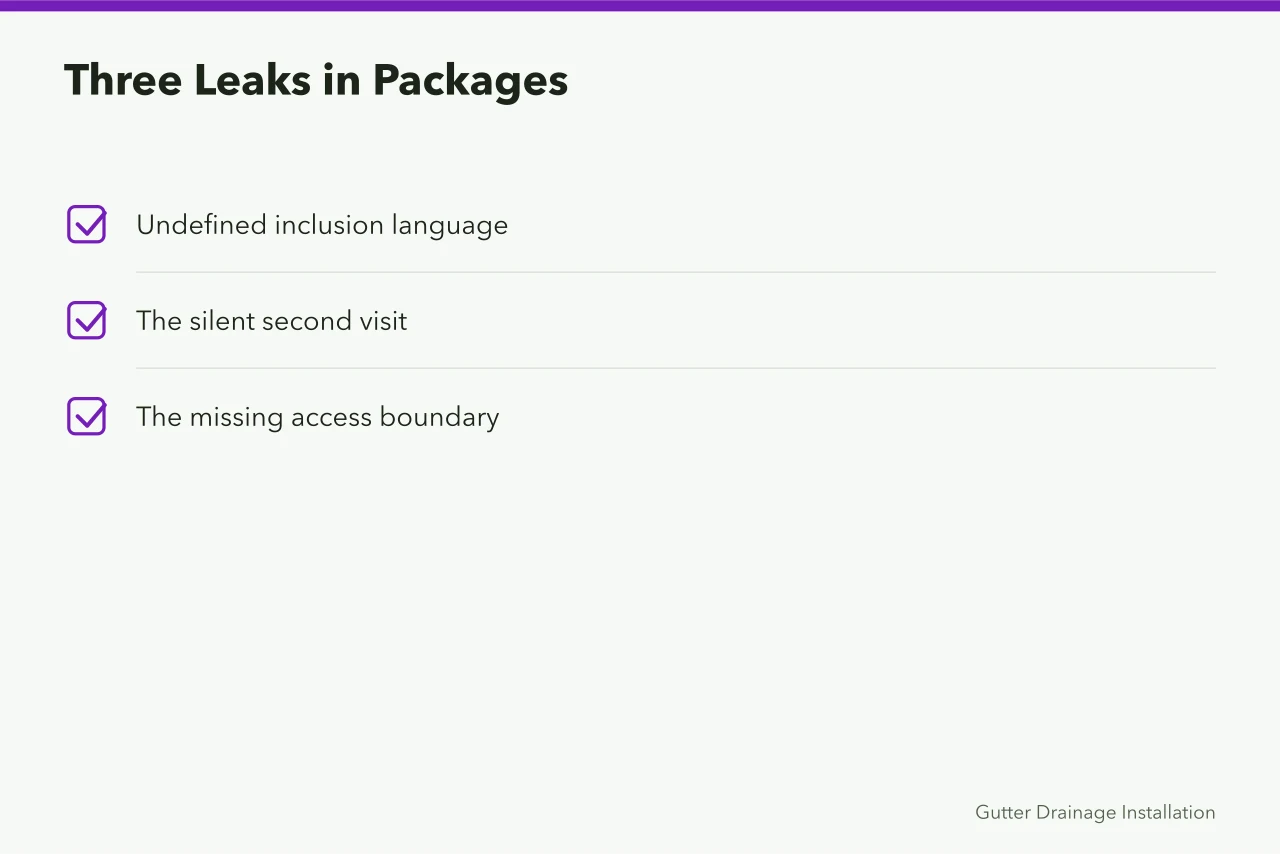
The silent second visit. Cleaning customers often assume one is included. If it is not, say so. If it is, price it. Either is fine; the assumption is not.
The missing access boundary. Two properties with identical run lengths can differ by hours, so a package that does not state its assumed access class gets sold at the wrong price by whoever answers the phone. The structural fix is in the packages and pricing guide.
A fourth leak ends differently. When a package promises work above your stated access limit, no price makes it good. Severe exposure in this trade sits at the roof edge, and OSHA's guidance on fall protection in residential construction puts site-specific controls on the employer.
In Canada, WorkSafeBC, CNESST or your provincial regulator sets the equivalent duty.
This article gives no working-at-height instruction; get certified training and follow the applicable code.
What moves the order without touching price
Crew capability changes hours per job faster than any pricing decision, which is why hiring and training belongs inside a profitability review rather than beside it.
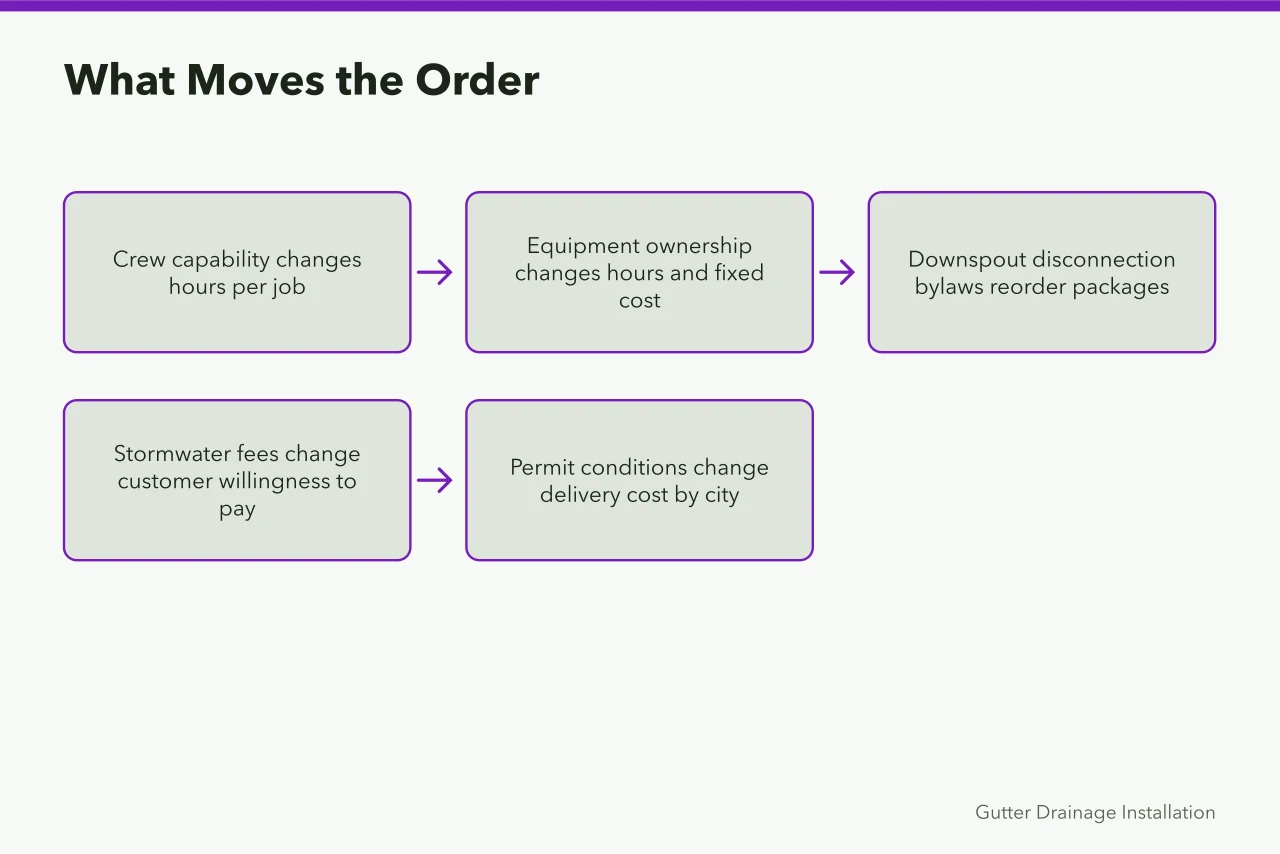
Equipment ownership changes both the hours and the fixed cost those hours must carry. A second story pole, a leaf blower attachment or a vacuum head such as Spinaclean's SkyVac cut cleaning time on the same route.
A standoff stabilizer from Ladder-Max makes the second story quicker to reach. The arithmetic for buying them twice is in the equipment and setup guide.
Two outside factors can reorder the list on their own. Downspout disconnection bylaws in Toronto, Vancouver and Montreal change what a discharge package may connect to, and stormwater fees change what the customer will pay to avoid.
Separately, a permit or registration condition can make one package materially more expensive to deliver in one city than the next.
Check what applies where you work in the licensing and compliance guide before building a growth plan around a package that is cheap only where you started.
Promoting the winner without creating refunds
A headline or starting price must be genuinely available on terms a reader understands. The Federal Trade Commission's advertising guidance for small businesses sets out the general expectation.
A package that ranks well only because its advertising implies more than its definition delivers is not profitable. It is a deferred refund.
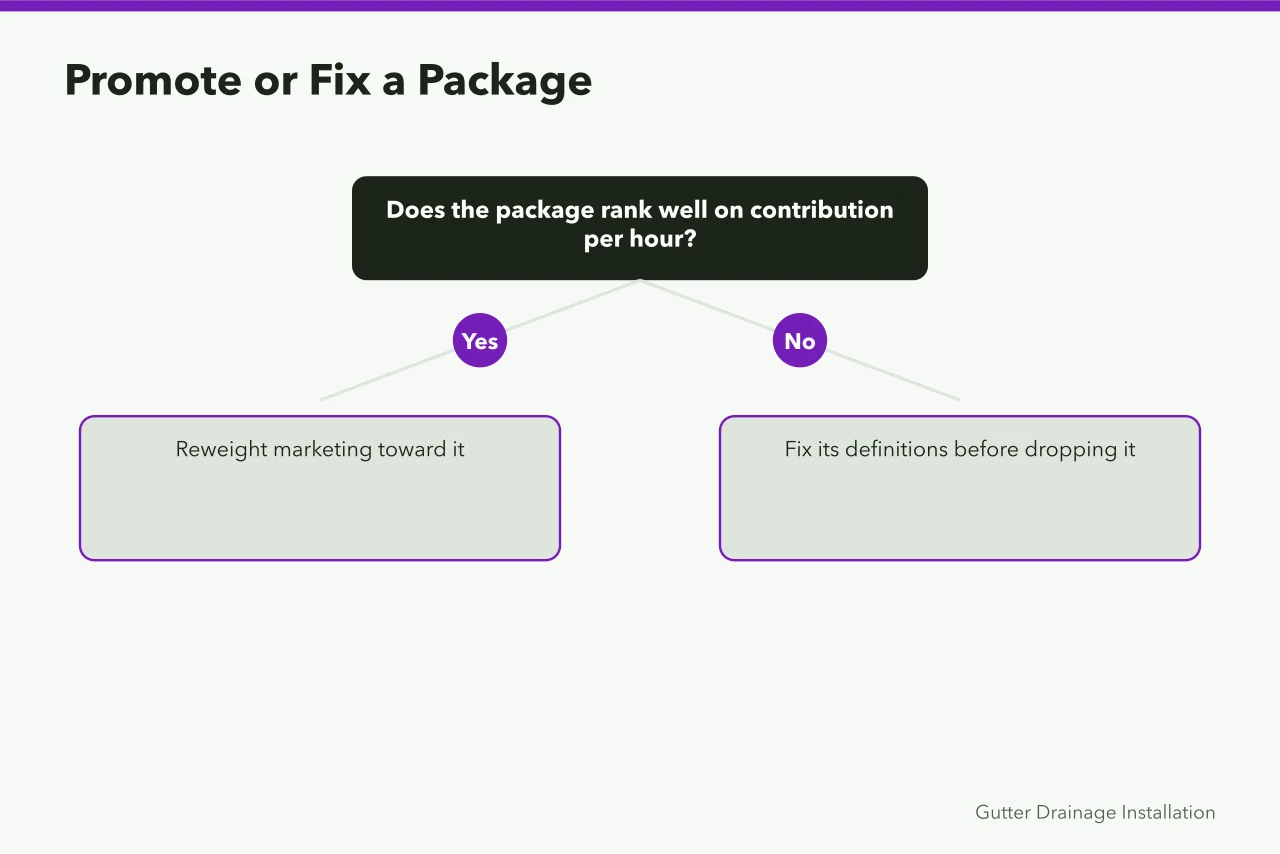
Reweight marketing toward what ranks well, which is a positioning decision covered in the marketing and growth guide. Fix the definitions of badly ranking packages before dropping them, because most rank badly for a definition reason. Only then consider retiring anything.
Common questions
Why not just use gross margin?
Because it ignores time. A package with excellent margin that consumes a whole day is worse, in a short season, than two shorter jobs with lower margin. Contribution per crew hour counts the hours you are actually short of.
How long a period do I need?
A full season. A month ranks whatever the weather allowed you to do, which usually means installation in a dry spell and nothing else. Seasonality will otherwise decide your rankings for you.
What if I cannot separate revenue by package?
Then that is the first fix, and it is an invoicing change rather than a systems project. Without it, none of the four inputs can be assembled and nothing here can be measured.
Does this apply to a one-person business?
More so. With one crew, every hour on a lower-contribution package is an hour unavailable for a better one, and there is no second truck to absorb the mistake.