Guides
Reviewing gutter service packages: strengths, gaps and a verdict
Jobber, Housecall Pro, Thumbtack and Angi sell gutter work in packages that look alike on a quote yet cover very different scope, pricing and support.
What to take away
- Reviewing gutter service packages means naming each one, then weighing its strengths, gaps and verdict. Software packages come from Jobber and Housecall Pro. Lead packages come from Thumbtack, Angi and Google Local Services Ads, and guard packages from LeafFilter and LeafGuard.
- Jobber and Housecall Pro are software subscriptions. The package is what a contractor builds inside them, so the quote reflects that scope, not the vendor's.
- Thumbtack and Angi sell the same request to several pros at once. Google Local Services Ads does the same behind a Google Guaranteed badge.
- LeafFilter and LeafGuard each sell one guard system, quoted per linear foot after an in-home assessment, with a national company behind the warranty.
- The verdict: sell a named clearing package and a named replacement package, both built in Jobber or Housecall Pro, and buy leads only to fill gaps in the calendar.
- Three lines make any two quotes comparable: where each downspout discharges, what was found at the fascia, and what is excluded.
The named gutter packages customers compare
A homeowner asking for gutter cleaning quotes is comparing four or five things, and only two of them are packages in any real sense.
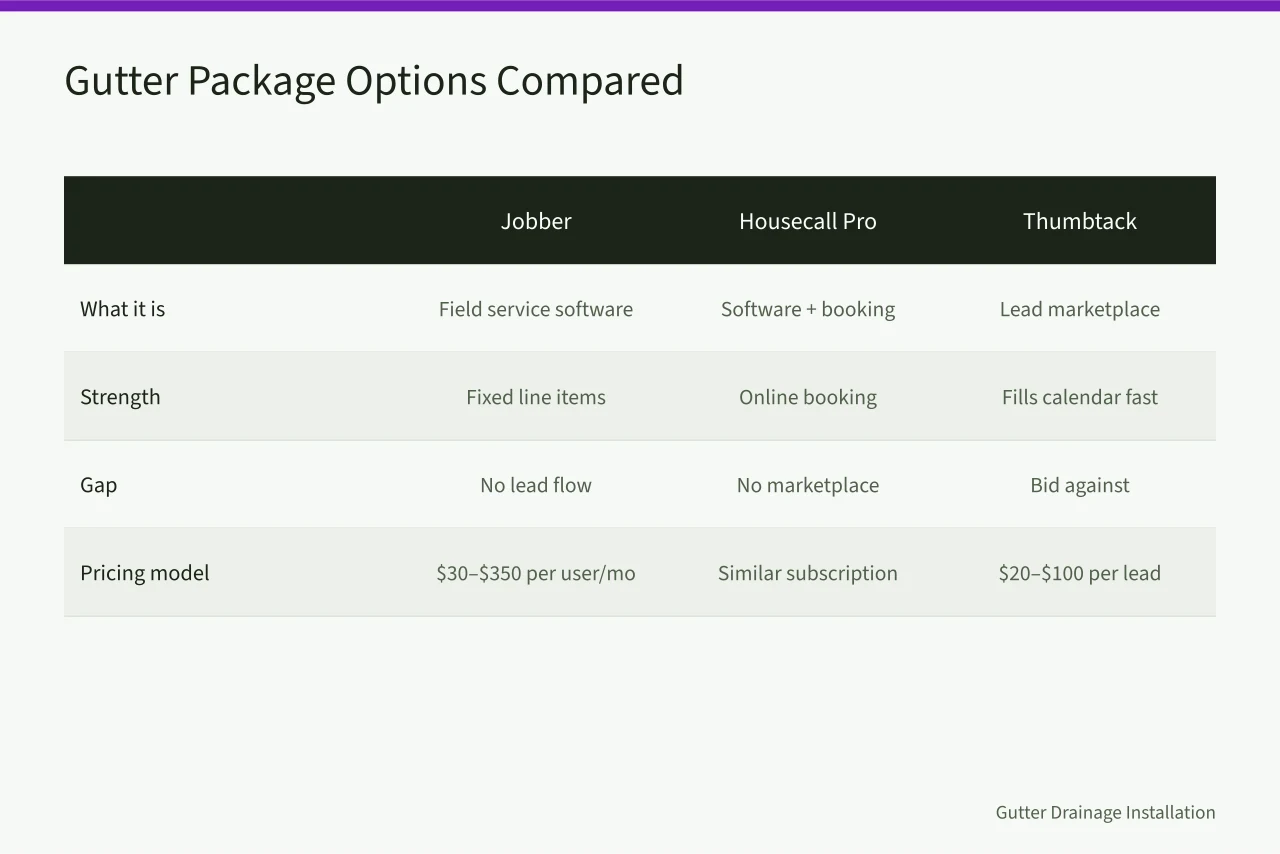
The first is a software-built package. Jobber sells Core, Connect and Grow. Housecall Pro sells Basic, Essentials and MAX. Both price per user per month, typically $30 to $350 as of 2026, cheaper on annual billing. Inside them a contractor assembles fixed line items: clearing, flush, haul-away, a condition report and a guard install.
The second is a lead-marketplace bid. Thumbtack, Angi and Google Local Services Ads send one request to several contractors. The customer sees a range of prices and no scope. The lowest number usually wins, and the lowest number usually carries the smallest scope. Leads commonly cost $20 to $100 each, set by market and job category.
The third is a dealer program. LeafFilter sells a micromesh guard, installed by its own crews, quoted per linear foot after an in-home assessment. LeafGuard sells a one-piece reverse-curve guard the same way. Both attach a lifetime no-clog claim and a national warranty. Typical quotes land between $15 and $50 per linear foot in most markets.
The fourth is a hand-written quote from a local company. It may be excellent. It is also the one most likely to omit the discharge terminal, which is where most complaints start.
Strengths and gaps of the seven named packages
| Option | What it is | Strength | Gap | Who it suits | Pricing model |
|---|---|---|---|---|---|
| Jobber (Core, Connect, Grow) | Field service software for quoting, scheduling and invoicing | Fixed line items let you sell a named package with a written scope | No lead flow, so the customer arrives through your own marketing | Contractors who want to sell named packages with fixed line items | Subscription per user per month, typically $30 to $350 |
| Housecall Pro (Basic, Essentials, MAX) | Same core plus a consumer booking page | Customers can book a package online at the listed price | Same subscription spend without a marketplace behind it | Contractors whose customers search by company name | Subscription per user per month, similar range |
| Thumbtack (leads, including Instant Match) | Lead marketplace that sends a request to several pros | Fills an empty calendar within days | You bid against three or four competitors who never saw the scope | Newer companies filling an empty calendar | Pay per lead, typically $20 to $100 by market and category |
| Angi (Angi Leads, Angi Ads) | Leads plus a directory profile | Reviews and a profile sit alongside the leads | You pay per lead whether or not the job closes | Companies that want reviews and a profile alongside leads | Pay per lead, plus optional profile upgrades |
| Google Local Services Ads | Pay-per-lead ads above search results with a Google Guaranteed badge | The badge requires license, insurance and background checks | Your budget caps volume, and categories fill with competitors | Established companies with reviews and insurance on file | Pay per lead, weekly budget set by the advertiser |
| LeafFilter | Installed micromesh guard system sold and warrantied by the company | A lifetime warranty that transfers with the home, backed nationally | Price is set in the home, and the no-clog claim depends on the warranty terms | Homeowners who want a guard system and a transferable warranty | Quoted per linear foot after an in-home assessment, typically $15 to $40 |
| LeafGuard | One-piece reverse-curve guard, installed by the company | One profile covers trough and guard, under a clean-it-free guarantee | One dealer network, with a narrow color and profile range | Homeowners replacing the trough and guard together | Quoted per linear foot after an in-home assessment, typically $20 to $50 |
The two software products are where a gutter company builds its own packages. The three lead sources are where it competes on price for work it did not scope. The two guard brands are the only entries here that are packages in the sense the title means.
The verdict
Sell two named packages, both built in Jobber or Housecall Pro, and buy leads only to fill gaps.
Jobber or Housecall Pro. Pick one and build inside it. Jobber suits a company that already generates its own leads. Housecall Pro suits one whose customers book by name online.
Thumbtack and Angi. Buy leads when the calendar is thin. Let the marketplace set demand, never scope, because that customer arrives trained to compare totals.
Google Local Services Ads. The most defensible paid lead of the three, since the badge requires a verified license, insurance and a background check.
LeafFilter and LeafGuard. Worth knowing as competitors, not as models to copy. Their pricing comes from an in-home assessment and their warranty is backed by a national company. A local contractor cannot match the warranty and should not pretend to.
The first package to sell is a recurring clearing visit with a written condition report. That report generates the repair and replacement work later, and it separates a real gutter company from a crew with a ladder.
The second is a full replacement sized from the contributing roof area and the local rainfall intensity, using the manufacturer's tables and whatever your building department has adopted. That package fixes a system that never worked.
Where the comparison goes wrong
| What the customer compares | What actually differs | How to check |
|---|---|---|
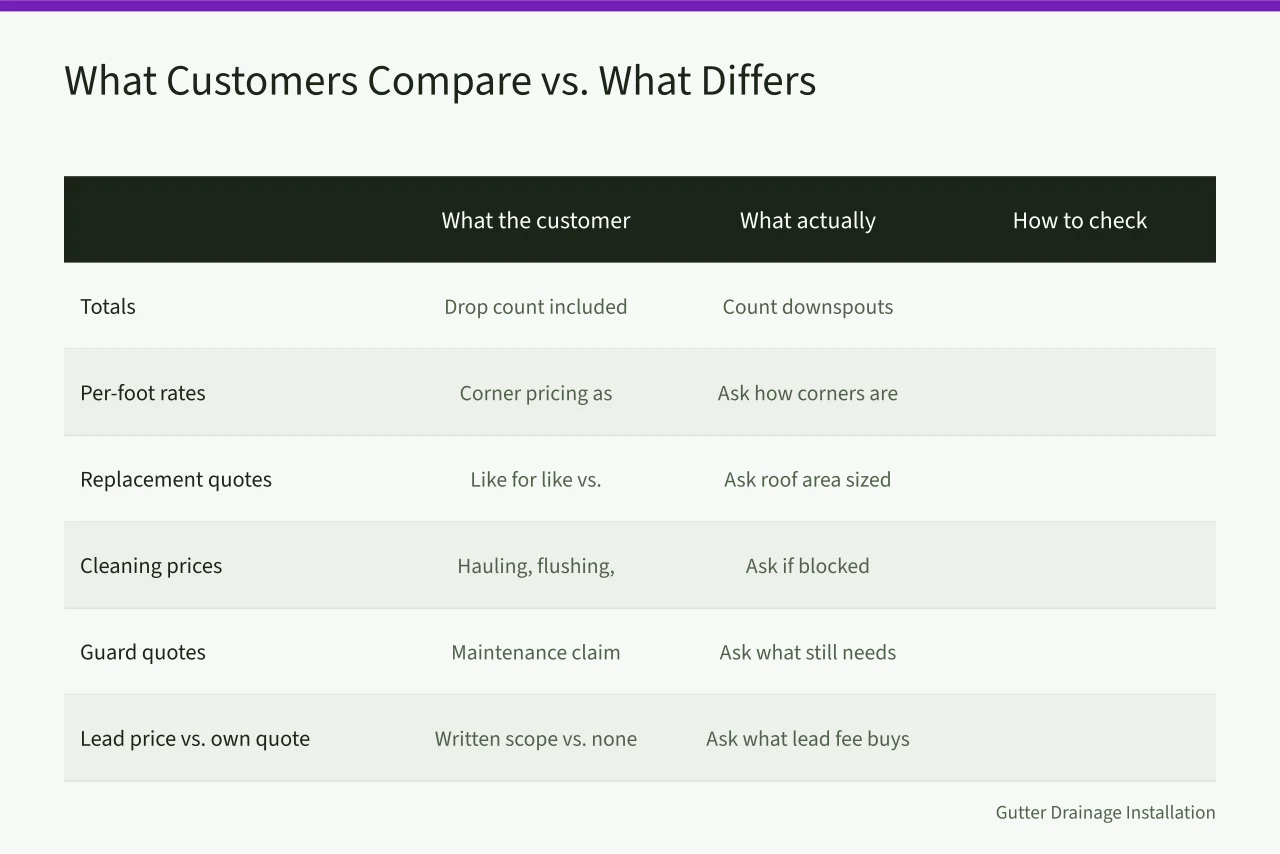
| Two totals | Drop count included | Count the downspouts each quote lists |
| Two per-foot rates | Whether corners are priced as labor | Ask how corners are handled |
| Two replacement quotes | Like for like against a resized system | Ask what roof area each was sized from |
| Two cleaning prices | Hauling, flushing, second visit | Ask what happens if it is blocked underground |
| Two guard quotes | The maintenance claim attached | Ask what still needs clearing and how often |
| A Thumbtack or Angi lead price against your own quote | A written scope against none at all | Ask what the lead fee buys the customer |
| A LeafFilter or LeafGuard quote against a local one | The warranty behind the claim | Ask who honors the warranty in year ten |
The last row decides most guard comparisons. A national brand can honor a warranty from a head office. A local contractor honors it personally, which works while the company is trading and fails when it is not.
What any package has to answer in writing
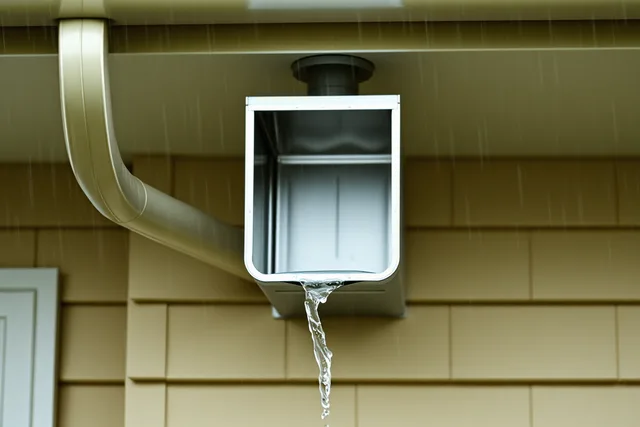
Where does each downspout discharge, and onto or into what? Most complaints attributed to gutters are complaints about the discharge end.
What was found at the fascia, and what happens to the price if more turns up once the old system is off? Soft board is common and not fully assessable from the ground.
What is excluded? Roof edge materials, buried line alteration, grading, permit fees and anything above the company's stated access limit.
Those three lines make two quotes comparable. Everything else is presentation. The reasoning behind them is in the packages and pricing guide, and the way to build an option set a customer can decide between is in how to structure packages for customers.
Two packages worth refusing
Any package that reaches above your stated access limit. A customer who pays more for higher elevation is offering to move your risk onto your crew.
This trade's severe exposure sits at the roof edge. OSHA's guidance on fall protection in residential construction places responsibility for site-specific controls on the employer.
Any package sold as maintenance free. If a headline claim cannot be supported on terms a reader would understand, it is a problem before it is a marketing decision. The Federal Trade Commission's advertising guidance for small businesses sets out the general expectation.
Which packages to actually sell
Your own records answer that, not a list. Rank your packages by contribution per crew hour with travel counted, using the method in the most profitable packages piece, and the IRS guidance on business records covers the file that ranking runs on.
Two constraints narrow the list before profitability does. A full replacement needs a formed run made on site, so the coil, machine and crew travel as one unit. See the equipment and setup guide for the scheduling consequences.
A clearing visit with a flush and a discharge extension is completable in one trip only if the truck carries the parts. That is what the equipment checklist exists to prevent you from learning the hard way.
Common questions
Why do two gutter quotes for the same house differ by so much?
Because one is a clearing visit and the other is a replacement, or because one counts four downspouts and the other counts two. Once both quotes are named as packages, the gap usually has an explanation.
Is a lead marketplace package worse than one I build myself?
It is unscoped rather than worse. The customer sees a price and no specification, so the lowest bidder wins and the scope shrinks to match. A package you build in Jobber or Housecall Pro carries its own scope in writing.
Should I offer a guard package?
Only if you can state honestly what still needs clearing and how often. Guards block large debris and do not end maintenance. The distance between those two sentences is where the complaints come from.
How do I compare a LeafFilter quote against my own?
Ask what linear footage was measured, what the warranty covers in year ten, and who honors it. Then price the same footage as a replacement plus a guard install and compare the two scopes, not the two totals.