Guides
Choosing gutter service software: reviews and verdicts
Jobber, ServiceTitan, Housecall Pro, Workiz and FieldPulse run gutter crews, and the verdict depends on how you bill and how many trucks you run.
What to take away
- Five gutter service software products run real crews: Jobber, Housecall Pro, Workiz, FieldPulse and ServiceTitan. All five schedule gutter work, invoice it and store job photos. None of them knows what a formed run is.
- Jobber and Housecall Pro suit one to five trucks. Workiz and FieldPulse sit in the same band with stronger dispatch and call handling. ServiceTitan is built for larger operations and priced accordingly.
- All five charge by the month, so the bill scales with seats and tiers rather than revenue. Entry plans typically run $30 to $100 per user or plan as of 2026; full dispatch tiers run $130 to $350.
- The decision for a gutter contractor turns on two things no demo shows: whether a crew captures hours door to door, and whether you can export everything the day you leave.
- Run any trial in a quiet period, on real jobs, long enough to include a return visit and a month-end.
Reviews and verdicts: Jobber, Housecall Pro, Workiz, FieldPulse and ServiceTitan
Jobber is the default for small trades in Canada and the United States. Quoting, scheduling, invoicing and payments sit in one app, and it handles GST/HST lines without a workaround. It suits a one to five truck gutter operation that wants to stop running the business from a phone's notes app.
Verdict: the easiest of the five to start on. Pricing is per month by tier, with a cheaper tier that caps users and a fuller tier that adds marketing and a client hub. Listed rates as of 2026 run about $30 to $250 a month depending on tier and seats.
Housecall Pro leans toward home services that take bookings from homeowners. Its scheduling board and its review and follow-up tools are the reason to pick it. It fits a gutter company that also cleans and repairs, where the office books work while crews are out.
Verdict: the best of the five for an office that lives in the calendar and the review queue. Pricing is per month, with add-ons priced separately. Typical plans as of 2026 run about $80 to $350.
Workiz handles dispatch and inbound calls better than most at its size, including call tracking that ties a phone number to a job. It suits a shop where the phone rings all day and someone has to route calls to crews.
Verdict: pick it over Jobber when the phone is the bottleneck. Pricing is per user per month, typically $70 to $230 as of 2026, with the phone features on higher tiers.
FieldPulse is the one to look at if you also do service work beyond gutters, because it handles maintenance agreements and recurring visits. It fits a company selling annual cleanings, where the same address returns to the schedule every year.
Verdict: the strongest of the five for recurring agreements. Pricing is per user per month, typically in the same $70 to $230 band as Workiz, and the rate drops as seats are added.
ServiceTitan is the heavy option. It models dispatch, payroll, inventory and reporting in depth, and it is priced and implemented like the enterprise tool it is. It suits a multi-crew operation with an office manager who will own the system.
Verdict: the deepest reporting and the longest setup. Expect a quote, an onboarding process that typically runs into the thousands of dollars, a per-technician monthly rate of a few hundred dollars as of 2026, and a contract, not a card charge.
Two more worth a look: ServiceM8 for Apple-first crews, and Kickserv for a low-cost start. Both schedule and invoice, and both publish entry plans under $100 a month as of 2026. Neither was built with gutter fabrication in mind.
Every rate above is a published list price, and vendors move them. Tier, seat count, plan length, payment processing fees and phone add-ons are what shift the number. Confirm current pricing on the vendor's page before you sign.
What none of them model
A formed run is made on site, with the machine, coil and crew traveling as one unit. No mainstream field service product schedules that natively.
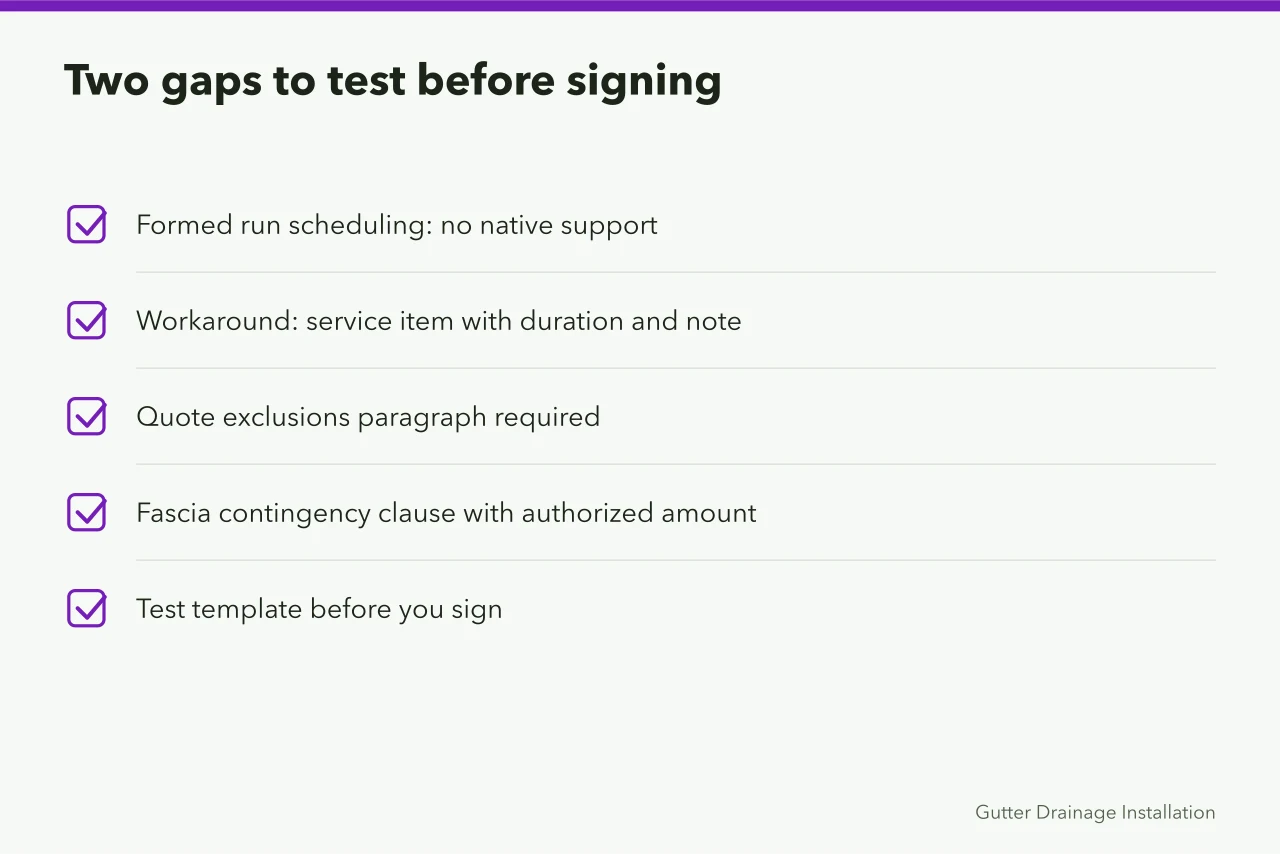
The workaround is a service item with a duration and a note about color changes and trailer logistics. It is clumsy, and it is what most gutter companies do. The scheduling problem is set out in the equipment and setup guide.
The second gap is the quote. A gutter quote needs an exclusions paragraph and a fascia contingency clause with an authorized amount. Some products hold those in a template, some do not. Test that before you sign.
The twelve tests
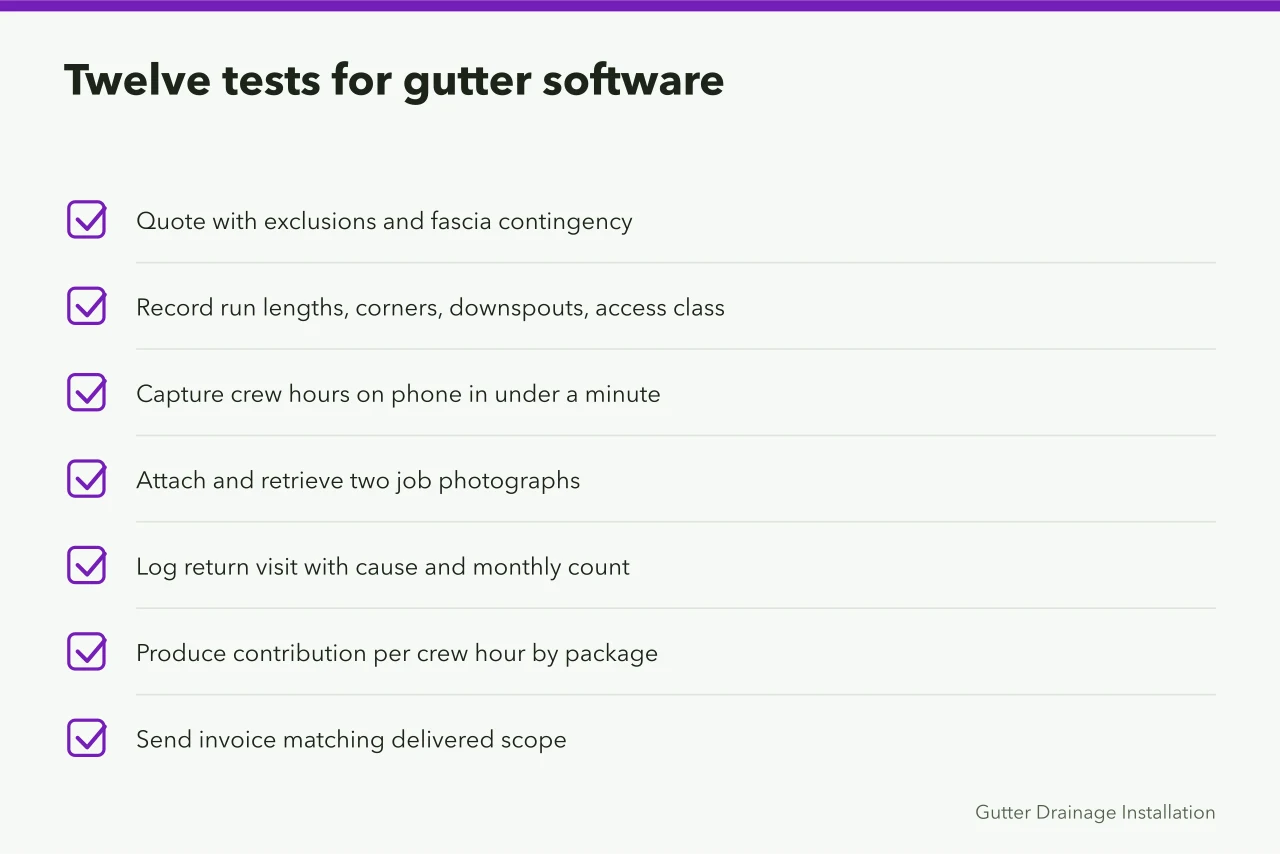
- Create a quote that contains an exclusions paragraph and a fascia contingency clause with an authorized amount. If the template cannot hold them, it cannot prevent this trade's disputes.
- Record a job's quantities: run lengths, corner count, downspout count and each terminal point, plus an access class. See whether they survive as structured fields or become a note.
- Capture crew hours from leaving the yard to returning, including travel, on a phone, with wet hands, in under a minute.
- Attach two photographs to a job, the fascia before work and the finished discharge terminal, then find them again a week later without knowing the customer name.
- Log a return visit against the original job with a cause, then produce a count of causes across a month.
- Produce contribution per crew hour by package. If the system cannot separate revenue by package, it cannot rank your services.
- Send an invoice that matches the delivered scope, including work that was declined, and see how much retyping that took.
- Hand the app to your least technical crew member with no training and watch what they do.
- Export everything. Not a report, everything, in a format you can open outside the system.
- Add a second user with their own login and restrict what they can see. Shared logins are the most common security failure in small companies.
- Turn on multi-factor authentication and check it applies to everyone, including the owner.
- Take a phone offline in a basement or a rural driveway and see what the app does with the job you were entering.
Tests three and nine carry the most weight. Hours captured door to door are the foundation of every pricing decision you will make, and export decides whether leaving costs you a week or a year.
Test eight is the one owners skip and regret. Software a crew will not use produces confident, wrong data, which is worse than an honest gap.
Test twelve matters more in this trade than in most, because crews spend time beside houses, behind them and in the wrong part of a service area for signal.
Running a trial that tells you something
Run it in a quiet period, on real jobs, for long enough to include a return visit and a month-end.
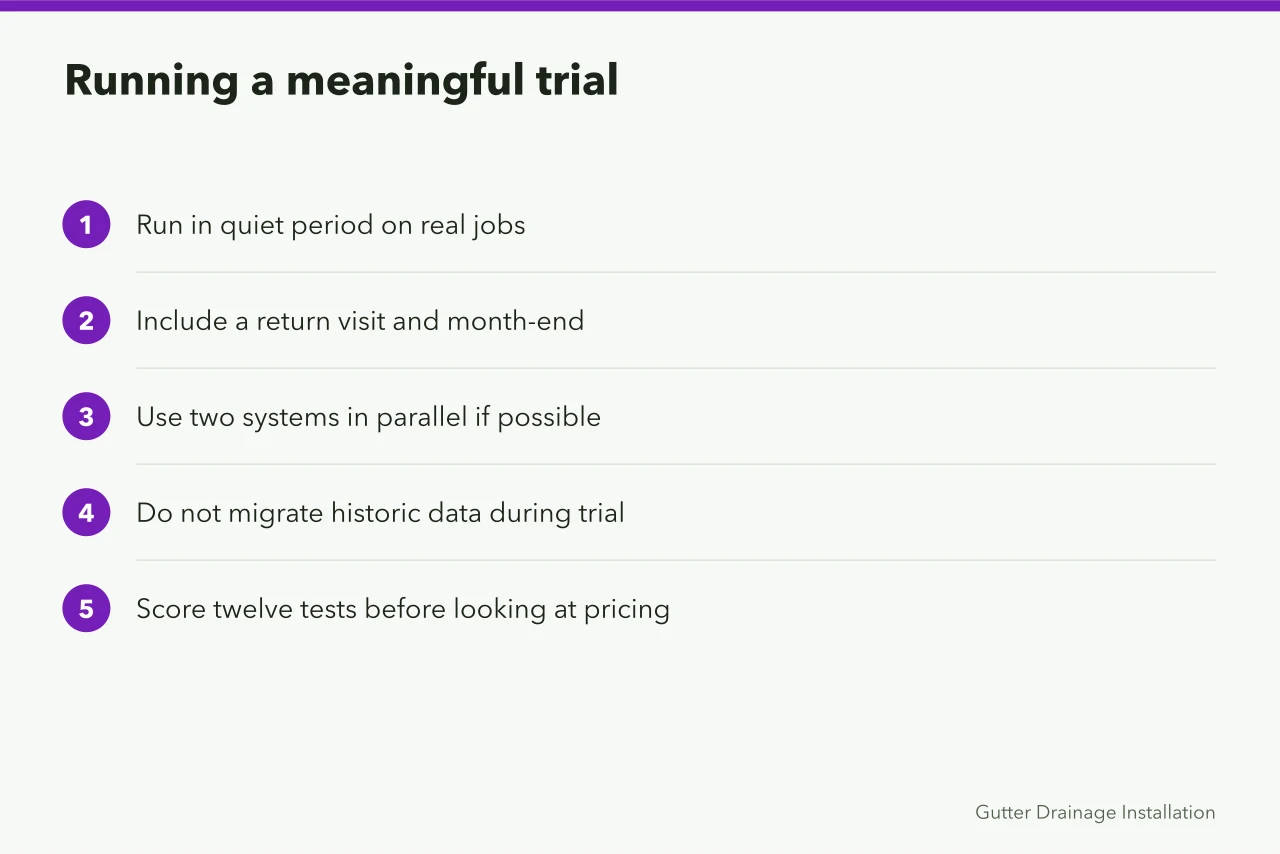
Use two systems in parallel if you can bear it, with the same jobs entered in both. Painful, and the only way to see which one your crews reach for.
Do not migrate historic data during a trial. Move a handful of jobs, evaluate, and only migrate when you have decided. Migrating twice is how a season of hours gets lost, and those hours are what your rate card is built on.
Score the twelve tests before you look at pricing. Price after a fair comparison is a decision; price before one is an anchor.
The questions vendors avoid
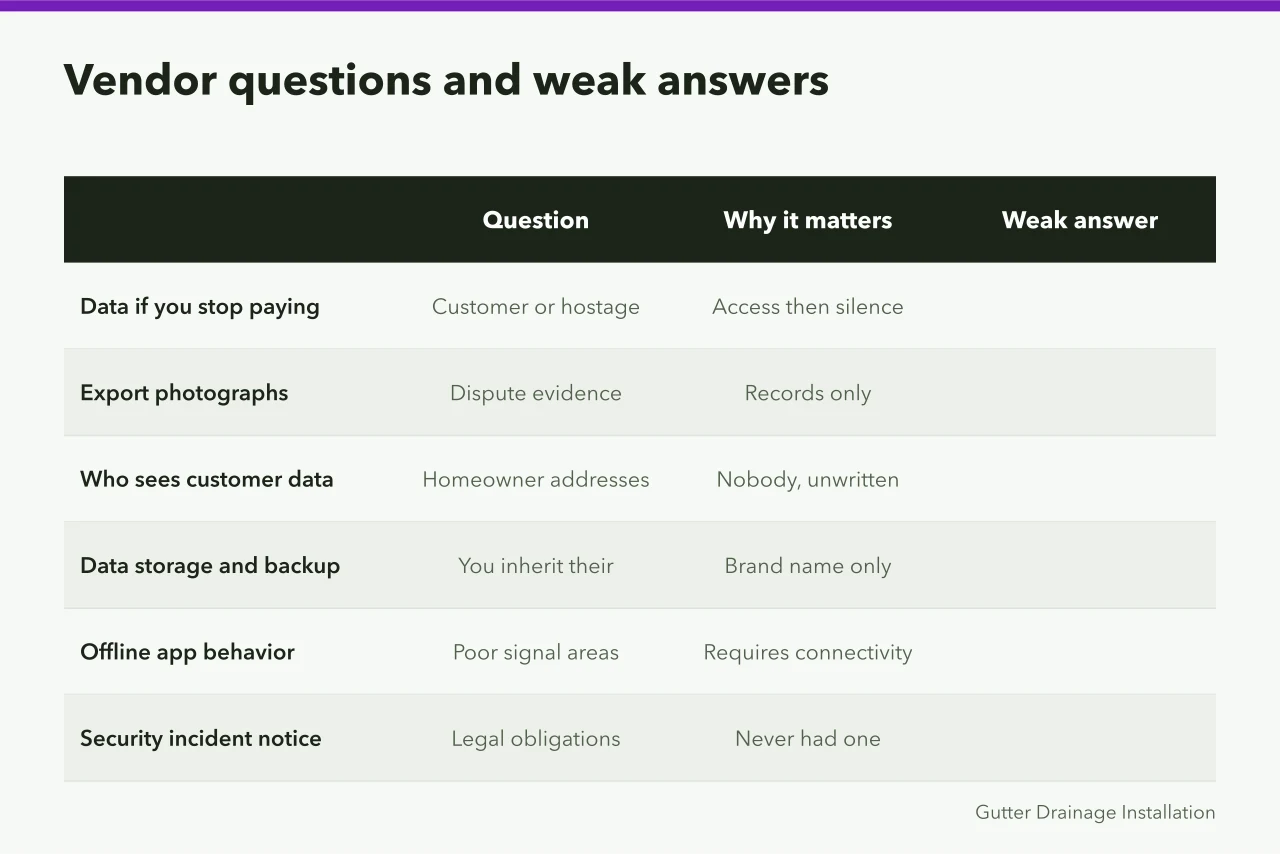
| Question | Why it matters | A weak answer |
|---|---|---|
| What happens to my data if I stop paying? | Determines whether you are a customer or a hostage | A period of access, then silence |
| Can I export photographs as well as records? | Photographs are your dispute evidence | Records only, images by request |
| Who at your company can see my customer data? | You hold homeowners' addresses and photographs | Nobody, with nothing in writing |
| Where is the data stored, and how is it backed up? | You inherit whatever they do | A brand name and a reassurance |
| What happens when the app is offline? | Crews work where signal is poor | Requires connectivity |
| How do you notify customers of a security incident? | Some jurisdictions impose obligations on you | Never had one |
The last row deserves attention. Holding customer names, addresses, payment details and property photos makes security your problem no matter who runs the servers.
The National Institute of Standards and Technology publishes quick-start guides for small business cybersecurity. The Cybersecurity and Infrastructure Security Agency keeps material aimed at small and medium businesses. Both are free and short enough to read before a purchase, not after an incident.
What the system has to hold regardless
Whatever you pick, the record has to survive. The IRS explains what records a business is expected to keep, and a system that cannot produce those on demand has failed at the one job nobody can waive.
Two other constraints come from the work itself. The system has to reflect what you actually sell and how the crew actually works, a training and adoption question covered in the hiring and training guide.
One small feature is worth more than most: a truck stocking checklist the crew ticks before leaving. Second visits caused by a missing outlet or elbow are among the most expensive routine failures in this trade, and the list is in the equipment checklist for new owners.
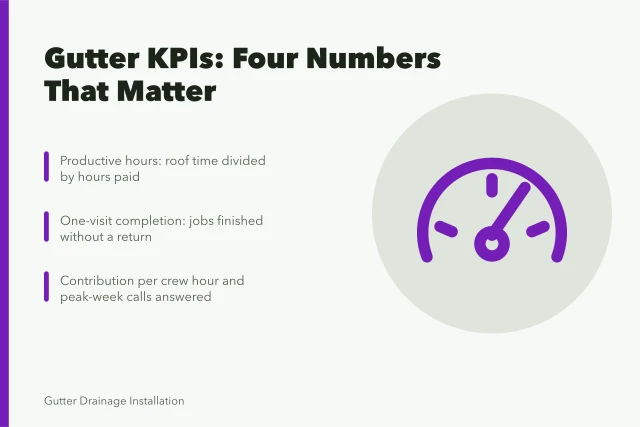
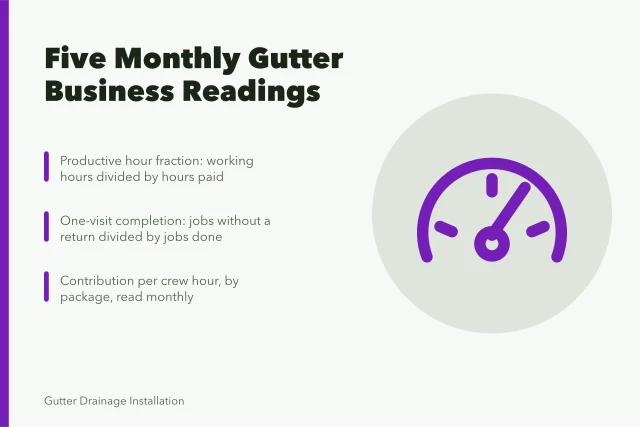
Which measures to put on the screen once the system is running is a separate question, answered in the software and KPI guide.
Common questions
How many products should I trial?
Two. Three is a project, and one gives you nothing to compare. Jobber against Workiz, or Housecall Pro against FieldPulse, will tell you more than a five-way bake-off nobody finishes.
Is the cheapest option ever right?
Frequently, for one crew. What makes a system expensive is usually features a small company never turns on. Kickserv and ServiceM8 both start low and cover scheduling and invoicing, with entry plans typically under $100 a month as of 2026.
Can I stay on a spreadsheet?
Yes, with one crew and discipline. Move when finding a job record starts costing you time, not when a vendor tells you to.
When should I not switch?
During the peak weeks, and in the same period as any other major change. Two changes at once means you cannot tell which one caused the problem.