Guides
Gutter service systems and KPIs for owners in 2027
Gutter service software and measurement: what a system is actually for, the four measures that matter, and the data you become responsible for.
What to take away
- Software does not fix a business that does not record anything. Get the job record right on paper first, then automate it.
- Four measures decide this trade: productive hours, one-visit completion, contribution per crew hour, and calls answered in the peak weeks.
- Revenue and job count are the two most-watched numbers and neither tells you anything actionable on its own.
- Once you hold customer data and photographs of people's houses, you have a security obligation. Treat it as part of the system choice.
What software is for at this size
For a company with one to five crews, a system does four things and nothing else worth paying for.
It stops work falling between the phone call and the schedule. It puts the job record, the photographs and the quote in one place a second person can find. It produces an invoice that matches what was actually delivered. And it lets you compare what you quoted against what it cost.
Everything beyond that is a feature list. Route optimization, automated follow-up sequences and dashboards are all real, and none of them helps a company that cannot say how many hours a job took.
So the sequence is: define the record, keep it manually for a season, then buy something that carries it. Buying first produces an expensive place to store nothing.
The record that has to exist first
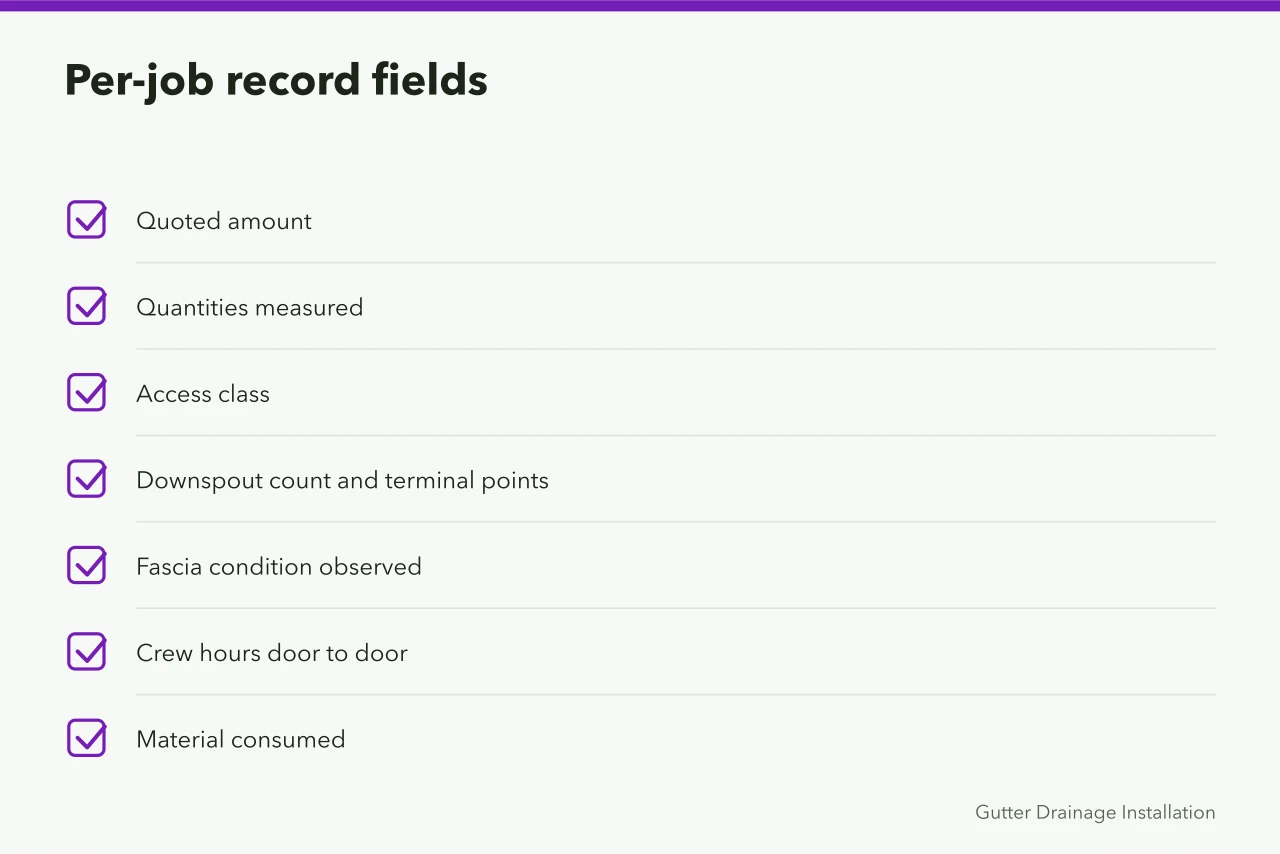
Two of those are always missing when owners bring their records to a review. Hours measured door to door rather than working time only, and the cause of every return visit. Without the first, your labor cost is fiction. Without the second, you cannot tell whether your callbacks are measurement, parts, pitch or discharge, and each has a different fix.
The IRS explains what records a business is expected to keep, and the file that satisfies that requirement is the same file the measures below run on. That is convenient rather than accidental: a business with a tidy tax record usually has enough to manage on.
The four measures that matter
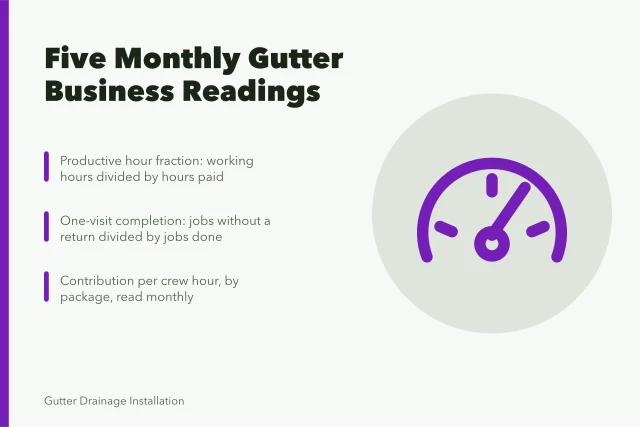
Productive hour fraction. Hours genuinely on a roof divided by hours paid. Travel, setup, teardown, supply runs, weather delays and second visits are all paid and none of them bills. This is the single most under-measured number in the trade and the fastest one to move.
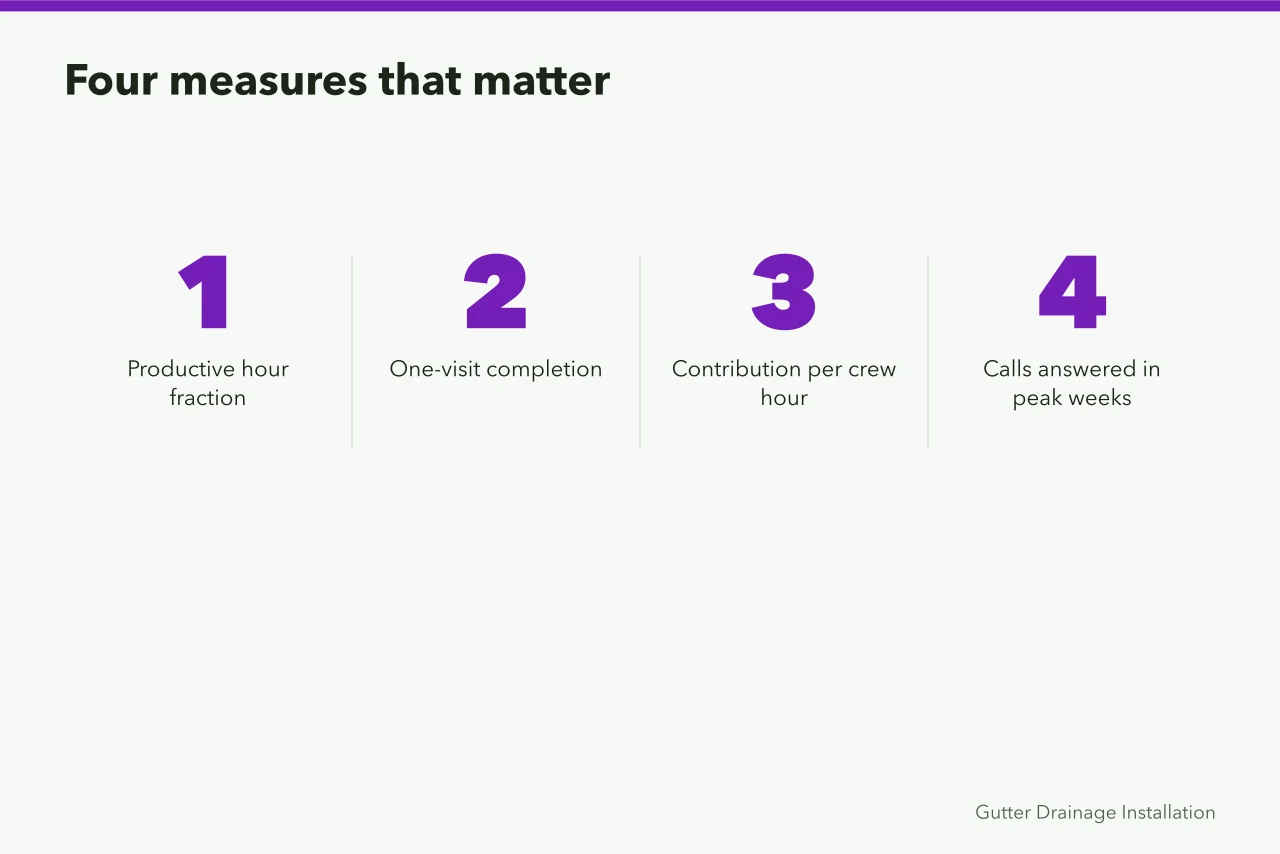
One-visit completion. The share of jobs finished without a return. In this trade a return is unusually expensive, because a formed run is made on site and the machine, coil and crew travel as one unit, as set out in the equipment and setup guide.
Contribution per crew hour, by package. Revenue minus material minus direct labor, divided by all hours including travel. This is what ranks your services honestly, and it frequently ranks them differently from revenue.
Calls answered in the peak weeks. Demand here is triggered by storms and by leaf drop, and a caller with a wet basement works down a list. A missed call in the peak is a job given away, and the measure costs nothing to keep.
Measures that mislead
| Measure | Why it is popular | What it hides |
|---|---|---|
| Monthly revenue | Easy to see | Nothing about whether the work paid |
| Jobs completed | Feels like productivity | A day of small scattered jobs looks like a good day |
| Gross margin percentage | Familiar from other businesses | Time, which is the thing you are actually short of |
| Average job value | Sold as a growth metric | Pushes toward large jobs that may contribute less per hour |
| Review count | Visible and flattering | Says nothing about whether the work is repeatable |
The third row is the one that costs money. A package with excellent margin that consumes a whole day is worse, in a short season, than two shorter jobs with lower margin. The arithmetic is in the pricing and profit guide.
Choosing a system without naming one
No page can tell you which product to buy, because the answer depends on how you sell, what your crews will actually use on a phone in the rain, and what you already run for accounting. What is transferable is the evaluation.
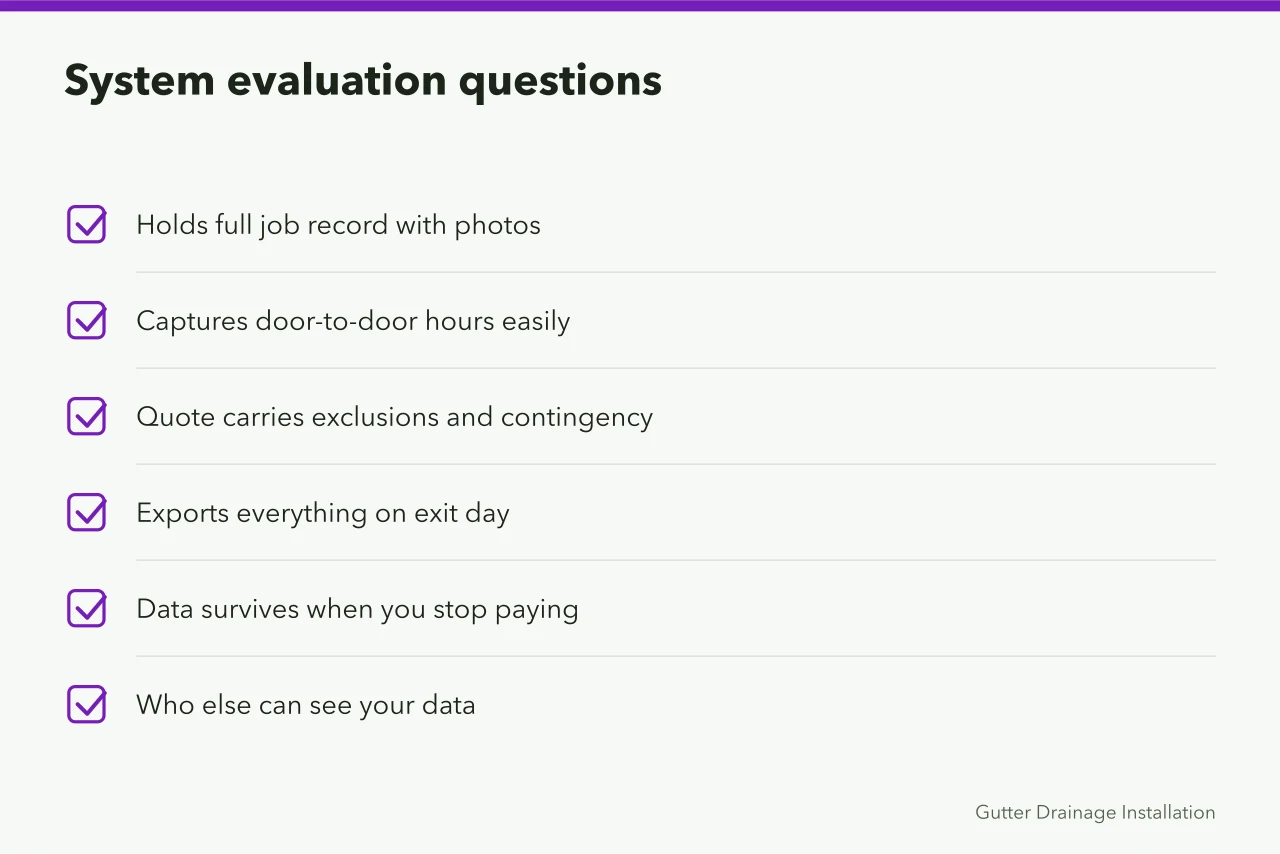
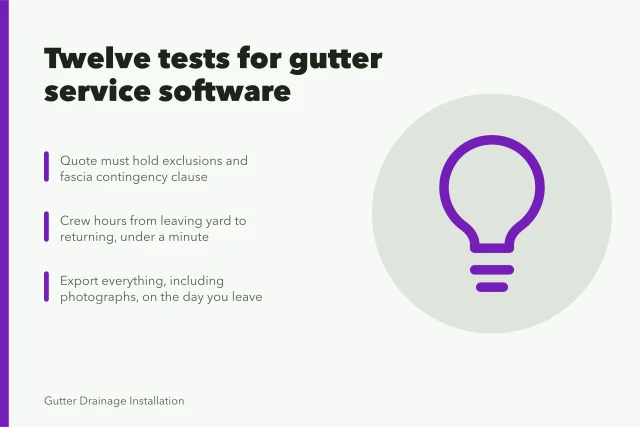
Ask whether it holds the job record above in full, including photos attached to the job rather than to a chat thread.
Ask whether hours can be captured door to door without the crew hating it.
Ask whether a quote can carry an exclusions paragraph and a contingency clause, since those prevent disputes in this trade. Ask whether you can export everything, in a usable format, on the day you leave.
Then ask the two questions vendors dislike. What happens to your data when you stop paying, and who else can see it.
Whatever you choose has to reflect what you actually sell, so define the packages first: the structure is in the packages and pricing guide.
It also has to be usable by the people doing the work. That training question is covered in the hiring and training guide. A system nobody updates on site produces confident nonsense.
The data you are now responsible for
The moment you hold customer names, addresses, phone numbers, payment details and photographs of the insides of people's properties, you have a security problem whether or not you think of it that way.
Two free, plainly written starting points exist. The National Institute of Standards and Technology publishes quick-start guides for small business cybersecurity, which break the subject into short, actionable pieces. The Cybersecurity and Infrastructure Security Agency maintains material aimed specifically at small and medium businesses, covering the basics that prevent most incidents.
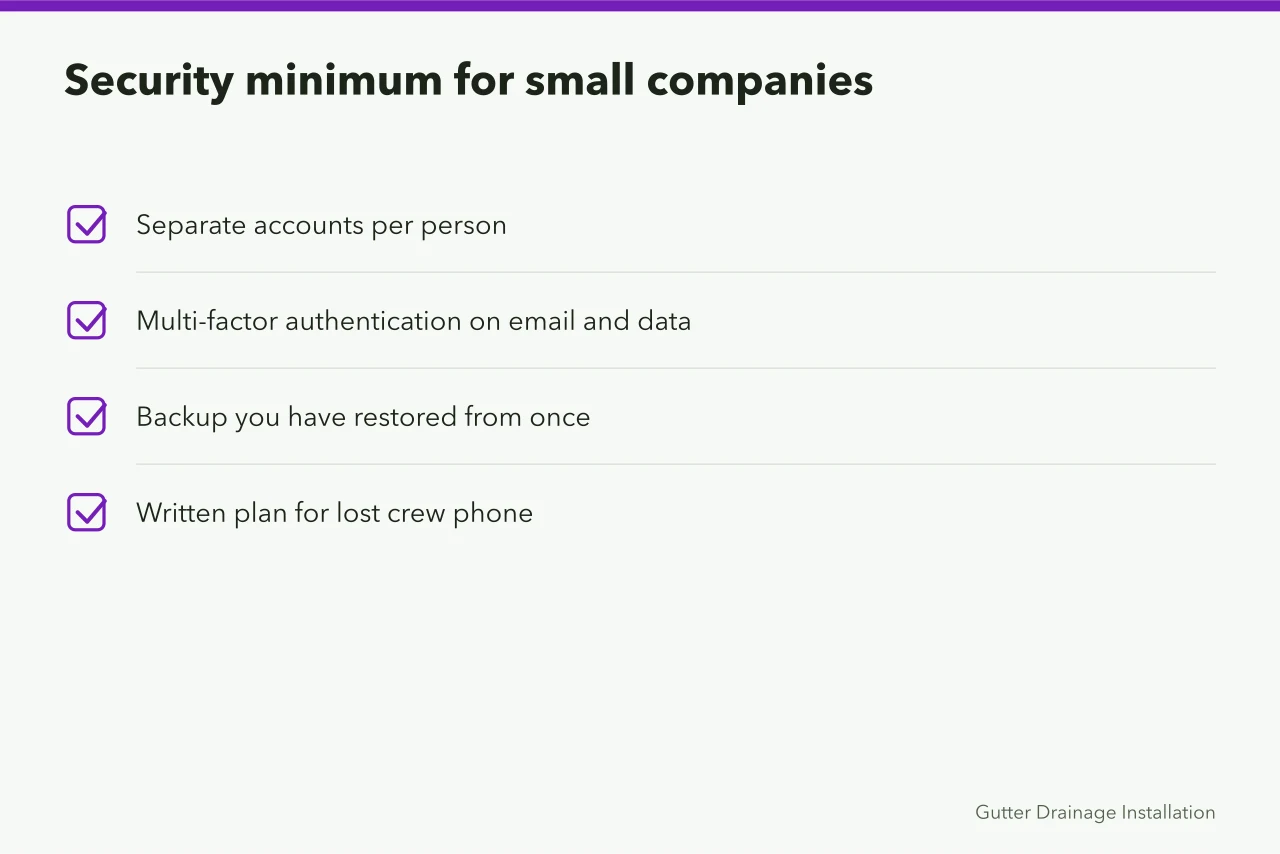
Some obligations attach by jurisdiction rather than by choice, particularly around notifying people after a breach. That belongs on the same compliance calendar as everything else, described in the licensing and compliance guide.
The records that are not optional
Two categories deserve to be in the system rather than in a folder on somebody's desk.
Safety records. Training sign-offs, gear issued per person, inspection records and stop-work events. This trade's severe exposure sits at the roof edge, and OSHA's guidance on fall protection in residential construction places responsibility for site-specific controls on the employer, which means being able to show what you trained and when.
Job photographs. The fascia before you touched it and the finished discharge terminal. Those two pictures settle most of the disputes in this trade, and they are worthless if nobody can find them a year later.
Migrating without losing the year
Move at the start of a quiet period, never during the peak weeks.
Export the old data first and confirm you can read it outside the old system. Run both in parallel for a short period rather than switching overnight. Migrate the current season's jobs and archive the rest rather than trying to move everything. And check that the historic hours came across, because those are what your rate card is built on.
Where the new system changes what you can promise customers about scheduling or communication, tell them before it changes rather than after, which is part of the wider consistency argument in the marketing and growth guide.
Common questions
Can I run this on a spreadsheet?
For one crew, yes, and many owners should. The discipline matters more than the tool, and a spreadsheet you actually fill in beats a system you do not.
How many measures should I watch?
Four is plenty. More produces a dashboard nobody acts on, which is the most common failure of software in businesses this size.
How often should I look at them?
Monthly, not annually. A season is over before an annual review notices a problem.
Should crews enter data on site?
Only the parts that are unreliable from memory: hours, photographs and what was found. Anything that needs typing on a ladder will not be entered.
What is the first thing to fix?
Hours measured door to door. Almost every pricing and profitability problem in this trade traces back to that one number being wrong.