Guides
What a gutter service business needs to operate legally
Gutter service licensing and compliance: the five registers to check yourself, why no list can be national, and how to keep the answers current.
What to take away
- No page can tell you what licenses you need. The answer is set by your state, your county and often your city, and it changes.
- There are five places the requirement can live. Check all five for every market you work in, not just the one where you registered.
- Safety is the part with no jurisdictional escape hatch. It is a written program you maintain, not a binder you own.
- Write down the date you checked each answer and who told you. That record is what turns a compliance scramble into a renewal.
Why nobody can list your requirements
Contractor regulation in the United States is layered, and the layers do not agree with each other.
Some states license contractors by trade and some do not license this work at all. Some counties register businesses that the state ignores. Cities add their own registration, their own permit thresholds and sometimes their own insurance minimums. The same physical job can be unregulated on one side of a line and require a licensed contractor on the other.
That is why this guide teaches the search rather than publishing an answer. An article that lists requirements is either out of date or describing somewhere you do not work, and acting on it is worse than starting from nothing, because you will stop looking.
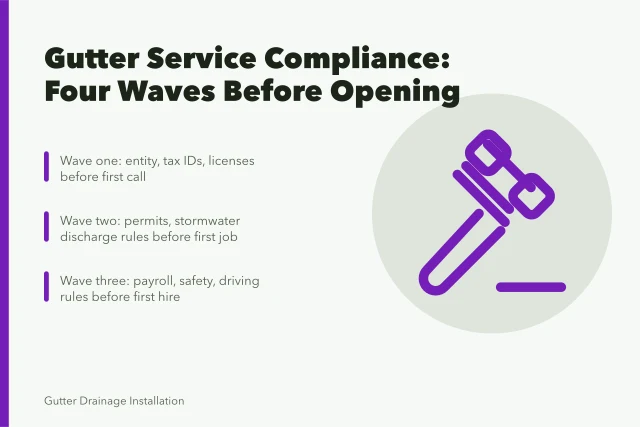
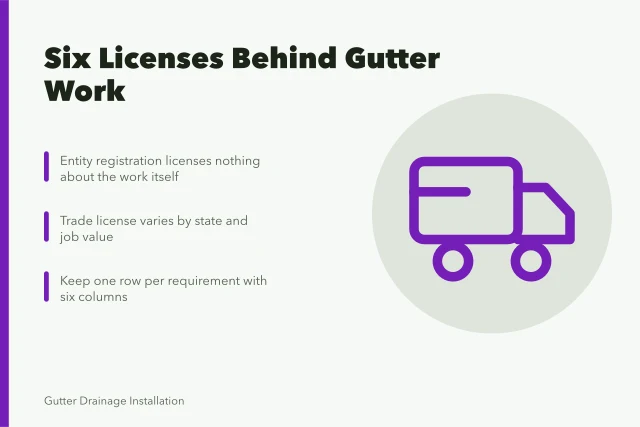
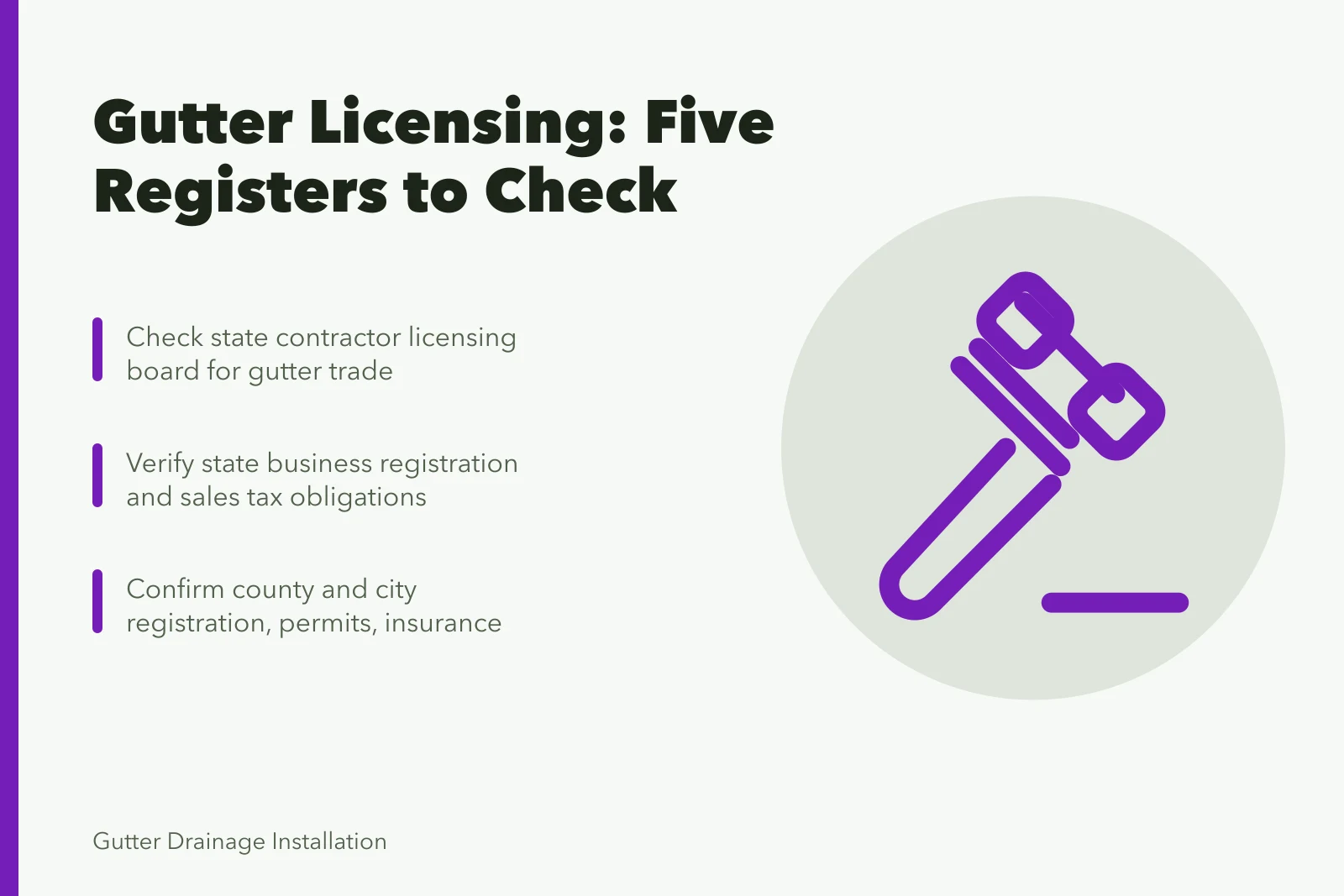
The five registers to check
Work through these in order for every market you take work in.
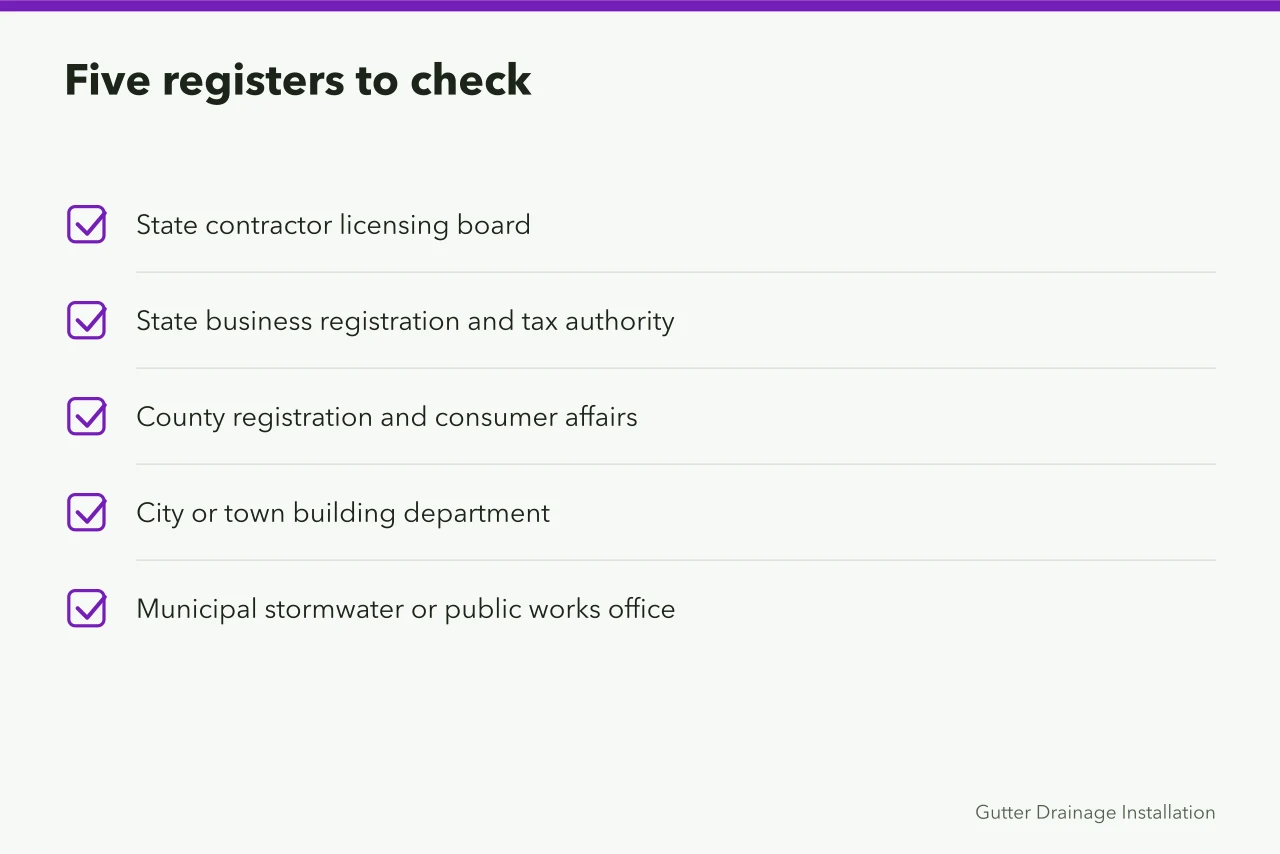
Register five needs special attention: it is not a licensing question and appears on no licensing checklist. Local rules govern whether a downspout may discharge to a storm sewer.
They also govern whether it must not be connected to a sanitary sewer and how far from a property line water may be released. Get the answer in writing once per market and put it in your standard scope so estimators stop guessing.
Contractor licensing: what the question actually is
When you call the state board, ask a narrower question than the one you want answered.
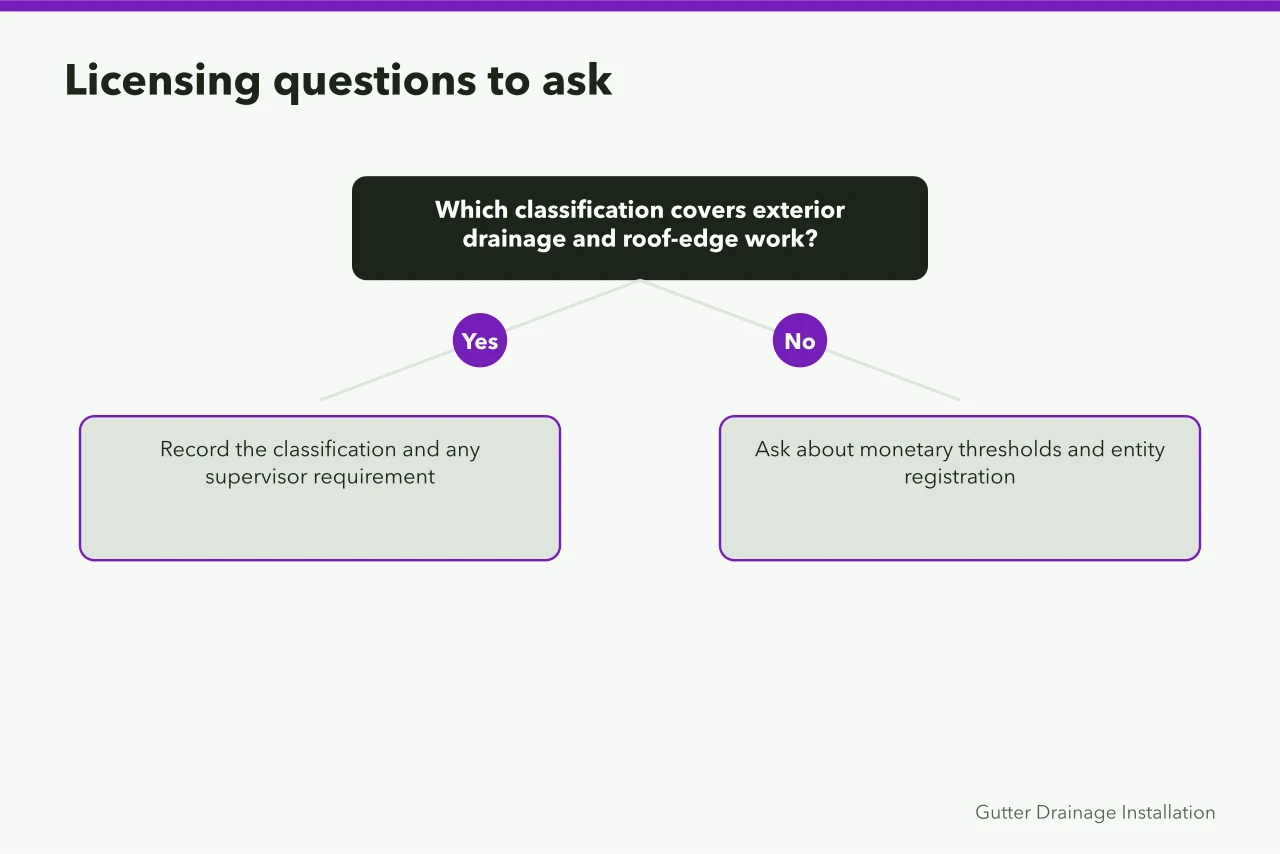
Do not ask if you need a license to install gutters, but ask which classification covers exterior drainage and roof-edge work.
Does a monetary threshold apply to a single project, and what requirement applies to the supervisor versus the entity? Does a separate registration cover employees?
Then ask the two follow-ups that catch people. Does the license travel across county lines within the state, and is there a reciprocity arrangement with the neighboring state you can see from your yard? Companies grow into the next metro area without noticing that the second one has its own rules.
Record the answer, the date and the name of the person who gave it. A dated note is the difference between a renewal and a discovery.
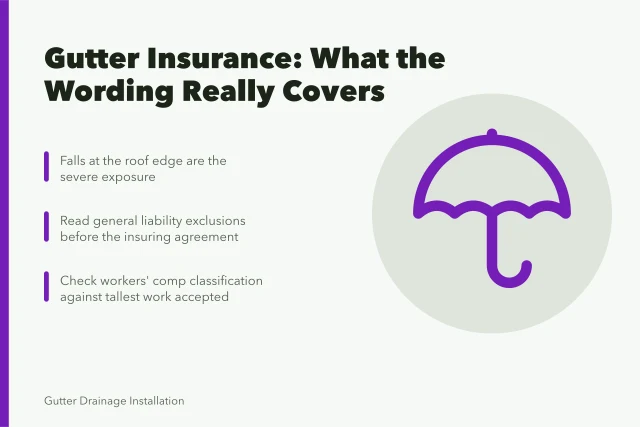
Insurance and bonding sit next to licensing
In many jurisdictions the license is conditional on insurance or a bond, which means letting a policy lapse is not just an insurance problem.
Ask the board what proof it requires and on what cycle. Ask your carrier to send the certificate directly to whoever needs it rather than passing it through you. And check whether your customers, particularly property managers and associations, impose their own minimums, because those are contract terms rather than law and no regulator will warn you about them.
Employment rules arrive with the first hire
The day you hire, a second body of rules applies, and none of it is trade-specific.
Wage and hour law, classification of workers, recordkeeping and posting obligations all begin at that point. The Department of Labor maintains compliance assistance aimed at new and small businesses, which is the plainest entry point into what it expects. Read it before the first paycheck rather than after the first complaint.
Two habits specific to this trade cause trouble. Paying by the job pushes crews to skip setup steps that cost time. That is a safety problem before it is a wage problem.
Treating a regular helper as a contractor because it is simpler is a classification question with real consequences. Ask an employment attorney or accountant in your state. Do not copy what a competitor does.
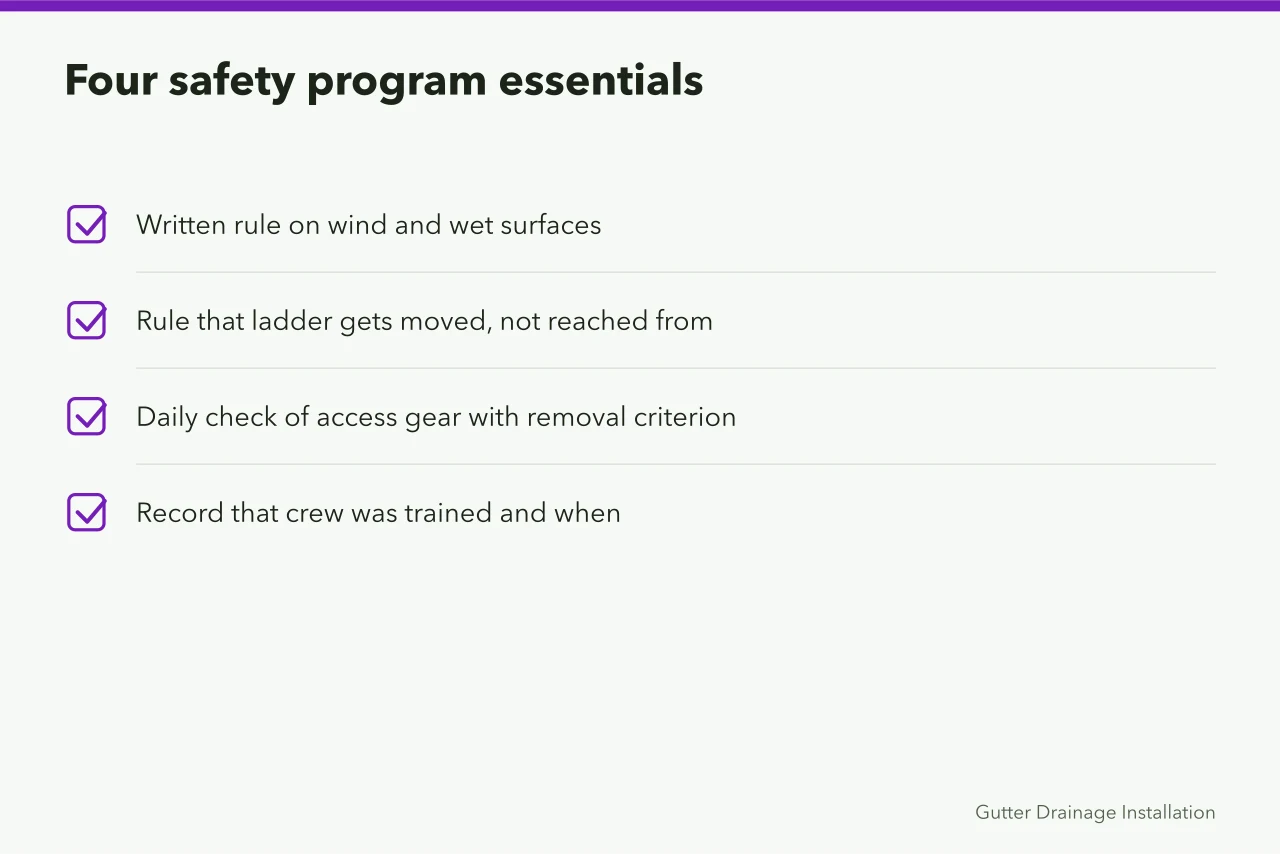
Safety is a written program
This is the part of compliance with no local variation to hide behind, because the exposure is physical.
Almost all work happens at the roof edge, on ladders, on surfaces wet earlier. OSHA's guidance for fall protection in residential construction describes the methods and states the employer remains responsible for site-specific controls and the federal or state-plan rules where you operate.
Some states run their own approved program, so confirm which set governs you.
Around that sits the program itself. OSHA's framework for a safety and health program sets out what a small employer is expected to build: management commitment, worker participation, hazard identification, correction of what turns up, and training. A program that exists only as a printed policy fails at the first inspection and, more importantly, at the first ladder.
Accessibility reaches the business, not the roof
Owners are often surprised that accessibility law touches them at all, and then surprised again by where it lands.
Your own premises matter, not the houses you work on. If the public comes to them, and increasingly how customers reach you, the rules apply. The ADA guide for small businesses spells out general obligations in plain language. Read it once, even if your office is a desk in a yard.
If you have a storefront, a counter, or a public entrance, the obligations are real and specific.
Ask an attorney about your own situation before making changes. What is safe to do without advice is read the guide and stop assuming the subject does not apply to a trade business.
Where compliance shows up in the price
None of this is free, and most of it is not job-specific.
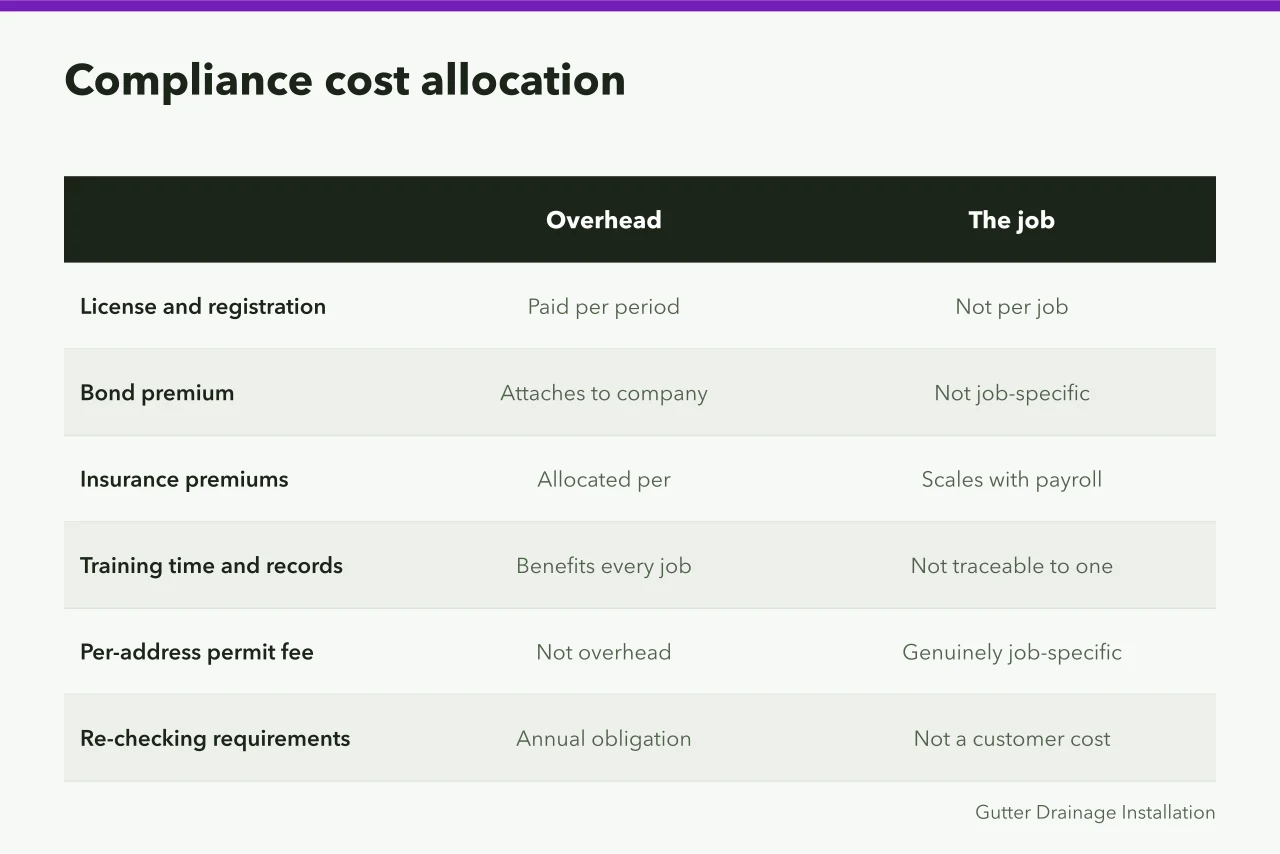
Registration, bonding, insurance premiums, training time and the administrative hours all belong in overhead, spread across productive hours, rather than added as a line on a quote. The exception is a genuine per-job permit fee, which belongs in the job.
| Cost | Where it belongs | Why |
|---|---|---|
| License and registration fees | Overhead | Paid per period, not per job |
| Bond premium | Overhead | Attaches to the company |
| Insurance premiums | Overhead, allocated per productive hour | Scales with payroll, not with a single address |
| Training time and records | Overhead | Benefits every job the crew touches |
| Per-address permit fee | The job | Genuinely job-specific and traceable |
| Time spent re-checking requirements | Overhead | An annual obligation, not a customer cost |
Getting that allocation wrong distorts every quote you write. Where compliance costs shape what you are able to offer in the first place, the reasoning is in the packages and pricing guide.
Some requirements attach to equipment and vehicles rather than the business. That is one reason to make the buying decisions in the equipment and setup guide only after you know your jurisdiction's expectations, not before.
If you are choosing between markets, regulatory burden differs enough between them to belong in that decision. the startup and market guide treats it alongside demand.
Keeping it current
Compliance decays quietly. Nobody writes to tell you a threshold moved.
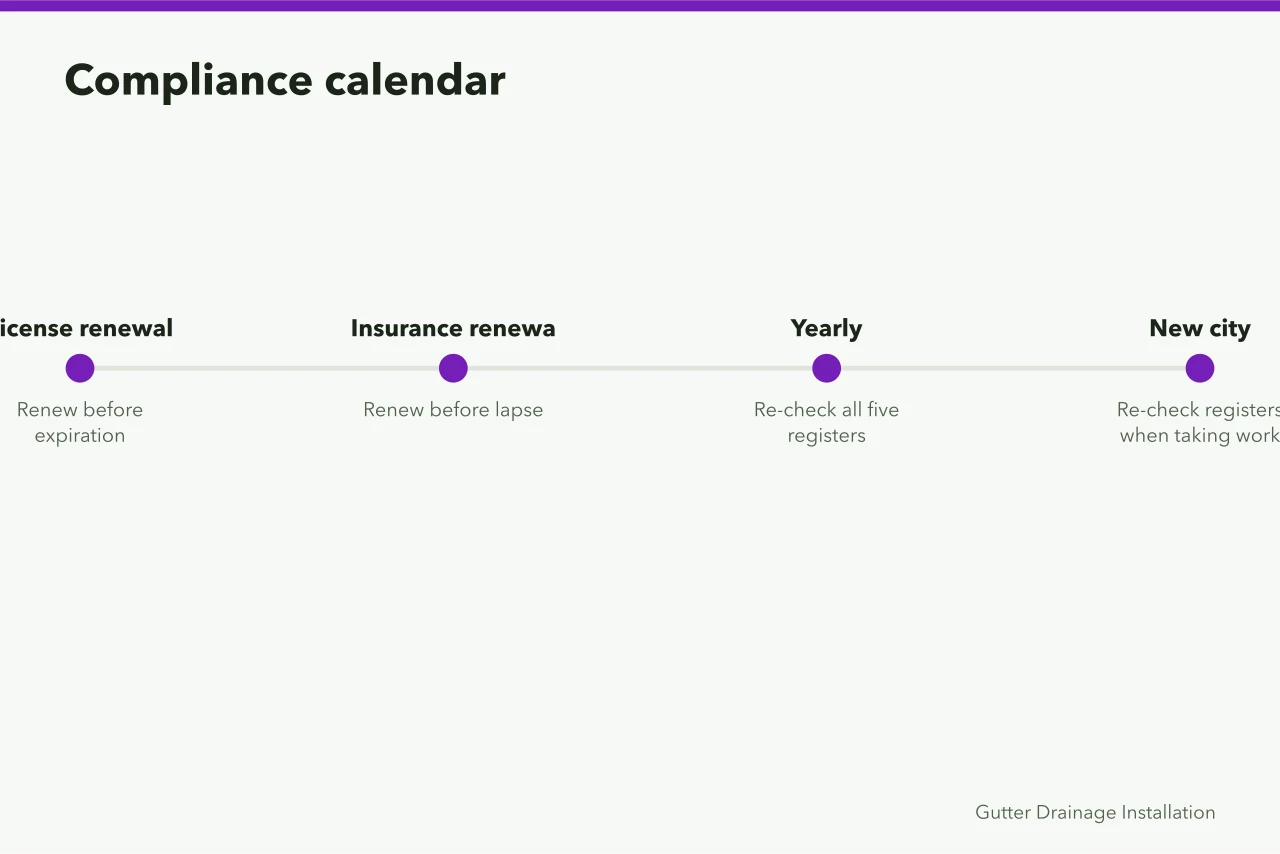
Put four things on a calendar: license renewal, insurance renewal, a yearly re-check of each of the five registers, and a re-check whenever you take work in a new city. Keep a single file with, for each item, what the requirement is, who told you, the date, and the renewal date.
That file is also what you hand an insurer after an incident, what a property manager asks for before adding you to an approved list, and what a buyer will want if you ever sell. It costs an hour a quarter and it is the cheapest thing in this article.
Common questions
Do I need a contractor license to clean gutters?
Often not, and sometimes yes, depending on the state and on whether repair work is bundled in. Ask the licensing board about the specific mix of services you sell rather than about the trade name.
Is there a project value below which no license is needed?
Many states have a threshold and many do not. Ask directly, and ask whether the threshold is per project or per contract, because the two are gamed differently and the board has heard it before.
What if I only work in one city?
You still have five registers, because state, county and city can each have a requirement. The city is not the only layer, it is just the closest one.
Does my license cover the crew?
Sometimes it covers the entity and sometimes it attaches to a qualifying individual, and there may be separate registration for employees. This is exactly the question to ask the board in those words.
How much of this can I do myself?
All of the searching. Ask a professional for the classification of workers, the tax treatment and anything with a legal consequence, because those are the three places where a confident guess is expensive.