Guides
Telling a real gutter service standard from a slogan, with examples
Gutter service operating standards written out in full, with three worked examples and the wording that separates a real standard from a slogan.
What to take away
- A standard names an observable condition, a person and a response. Anything missing one of those three is a slogan.
- Write standards for the moments when someone is tired, late and alone. That is when they get tested.
- Three standards carry most of the value in this trade: the discharge terminal, stop-work authority, and one-visit completion.
- A standard is failing when people meet it in your presence and not otherwise. Sample rather than announce.
What a standard is
A standard is a sentence that decides an argument before the argument happens.
It has three parts. An observable condition, stated so two people would agree whether it is met. A named person who owns it. And a response, including what happens when the condition is not met.
Compare these two.
Weak: we take pride in leaving every site clean.
Strong: before the truck moves, the crew lead confirms debris is bagged and loaded, fasteners are recovered with a magnet across the drive and walkways, and the customer has been told the site is clear. If the customer is absent, a note is left saying the same.
The second one can be checked by somebody who was not there. That is the entire difference.
The anatomy, applied
| Part | Question it answers | Weak version | Strong version |
|---|---|---|---|
| Condition | What exactly is true? | Work is finished properly | Water exits at the terminal named in the quote |
| Evidence | How would anyone know? | The crew says so | A photograph in the job file |
| Owner | Who is accountable? | The team | The crew lead on site |
| Response | What happens if not? | We fix it | Corrected before the truck moves, or logged with a cause |
The evidence row is what most standards are missing. Without it, a standard is an intention, and intentions degrade quietly during the busy weeks.
Worked example: the discharge terminal
This one earns its place because most complaints attributed to gutters are complaints about where the water ended up.
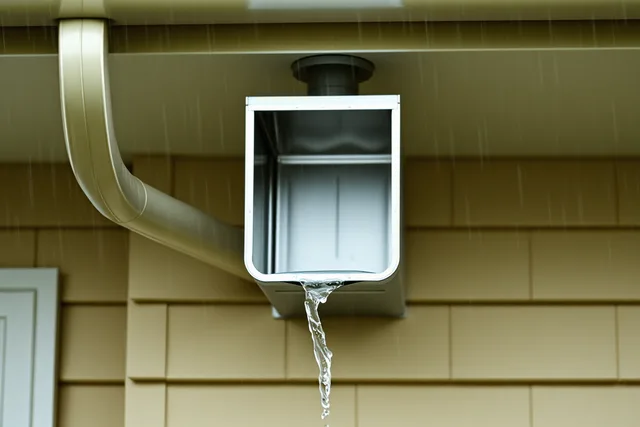
Condition. Every downspout terminates at the point named in the quote, discharging onto or into something specific, with the receiving ground falling away from the building, and nothing discharging onto a walkway or drive where it can refreeze.
Evidence. A photograph of each finished terminal in the job file, plus a note where a buried line was opened and flow confirmed by watching the level rather than the first few seconds.
Owner. The crew lead, before the truck moves.
Response. Where the terminal cannot be completed as quoted, the crew stops, records why, and the office contacts the customer the same day with the options and any price consequence. Nothing is improvised at the property.
Why this wording. The vague version, leave the discharge tidy, permits a downspout aimed at ground that slopes back toward the foundation. The strong version does not, and it produces the photograph that answers the call next spring.
Worked example: stop-work authority
The standard nobody wants to test and everybody needs.
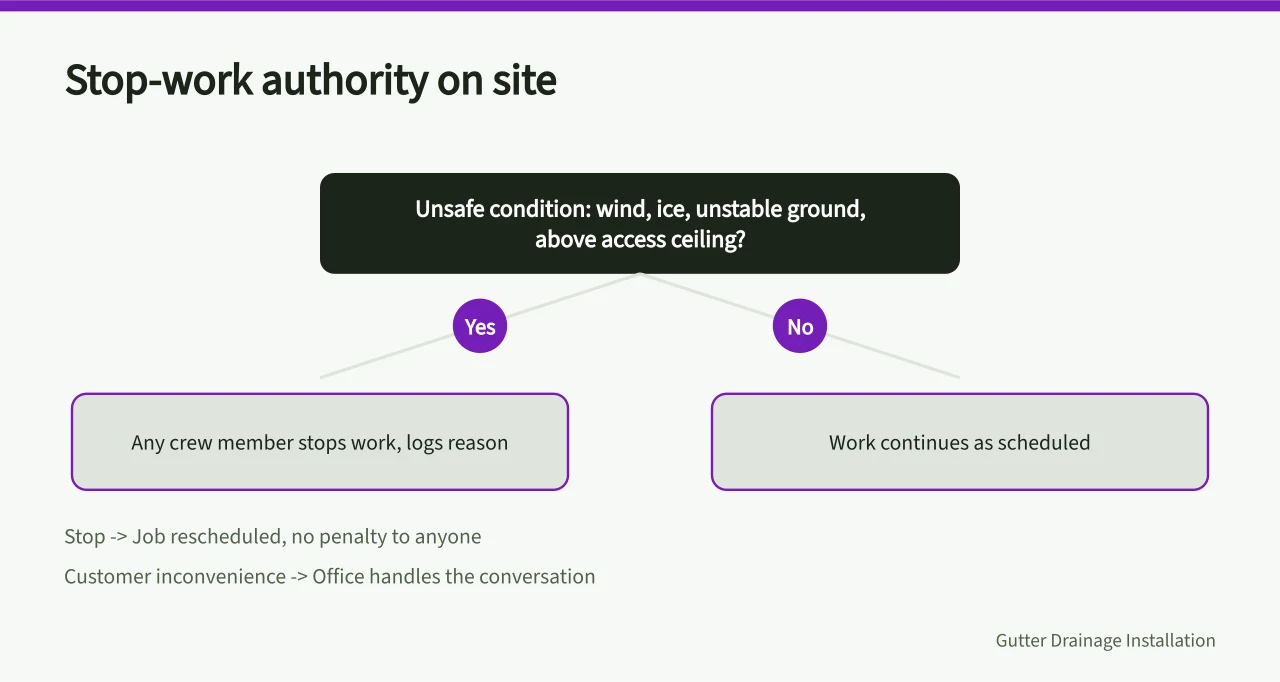
Condition. Any crew member may stop work when wind, wet or icy surfaces, unstable ground under a ladder, or an elevation above the company's stated access ceiling makes the work unsafe.
Evidence. A logged stop, with the reason, and no requirement to justify it further.
Owner. Every person on site, individually. Not the crew lead, and not the office.
Response. The job is rescheduled without penalty to anyone. The office reschedules and, where a customer is inconvenienced, the office absorbs that conversation rather than the crew.
Why this wording. Authority that has to be requested is not authority. This trade's severe exposure sits at the roof edge, and OSHA's guidance on fall protection in residential construction places responsibility for site-specific controls on the employer, which means the employer has to make stopping cost the worker nothing.
The clause about no penalty is the load-bearing one. Crews paid by the job will not use authority that costs them money, and a standard that ignores that is a standard about pay rather than about safety. How the pay structure interacts with this belongs in the hiring and training guide.
Worked example: one-visit completion
The standard with the clearest financial return.
Condition. Each scheduled job is completed in one visit, including the water test and the handover.
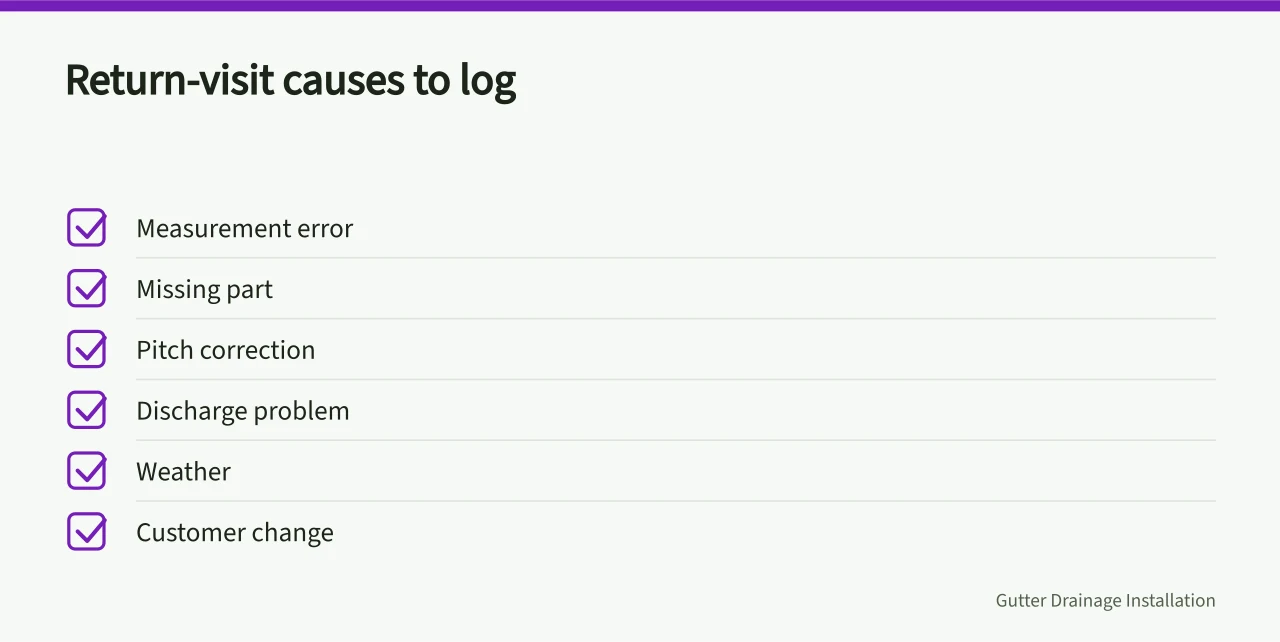
Evidence. Return visits logged against the original job with a cause: measurement, missing part, pitch correction, discharge, weather, or customer change.
Owner. The office for scheduling and stocking, the crew lead for execution.
Response. Each cause is counted monthly and the largest one gets a fix. A missing-part cause becomes a change to the truck list. A measurement cause becomes a change to the verification step before anything is formed.
Why this wording. A return visit here is unusually expensive because a formed run is made on site, and the machine, coil and crew travel as one unit, as set out in the equipment and setup guide.
Attributing causes rather than counting returns makes the standard actionable, and most parts-related causes disappear once the truck is stocked to the list in the equipment checklist for new owners.
Two more worth writing
The handover standard. What the customer is told, in what order, and what is left in writing. Anything explained only in a driveway will be remembered differently by both parties.
The review request standard. The same process for every customer, regardless of how the job felt. That is both fairer and safer: the Federal Trade Commission's guidance on soliciting and paying for online reviews sets out what marketers are expected to do, and asking selectively by expected sentiment is exactly the habit to avoid.
How to tell a standard is failing
Three signals, in order of how early they appear.
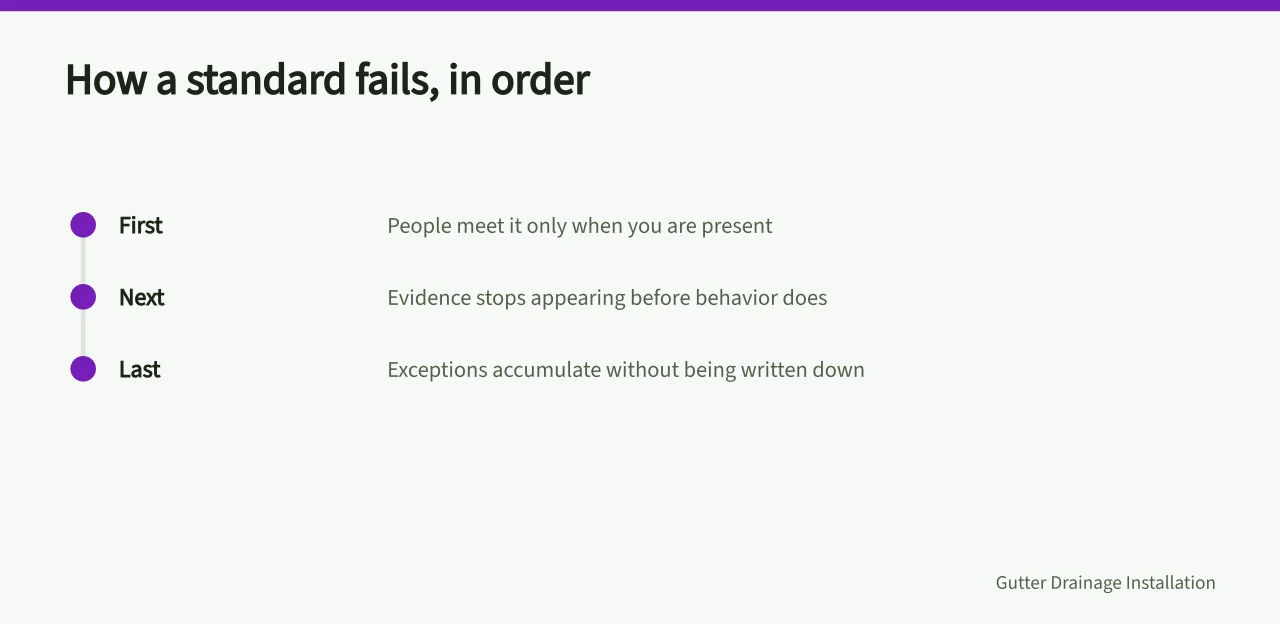
People meet it when you are present and not otherwise. That is a resourcing problem, not a character problem: the standard costs time that is not in the schedule.
The evidence stops appearing before the behavior does. Missing photographs precede missing checks by weeks, which makes the file a leading indicator.
Exceptions accumulate without being written down. An exception you can name is a policy. An exception you feel is a leak.
The check-level version of all this, tied to moments in the job, is the quality assurance checklist, and the reasoning behind which checks matter physically is in the quality assurance guide.
Keeping the evidence usable
Standards produce records, and records are only worth keeping if they can be found. File photographs against the job, log returns against the original job rather than as new work, and keep the whole thing where the office can query it.
The IRS explains what records a business is expected to keep, and one well-organized job file will serve the tax record, the quality review and any dispute at the same time.
Common questions
How many standards should a small company have?
Few. Three to five written well beat twenty written badly, and the ones to write first are wherever your callbacks are concentrated.
Who should write them?
Whoever does the work, edited by whoever is accountable. A standard written entirely in the office describes a job nobody recognizes.
How often should they be reviewed?
Once a season, and immediately after any incident or repeated callback. Reviewing them in the peak weeks is not realistic, which is why the seasonal review sits before the peak rather than during it.
What if a customer asks us to breach one?
Then the standard was written for exactly this moment. Explain it, offer the alternative, and if there is none, decline the work.
Do standards slow a crew down?
At first, and then they speed it up, because most of the time this trade loses is spent returning to jobs that were finished once already.