Guides
Gutter service finances: bookkeeping habits and cash flow rules
Gutter service bookkeeping for a seasonal trade: the weekly rhythm, the monthly close, and building a cash map that survives the quiet months.
What to take away
- A seasonal trade needs a cash routine, not just a bookkeeping routine. Money arrives in bursts and costs arrive every month.
- Do the weekly rhythm badly and the monthly close becomes archaeology. Do it well and the close takes an hour.
- Map the year by month before the season, and know which month empties the account.
- Money collected in advance is not revenue and often is not yours yet. Treat it accordingly.
Why this trade needs its own routine
Demand concentrates around leaf drop and around the first sustained rains after a dry stretch. Insurance, finance payments, storage, phone and your own living costs do not concentrate at all.
That mismatch is the whole cash problem. A company can be profitable across a year and insolvent in February, and the annual profit figure will not warn it.
Installation work adds a second wrinkle. Material and wages are spent before the invoice is paid, so every job in progress is money already gone. A busy month can drain cash faster than a quiet one.
The weekly rhythm
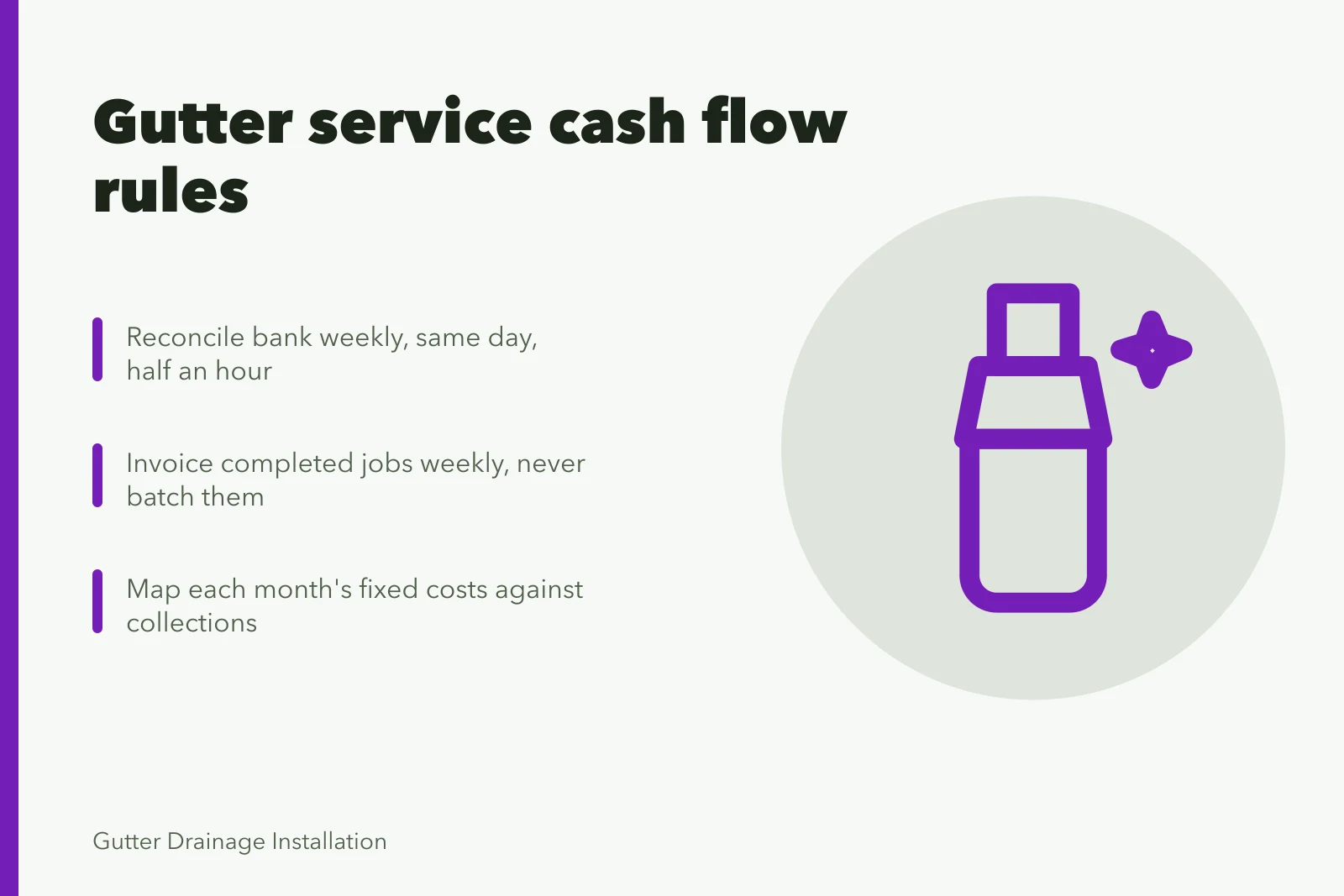
Half an hour, same day each week.
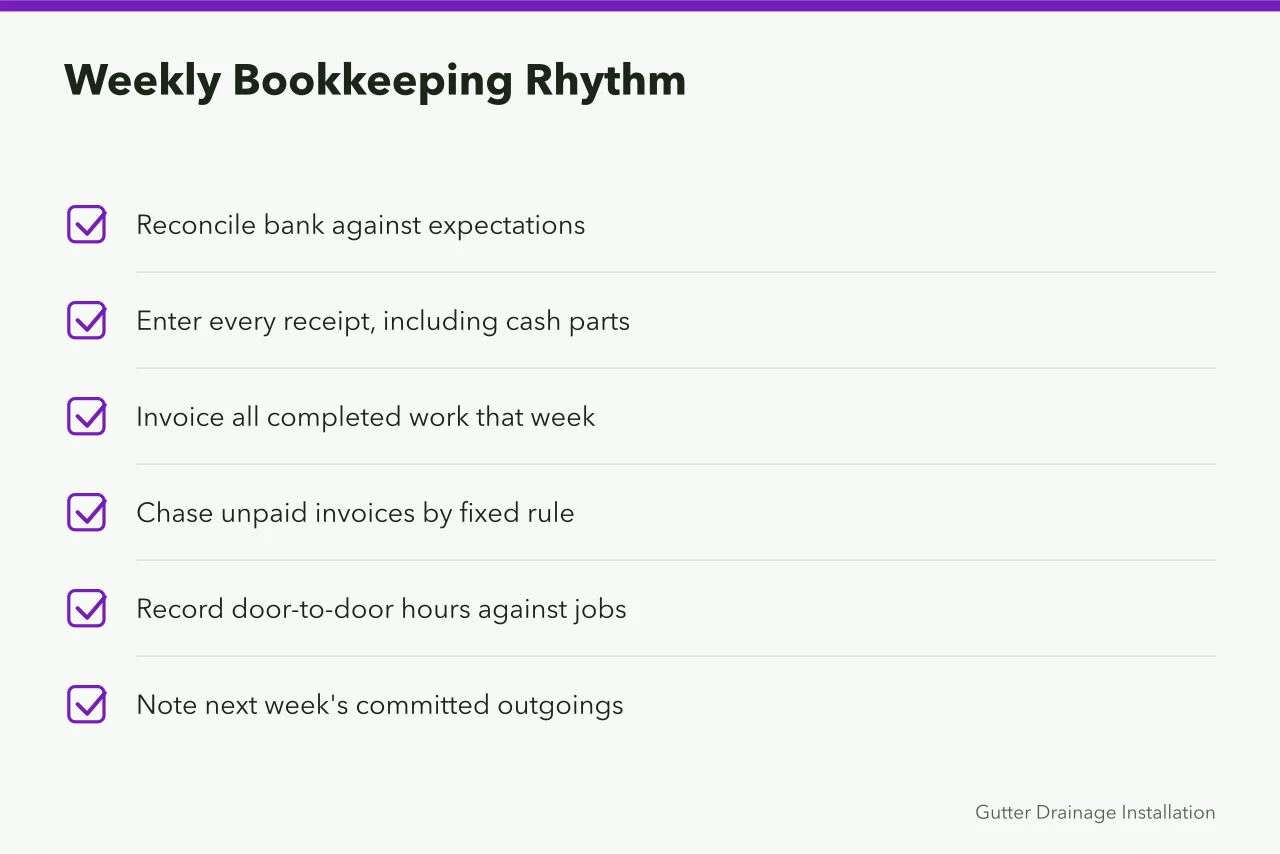
Step three is worth defending. Batching invoices to the end of the month adds weeks to your cash cycle for no benefit. In a trade where material is bought up front, that delay is expensive.
Step five is not bookkeeping and it belongs here anyway. Hours entered weekly are accurate and hours reconstructed monthly are guesses. Everything you later want to know about pricing depends on them.
The monthly close
An hour, and only possible if the weekly rhythm happened.
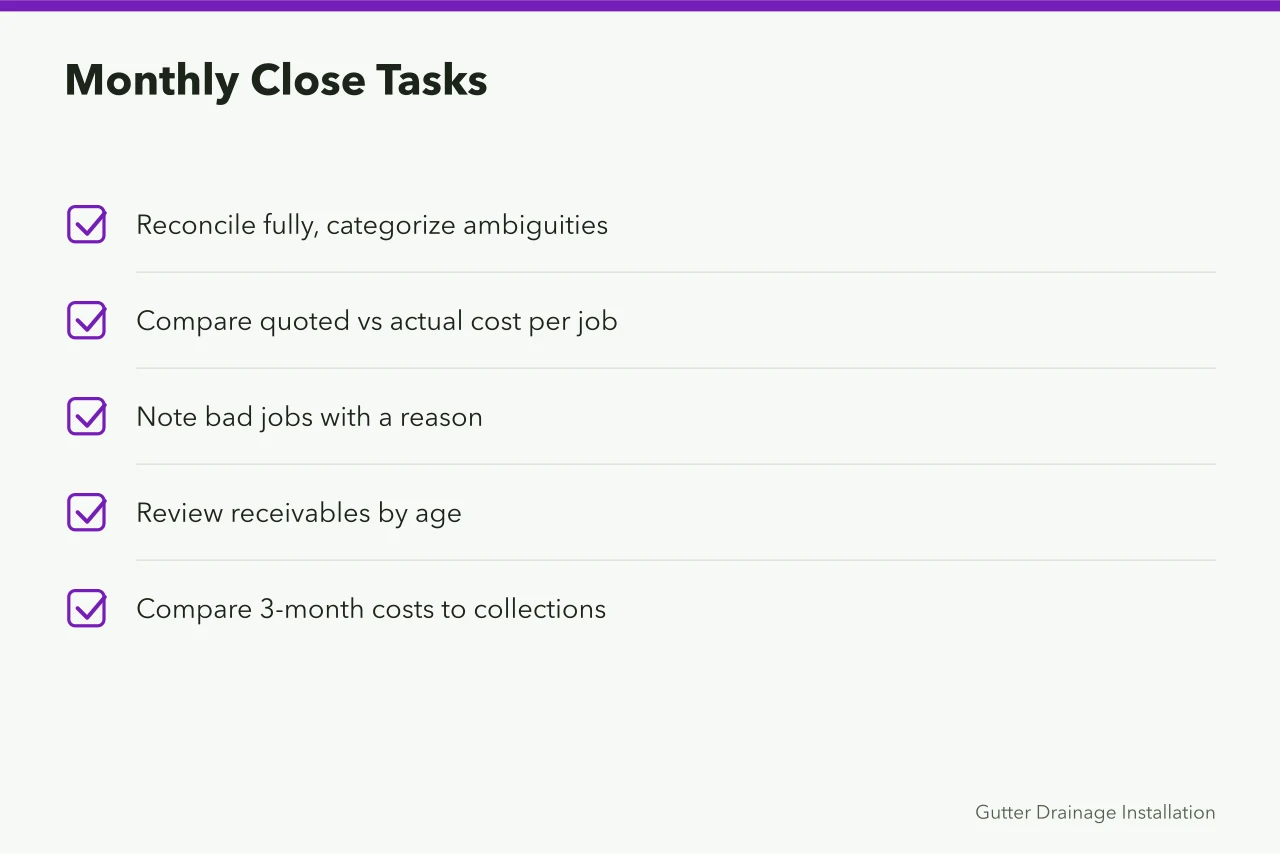
Reconcile fully. Categorize anything ambiguous rather than leaving it. Compare quoted amounts against actual cost per job for the month, and note the jobs that went badly with a reason. Look at receivables by age, not just as a total. Then look at the coming three months of committed costs against realistic collections.
That last comparison is the one that matters in a seasonal business. A profitable month with everything invoiced late is not a good month.
Where a number needs a professional judgment, ask one. How a particular purchase is treated is a question for a tax professional. So are deductibility in your circumstances and a vehicle used for both work and personal purposes. Ask one in your state, for your year, not a web page.
The seasonal cash map
Build it once, before the season, and keep it on one page.
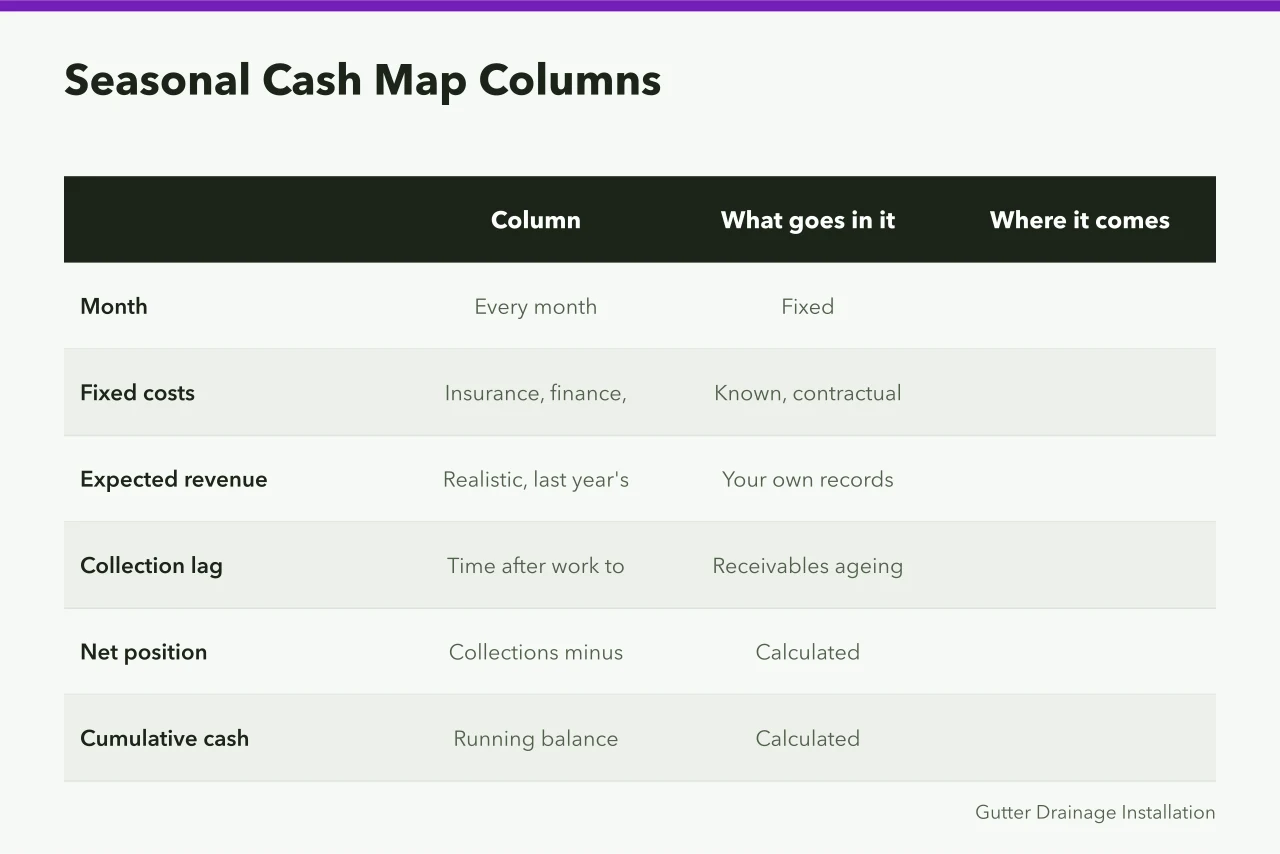
| Column | What goes in it | Where it comes from |
|---|---|---|
| Month | Every month of the year | Fixed |
| Fixed costs | Insurance, finance, storage, phone, software, your draw | Known, mostly contractual |
| Expected revenue | Realistic, from last year's shape rather than a target | Your own records |
| Collection lag | How long after the work you actually get paid | Receivables ageing |
| Net position | Expected collections minus fixed and variable costs | Calculated |
| Cumulative cash | Running balance | Calculated |
The cumulative column is the answer. It shows you the low point of the year, which is the number that determines how much working capital you need and whether a finance payment is survivable.
Two habits improve it more than anything else. Shorten the collection lag by invoicing on completion. And carry work that fills the shoulder months, because cleaning, repair and discharge work needs little capital and turns a flat month into a survivable one.
Money that is not yours yet
Three categories deserve separate treatment.
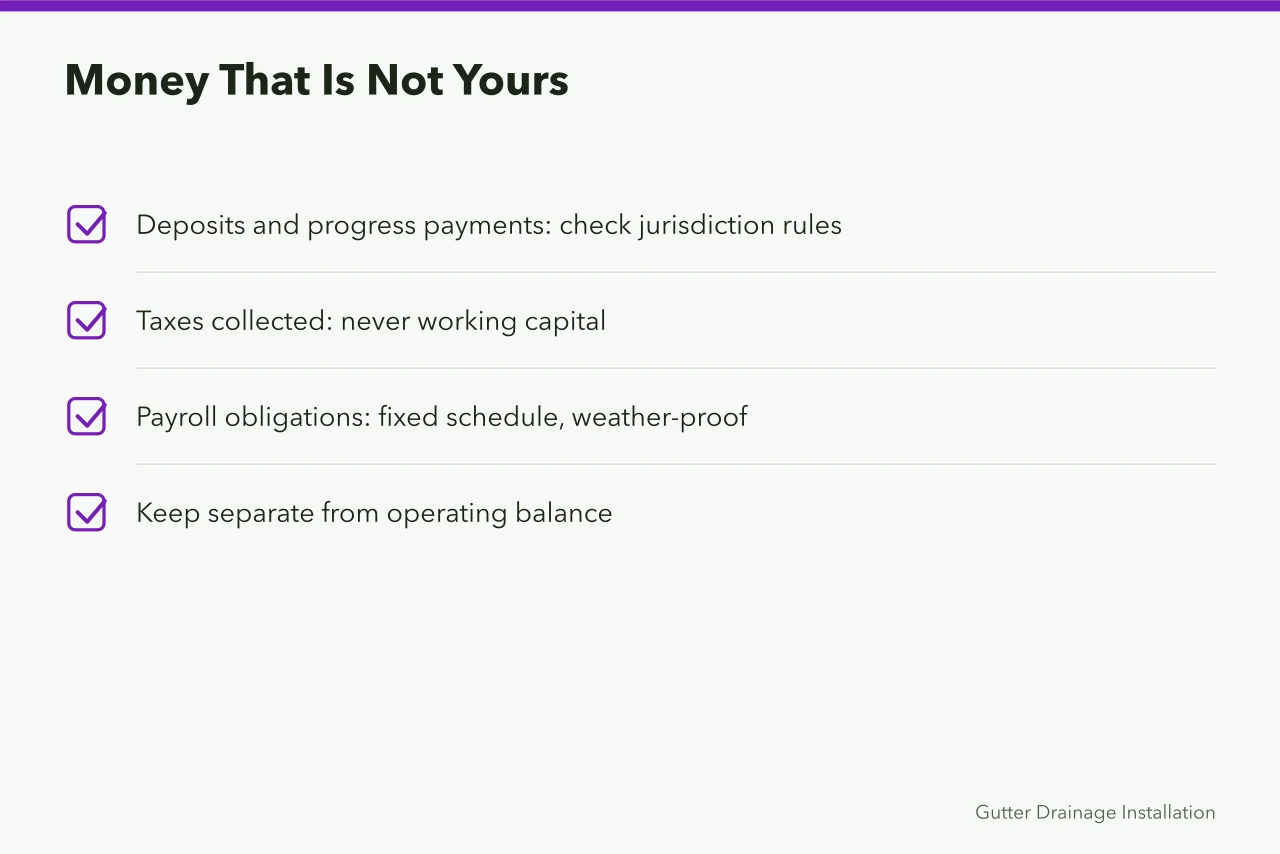
Deposits and progress payments. Rules on holding customer money vary by jurisdiction and by contract, and in some places they are regulated. Ask before you build a business model that relies on them.
Amounts collected for taxes. Whatever applies where you operate, money collected on behalf of an authority is not working capital. Spending it is the most common way a solvent small business becomes an insolvent one.
Payroll obligations. These arrive on a schedule that does not care about the weather.
Keeping those out of the operating balance, mentally or in a separate account, is unglamorous and it prevents the failure mode that closes seasonal businesses.
Where the records have to live
Every one of the routines above runs on the job record: quote, quantities, hours door to door, material, return visits with causes, and payment. The IRS explains what records a small business is expected to keep and why the supporting document matters more than the summary line.
That record now contains customer names, addresses, payment details and often photographs of people's properties. That makes it a security responsibility as well as a bookkeeping one. The National Institute of Standards and Technology publishes quick-start guides for small business cybersecurity, and the Cybersecurity and Infrastructure Security Agency maintains material aimed at small and medium businesses.
The minimum worth doing is short: separate logins per person, multi-factor authentication on email and on anything holding customer data, and a backup you have restored from at least once.
Which system holds it is a separate decision, covered in the software and KPI guide, and the honest answer for one crew is often a spreadsheet kept properly.
Three costs owners miss
Equipment consumables. Coil offcuts, sealant, fasteners and blades are individually trivial and collectively significant, and they are usually bought with cash on a supply run. Categorize them, because they belong in your material cost per job. The buying pattern behind them is in the equipment checklist for new owners.
Downtime. When a machine or a vehicle stops, the cost is the crew day, not the repair. Equipment ownership decisions carry that risk with them, which is set out in the equipment and setup guide.
Training and supervision. Real hours, paid, that never appear on an invoice. They belong in your labor cost per productive hour rather than being treated as free, and the reasoning is in the hiring and training guide.
Common questions
Do I need an accountant?
For the annual filing and for anything with a consequence, yes. For the weekly rhythm, no, and doing it yourself is how you learn what the numbers mean.
Cash or accrual?
That depends on your size, structure and jurisdiction. Ask a professional rather than choosing from a comparison table, because switching later is not free.
How long should terms be?
Short enough that you are not financing the customer. Whatever you choose, print it on the quote and enforce it by a fixed rule rather than case by case.
What is the first sign of trouble?
Receivables ageing while revenue looks fine. It means you are working and not collecting, which is the pattern that catches busy companies.
How much working capital is enough?
Enough to cover fixed costs through your cumulative low point, plus the reserve for the first equipment failure. Your own cash map gives you the number; nobody else can.