Guides
Why coastal, prairie and northern Canada price gutter work differently
Salt air, hail, permafrost and freight push gutter drainage installation pricing apart across Canada, so one national rate card loses money somewhere.
What to take away
- Four regional forces set gutter drainage installation pricing in Canada: salt air corrosion, hail and wind, permafrost and short seasons, and freight to remote communities.
- Atlantic Canada jobs carry a corrosion premium. Coated aluminum and corrosion-rated fasteners cost more than the hourly rate difference between provinces.
- Prairie pricing follows hail and wind exposure, which pushes impact-rated troughs and paid post-storm inspection work.
- Northern pricing is a logistics problem first. Permafrost, a compressed build window and shipping decide whether a contract is profitable.
- One national rate card either overcharges southern markets or loses money in the North. Build one rate card per region.
Why gutter drainage installation pricing differs across Canada
Four variables separate a Halifax quote from a Yellowknife quote. What the air does to metal. What the sky drops on it. How long the ground stays workable. How far the material travels.
Climate drives specification before labour enters the conversation. Salt air, hail, freeze-thaw cycling and permafrost each push a job toward different products, fasteners and warranty terms.
Season length drives scheduling. A crew in Nova Scotia works most of the year with weather delays. A crew in the Northwest Territories works a compressed window and absorbs downtime it cannot bill.
Freight drives the invoice. Gutters are long, light and awkward, so the further a job sits from a distributor, the more of the price is transport.
Market size sets the ceiling on all of it. Statistics Canada publishes the Housing statistics owners use to size a region before committing a crew to it. Owners comparing provinces should read which markets for a gutter service support a full-time crew before buying a second truck.
Salt air and coastal corrosion in Atlantic Canada
Atlantic Canada salt air corrosion is the defining cost in Nova Scotia, New Brunswick, Newfoundland and Labrador, and Prince Edward Island. Coastal air carries chloride that attacks aluminum, steel fasteners and any scratched coating.
Homes within a few kilometres of open water age differently. Hangers pit, screws seize, painted finishes chalk faster. A job that looks identical to an Ontario job on paper is not identical in service life.
Specification responds in predictable ways: heavier gauges, coated or painted aluminum, fasteners rated for corrosive environments.
The warranty conversation changes with it. A manufacturer's standard finish warranty assumes normal exposure, and a shoreline property is not normal exposure. Put that in writing before the work starts.
Maintenance intervals shorten because corrosion, not debris, is the failure mode. That supports recurring service contracts, which is where the pricing and profit side of a coastal business gets steadier.
Wind adds a second coastal cost. Atlantic storms and nor'easters pull at fascia and downpipe brackets, so attachment details deserve as much attention as the trough.
Hail and wind exposure across the Prairies
Prairie hail exposure in Alberta, Saskatchewan and Manitoba turns gutters into impact surfaces. One storm can dent troughs, crack downpipe joints and drive water behind fascia.
Hail damage is rarely uniform. One side of a roof takes the hit while the other is untouched, so inspection, not replacement, is the first billable step after a storm.
Wind compounds it. Open prairie terrain gives wind a long run at a house, and a loosely hung gutter becomes a projectile. Hanger spacing and fastener choice are the defence.
Product selection shifts toward impact resistance. Thicker aluminum, steel where weight allows, and joints that flex rather than crack cost more up front and less over a decade of storms.
Scheduling follows the storm calendar. Prairie crews keep capacity free in the hail months for inspection and repair, then return to installation and cleaning in the shoulder seasons.
Insurance work changes the paperwork. Property and water damage guidance from Canadian insurers shapes how claims are documented, so photograph conditions and record product details on every post-storm call.
Permafrost, short seasons and shipping costs in Northern Canada
Northern Canada permafrost and shipping costs decide whether a northern contract is worth signing. Yukon, Northwest Territories and Nunavut share a short work window and long supply lines.
Permafrost complicates the ground, not the gutter. In communities built on frozen ground, settling and frost heave move foundations and eaves, so downpipe discharge points need to tolerate movement rather than fight it.
The build season is compressed. Material has to arrive before the window opens, and a late shipment does not delay one job, it delays the season.
Shipping costs materials by weight and volume. Gutters are bulky, so freight can rival the product cost on a remote delivery. Barge, road and air each carry different lead times and different risk of damage in transit.
Labour is scarce and expensive. Skilled trades are limited in small communities, and travel, accommodation and rotation costs for outside crews belong in the quote rather than in a year-end surprise.
Winter work is mostly reactive. Emergency repairs happen in conditions where a ladder is unsafe, so northern owners price those calls with the same care they price a full installation. Work at height is governed by the applicable provincial or territorial authority and CSA standards, and belongs with certified training, not a price list.
The CMHC About CMHC | CMHC page explains the national housing body's role, which helps owners frame northern work inside the wider Canadian housing picture.
Materials, scheduling and contract pricing from Halifax to Yellowknife
A Halifax to Yellowknife pricing comparison is really a comparison of four cost lines: product, freight, labour and risk. Each region loads a different one.
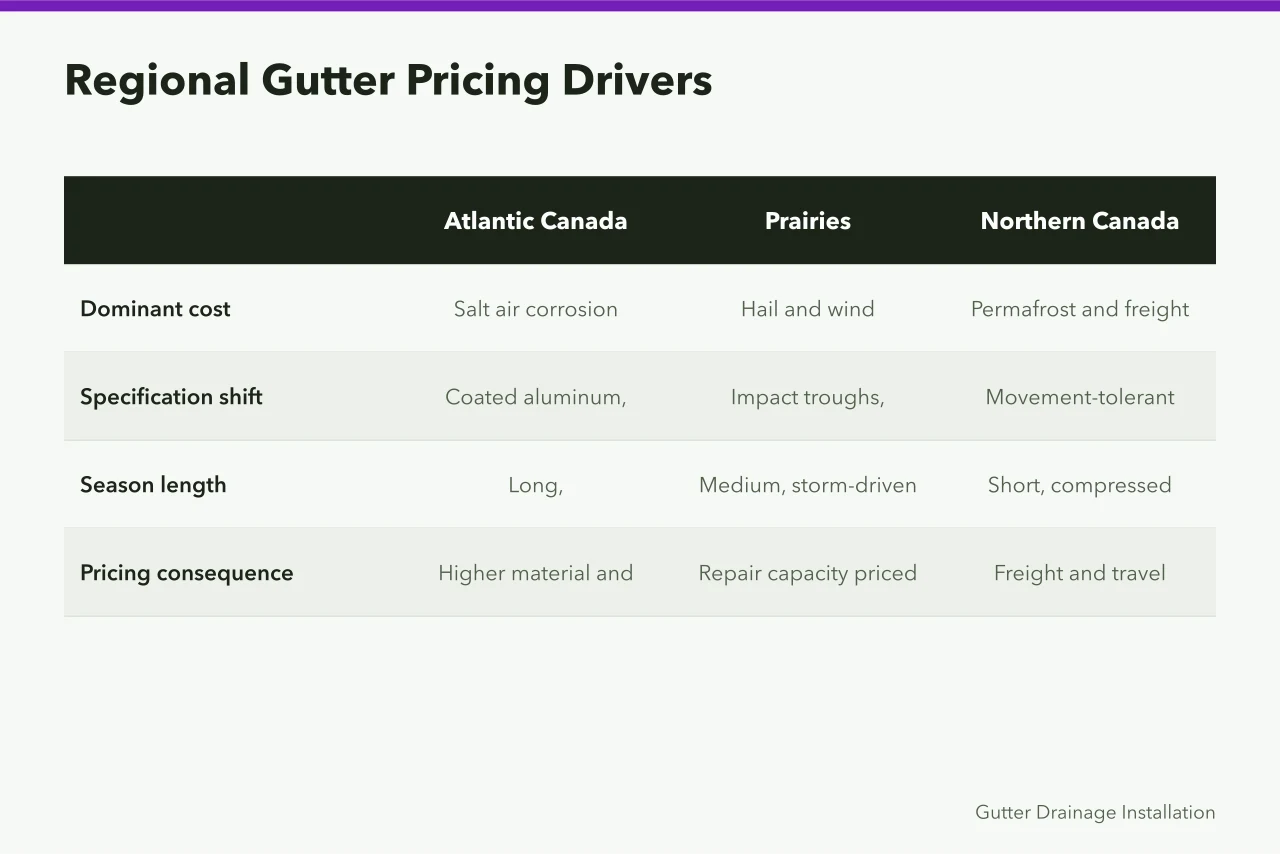
| Region | Dominant cost driver | Specification shift | Season length | Pricing consequence |
|---|---|---|---|---|
| Atlantic Canada | Salt air corrosion | Coated aluminum, corrosion-rated fasteners | Long, storm-interrupted | Higher material and warranty allowance |
| Prairies | Hail and wind | Impact-resistant troughs, tighter hanger spacing | Medium, storm-driven spikes | Repair capacity priced separately |
| Northern Canada | Permafrost and freight | Movement-tolerant discharge, sturdy fixings | Short, compressed | Freight and travel billed explicitly |
| Southern Ontario and BC | Competition and volume | Standard specification | Year-round | Margin comes from efficiency |
Contract pricing should name the region's dominant risk. A coastal contract that says nothing about corrosion invites a callback argument. A northern contract that hides freight invites a loss.
Scheduling differs by region too. Coastal work absorbs rain delays, Prairie work absorbs hail spikes, northern work absorbs a hard stop when the season closes.
Payment terms should follow the risk. Northern jobs justify deposits that cover material and freight before dispatch. Coastal and Prairie jobs justify maintenance plans that spread cost across the year.
Owners who want a defensible number rather than a guess should work through how to price gutter service jobs with regional inputs instead of a national average.
CMHC Northern Housing Report context for northern pricing
The Northern Housing Report is the reference most northern owners reach for when they need to explain conditions to a southern supplier, lender or insurer. It covers housing and climate realities in Yukon, Northwest Territories and Nunavut.
Use it to justify the parts of a quote that look unusual to an outside reader: short seasons, remote logistics and the maintenance burden that comes with them.
The national supply picture matters as well. The Fall 2026 Housing Supply Report | CMHC tracks residential construction activity, which is the pipeline that eventually needs gutters.
Northern work also sits inside the National Building Code of Canada and territorial adaptations. Confirm which code edition applies, and have a licensed engineer or building official settle attachment and sizing questions, before specifying details.
Workers' compensation coverage varies by jurisdiction, and northern jobs often involve travel. Confirm registration and coverage before a crew leaves home.
Building a regional pricing model for gutter work
A regional pricing model is a rate card per region, not one national number with a travel surcharge bolted on. Build it in five steps.
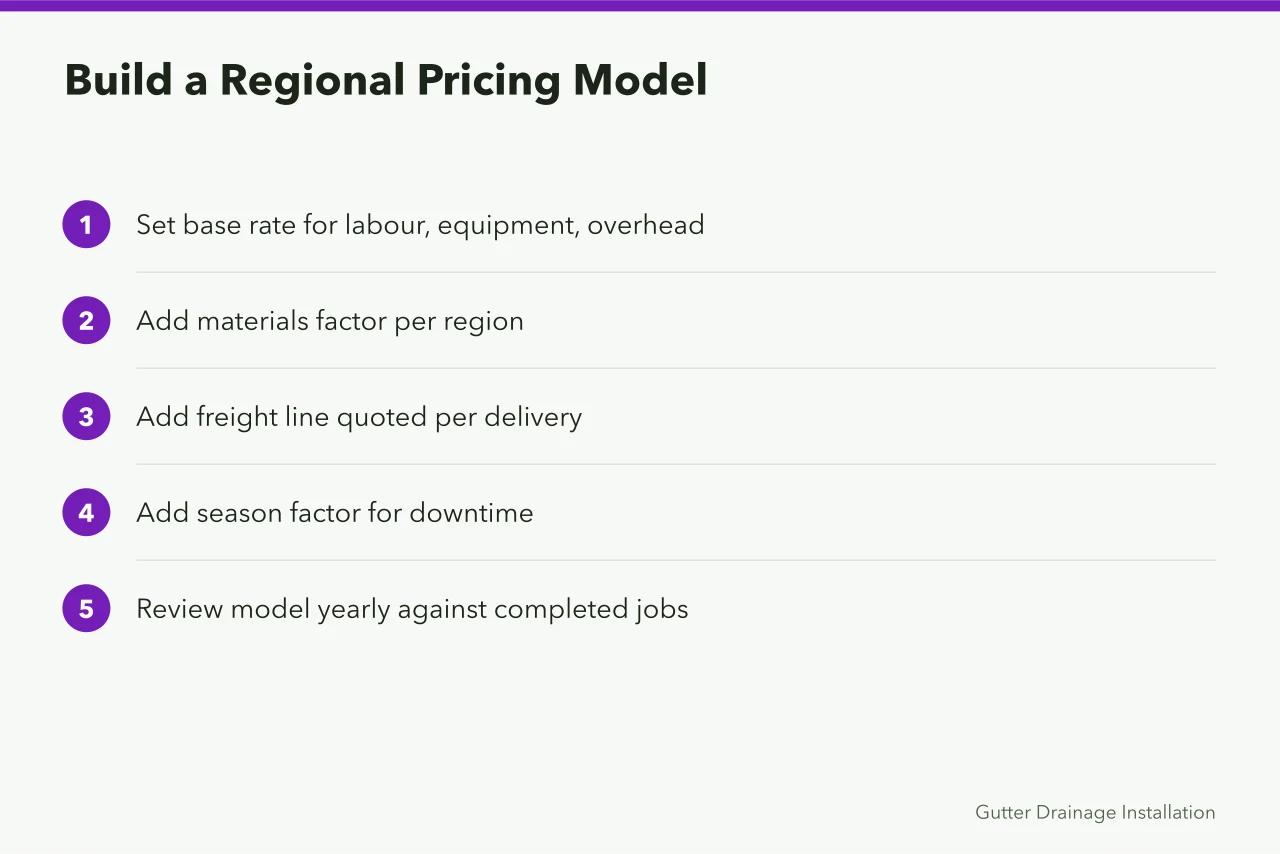
- Set a base rate for labour, equipment and overhead in your home region, then record what each job actually consumes.
- Add a materials factor per region: a corrosion factor for Atlantic Canada, an impact factor for the Prairies, a movement and durability factor for the North.
- Add a freight line that reflects real shipping costs to the specific community, quoted per delivery rather than averaged.
- Add a season factor that prices the downtime a short window creates, so northern work is not subsidized by southern volume.
- Review the model each year against your own completed jobs, and adjust the factors rather than the base rate.
A 45-metre detached home in Halifax with coated aluminum and corrosion-rated fasteners prices higher on materials than an identical home in Winnipeg, where the same home instead carries a hail allowance and a post-storm inspection visit.
A similar home in Yellowknife adds freight and travel to the same specification, and the season factor covers the weeks the crew cannot work. Three houses, three numbers, one method.
Track the unit economics of each region separately. A blended average hides the region that is quietly losing money.
Before adding a second region, check whether the business expands sensibly with the crew and equipment already owned, because a new region multiplies logistics before it multiplies revenue.
Checklist for a regional quote:
- Region's dominant risk named in the contract
- Materials specified for corrosion, impact or movement
- Freight quoted per delivery, not averaged
- Season length reflected in the schedule and price
- Travel and accommodation billed where crews rotate
- Maintenance interval stated for the exposure
- Applicable code edition and workers' compensation coverage confirmed
Common questions
Why does the same gutter job cost more in Halifax than in Winnipeg?
Salt air corrosion forces coated aluminum and corrosion-rated fasteners, and coastal storm exposure shortens the maintenance interval. The labour is similar, the specification is not.
How does hail change Prairie gutter pricing?
It adds an impact allowance and a repair capacity plan. Crews keep room in the hail months for inspection and insurance documentation rather than treating storms as unbillable disruption.
Why is northern gutter work priced so much higher?
Freight, travel, a compressed season and scarce trades all land in the quote. Permafrost movement also pushes discharge details toward products that tolerate settling.
Can one national price list work?
No. A single rate either overcharges dense southern markets or loses money in the North. Use one method with regional factors instead.