Guides
Ice damming on Edmonton and Winnipeg roofs, a winter guide for gutter work
Gutter drainage installation in Edmonton and Winnipeg must handle ice damming, snow load, attic heat loss and freeze-thaw cycles, plus NRCan envelope guidance.
What to take away
- An ice dam needs three things at once: snow on the roof, heat leaking from the house, and an eave cold enough to refreeze the melt.
- Edmonton and Winnipeg supply all three for months, so the weak points on a Prairie roof are predictable.
- Eavestrough sizing, slope, hanger spacing and downspout discharge decide where the spring melt ends up.
- Natural Resources Canada puts insulation, air sealing and ventilation ahead of hardware, and that order is the right one.
- Photographs with dates, plus the installation invoice and maintenance record, carry most of an ice dam insurance claim.
How ice dams form on Edmonton and Winnipeg roofs
An ice dam is a ridge of ice at the eave that blocks meltwater. Water pools behind it, works under the shingles and finds a path indoors.
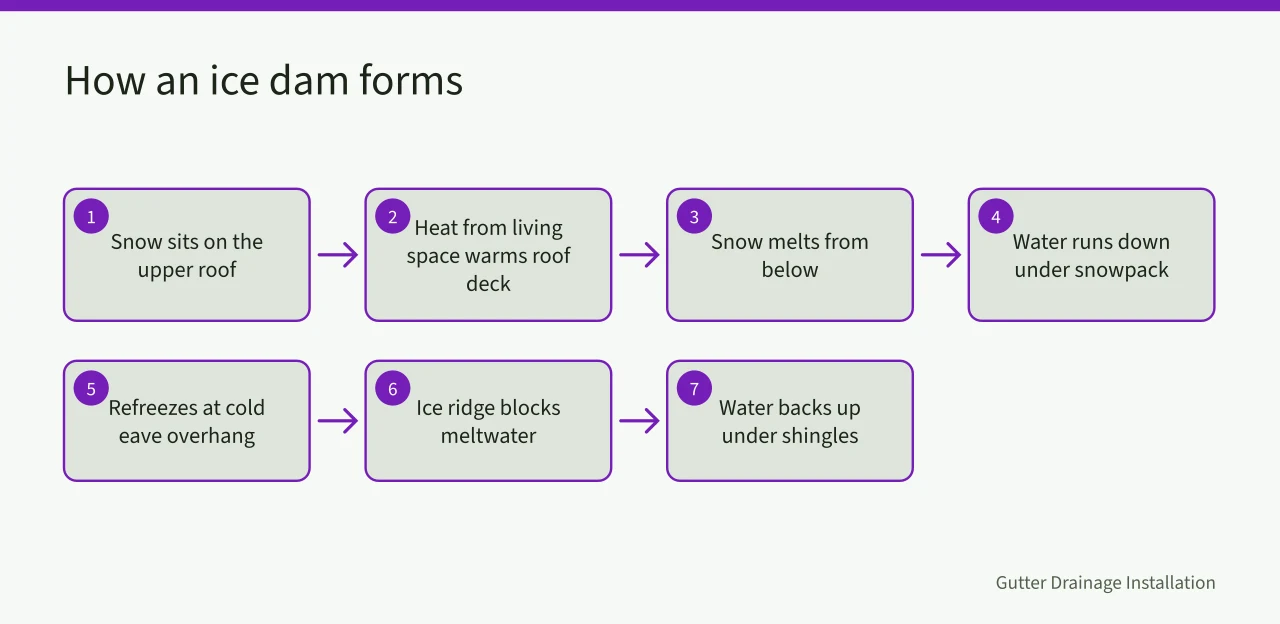
The mechanism is simple. Snow sits on the upper roof. Heat escaping from the living space warms the roof deck and melts the underside of that snow. Liquid water runs down the slope under the snowpack until it reaches the eave, which overhangs the heated wall and stays near outdoor temperature. It refreezes there.
Each melt-and-freeze cycle adds a layer. A dam a few centimetres high is enough to back water up the roof, and once the water sits above the eave line, gravity and capillary action push it under the shingle courses.
Both cities sit in a continental climate with long winters, deep frost and a snowpack that stays put. Edmonton runs cold and dry with heavy snow load. Winnipeg runs colder still, and its spring melt arrives in a compressed window.
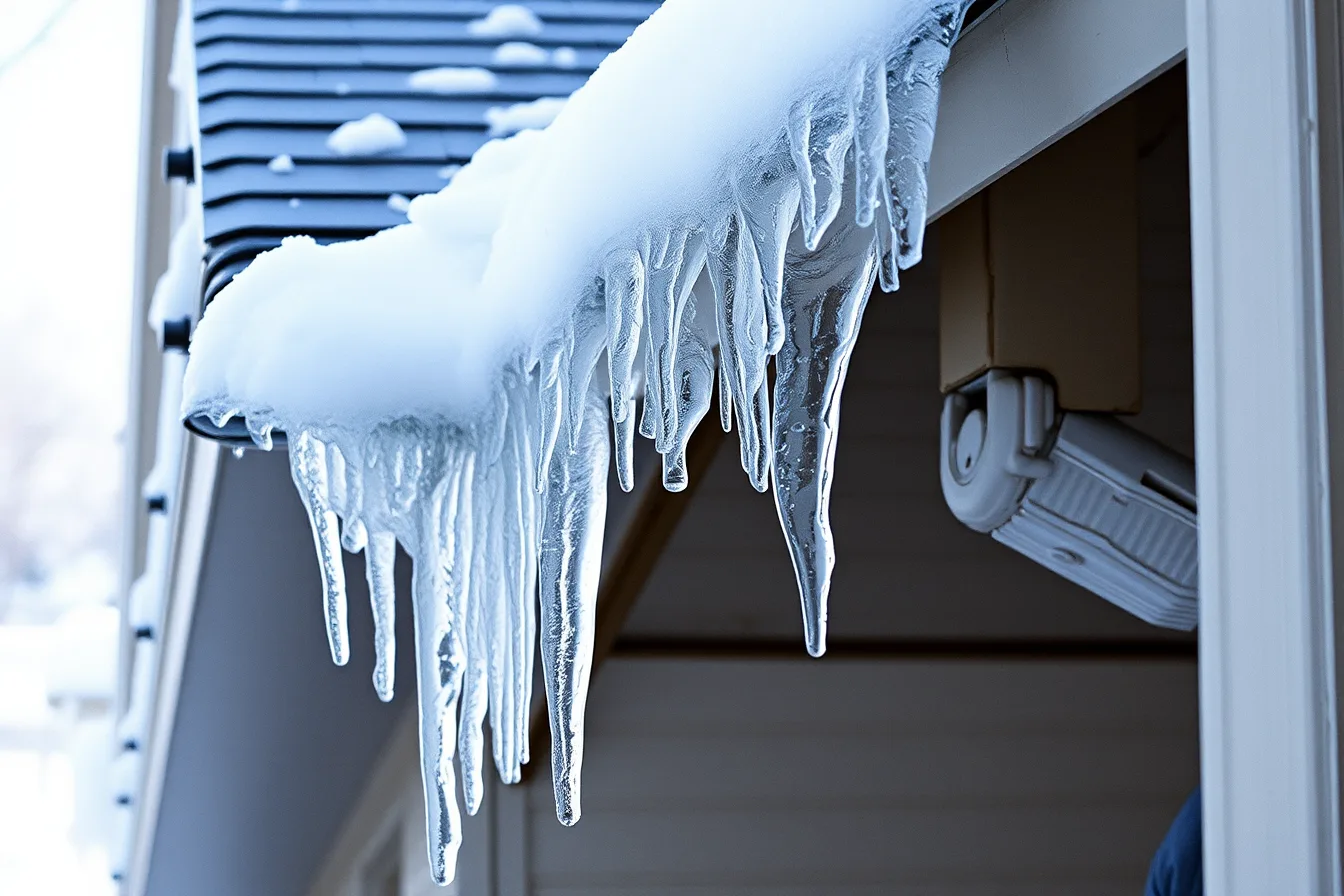
The eave is where the damage shows first. Staining on the soffit and fascia comes before ice at the trough, icicles along the gutter line, water in the attic, stained ceilings, lifted shingles and rot at the roof deck.
What the eavestrough does to the eave temperature
A gutter packed with ice and snow holds the cold and gives the refreeze a place to start. A trough that drains freely lets meltwater leave the roof instead of pooling at the edge.
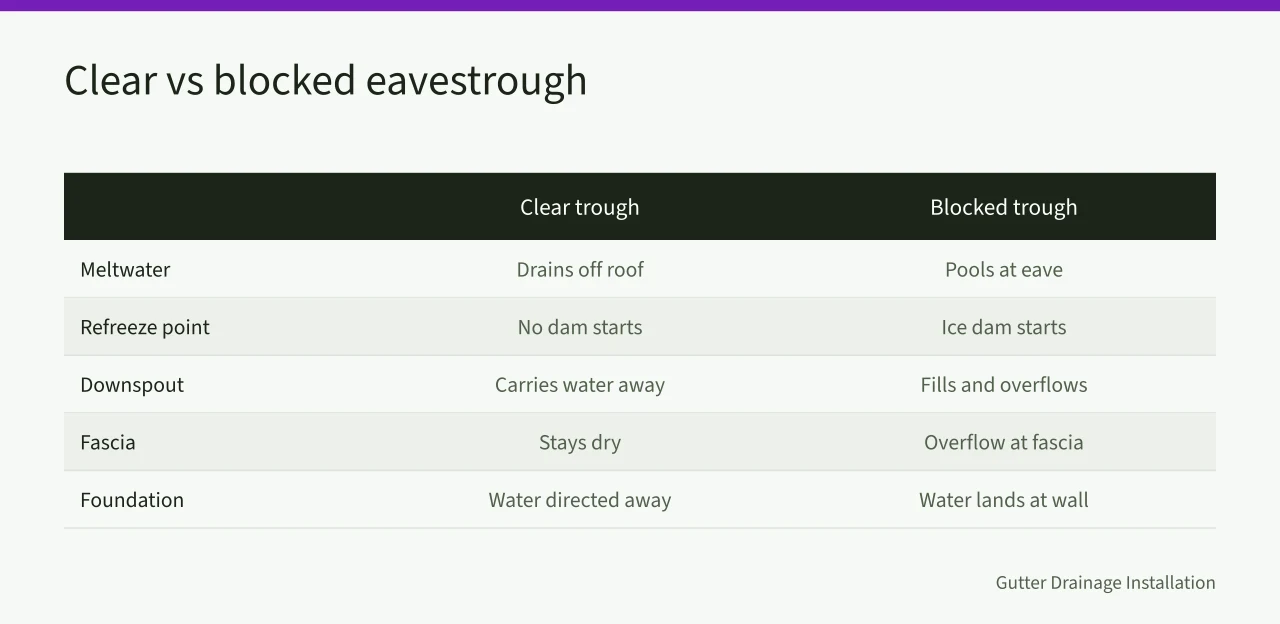
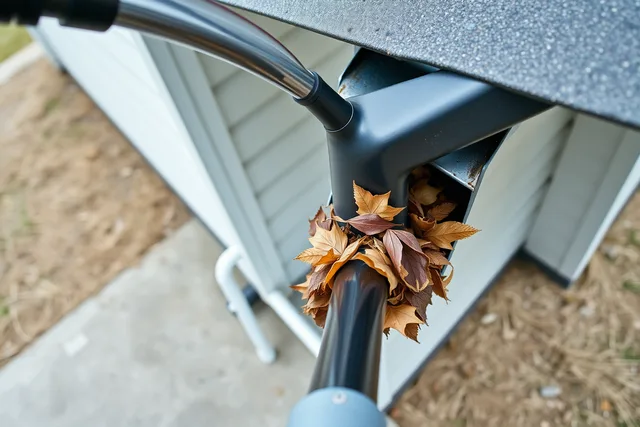
Downspouts matter just as much. A blocked downspout fills the trough, which backs up and overflows at the fascia. That overflow lands on the foundation, the walkway and the siding, and in Winnipeg a fast melt gives it nowhere else to go.
Homes with a history of damming usually share a profile: a heated attic, blocked soffit vents, a north-facing slope that never sees sun, and a trough that has not been cleared since autumn. Fixing one item helps. Fixing the set is what stops the dam.
Snow load, attic heat loss and freeze-thaw cycles
Snow load is the weight of snow and ice on the roof. It is a structural number and a drainage number at the same time. A heavy snowpack insulates the deck, which keeps it warmer and slows refreezing at the eave, and when the snow finally goes it arrives all at once.
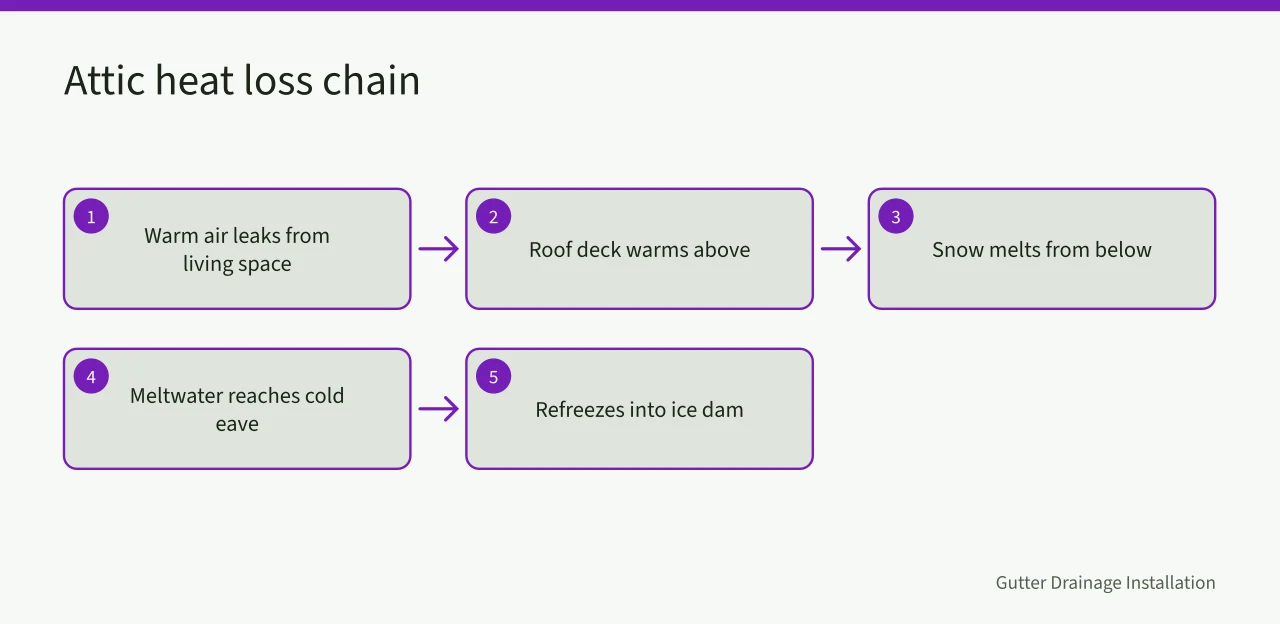
Attic heat loss is the engine. Warm air leaking from the living space warms the roof deck above it, and the warmer the deck, the more snow melts from below. Air leaks around hatches, light fixtures, chimneys and ductwork do most of that work.
Insulation slows heat transfer but does not stop air movement. A well-insulated attic with a leaky ceiling plane still melts snow, which is why air sealing and insulation are usually done together and why the order matters.
Ventilation is the third leg. Intake at the soffit and exhaust at the ridge keep the attic close to outdoor temperature. Blocked soffit vents are common after a bad winter, because insulation, snow or a careless repair can cover them.
Freeze-thaw cycles tie the two together. Around freezing, water in a trough expands as it freezes and pushes the gutter away from the fascia, then thaws and pushes again. That cycle breaks hangers, opens seams and cracks downspout elbows, and on the Prairies it causes more eavestrough failure than a single heavy snowfall.
NRCan guidance on insulation and moisture in the building envelope
Natural Resources Canada publishes guidance for the building envelope, which is the roof, walls, windows and foundation, and its job is to separate indoor air from outdoor air.
The energy efficiency for buildings material covers envelope and moisture considerations, which is the frame that fits ice damming. Moisture moves with air, so stopping the air slows the moisture and also slows the roof melt.
For homeowners, the energy efficiency for homes guidance covers insulation and air sealing in terms a homeowner can act on. It is the right starting point before anyone quotes new eavestrough.
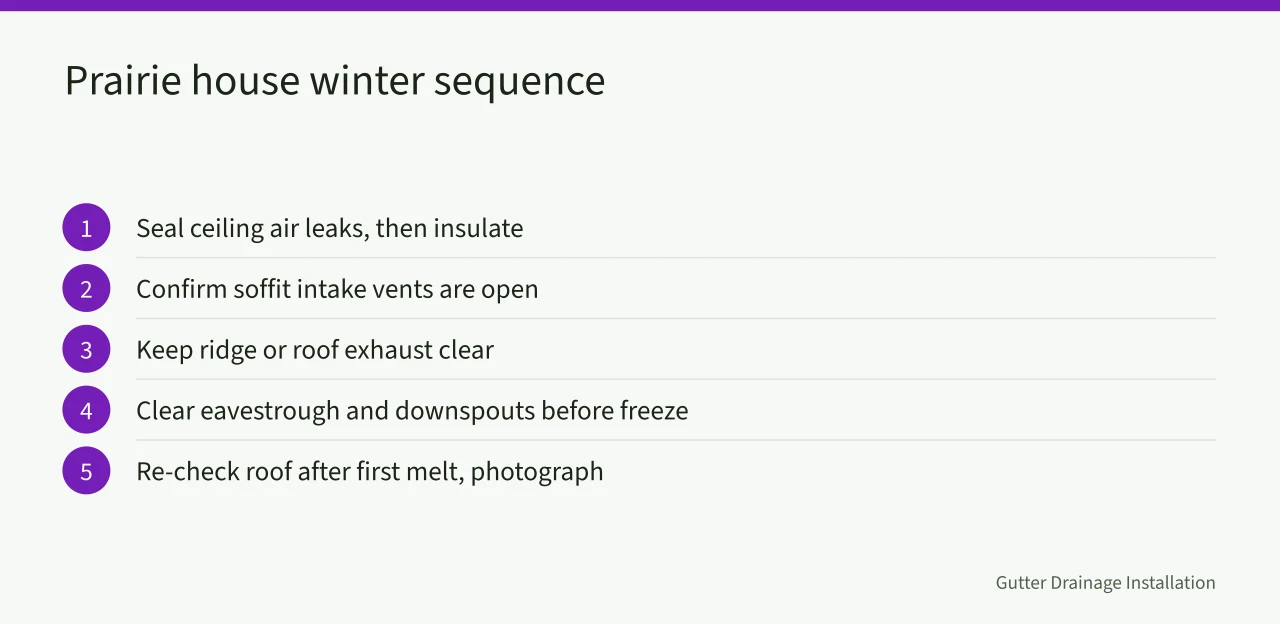
A practical sequence for a Prairie house:
Roof drainage hardware has its own code path. The National Building Code of Canada, administered by the National Research Council, sets out roof drainage and eavestrough provisions that provincial codes adopt or adapt, and the NRC codes centre is where those requirements live.
Sizing, slope and downspout capacity are not styling choices. They are set by the roof area they drain and by the rainfall and snowmelt the region expects, which is a determination for a licensed engineer or your local building official rather than a rule of thumb.
Sizing the market is a separate question, and it is where national housing statistics help. Building permit and housing data show how much stock exists to service in each city, which is the honest way to plan crews and routes rather than guessing.
What eavestrough and downspout work prevents
Eavestrough work cannot stop attic heat loss, but it decides where the meltwater goes. That is the whole job in a Prairie winter: move water off the roof and away from the foundation before it refreezes.
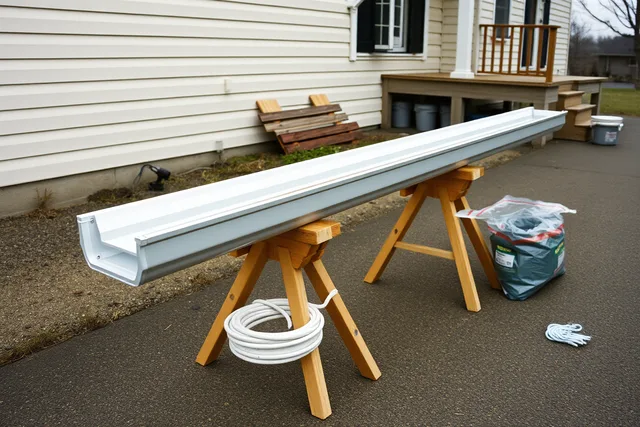
A trough too small for the roof area overflows at the fascia during a fast melt. Wider trough and larger downspouts cost more up front and fail less often in March.
Slope comes next. Water has to reach the outlet before it freezes. A trough that is level, or worse, back-sloped, holds a puddle that freezes overnight and starts the dam.
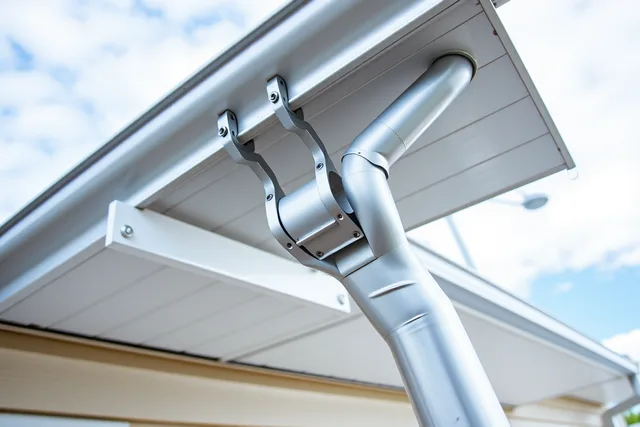
Hangers and fasteners hold the run through freeze-thaw. Ice in a full trough adds weight that a sparse hanger pattern will not carry, and reusing the old holes is a common shortcut and a common callback.
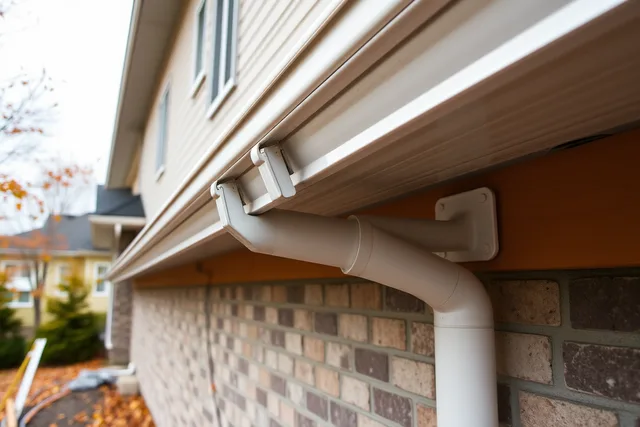
Downspout discharge is the part homeowners notice last and insurers notice first. The downspout has to carry water to a point where it can leave the property, ideally onto a splash pad or into a drainage path that slopes away from the foundation. A downspout that ends at the wall sends meltwater into the basement.
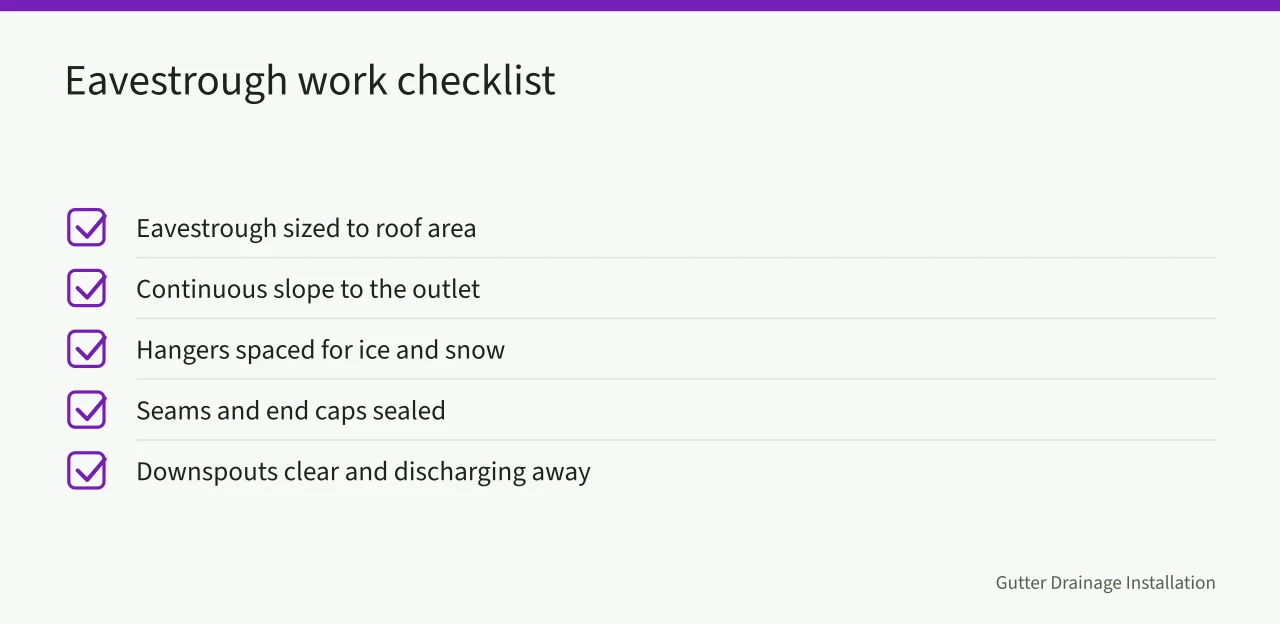
- Eavestrough sized to the roof area, not to the old trough.
- Continuous slope to the outlet, checked with a level.
- Hangers spaced for ice and snow weight, not just for water.
- Seams and end caps sealed for freeze-thaw movement.
- Downspouts clear, fastened and discharging away from the foundation.
- Soffit vents clear and not blocked by the gutter or by insulation.
- Photographs of the finished run, taken from the ground and at the outlet.
Gutter guards are a separate decision. In Edmonton and Winnipeg, a fine mesh that clogs with ice is worse than an open trough that can be cleared, so a guard has to shed snow rather than trap it.
A crew that follows written operating standards will catch most of this before the first freeze. The standard should name the slope tolerance, the hanger spacing and the discharge distance, so two installers produce the same result.
Winter scheduling and material choices for gutter drainage installation
Winter work in Edmonton and Winnipeg is possible, but it is a different job. Sealants need a temperature range, metal is brittle when it is very cold, and ladders on ice are a genuine hazard.
Roof-edge work belongs to a crew with fall protection training and coverage; WorkSafeBC, CNESST and the CSA publish the requirements that apply, and OSHA covers the same ground for cross-border crews.
The practical calendar runs in two seasons. Late summer and early autumn are for replacement, re-sloping and downspout work, done while the roof is clear and the sealants will cure. Late winter and early spring are for repairs after the melt, when the damage is visible and the ground is firm enough to work.
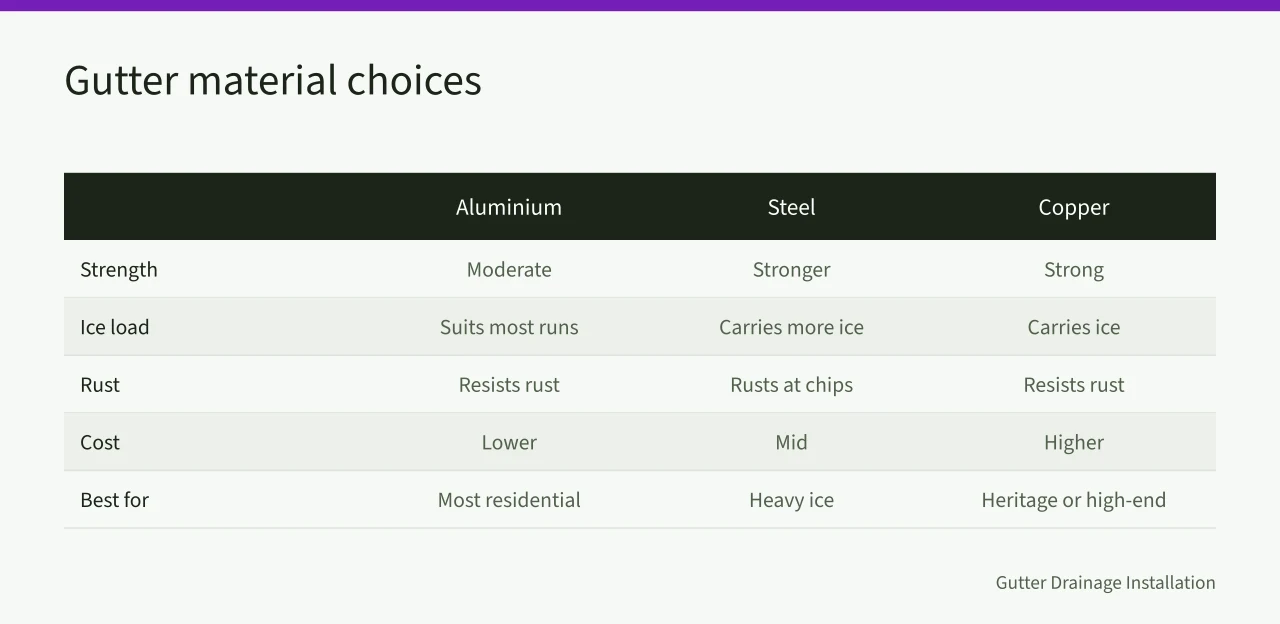
Materials hold up differently across a Prairie winter. Aluminium moves with temperature and resists rust, which suits most residential runs. Steel is stronger, carries more ice, and rusts where the finish chips. Copper lasts and costs more, and it is usually a heritage or high-end choice.
Sealants matter more than most homeowners expect. A sealant rated for cold application stays flexible through freeze-thaw. A general-purpose caulk cracks by January and opens the seam it was meant to close.
Fasteners should be corrosion-resistant and long enough to bite into sound wood. Scheduling is where a small operator wins or loses the season: book autumn work early, because everyone calls after the first snowfall, and keep a repair slot open in late winter for the calls that always come.
If you are pricing this work, a quote template with line items for removal, disposal, materials and disposal fees keeps the conversation short. Homeowners in both cities compare quotes closely, and a clear scope is the difference between a signed job and a callback.
For planning beyond this season, the gutter service equipment brands owners buy twice for 2027 point the same way: more repair, more documentation, and more homeowners asking about drainage rather than cleaning.
Documenting ice dam damage for homeowners and insurers
An ice dam claim lives or dies on evidence. The adjuster was not on the roof in February, so your photographs and notes are the record of what happened and when.
Photograph in a fixed order:
- the full roof from the street
- the eave line
- the ice at the trough
- the soffit and fascia
- the attic side of the roof deck
- the interior stain Include something for scale, such as a tape measure or a hand tool.
Note the date and the weather at the time of each photo. A sequence that shows the dam growing, then the interior stain appearing, tells a clearer story than a single dramatic image.
Keep the paperwork together. The original installation invoice, the maintenance record and any prior repair receipts show the property was maintained, and the Insurance Bureau of Canada publishes property and water damage guidance that reflects how much weight that history carries.
For the homeowner, the practical checklist is short:
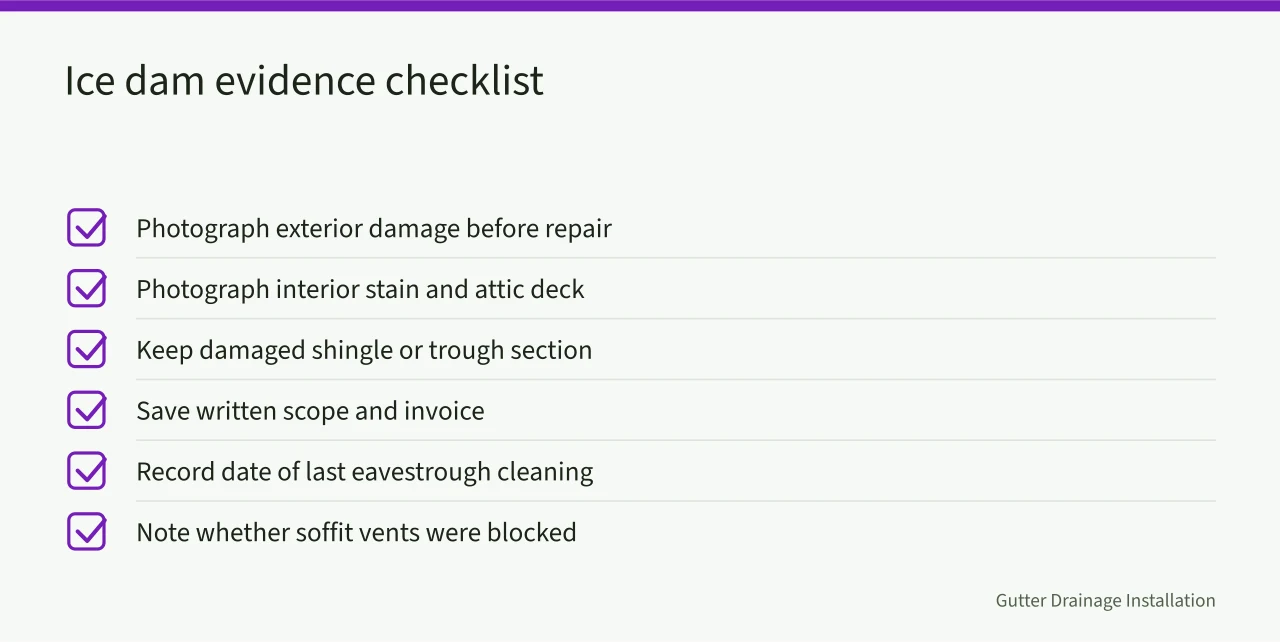
A documented job also protects the contractor. A quality assurance checklist signed at handover shows what was installed and what was excluded, which ends most disputes before they start.
The same records feed the next season. If a run failed at the same eave twice, the notes tell you whether the cause was slope, hanger spacing or attic heat loss, and that is how a repair becomes a fix.
Equipment choices show up here too. Cameras, moisture meters and the ladders and lifts you use on a Prairie roof all affect how well you can document a claim. The equipment reviewed for this trade is worth checking before a winter season, because a tool that fails at minus twenty costs a day.
Common questions
Does gutter drainage installation stop ice dams?
No. It controls where meltwater goes. Stopping the dam needs air sealing, insulation and ventilation to keep the roof deck cold.
Which city has the harder winter for gutters?
Winnipeg runs colder and its spring melt is compressed, which puts more demand on downspout capacity. Edmonton's heavy snow load stresses hangers and fasteners.
When should eavestrough work be booked in Edmonton or Winnipeg?
Late summer to early autumn for replacement and re-sloping. Late winter for repairs, once the melt reveals the damage and the ground is workable.
What does an insurer want to see after an ice dam claim?
Dated photographs of the exterior and interior damage, a maintenance record, and the written scope and invoice for the repair.