Guides
What Size Gutter Drain Pipe Do I Need for My Roof?
What size gutter drain pipe you need depends on roof area and peak US rainfall. A 2 by 3 inch downspout carries about 600 square feet of roof.
What to take away
- A 2 by 3 inch downspout handles roughly 600 square feet of roof at a 1 inch per hour rain; a 3 by 4 inch handles about 1,200 square feet.
- The hard limit is the outlet, not the gutter. A 6 inch gutter feeding a 2 by 3 inch downspout still fails.
- One downspout per 35 to 40 feet of gutter run is the floor, regardless of pipe size.
- If your roof area exceeds 1,200 square feet per outlet, you have run out of standard residential parts.
The constraint in inches and square feet
Downspout capacity depends on cross section and how fast water leaves the outlet. At a 1 inch per hour rain, a 2 by 3 inch rectangular downspout carries about 600 square feet of roof. A 3 by 4 inch carries about 1,200.
A 3 inch round pipe sits near 700 square feet, and a 4 inch round near 1,200.
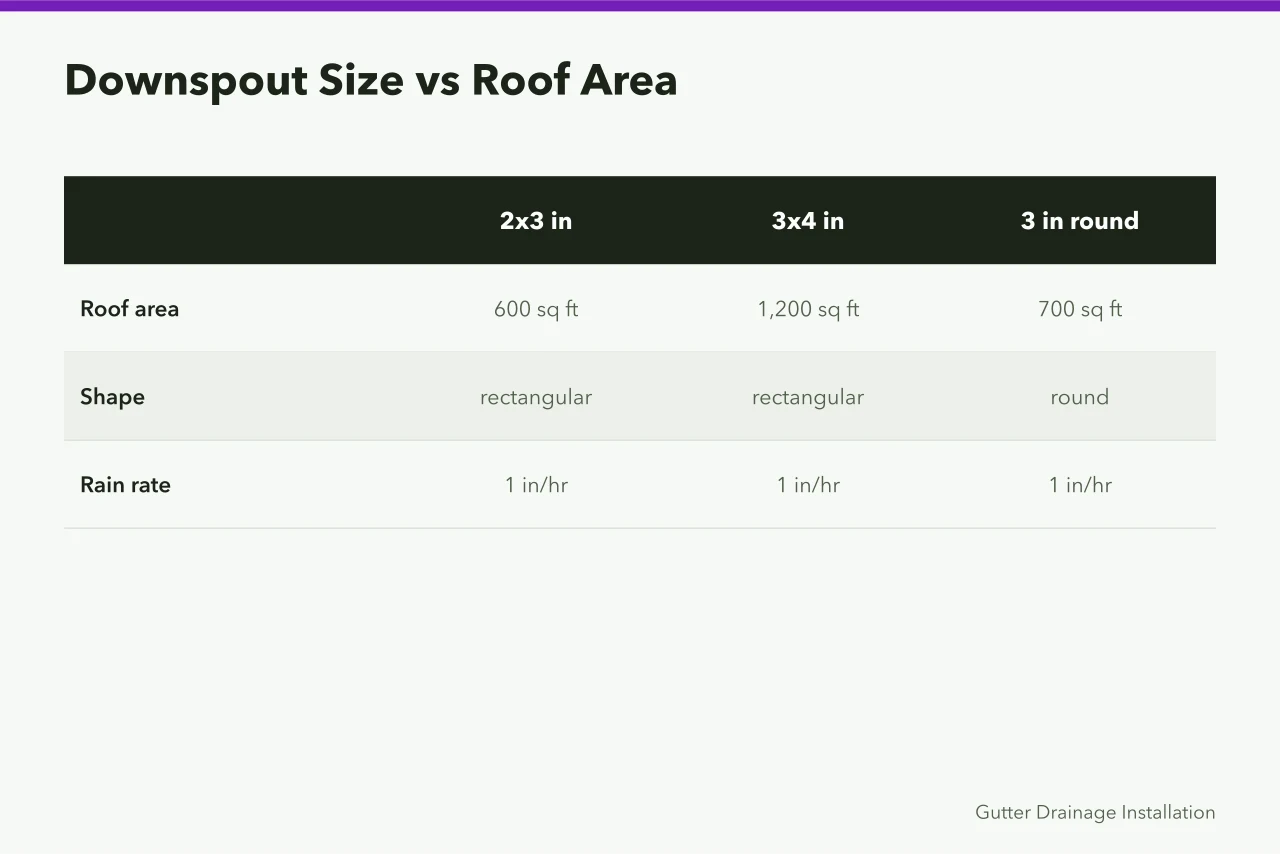
These are illustrative planning figures, not code values. Your local rainfall intensity is the number that matters, and it comes from the National Weather Service rainfall frequency atlas, not from a chart on a supplier's page. In a Gulf Coast city the one-hour intensity is far higher than in Phoenix, so the same roof needs a bigger outlet there.
What the constraint rules out
A 2 by 3 inch downspout is ruled out for any roof plane over about 600 square feet at 1 inch per hour. That covers most two-story front elevations and nearly every detached garage with a wide span.
A 3 inch round pipe is ruled out where the run exceeds 20 feet with elbows. Friction in the bends eats capacity, and the pipe was marginal to begin with.
A single downspout is ruled out for a run over 40 feet. Water reaches the far end of the gutter after the near end is already full.
- Measure roof footprint, not gutter length
- Find your local 1-hour rainfall intensity
- Count existing outlets before buying pipe
- Check every elbow and reducer for a size drop
What still works
Increasing outlet count is the cheapest fix and it does not touch the gutter. Two 2 by 3 inch downspouts on a 900 square foot plane beat one 3 by 4 inch downspout, and the parts cost less.
Sizing up the pipe works when the gutter can feed it. A 5 inch gutter with a 3 by 4 inch outlet is a standard, well-stocked combination at most US building suppliers. A 6 inch gutter with the same outlet works on longer runs because the gutter itself holds more water between surges.
The Wikipedia overview of rain gutters is a fair starting point on how these parts fit together before you order anything.
The compromises worth making
Switching from a 2 by 3 inch to a 3 by 4 inch downspout on an existing 4 inch gutter is worth it if the gutter has room at the outlet. The pipe costs a few dollars more per length and the hangers rarely need moving.
Adding a second outlet at the low end of a sloped run is worth it. The labor is a hole saw, a seal, and an hour.
Extending discharge away from the foundation is worth it in every case. Our notes on downspout disconnection rules explain why the outlet end matters as much as the inlet. Federal guidance on flood risks to homes covers what happens when that discharge lands next to the wall.
The compromises that are not worth it
Reducing a 3 by 4 inch downspout to a 2 by 3 inch pipe to fit an old drain is not worth it. You have spent money to move the bottleneck downstream.
Adding a gutter guard to fix an undersized outlet is not worth it. The guard keeps debris out; it does nothing for capacity. The gutter guard overview makes the same point.
Running a long horizontal pipe underground to a distant storm drain is usually not worth it. Each foot of flat run costs head, and the pipe silts up. The storm drain overview shows how these systems are meant to be laid out.
When to stop and do it properly
Stop when the roof plane exceeds 1,200 square feet per outlet. At that point you are choosing between commercial-size downspouts, a siphonic system, or a redesign of the roof drainage. None of those is a weekend job.
Stop when the calculated pipe size exceeds what the gutter can feed. If your numbers say 4 inch round and your gutter is 4 inch K-style, the gutter is now the constraint.
Stop when water backs up under the gutter during a normal storm. That is a capacity failure, not a cleaning problem, and it will not clear on its own.
A crew that has sized hundreds of these jobs keeps a short reference sheet. Our employee training checklist shows how that sheet gets handed to a new hire on day one.
Common questions
Is 4 inch or 6 inch gutter better for a big roof? 6 inch, if the downspouts match. A 6 inch gutter with 2 by 3 inch outlets behaves like a 4 inch gutter with a clog. Size the outlet first, then the gutter.
How many downspouts does a 200 foot gutter run need? At least five, spaced 35 to 40 feet apart. Fewer than that and the middle of the run sags under the weight of standing water.
Can I just add a bigger downspout to a 4 inch gutter? Sometimes. The outlet opening in the gutter has to be cut larger, and the hangers near it may need to move. If the gutter is thin aluminum, the cut can distort the profile.
Does pipe shape matter, round or rectangular? Round flows better for the same cross section. Rectangular fits tight against a wall. Capacity charts are published for both, so compare square inches rather than shape.