Guides
The gutter service equipment brands owners buy twice for 2027
Five gutter equipment brands owners end up replacing, and the parts, profile and service questions that decide whether the second purchase is needed.
What to take away
- The five gutter service equipment brands owners buy twice are New Tech Machinery, KWM Gutterman, Englert, Roller Die + Forming and Van Mark. Each one gets replaced over a thin parts bench, an unpublished profile or a phone that goes unanswered in October.
- Ask for the current lead time on the three parts that wear first. A supplier who answers from memory has a parts operation; one who never calls back has told you what October feels like.
- Score answers before you hear a price. Price after a fair comparison is a decision; price before one is an anchor.
- Anything scored none on specification, parts, warranty or guarding ends the evaluation regardless of price.
- Keep every written answer filed with the invoice and the serial number.
The five gutter service equipment brands owners buy twice
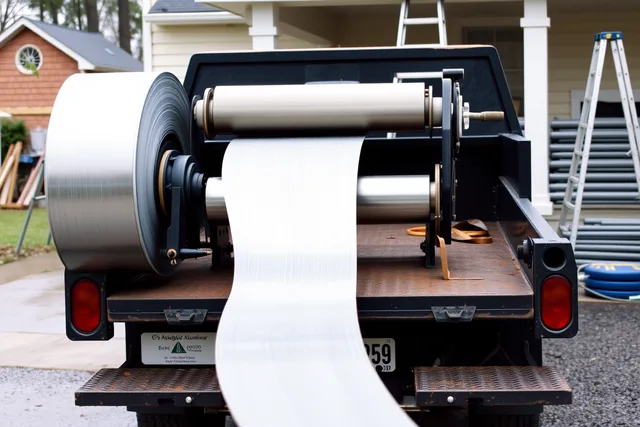
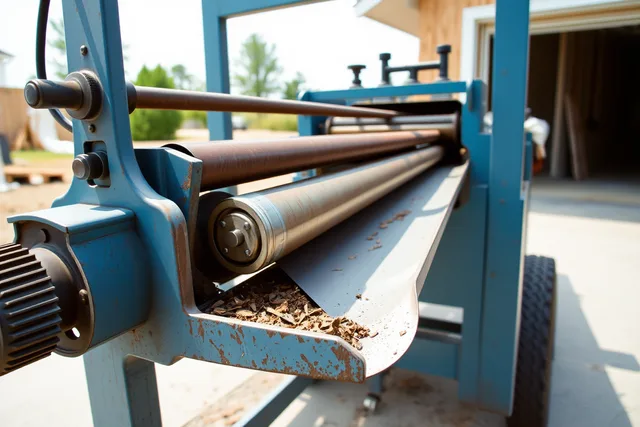
A gutter machine is a coil-fed roll former, and the metal it bends is commodity. What separates the makers is the parts bench behind the machine, the published profile, and whether anyone picks up in your busiest week.
Here are the five gutter service equipment brands owners buy twice, what each one is, and who it fits.
New Tech Machinery builds portable roll formers in Denver, Colorado, and is the name most often cited as the machine a contractor keeps. Its gutter machines form 5-inch and 6-inch K-style and half-round profiles.
The company publishes coil thickness ranges and forming speeds per model, so you can compare it against the other four on paper. Suits crews running one profile hard across a metro area. Sold direct, priced per machine on quote, with a parts and service network across North America.
A new portable machine in this class typically runs about $20,000 to $50,000 as of 2026. Profile count, controller, tooling and freight decide where in that range you land.
KWM Gutterman of Rockford, Illinois builds the KWM-5 and KWM-6 portable formers. Contractors describe it as the brand they replaced with something else, then missed.
Its machines run common K-style profiles that fit hangers and outlets stocked widely, which is the whole argument for it. Suits the owner who wants a profile any supply house can match. Sold direct and through dealers, quote-based.
Englert of Perth Amboy, New Jersey sells both machines and the coil that feeds them, plus hangers, outlets and fasteners. That single-source arrangement is convenient and worth questioning: a tie between machine and coil can be sound engineering or a commercial lock.
Suits contractors who want one invoice and one warranty contact. Priced per quote through regional reps, with coil usually quoted by weight on top of the machine.
Roller Die + Forming of Louisville, Kentucky builds roll forming equipment and tooling, including portable gutter machines. It is the option for a contractor who wants a specific profile rather than the standard one.
Tooling is quoted separately from the machine, so plan for two lines on the estimate. Suits shops forming half-round or a profile a regional market expects. Quoted per project.
Van Mark builds portable roll forming equipment for the trades, including gutter machines. It appears on the buy-twice list for the opposite reason: it is often the first machine bought on price and the second bought elsewhere.
Suits a one-truck operation testing whether it wants to form on site at all. Entry formers in this tier typically start under $20,000 as of 2026, with tooling, coil handling and freight extra. Sold through dealers, quote-based.
None of these five is bad equipment. Each is on the list because a purchase decision made without the questions below tends to be made again.
Ask each maker for the parts diagram for the model you are quoted. One that can email it has already answered question five.
What you are actually buying
The differences that show up in your year are these:
- whether parts exist next season, and how fast they ship
- whether specifications are published rather than described
- whether the profile matches hangers and outlets you can buy anywhere
- whether somebody competent answers when a machine stops in your busiest week
- whether the documentation lets a new crew member run it safely
Four of the five are about the supplier, not the steel. That is the point.
Ask which of the five arrive in writing. A spec sheet and a parts diagram turn a sales call into a comparison.
The questions that decide it
- What coil thicknesses and materials is this machine specified for, in writing?
- What is the published forming speed, and under what conditions was it measured?
- Which profile does it form, and which commonly stocked hangers and outlets fit it?
- How long has that profile been in production, and has any version been discontinued?
- What is the current lead time for the three parts that wear first?
- Which parts can a crew replace on site, and which need a service visit?
- Is there a service network within a day's drive of my market?
- What does the warranty cover, exclude, and does it transfer on resale?
- What operator training is provided, and is it documented well enough to train a second crew?
- What are the guarding and lockout provisions, and what does the manual require before clearing a jam?
- What is the loaded weight, and what does it require of a trailer and tow vehicle?
- What does the manufacturer say about running coil from a third-party supplier?
- What is the process and typical timeline for a warranty claim?
- Can you give me two customers in my region who bought more than two seasons ago?
- What has changed on this model in the last three years, and why?
Question five separates suppliers. Question fourteen is the only reference request worth making: new customers say the sale went well, and customers two seasons in know whether parts arrive.
Scoring the answers
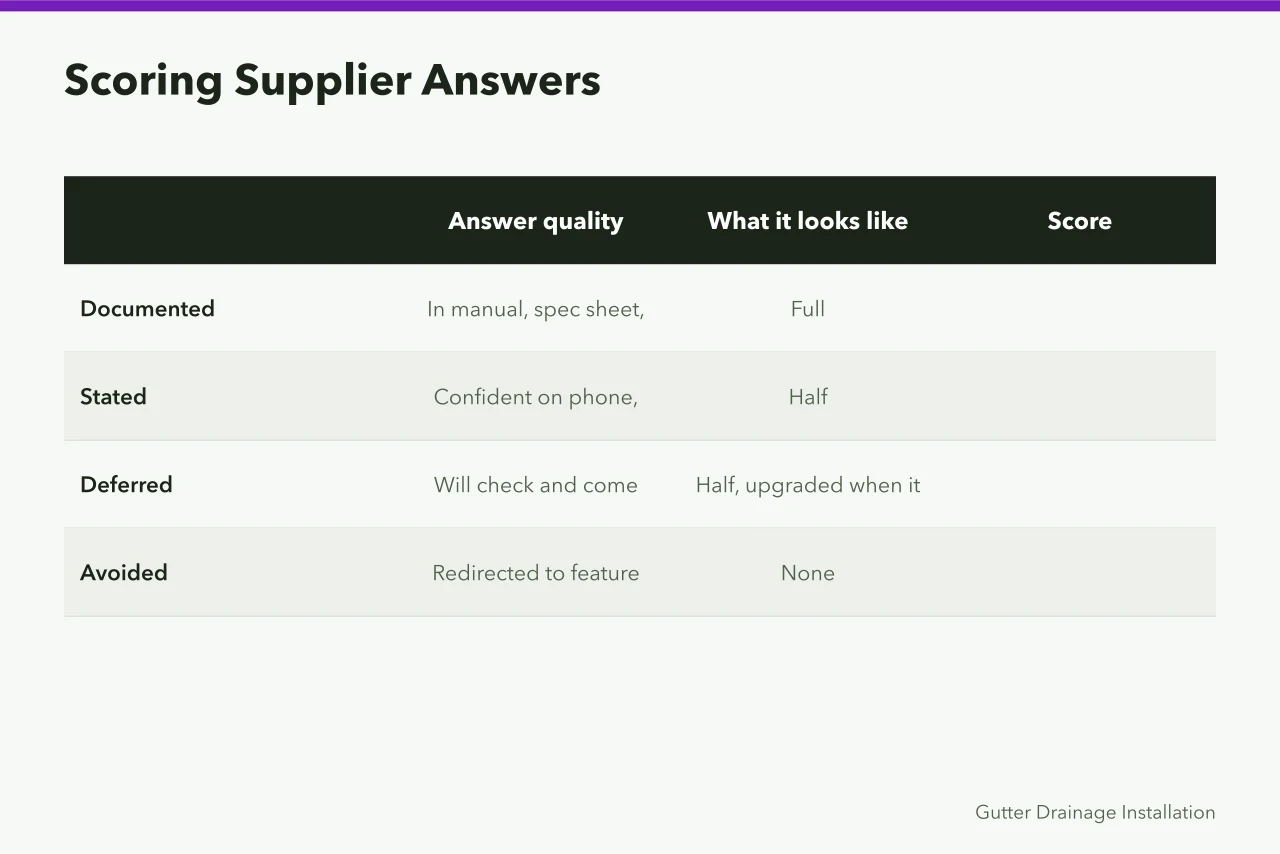
Score each answer before you ask what anything costs.
| Answer quality | What it looks like | Score |
|---|---|---|
| Documented | In the manual, the spec sheet or an email you can keep | Full |
| Stated | Answered confidently on the phone, nothing in writing | Half |
| Deferred | Will check and come back, and does | Half, upgraded when it arrives |
| Avoided | Redirected to a different feature or to a price | None |
Anything scored none on questions one, five, eight or ten ends the evaluation regardless of price. Those four are the specification, the parts operation, the risk transfer and the safety documentation. A supplier who will not put them in writing is asking you to carry all four yourself.
Question ten sits in that group because equipment documentation is what your safety program is built on. OSHA's framework for a small employer's safety and health program expects hazards to be identified and controlled.
You cannot write a jam-clearing procedure from a machine whose manual does not describe one. The same goes for the roof edge, where OSHA's residential fall-protection guidance puts the responsibility on the employer rather than the equipment.
Work at height follows the authority that governs your site, so train to it rather than to a page.
The two answers that should end the call
"Everyone uses ours." This is not a specification. Ask question one again and note which score it earns.
"You will not need parts for years." Nobody who sells parts says this. It tells you the parts operation is thin, or that the person is not close to it. Both are the same problem in October.
Turning the audit into a purchase
Once two suppliers score well, the choice is arithmetic, not brand. the new against used cost guide lists the variables to write it in.
Undecided on items? Work through the equipment checklist for new owners. Before you commit to a forming machine, read the equipment and setup guide on what it does to your schedule.
Whatever you buy must be run by people you trained to a standard you can describe. That is covered in the hiring and training guide.
Some jurisdictions attach rules to registered contractors and their equipment, so check what applies where you work in the licensing and compliance guide rather than assuming.
Keep every answer you were given in writing, filed with the invoice and the serial number. The IRS explains what records a small business is expected to keep, and the same file is what an insurer and a future buyer will ask to see.
Common questions
Are there really better and worse manufacturers?
Yes. The narrower claim is that the difference cannot be established from a web page. It varies by what you form, how hard you run it and how close the nearest service is to you.
What if my supplier is also my coil supplier?
Ask question twelve carefully. A tie between the machine and the coil can be sensible engineering or a commercial lock, and the answer usually tells you which. Englert and similar single-source makers are the ones to press here.
How many suppliers should I run this on?
Three is enough to see the spread. Beyond that you are spending your own time to confirm a pattern you already have.
Is copying what the local competitor uses a bad heuristic?
It is a decent one, for a reason that has nothing to do with quality: shared parts and a shared service relationship in your own market. Ask them question five before you copy them.