Guides
Serving US and Canadian clients as a cross-border gutter business
A gutter business working both sides of the border runs two tax systems, two insurance markets and two payroll regimes, and none of them pause for a short job.
What to take away
- A crew based in Windsor that takes a Detroit job is working inside two tax administrations, two labour regimes and two insurance markets on the same day.
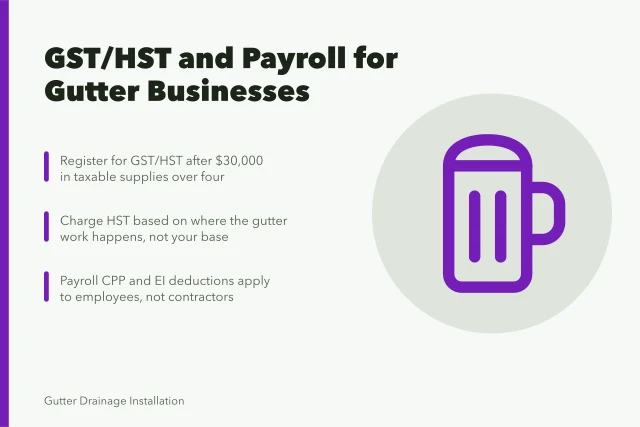
- Register for GST/HST once Canadian taxable supplies pass the small-supplier threshold, and charge the tax where the building sits, not where your truck is parked.
- The IRS wants US-source income reported whether or not you have a US entity; a W-8BEN-E or W-9 decides how much a payer withholds.
- A Quebec CNESST account does not cover a crew on a Vermont roof, and a Vermont policy does not satisfy a provincial board.
- Price US work from US costs. Converting a Canadian price is how a cross-border job loses its margin.
What actually changes when the work crosses a line
The gutters do not change. The administration does.
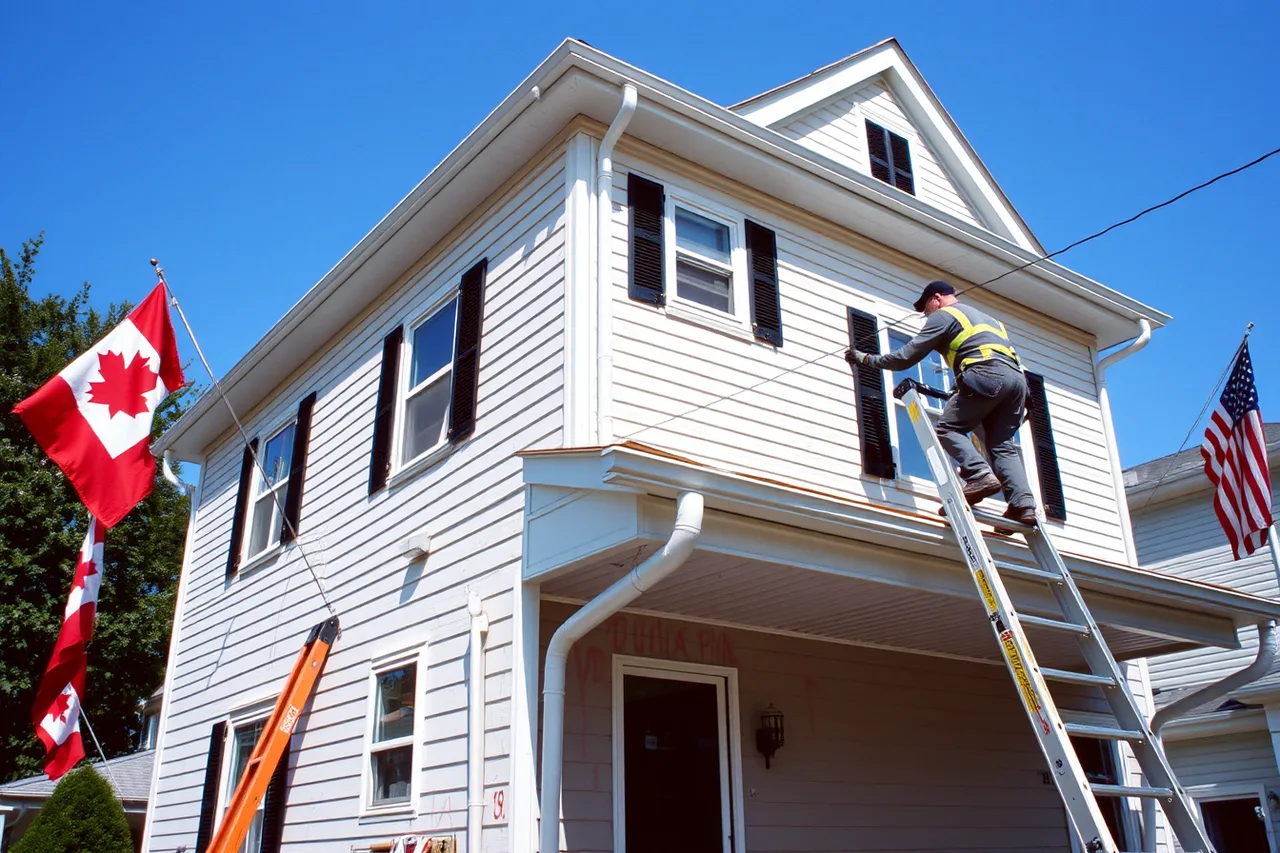
A gutter installation and cleaning business working both countries answers to the Canada Revenue Agency on one side and the Internal Revenue Service on the other. Neither accepts the other's filing as proof of anything.
Most border contractors start with a favour. One builder across the line asks, or a property manager with buildings in both countries wants a single vendor. That first job is easy.
The second job is where the letters arrive.
Canada brings the CRA, provincial workers' compensation boards, municipal stormwater and drainage bylaws, and the National Building Code of Canada or its provincial equivalent. The United States brings the IRS, state licensing boards, state workers' compensation funds and local building departments.
A contractor already juggling Ontario, British Columbia, Alberta, Quebec or Atlantic Canada rules at home is not simplifying anything by adding a US state. The count doubles.
What stays the same
Gutters still fall toward a downspout. Ice damming still ruins soffits through an Edmonton or Winnipeg winter. CSA Group standards such as CSA A123.21 still inform how work is specified on Canadian projects.
What changes is that every administrative task now has two versions, and the second version has its own deadline.
If you are still assembling the basics, the guide to what a gutter service business needs to operate legally covers registration, permits and records before you add a second country.
Currency, invoicing and payment handling
Currency is the first place a cross-border job quietly loses money. You quote in Canadian dollars, the client pays in US dollars, and the rate moves between the two events. On a large commercial job that spread can eat the profit.
Set the invoicing currency in the contract and print it on every invoice. "CAD" or "USD" beside the total, not implied by a dollar sign.
Invoice rules that hold up
- State the currency code on the invoice, not just a dollar sign.
- Show the exchange rate and the date it was applied when you convert.
- Put your GST/HST registration number on Canadian invoices where the tax applies.
- Put your US employer identification number or foreign TIN where a US client asks.
- Keep the bank record showing the amount received in the account currency.
- Note the place of supply, because it drives the tax treatment.
- Retain the signed contract that set the currency.
Getting paid without giving back the margin
A US client paying by cheque in US funds creates a conversion cost at your Canadian bank. Wires cost less per dollar on large invoices but carry fees at both ends.
Some contractors open a US dollar account in Canada and bill into it. The funds stay separate and reconciliation gets simpler. A US dollar account held with a US bank goes further, and it also creates a US banking footprint your accountant should know about.
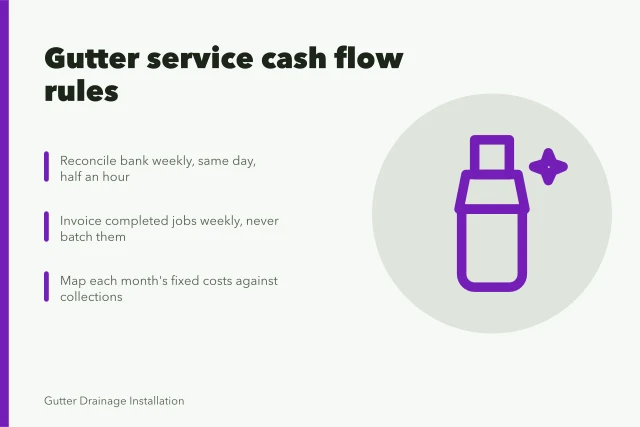
One account per currency is the goal. That single habit keeps the bookkeeping honest.
The same discipline, matching invoices to deposits and reconciling monthly, is what separates the markets worth working from the ones that quietly drain a small contractor.
Pricing in two currencies
Do not convert your Canadian price and call it a US price. Labour, insurance, permits and travel differ on each side.
Build the US number from US costs: state licensing fees, US workers' compensation premiums, US fuel and disposal. Rates and thresholds differ, so the two columns rarely match.
| Cost item | Canadian job | US job |
|---|---|---|
| Licensing and permits | Provincial or municipal | State or municipal |
| Workers' compensation | Provincial board | State fund or private carrier |
| Sales tax | GST/HST where applicable | State and local sales tax |
| Currency risk | Usually none | Exchange movement on payment |
| Payroll burden | CPP and EI | FICA and US unemployment |
If the US column looks heavier, it usually is. Price it rather than absorb it.
CRA reporting on one side, IRS reporting on the other
The Canada Revenue Agency expects registration for GST/HST once taxable supplies exceed the small-supplier threshold, then collection and remittance on taxable supplies. The registration, collection and remittance rules sit in the CRA's guidance on GST/HST for businesses.
Place of supply decides the treatment. A gutter job on a Canadian building is generally a Canadian supply even when the customer's head office sits in another country. Zero-rating applies in specific situations, not as a blanket rule for foreign clients.
Canadian filing rhythm
Most small gutter companies file GST/HST annually or quarterly. Payroll remittances run more often, monthly or quarterly depending on payroll size. Corporate income tax follows the fiscal year chosen at incorporation.
Miss a remittance and interest starts. The CRA is patient with explanations and impatient with silence.
US reporting when you have no US entity
A Canadian corporation with no US entity still has US filing duties if it earns US-source income, owns US property or holds a US bank account. The form varies: a protective return, an information return, or a treaty-based disclosure.
Form a US subsidiary or LLC and the picture changes again. A US entity files its own federal return, may owe state franchise tax, and creates a second set of books. Many border contractors wait until volume justifies it.
Withholding and the forms that stop it
A US client paying a Canadian contractor may withhold under US domestic rules unless a treaty reduces the rate and the contractor files the right form. A Canadian client paying a US contractor faces the mirror question.
A Canadian corporation claiming treaty benefits typically gives the payer a W-8BEN-E. Get the form to the payer before the first invoice, not after the first withholding.
Tax paid in one country on income also taxed in the other is often creditable, which is why the treaty exists. Claim it deliberately rather than discovering it later.
Insurance and licensing do not travel by default
Licensing is local. A company licensed in Ontario is not licensed in New York, Michigan or Maine. Most US states license or register contractors at state level, and many municipalities add registration, bond or permit requirements on top.
Canada works the same way in reverse. Federal guidance points to the permits, licences and regulations that apply, and the Canada.ca page on permits, licences and regulations is the starting point for finding the federal, provincial and municipal pathways for your trade.
What to check before you cross
- Confirm whether the US state registers or licenses your trade, and whether gutter work falls under a general contractor or specialty licence.
- Check the city or county for a separate registration, bond or permit requirement.
- Verify whether your Canadian trade certification is recognised or whether you need a local qualifier.
- Confirm the general liability policy extends to the US state you will work in.
- Confirm auto coverage extends across the border for vehicles and trailers.
- Confirm the workers' compensation position for every person on the crew.
The territory clause is the one that bites
A standard Canadian commercial general liability policy often carries a territorial limit. Work performed in the United States may be excluded unless the policy is endorsed or a separate US policy is placed. Commercial auto, tools and equipment floaters follow the same pattern.
Brokers in the two countries place coverage under different policy wordings, so read the territory clause instead of assuming it. Do not assume your broker knows you cross the border either. Say it plainly.
The variables that move your premium, revenue, payroll, subcontractors and US exposure, are the ones covered in the breakdown of insurance costs and coverage.
Certificates win work and lose it
US general contractors ask for certificates of insurance before a sub gets on site. Canadian builders do the same. Keep current certificates for general liability, auto, umbrella and workers' compensation in a folder you can email within the hour.
An expired certificate costs a job. On border work it costs a job you have already mobilised a crew for.
Workers' compensation and payroll across the line
Workers' compensation is jurisdictional. In Canada, coverage runs through the provincial board where the worker is based or where the work is performed, depending on the province. WSIB covers Ontario, WorkSafeBC covers British Columbia, WCB Alberta covers Alberta, and CNESST covers Quebec.
In the United States, coverage runs through a state fund or a private carrier, state by state. A Canadian certificate does not satisfy a US state requirement. A US policy does not satisfy a provincial board.
Payroll when a crew crosses
The two countries collect different contributions. Canada runs on CPP and EI, the United States on Social Security and Medicare, so the same wage carries a different on-cost on each side.
A Canadian employee who works part of the year in the US may create US payroll obligations, depending on the length of stay and the treaty position.
A US employee working in Canada creates the mirror image: Canadian deductions, CPP and EI, and a Canadian reporting obligation.
The CRA's payroll guidance sets out the deduction, remittance and reporting duties for Canadian employers.
Three structures, three costs
Most border contractors pick one of three approaches. Keep crews on their home side and subcontract the other side. Second employees temporarily and rely on the treaty's short-stay relief. Or stand up a payroll entity in the second country once volume is steady.
Subcontracting shifts control and margin. Secondment adds travel and lodging. A second payroll entity adds filings. The right answer depends on how many days a year your people actually spend across the line.
Records that survive a review
Keep timesheets showing where each person worked each day. Keep travel logs. Keep certificates and account numbers for every jurisdiction. If a board or agency asks, the answer should be a document, not a recollection.
Pay levels differ across the border, and the on-costs, payroll taxes, workers' compensation and benefits, differ more than the wage itself. Run the comparison of pay rates before quoting a cross-border job.
Tax treaties, withholding and permanent establishment
The Canada-United States tax treaty exists to stop the same income being taxed twice. It allocates taxing rights and reduces withholding rates on certain payments. It does not remove filing obligations, and it does not apply automatically.
Claiming a treaty benefit means telling the payer who you are and where you are resident. That is what the W-8BEN-E and similar forms do. Without them, the payer withholds at the default domestic rate.
Permanent establishment, in trade terms
A permanent establishment is a fixed place of business in a country, or a dependent agent who habitually concludes contracts there, that gives that country the right to tax your business profits. A Canadian corporation with no US office, no US employees and no fixed US base usually has none.
Short gutter work rarely creates one. A rented yard, a US-based supervisor or a crew that stays for months can. The line is factual, so document the facts: where the crew slept, where the equipment was stored, who signed the contracts.
Why the treaty matters to a gutter company
Three reasons. It can reduce withholding on payments you receive. It can prevent double taxation through foreign tax credits. And it sets the threshold at which the other country can tax your business profits at all.
Treaty positions are not self-assessing in practice. You claim them on forms and support them with records. If the position is wrong, the correction is expensive.
Where the federal framework fits
Most gutter work falls under provincial labour and occupational health and safety law in Canada, not federal. Federal labour jurisdiction covers interprovincial undertakings and a few other categories, and the framework sits in statutes such as the Canada Corporations Act.
The practical point for a border contractor is that occupational health and safety duties follow the worker, not the head office. A crew working in another province or state must meet local rules on fall protection, ladders, scaffolding and site safety.
Confirm the current requirements with WorkSafeBC, CNESST, OSHA or the applicable provincial regulator, and put crews through certified training rather than a verbal briefing.
Running both sides without breaking either
Separation and documentation do the work. Separate bank accounts by currency. Separate job files by jurisdiction. Separate insurance certificates by country. One set of books, clearly tagged.
Set a threshold for taking cross-border work. Below a certain job value the compliance cost exceeds the margin, and the honest answer is to refer the work to a local contractor and keep the relationship.
A quoting routine that runs before the price goes out
- Confirm the client's country and the job site's country before quoting.
- Price from local costs, not converted home costs.
- Check licensing, permits and workers' compensation for that jurisdiction.
- Confirm insurance territory and add an endorsement where needed.
- Issue the invoice in the contract currency with the tax treatment stated.
- File the CRA and IRS positions on time, every time.
Where owners get the sequence wrong
Most mistakes happen in the first month. The contractor quotes before checking licensing. The crew works before the insurance endorsement is issued. The invoice goes out without a currency stated. The withholding form reaches the payer after the payment.
Each of these is cheap to fix in advance and expensive to fix afterwards. Build the check into the quoting process so it runs before the price leaves the office.
Funding the expansion
Cross-border work costs more up front. US licensing fees, a US insurance policy, travel and lodging, and possibly a second payroll setup all land before the first US invoice is paid. Plan the working capital, not just the tax treatment.
The routes available to a small gutter company, retained earnings, equipment financing, lines of credit and partner capital, are set out in the overview of startup costs and funding.
First-year checklist
- Canadian business registration and GST/HST account in place.
- US state licensing or registration confirmed for each state you work in.
- General liability and auto policies endorsed for US territory.
- Workers' compensation in every jurisdiction where a crew sets foot.
- Payroll provider briefed on cross-border employees.
- Treaty forms issued to payers before the first invoice.
- Separate accounts per currency, reconciled monthly.
- Accountant engaged who has filed cross-border returns before.
If you are at the very beginning, the federal guidance on starting a business covers registration, structure and the first compliance steps for a Canadian operation.
When to bring in help
The trigger comes earlier than most contractors think. The first US job with withholding, the first employee working across the line, or the first US state licence application is the moment.
A good accountant costs less than a corrected filing. A good insurance broker costs less than an uninsured claim. On border work both are part of the cost of doing business, not optional extras.
Common questions
Do I need a US entity to take a gutter job in the United States?
No. A Canadian corporation can generally perform US work and report the income under the treaty. A US entity becomes worth considering when volume, staffing or permanent establishment risk grows.
Which tax do I charge a US client for gutter work on a Canadian building?
GST/HST generally applies based on the place of supply, which is where the building sits. Zero-rating is specific, so confirm the treatment with your accountant before the invoice goes out.
Does my Canadian workers' compensation coverage follow a crew into the US?
No. US states require coverage through a state fund or a private carrier. Confirm the requirement for each state before the crew crosses, and confirm the Canadian position for the days they work at home.
When does a cross-border gutter job create a permanent establishment?
Usually when there is a fixed place of business, or a dependent agent concluding contracts in that country. Short jobs rarely qualify, but a long project with a rented yard or a US supervisor can.