Guides
Which markets suit a gutter service business
Markets for gutter service work cannot be ranked nationally, so here is the scoring method: seven inputs, where to find each, and how to weight them.
What to take away
- No list of best cities appears here. A national ranking would be someone else's route dressed up as research.
- Seven inputs decide whether a market suits this trade, and six of them you can gather in an afternoon.
- Tree canopy and housing stock matter more than population. You can read both from a car.
- Score two or three candidate markets against each other rather than looking for a winner in the abstract.
Why no cities are listed
A market is good for a gutter business because of the interaction between its rainfall, its housing, its labor cost, its regulation and how far apart the jobs are. Those interact differently for a one-crew cleaning operation than for a company running a forming machine.
So a national ranking would be answering a question nobody asked: best for whom, doing what, at what scale? What travels between readers is the scoring method, not the ranking.
Use it comparatively. Score the market you are in and one or two you are considering, and read the differences rather than the totals.
The seven inputs
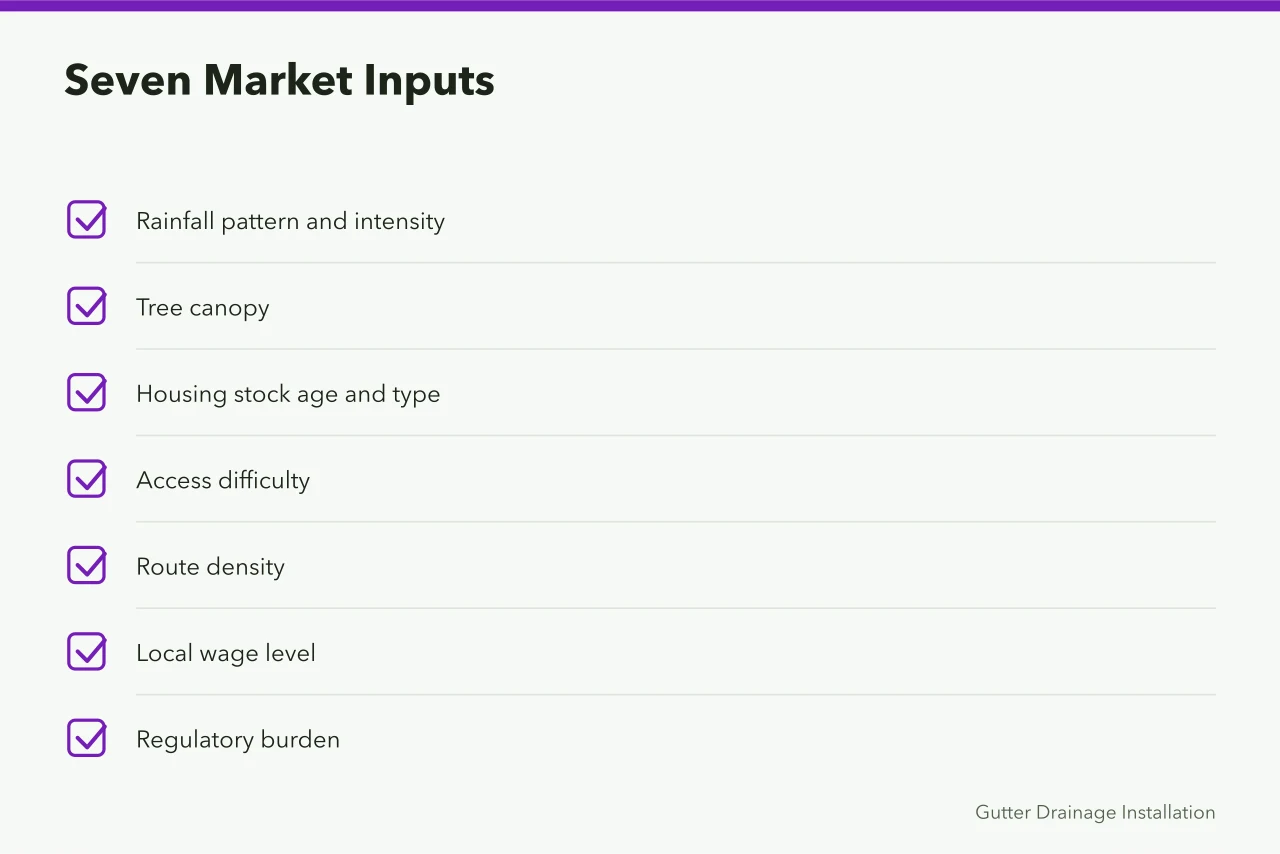
| Input | What it decides | Where to find it |
|---|---|---|
| Rainfall pattern and intensity | System sizing, and therefore job value | Regional climate data, and your building department on adopted requirements |
| Tree canopy | Recurring cleaning demand | Drive it, and look at aerial imagery |
| Housing stock age and type | Work mix: repair against replacement | Drive it |
| Access difficulty | Hours per job, crew requirements, risk | Drive it, looking at stories and pitch |
| Route density | Unbillable driving time | Map your candidate service area and count properties per mile |
| Local wage level | Your cost base | Published area wage estimates |
| Regulatory burden | Fixed cost and time to start | State, county, city and stormwater offices |
Four of the seven are answered by driving the market with your eyes open. That is not a shortcut, it is the most reliable research available in this trade.
Reading each one
Rainfall. It decides how much water each run has to carry, which affects sizing and therefore job value. It also drives the trigger events that generate calls. What it does not do is give you a number you can apply: sizing comes from the manufacturer's tables and from whatever your building department has adopted, both of which you confirm locally.


Canopy. The single best predictor of recurring cleaning demand, and the easiest thing on the list to observe. Mature trees over roofs mean work every year, forever. New developments with saplings mean almost none for a decade.
Housing stock. Older neighborhoods generate repair, re-hang and pitch correction work. Newer developments generate replacement work in waves and then go quiet. Mixed markets are more stable than either.
Access. Note how many stories, how steep, how close together, and what the ground around the houses is like.
A market of steep three-story houses needs different crews, different gear, and a different risk posture. This trade's severe exposure is at the roof edge, and OSHA's guidance on fall protection in residential construction puts control responsibility on the employer.
Route density. Count how many candidate properties sit within a short drive of each other. Driving time is paid and unbillable, so density is a direct input to your labor cost. Two markets with identical prices can produce very different contribution per crew hour.
Wages. The Bureau of Labor Statistics publishes occupational employment and wage estimates by area. Compare metro areas for the occupations you actually compete with for labor, which includes roofing, siding, exterior construction, landscaping and tree work rather than just the closest job title.
Regulation. Licensing can differ at state, county and city level, permits may or may not apply to a like-for-like replacement, and the rules on where discharged water may go are municipal. The method for establishing all of it is in the licensing and compliance guide, and it has to be re-run per market.
Scoring without inventing numbers
Do not build a weighted index with invented coefficients. Score each input high, medium or low against your own requirements, then read the pattern.
Two patterns are worth recognizing.
A market strong on canopy and housing age but weak on wages and density suits a cleaning and repair operation with tight routes. It does not suit a company that wants to run a forming machine at volume.
A market strong on rainfall and housing turnover but weak on canopy suits replacement and new installation work. It will not produce the recurring maintenance base that carries a company through the quiet months, which is a real weakness discussed in the expansion and market guide.
Neither is better. They are different businesses, and choosing the wrong one for the market you are in is the actual mistake.
The checks that come before commitment
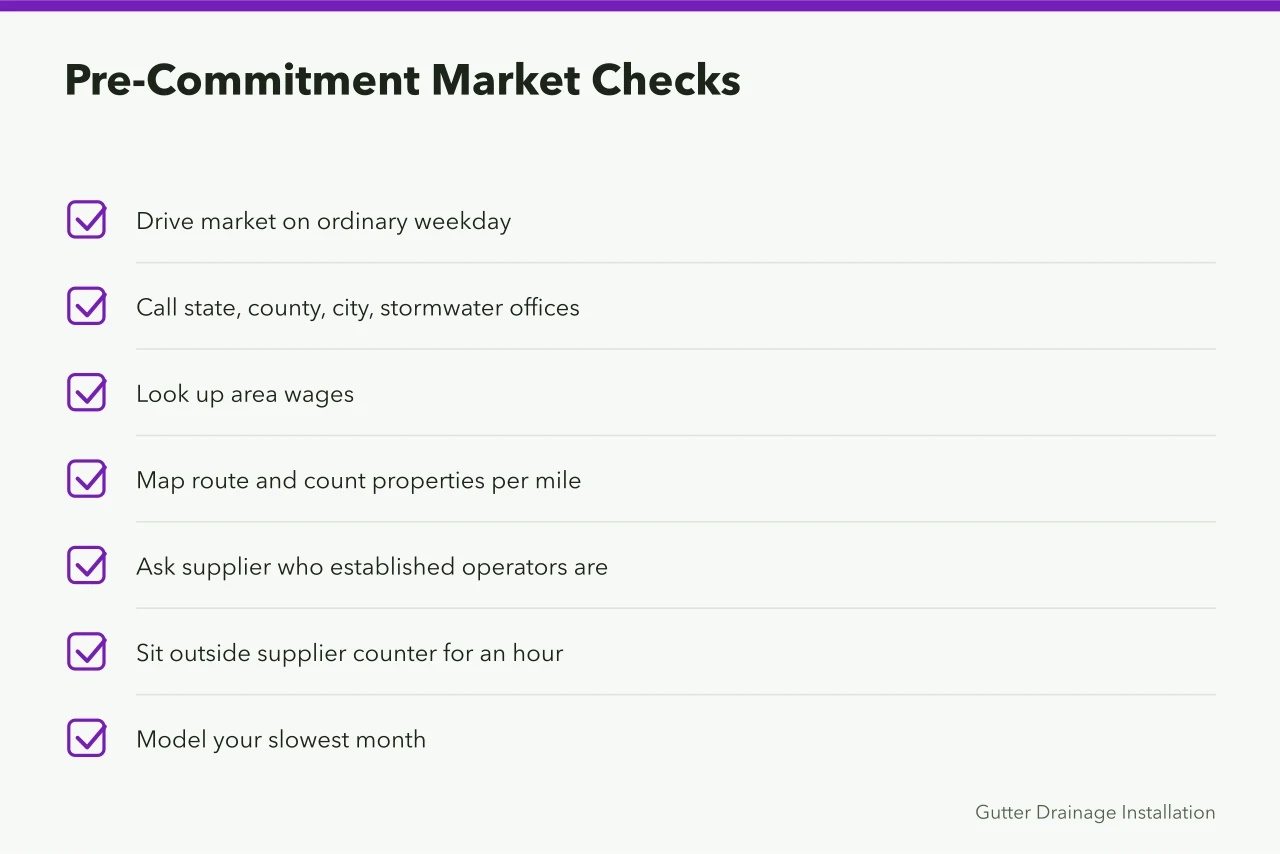
- Drive the candidate market on an ordinary weekday and look at rooflines, canopy and downspout terminations.
- Call the state board, the county, the city building department and the stormwater office. Record who told you what, and when.
- Look up area wages for the occupations you will hire from.
- Map a plausible route and count properties per mile.
- Ask a supplier in that market who the established operators are and what they buy.
- Sit outside a supplier counter for an hour and see how busy it is.
- Model your slowest month in that market, not your best.
Step seven is the one that decides it. A market that works in October and cannot carry you in February is a market you enter with working capital or not at all.
What to do before hiring anyone there
Entering a market and staffing it are separate decisions and should be separated in time. Test the market with your existing crew and a longer drive before committing to a local crew, and re-derive the hours because access class differs. The staffing side is covered in the hiring and training guide.
Check equipment implications: a market of taller or steeper properties may need access gear you do not own. The buying order for that access gear sits in the equipment checklist for new owners.
If formed installation is part of the plan, the machine, the coil, and the crew travel as one unit, so a distant market is a whole trailer trip rather than a longer drive. See the equipment and setup guide.
Free help exists for arguing with your assumptions before you spend anything. The Small Business Administration's guidance and counseling pages point at local advisers who will read a forecast with you at no charge.
Common questions
Is a bigger city always better?
No. Bigger cities have more competition, higher costs and often worse route density for a small operator. What you want is enough properties close together, not a large total.
Does high rainfall make a market good?
It raises job value and generates trigger events. It also raises the standard your work has to meet, because undersizing shows up quickly. It is one input, not the answer.
How much does regulation actually matter?
Enough to change your fixed costs and your time to start, and occasionally enough to rule out a market for a small company. Find out before you plan, not after.
Can I serve two markets from one base?
Only where the drive does not destroy your productive hours. Count the driving time honestly and treat it as a cost rather than as ambition.
What is the fastest way to disqualify a market?
Drive it. If the canopy is thin, the houses are new and the properties are far apart, you have your answer before making a single phone call.