Guides
Pay rates in a gutter service business, with the on-costs
Gutter service employee pay: how to look up your own market's rates properly, turn a wage into a real labor cost, and compare pay structures honestly.
What to take away
- Pay rates in a gutter service business typically run $18 to $30 an hour in most metro areas. The occupation you hire against sets where in that band you land.
- Employer on-costs typically add 25% to 40% on top of the wage. Payroll taxes, workers' compensation for at-height work, training and gear all attach before anyone reaches a roof.
- A $24 wage becomes a $45 to $50 labor cost per productive hour once you divide by the fraction of paid hours that actually bill.
- Pay structure changes behavior at the roof edge more than pay level does.
- Look up the occupations you compete with for people, not the one that has your job title on it.
What gutter labor pays
Gutter cleaning and installation has no occupation code of its own. The Bureau of Labor Statistics files the closest matches under roofers (SOC 47-2181), construction laborers (47-2061), groundskeeping workers (37-3011) and tree trimmers and pruners (37-3013).
In the latest published estimates, median hourly pay sits in the low-to-mid $20s for roofers, near the low $20s for construction laborers, in the high teens for groundskeeping crews and in the low $20s for tree trimmers. Treat those as orientation, not as an offer.
Metro spread is wider than the national spread. Roofers typically earn $16 to $20 an hour in a low-cost metro and $30 to $38 in a large coastal one. Inside a market, experience moves pay more than geography does.
A helper with no ladder time typically starts $2 to $6 an hour below the local median. Somebody who can set a ladder, run a machine and talk a homeowner through the work sits in the top quartile.
Wages for outdoor trade work vary widely between metro areas, and inside one metro they vary by which employers are hiring that month. Publishing a single national figure would be worse than publishing nothing. The useful number is the one in your market, and finding it takes about twenty minutes.
Looking up your own market
The Bureau of Labor Statistics publishes occupational employment and wage estimates by area. Work through it like this.
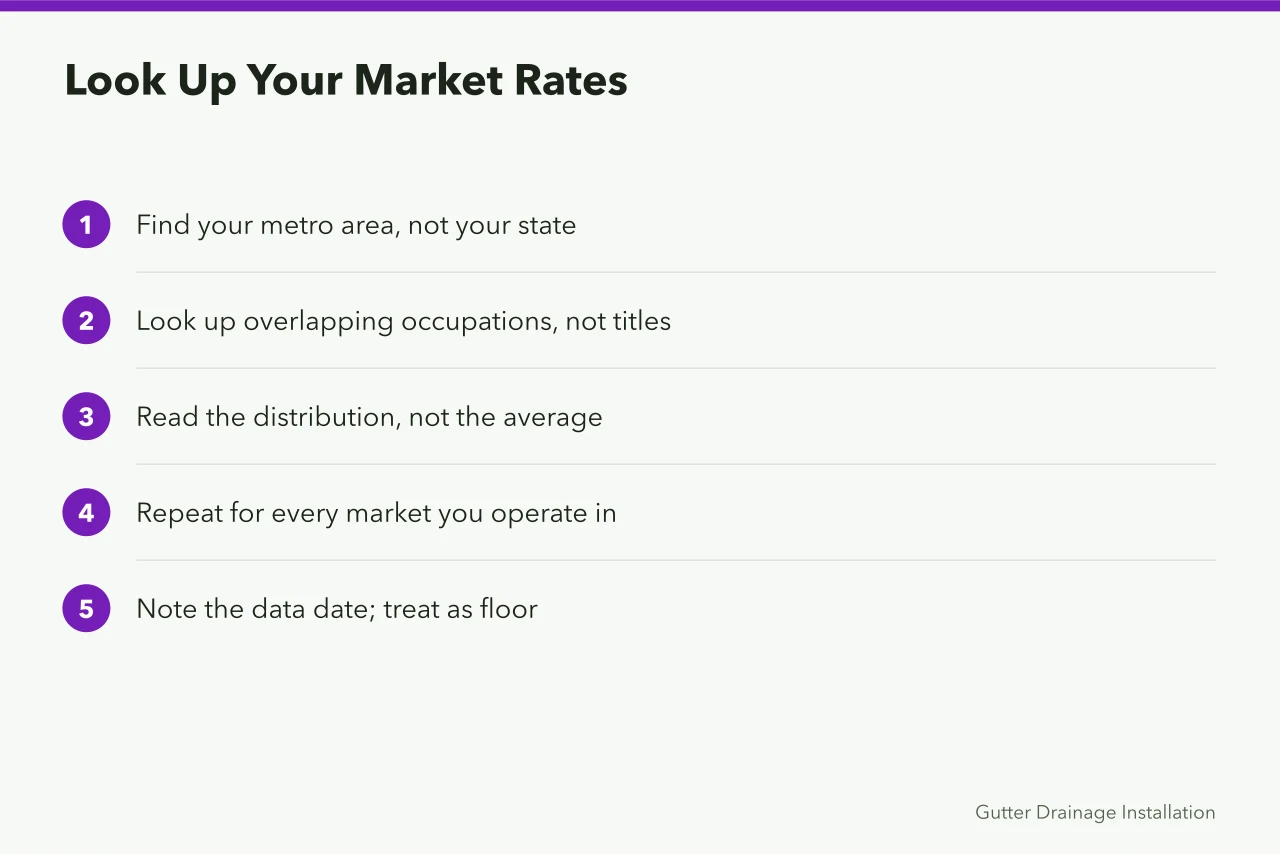
Point two is the one owners get wrong. You are not competing with other gutter companies for people. You are competing with every employer who can offer similar physical work, and often with employers offering the same money indoors.
From wage to labor cost
Write it as an equation and fill it from your own records. W is the hourly wage. E, I, T and G are the on-costs that attach to it, and U is the fraction of paid hours that bill.
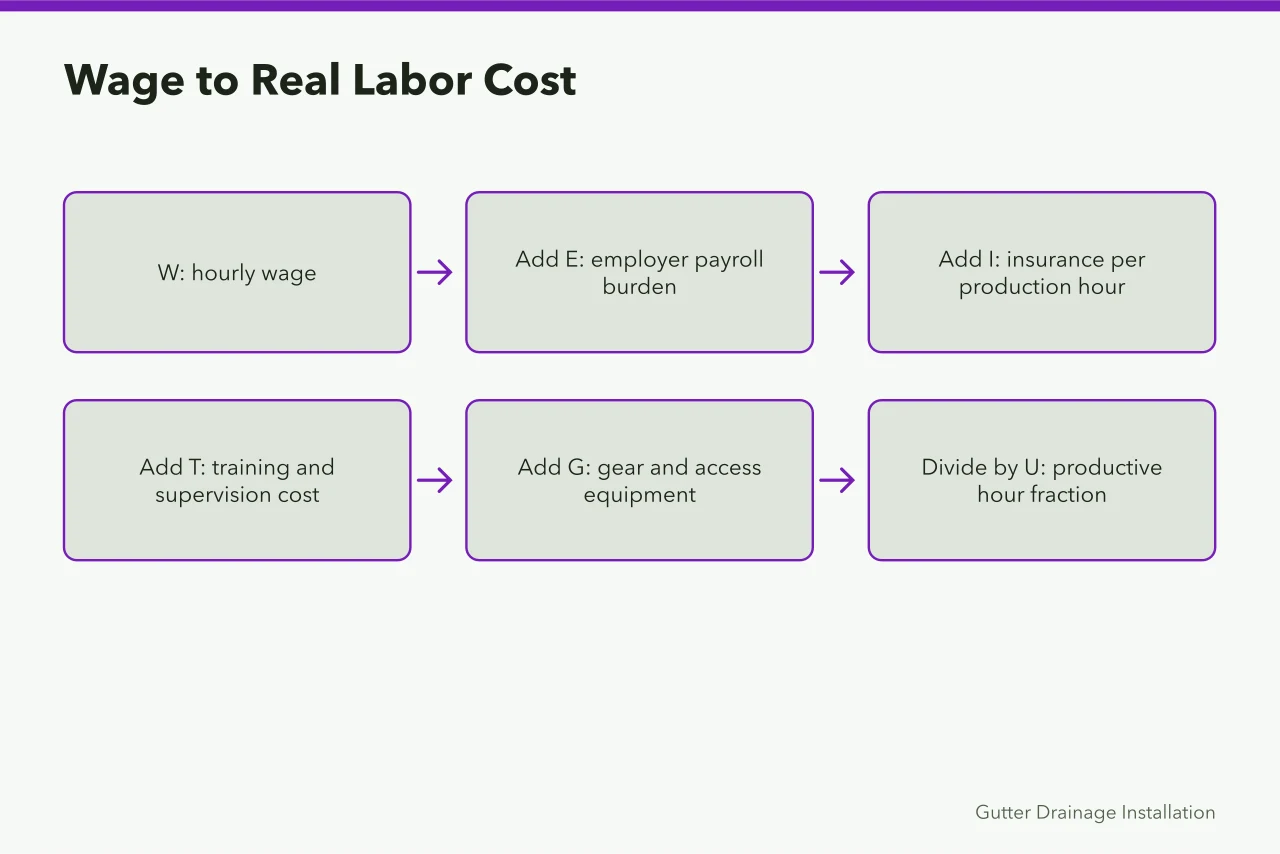
Start with W, the hourly wage. Roofing-class labor typically runs $18 to $24 an hour in a mid-size metro and $28 to $35 in a large coastal one.
Add E, the employer payroll burden. FICA takes 7.65% of wages. Federal unemployment adds 0.6% on the first $7,000 of each employee's pay after the state credit. State unemployment insurance typically runs 1% to 4% for a new employer. At a $24 wage, E usually lands between $2 and $3.50 an hour.
Add I, the insurance cost attributable to a production hour. Workers' compensation for roofing classes commonly runs $8 to $20 per $100 of payroll, which is $2 to $5 an hour at $24. General liability for a small gutter operation typically costs $1,000 to $3,000 a year, or $0.50 to $1.50 per crew hour.
Add T, training and supervision spread across productive hours. A 10-hour OSHA construction course typically costs $30 to $90 per person. A working supervisor's paid hours land on the same jobs. That cost is real and always omitted.
Add G, gear per person. A harness typically costs $100 to $250, a rope and grab $100 to $200, and a ladder stabilizer $50 to $150. Access equipment is inspected and replaced on a criterion rather than when it looks bad.
Then divide by U, the fraction of paid hours that are genuinely productive on a roof. Travel and setup are paid and none of it bills. So are teardown, the supply run and a weather delay. So is the second visit for a missing part.
A crew at $24 an hour with $3 of payroll burden, $3.50 of insurance, $1.50 of training and $1 of gear costs $33 per paid hour. At a productive fraction of 0.70, the labor cost is $47 per productive hour.
That final division is what separates a labor cost from a wage. It is usually the largest correction in the whole calculation. A company that quotes against W alone is not competing aggressively, it is losing money in a way that takes a season to become visible.
The productive fraction is a management number
U is not fixed. It is the thing you manage. A crew with steady work and tight routing typically holds U between 0.60 and 0.75, and weather-heavy weeks push it lower.
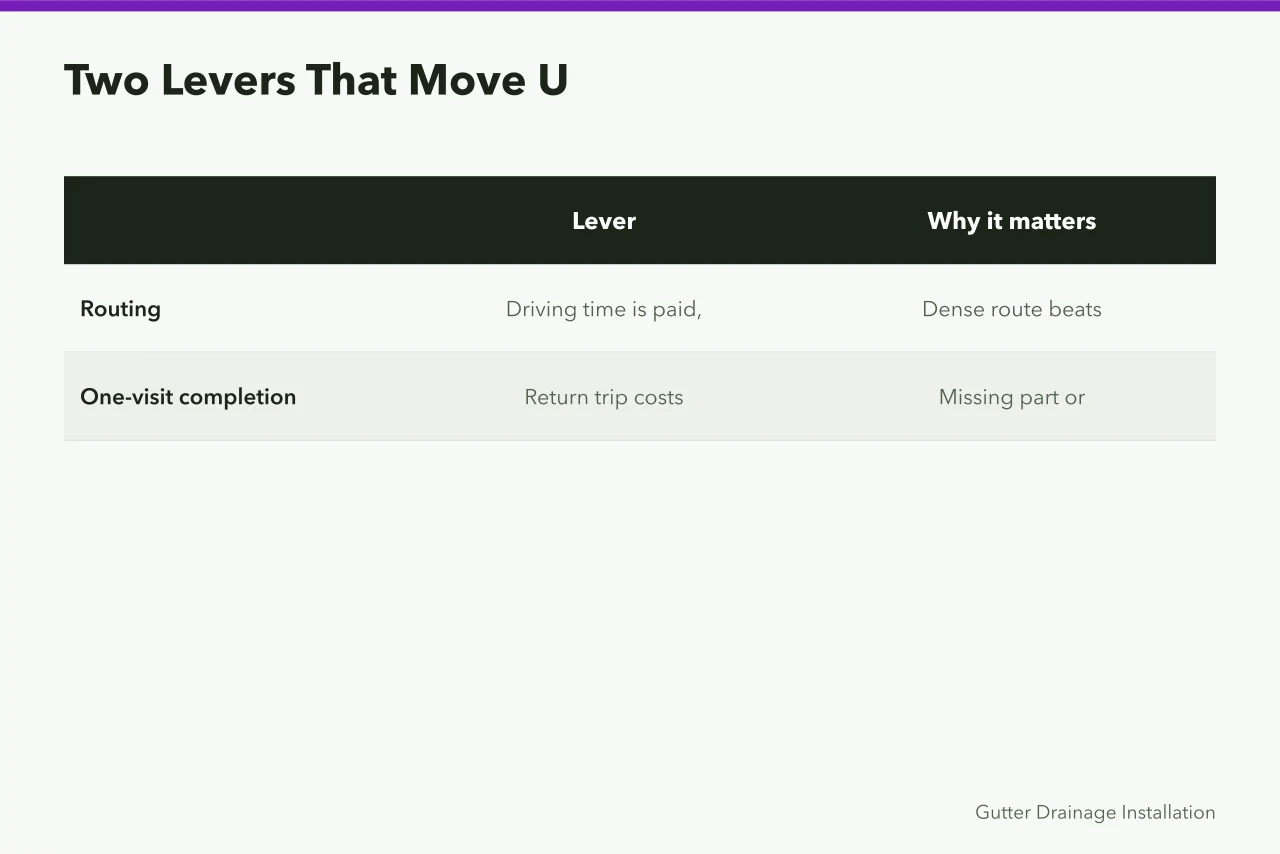
Two levers move it more than anything else. Routing, because driving time is paid and unbillable, and a dense route in one neighborhood beats a scattered day at the same prices. And one-visit completion, because a return trip costs the hours twice against the same revenue.
Most return trips come from a missing part or from a measurement that was not verified before anything was formed. The first is solved by loading the truck to the list in the equipment checklist for new owners.
The second is expensive here in a way it is not in other trades. A formed run is made on site, and the machine, coil and crew travel as one unit, which is set out in the equipment and setup guide.
Pay structures compared
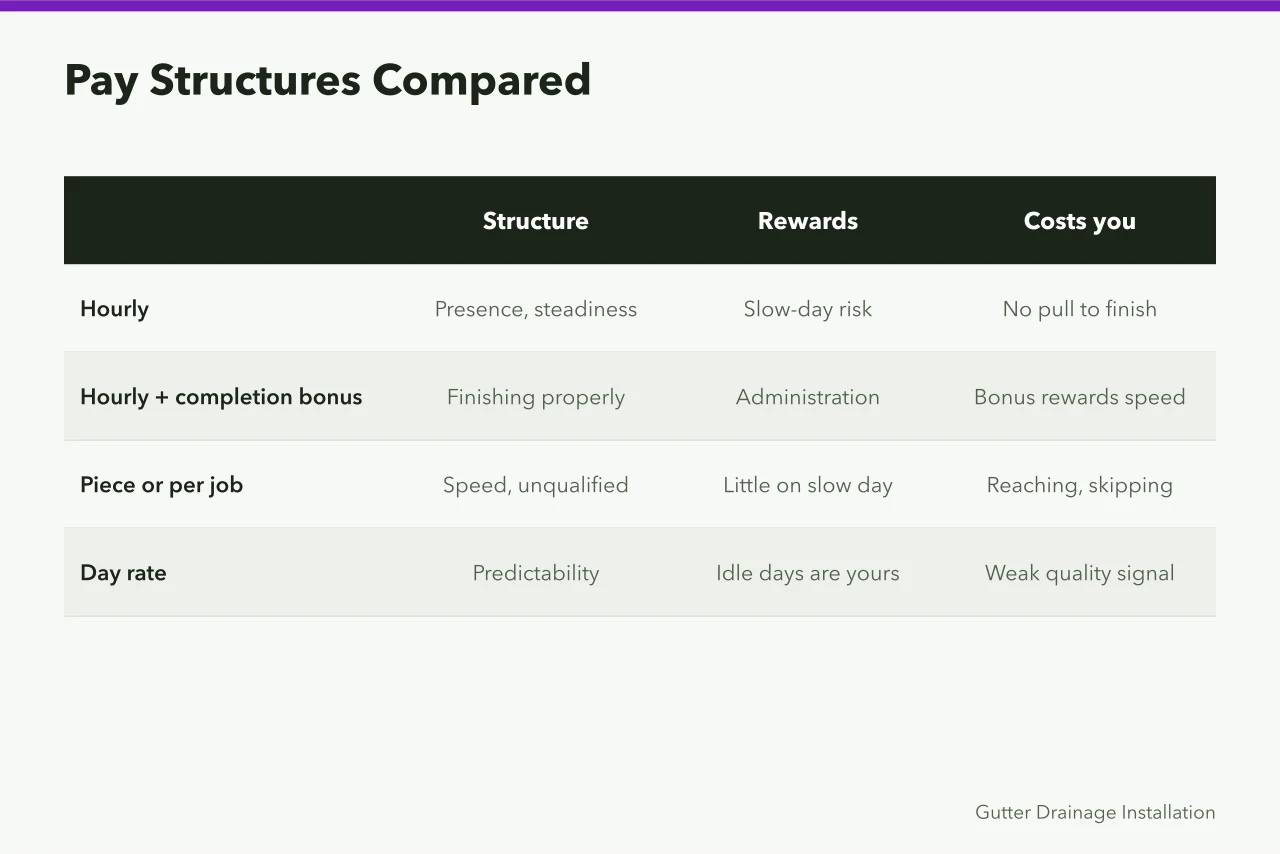
| Structure | What it rewards | What it costs you | Where it fails in this trade |
|---|---|---|---|
| Hourly | Presence and steadiness | You carry the risk of a slow day. Typically $17 to $22 an hour to start, $24 to $30 for a lead | No pull toward finishing, so routing has to be managed |
| Hourly with a completion bonus | Finishing properly, if the bonus is tied to checks | Some administration. A typical bonus runs $25 to $75 per completed job | The bonus must not reward speed alone |
| Piece or per job | Speed, without qualification | Very little on a slow day. Derive the rate from your cost per productive hour, not from a guess | Rewards reaching from a ladder and skipping the water test |
| Day rate | Predictability for both sides | Idle days are yours. Typically $220 to $320 per worker day | Weak signal about quality either way |
| Hourly with a quality holdback | Passing the water test and the discharge check | Withheld money invites disputes. A typical holdback is 10% of the job, released after 30 days | The holdback has to be paid on time or trust goes |
The third row is the hardest to get right. Paying by the job rewards the behaviors that cause incidents and callbacks: reaching instead of moving the ladder, leaving before the water test, not confirming the discharge terminal.
Write a stop-work policy on top of it, and the policy will not be used, because using it costs the worker money.
Whatever structure you pick, stopping work for weather or unsafe conditions has to be free to the person who stops. Anything else is a policy that exists on paper. The training and competence side of this is covered in the hiring and training guide, and the selection side in how to hire reliable staff.
The obligations that come with payroll
Wage and hour rules, recordkeeping and required postings begin with the first employee. The Department of Labor publishes compliance assistance aimed at new and small businesses as an entry point.
Overtime, travel time and training time all have rules, and travel time in particular is worth understanding in a trade where crews drive a lot. The federal minimum wage posting and accurate hours records are the two items most often missed.
Payroll filings carry numbers of their own. FICA is 7.65% of wages, federal unemployment is 0.6% on the first $7,000 per employee, which is $42 a year, and state unemployment runs at whatever rate your state assigns a new employer.
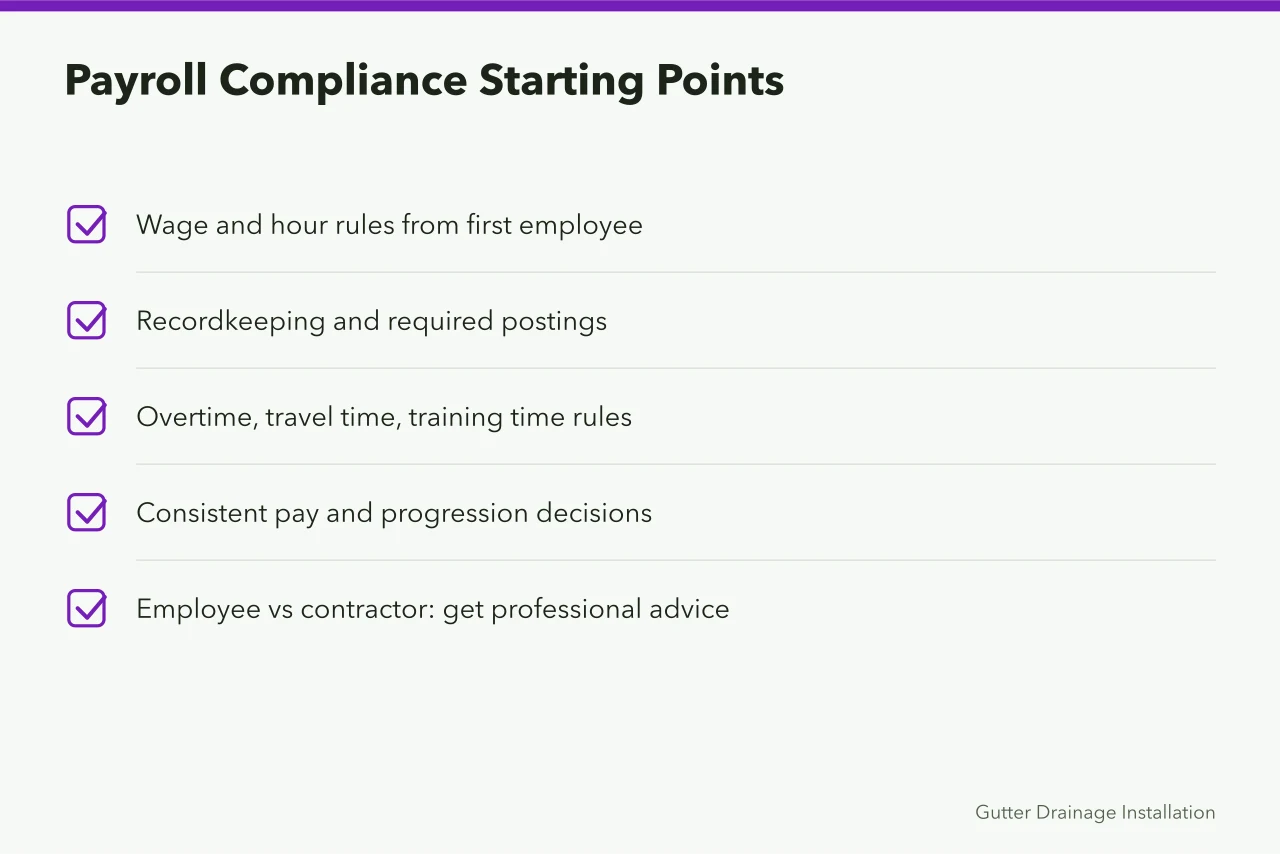
Pay decisions also have to be made consistently. The Equal Employment Opportunity Commission's small business resource center covers the obligations that attach to employment practices, including how pay and progression decisions are made.
One question needs professional advice rather than a page: is a regular helper an employee or a contractor? It depends on the facts of the arrangement, carries real consequences, and is where a confident guess gets expensive.
Ask an employment attorney or accountant in your state and keep it on the compliance calendar described in the licensing and compliance guide.
What to do with the number once you have it
Feed the labor cost into your rate. A quote built on the $24 wage instead of the $47 cost understates labor by nearly half on every job.
Then test it against reality by recording actual crew hours per job and comparing them against what you quoted. A labor cost that has never been checked against a completed job is an assumption.
Re-derive it whenever the crew changes materially, because the same house takes very different hours depending on who is on it. Re-check the market data before each season rather than carrying last year's figure into a year when local wages moved.
Common questions
What should I pay a first helper?
In most markets a helper with no ladder experience starts at $16 to $20 an hour, and someone who can run a truck alone commands $22 to $28. In a large coastal metro both bands run $5 to $8 higher.
Should I pay more than the local rate?
Paying at the upper end of what your market pays for comparable physical work usually costs less than turnover does, particularly in a trade where a crew's local knowledge is worth real money. Decide it with your own numbers rather than a rule.
How do I handle travel time?
Understand the rules that apply where you operate before you design anything, then price the time into the job. Unpaid travel time is a compliance risk and a routing incentive pointing the wrong way.
Is a bonus worth the administration?
Where it is tied to observable checks rather than to speed, often yes. Where it is tied to jobs completed, you have built a piece rate with a friendlier name.
What about the slow season?
Carry the crew on cleaning, repair and discharge work if you can. Losing trained people over the winter and rehiring in spring is the most expensive labor pattern in this trade.
How often should I revisit pay?
Once a season, before the peak weeks. Adjusting pay in the middle of the busy period is a decision made under pressure, and it is usually more expensive than the one you would have made calmly.