Guides
Hiring gutter service staff who survive the first two weeks
Gutter service hiring step by step: writing an advertisement that filters, the screening call, a paid working session, and judging the first two weeks.
What to take away
- Write the advertisement to repel the wrong people. This trade has specific conditions and hiding them wastes everyone's time.
- Replace the interview with a paid working session on a low elevation. You learn more in an hour than in three conversations.
- Ask everyone the same questions and keep the requirements tied to the work. That is both fairer and safer.
- Decide in the first two weeks. Reliability shows up early and almost never improves on its own.
Write the advertisement that filters
An advertisement has two jobs, and most owners only write for one of them.
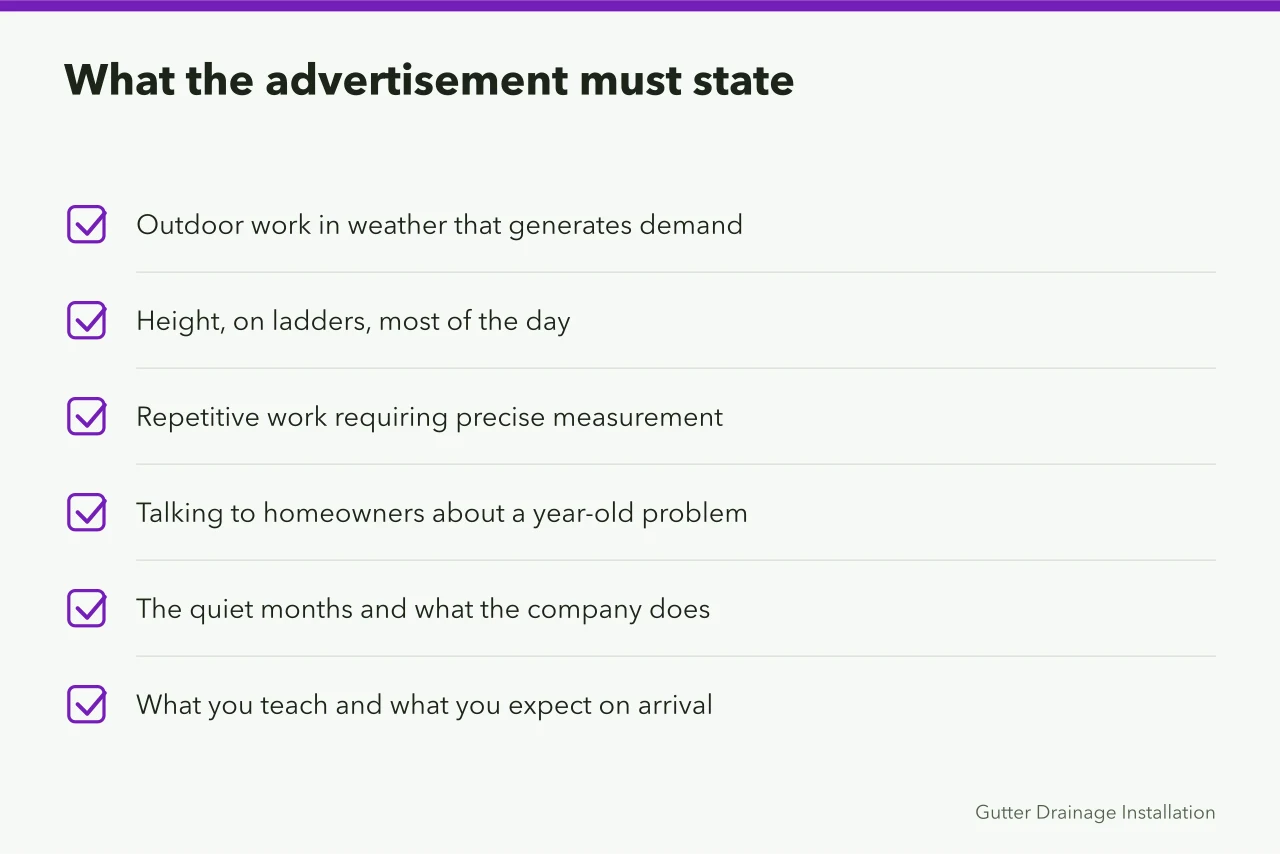
Say plainly what the conditions are. Outdoor work in the weather that generates the demand. Height, on ladders, most of the day. Physically repetitive work that also requires precise measurement. Talking to homeowners at their own houses about a problem that has annoyed them for a year.
Say what the season looks like, including the quiet months and what the company does during them. Candidates who leave in January mostly leave because nobody told them January existed.
Say what you will teach and what you expect on arrival. This trade can teach almost everything except comfort at height and the willingness to stop when conditions turn.
Keep the requirements tied to what the work needs rather than to a picture of a person, and use the same wording for everyone. The Equal Employment Opportunity Commission maintains a resource center for small businesses covering hiring practices and what may be asked, and it is written for companies without a personnel department.
Advertise a rate you can defend. The Bureau of Labor Statistics publishes occupational employment and wage estimates by area, so you can see what related physical trades pay locally before you decide what to offer.
The screening call
Keep it short and ask everybody the same five things.
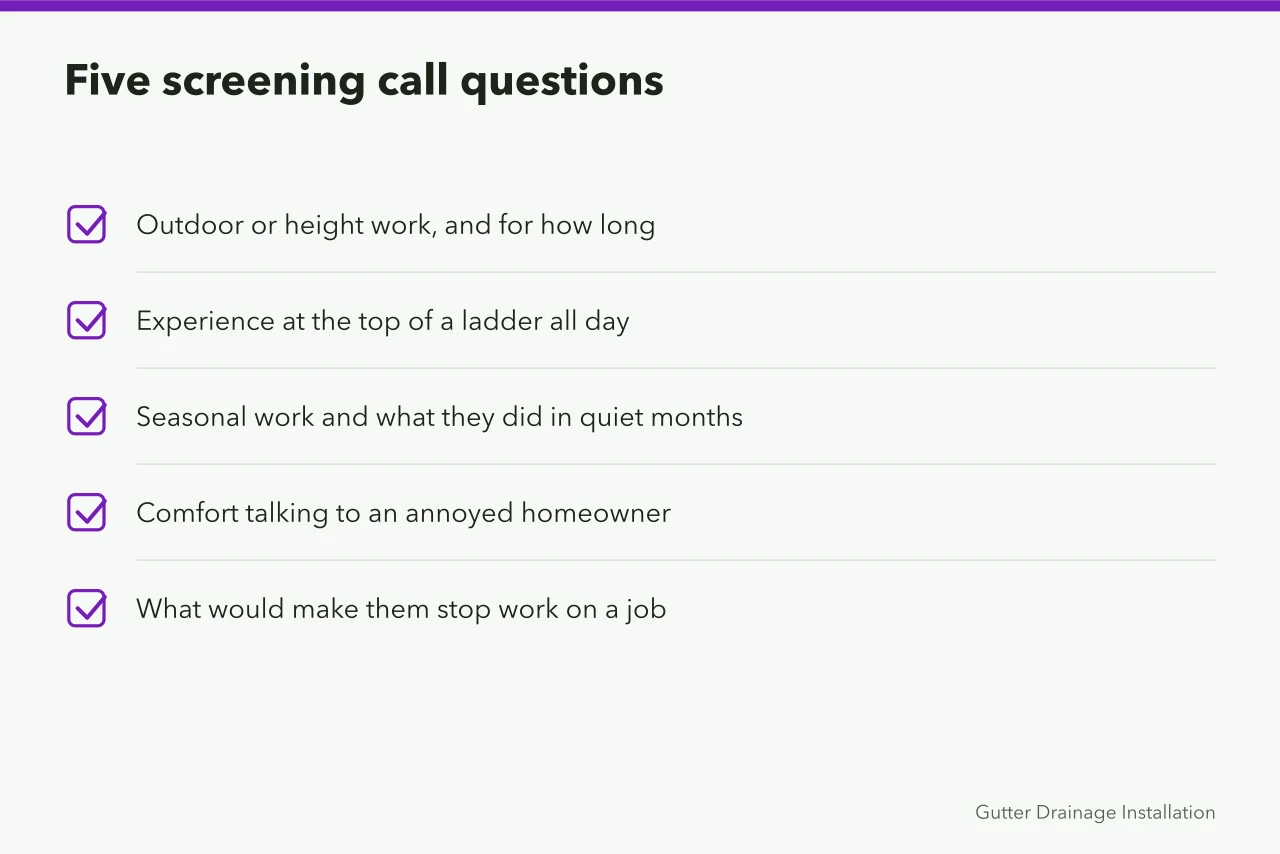
- What outdoor or height work have they done, and for how long?
- What is their experience of working at the top of a ladder for most of a day?
- Have they worked seasonally, and what did they do in the quiet months?
- Are they comfortable talking to a homeowner who is annoyed?
- What would make them stop work on a job?
Question five is the one that matters. There is no trick to it and the answer is revealing either way. Somebody who names weather, ground conditions or an elevation they are not comfortable with is telling you they will use judgment. Somebody who says nothing ever stops them is telling you about your future incident.
Do not treat that as a strength. Companies select for it constantly without meaning to.
The working session instead of an interview
Pay for a short session on a straightforward, low property. Not a trial shift dressed up, and not unpaid work.
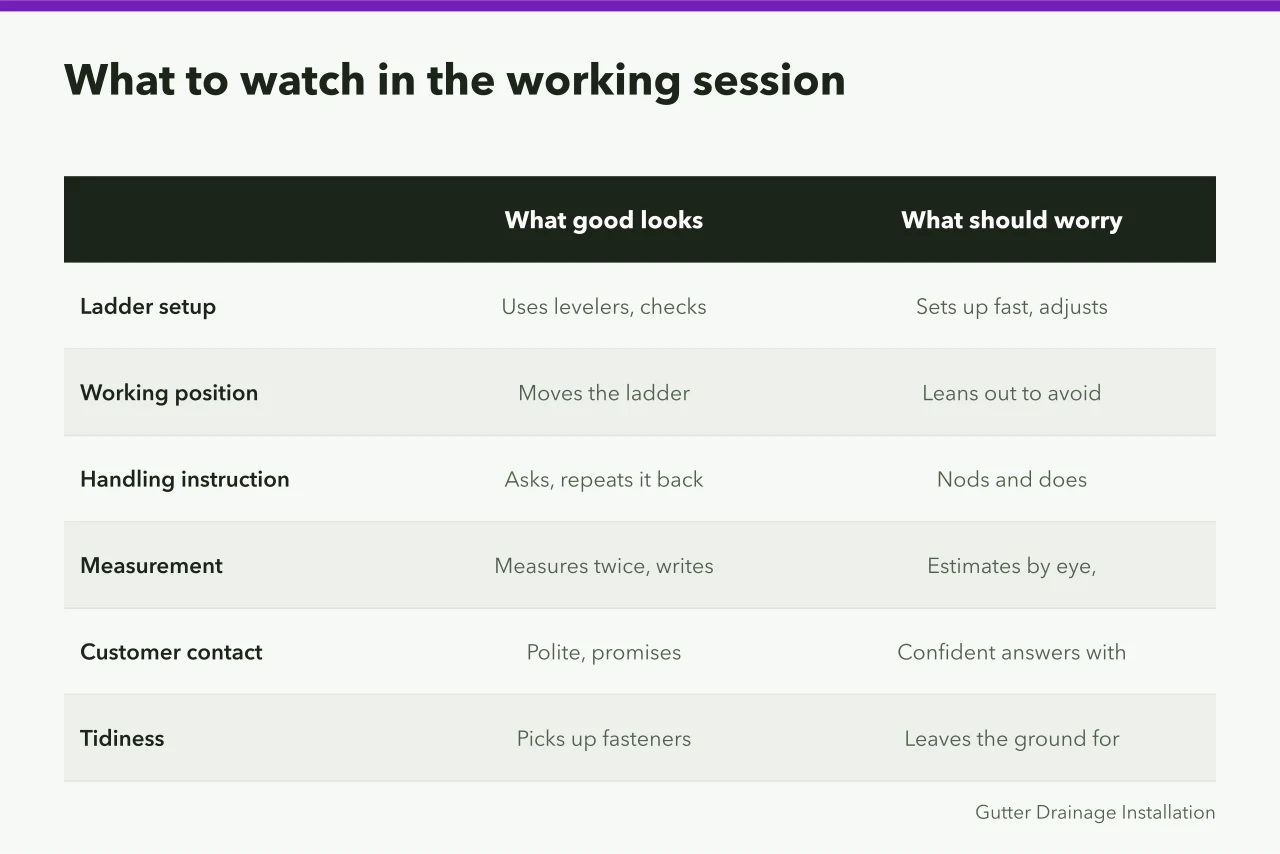
| What you watch | What good looks like | What should worry you |
|---|---|---|
| Ladder setup on uneven ground | Uses levelers, takes time, checks the footing twice | Sets up fast and adjusts nothing |
| Working position | Moves the ladder rather than reaching | Leans out because moving is inconvenient |
| Handling instruction | Asks a clarifying question, repeats it back | Nods at everything and does something else |
| Measurement | Measures twice, writes it down | Estimates by eye, remembers the number |
| Customer contact | Polite, does not promise anything | Answers technical questions confidently with no basis |
| Tidiness | Picks up fasteners without being asked | Leaves the ground for someone else |
The measurement row deserves attention specific to this trade. A wrong-length run is not a correction. It is a return trip with the trailer and the machine, the scheduling reality in the equipment and setup guide.
Somebody casual about a tape measure is expensive here in a way they would not be in another trade.
Check what can be checked
Verify a driving record where the role involves driving, with consent and in line with what your state permits. Confirm any certification claimed. Call the last employer and ask two questions: would you rehire, and what would this person need supervision on?
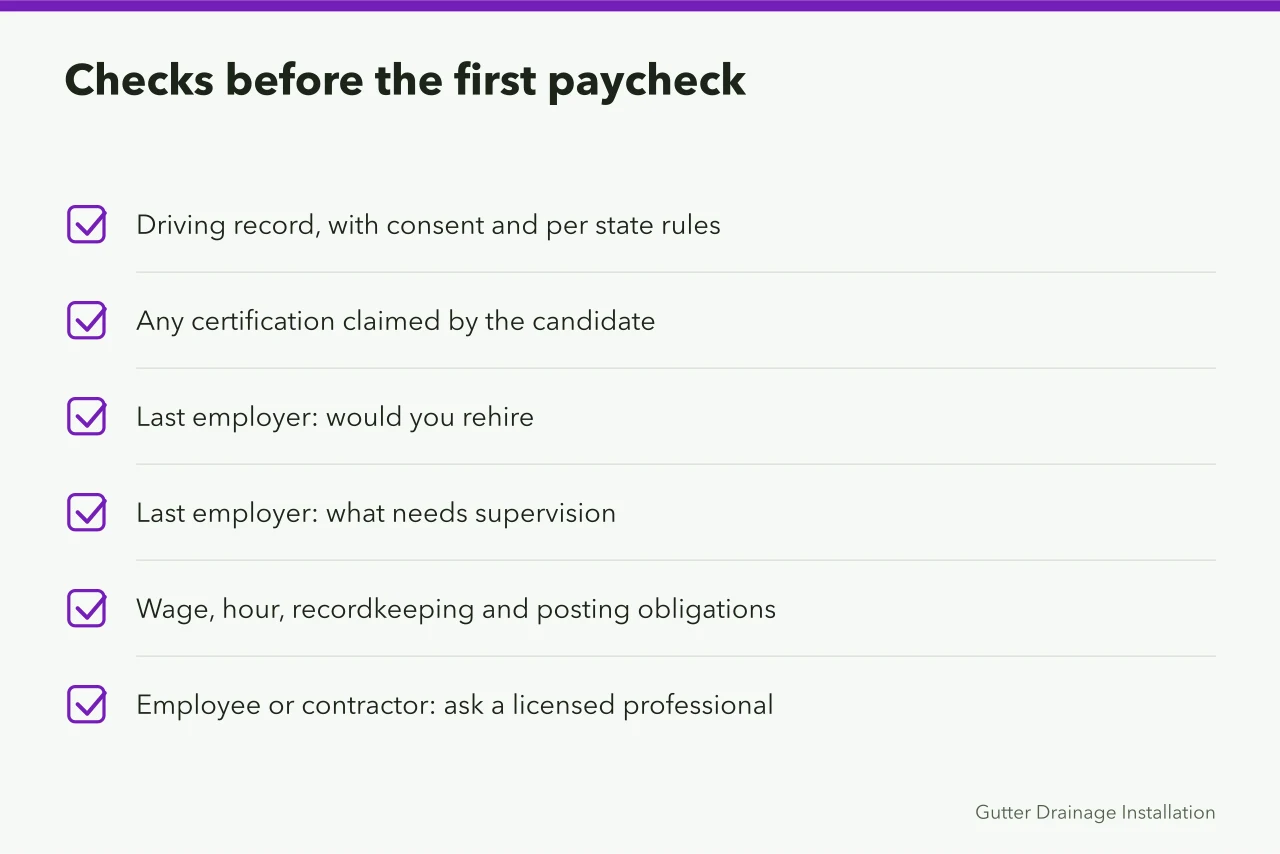
Then confirm your own paperwork side is in order before the first paycheck. Wage and hour obligations, recordkeeping and required postings all begin at hiring, and the Department of Labor publishes compliance assistance aimed at new and small businesses as an entry point.
One question needs professional advice rather than a checklist: whether the arrangement makes somebody an employee or a contractor. It depends on the facts and it has real consequences, so ask an employment attorney or accountant licensed in your state. The wider calendar this belongs on is in the licensing and compliance guide.
The first two weeks
Put the new person on ground work and low ladder work with somebody watching, and give them a truck responsibility from day one.
The truck responsibility is deliberate: stocking to the small-parts list, checking the load before leaving, and confirming the coil and color for the day teach the shape of the job faster than any explanation. This routine prevents return visits caused by a missing outlet or elbow.
The list is in the equipment checklist for new owners.
Watch for four things in those two weeks: arrives on time without being managed, asks when unsure, tidies without being told, and moves the ladder rather than reaching. Those four predict almost everything about the next two years.
Deciding early
Reliability shows up in the first fortnight and it rarely improves on its own. If two of the four signals are missing, have the conversation immediately rather than hoping the busy season fixes it. It will do the opposite: pressure makes existing habits stronger, not better.
Where the person is right and the skills are not yet there, that is a training question rather than a hiring one, and the sequence is set out in the hiring and training guide.
Common questions
Should I hire from roofing?
Often, yes. The height tolerance and the seasonal rhythm transfer well. Expect to spend time on the parts specific to drainage, particularly where water goes after the downspout.
Is a paid working session legal?
Pay for the time and treat it as work, because it is. Ask an employment professional in your state about how to structure it before you run the first one.
How do I compete on pay with larger employers?
Usually on the things they cannot offer: predictable hours, a crew that stays together, decent equipment and being told what is happening. Those retain people at rates that would not attract them.
Should the first hire be experienced?
If you are still learning the work yourself, yes, because you cannot supervise what you have not done. If you are competent, training from nothing produces someone who does it your way.
What is the single best predictor of a good hire?
How they set a ladder on uneven ground when they think nobody is timing them.