Guides
Gutter service unit economics for owners
Gutter service profit margins: the two break-evens every owner needs, the algebra in named variables, and why the seasonal one decides the year.
What to take away
- You have two break-evens. The daily one tells you whether to send a crew out. The seasonal one tells you whether the business works at all.
- Write both in your own variables. Any figure quoted at you as an industry margin was produced somewhere else, under conditions you cannot see.
- A margin percentage hides the thing that actually kills gutter companies, which is unbilled hours rather than a thin rate.
- Of the four levers on margin, the fastest is the productive fraction, and it is the one nobody looks at.
Two break-evens, not one
Most owners carry one number in their head and it is the wrong one.
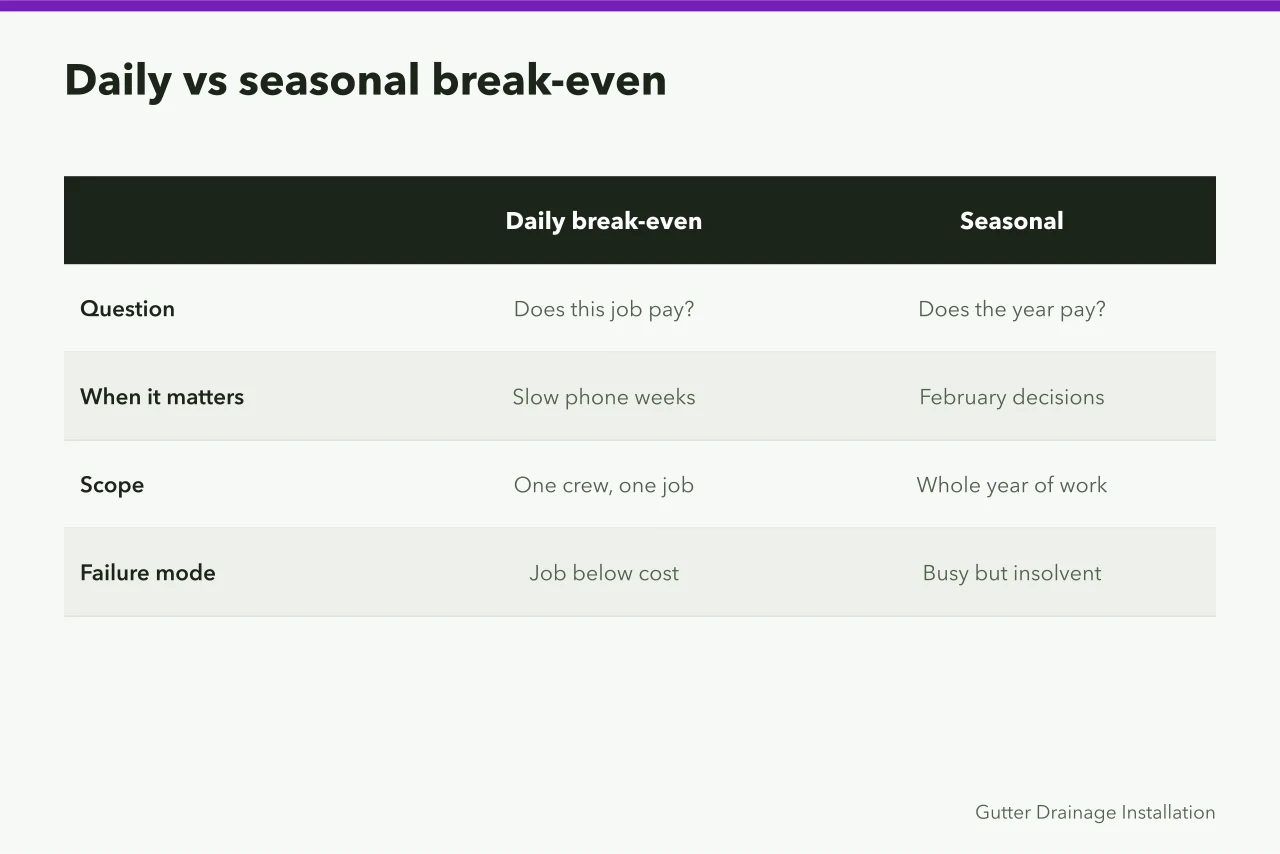
The daily break-even asks whether a specific job covers the cost of putting a crew in front of it. It matters when the phone is slow and you are deciding whether a small repair three towns away is worth doing.
The seasonal break-even asks whether the total work you can physically complete in a year covers everything the business costs to exist for that year. It matters in February, when you are deciding whether to hire, whether to buy, and whether the model works.
A company can clear the first one on every job and still fail the second. That is the most common way a busy gutter business goes under.
The variables
Define these once and keep them in the same place as your job-costing records.
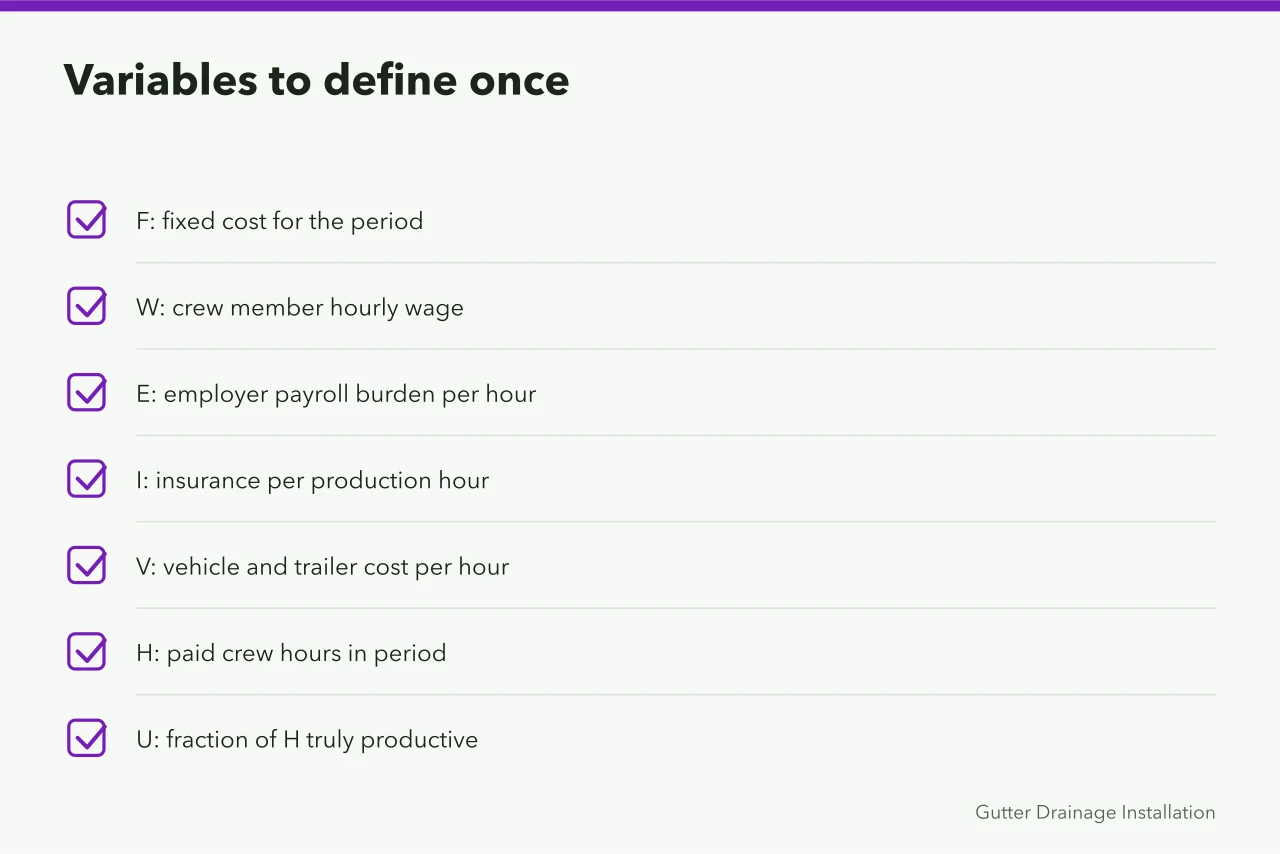
Two of these are usually wrong on first attempt. U is optimistic, because travel, setup, teardown, the supply run and the weather delay are all paid and none of them bills. And D is optimistic, because owners count calendar days rather than days a crew can actually be on a roof.
Deriving the daily break-even
Work it in this order.
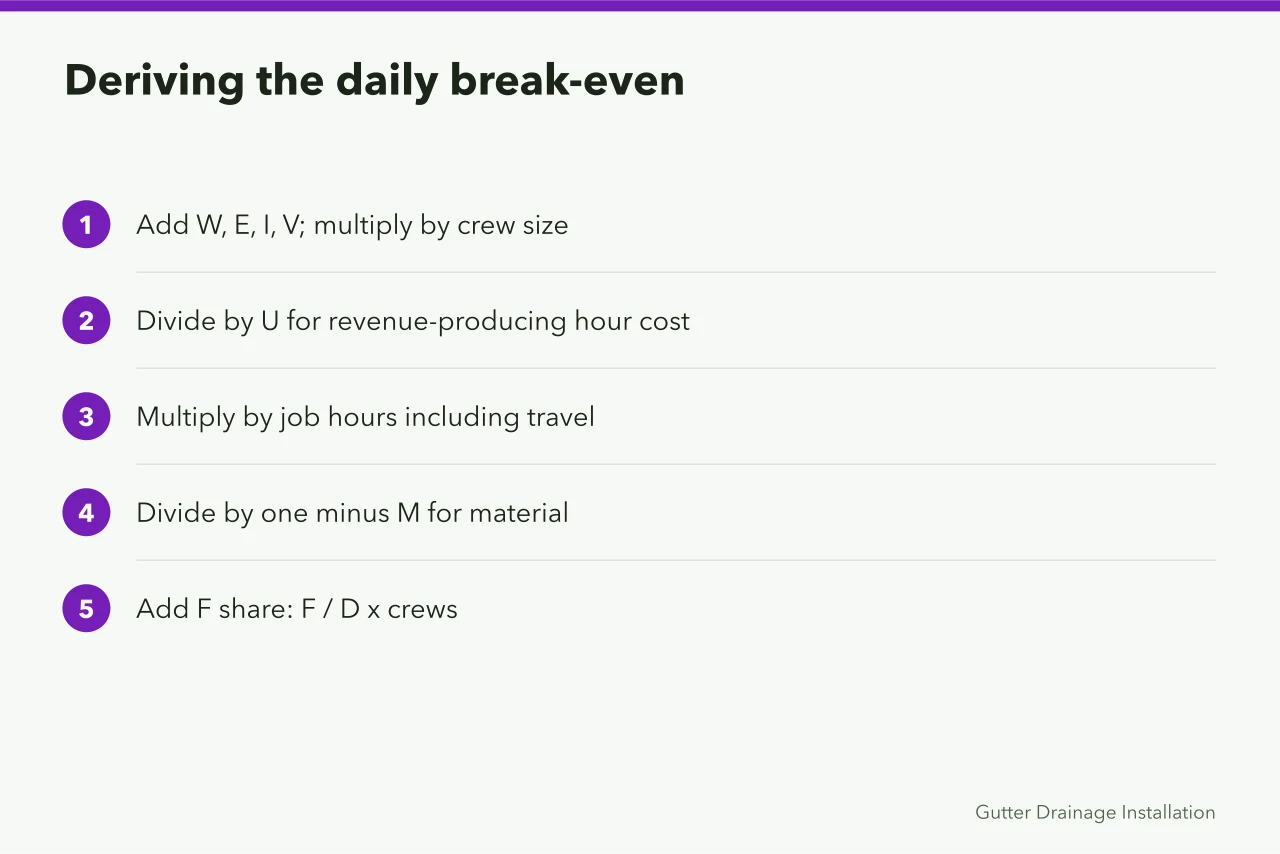
The result is the number the job has to beat before the business is any better off for having done it. Anything below it is work you are paying to perform.
Step five is where owners argue. It is tempting to say that fixed costs are paid anyway, so a marginal job at any price above direct cost is worth taking. That is true for one job on one slow day. It stops being true the moment those jobs displace better ones, which they always do in the busy weeks.
The seasonal break-even
This is the one that decides whether the model works.
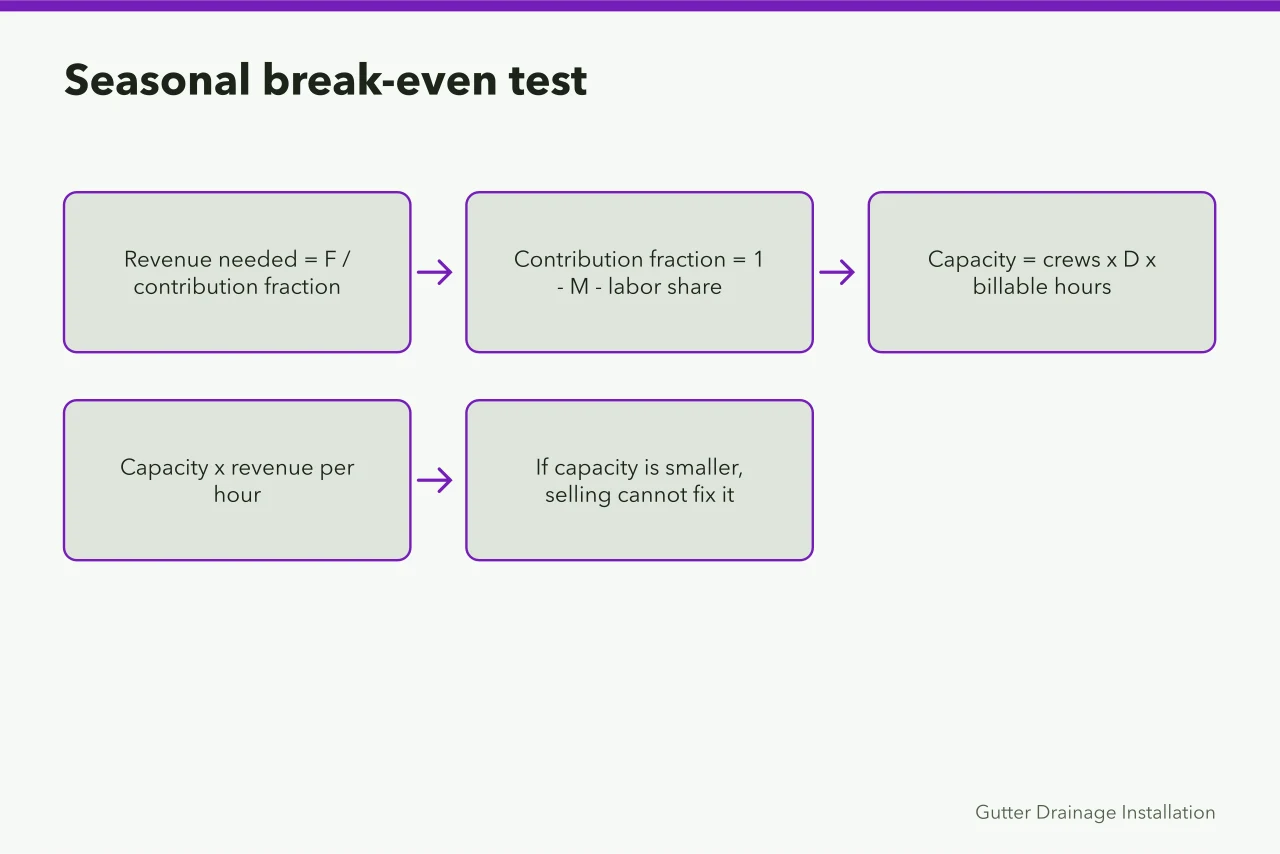
Revenue needed for the season is F divided by the contribution fraction, where the contribution fraction is one minus M minus the direct labor share of revenue. Then test it against physics: can the crews you have, working the days you actually get, complete that much work?
That second half is what a spreadsheet omits. Multiply crews by D by billable hours per day by your average revenue per billable hour, and compare it against the revenue you just calculated as necessary. If the capacity number is smaller, no amount of selling fixes it. You need more crews, more productive hours, or a higher revenue per hour.
Seasonality hits gutter work harder than most trades. Demand clusters around leaf drop and the first heavy rains.
Those same weeks bring equipment failures and the hardest crew shortages. A business that breaks even only when every peak week goes perfectly has budgeted for a year with no rain delays.
What a margin percentage hides
A healthy-looking gross margin can sit on top of a business losing money, and the usual reason is U.
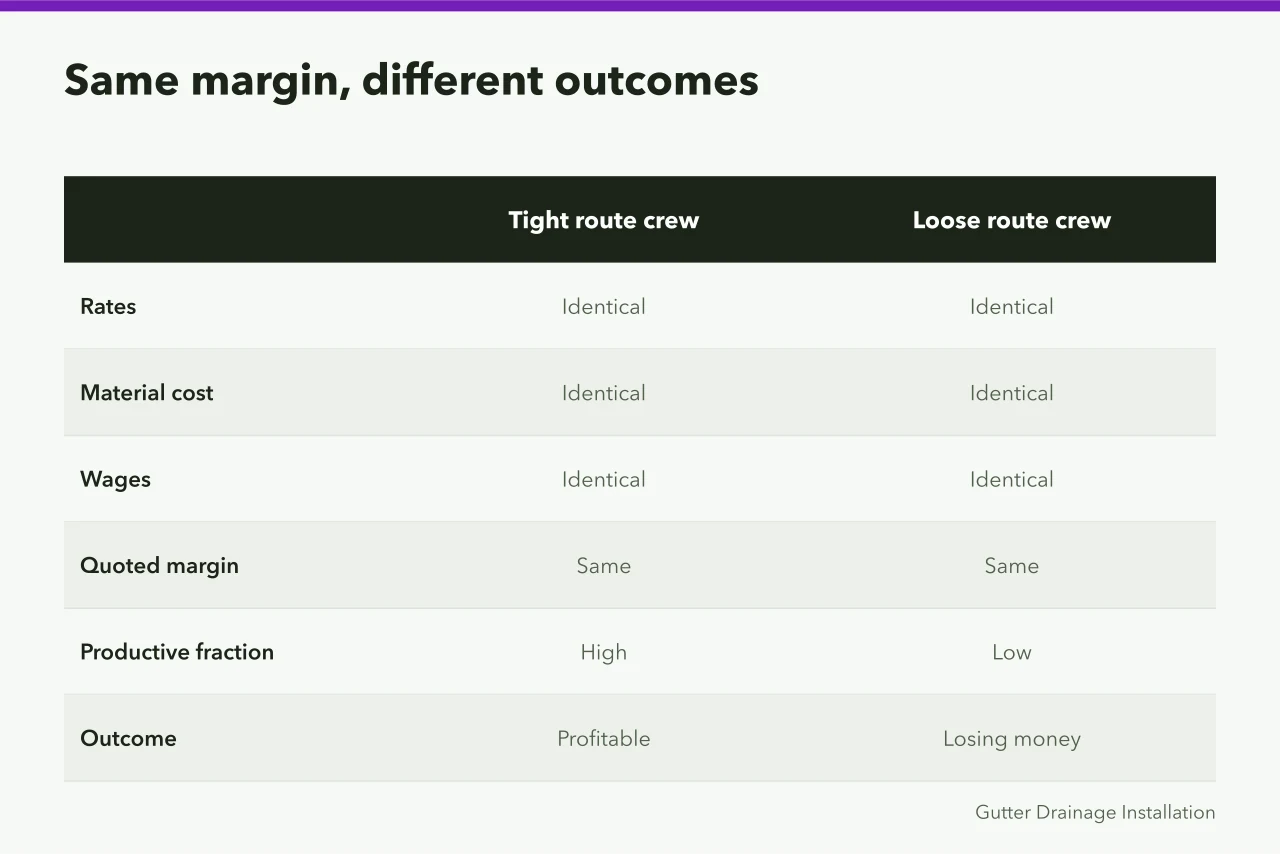
Consider two companies with identical rates, identical material cost and identical wages. One runs a tight route and finishes jobs the first time. The other drives further between jobs, returns for a missing outlet, and remeasures once a month. Their quoted margins are the same. Their outcomes are not.
That is why the productive fraction belongs on the wall next to the margin. Two things move it more than anything else: routing, and whether the truck leaves with everything the job needs. The second is a solved problem, and the equipment checklist for new owners is the solution.
The four levers, ranked
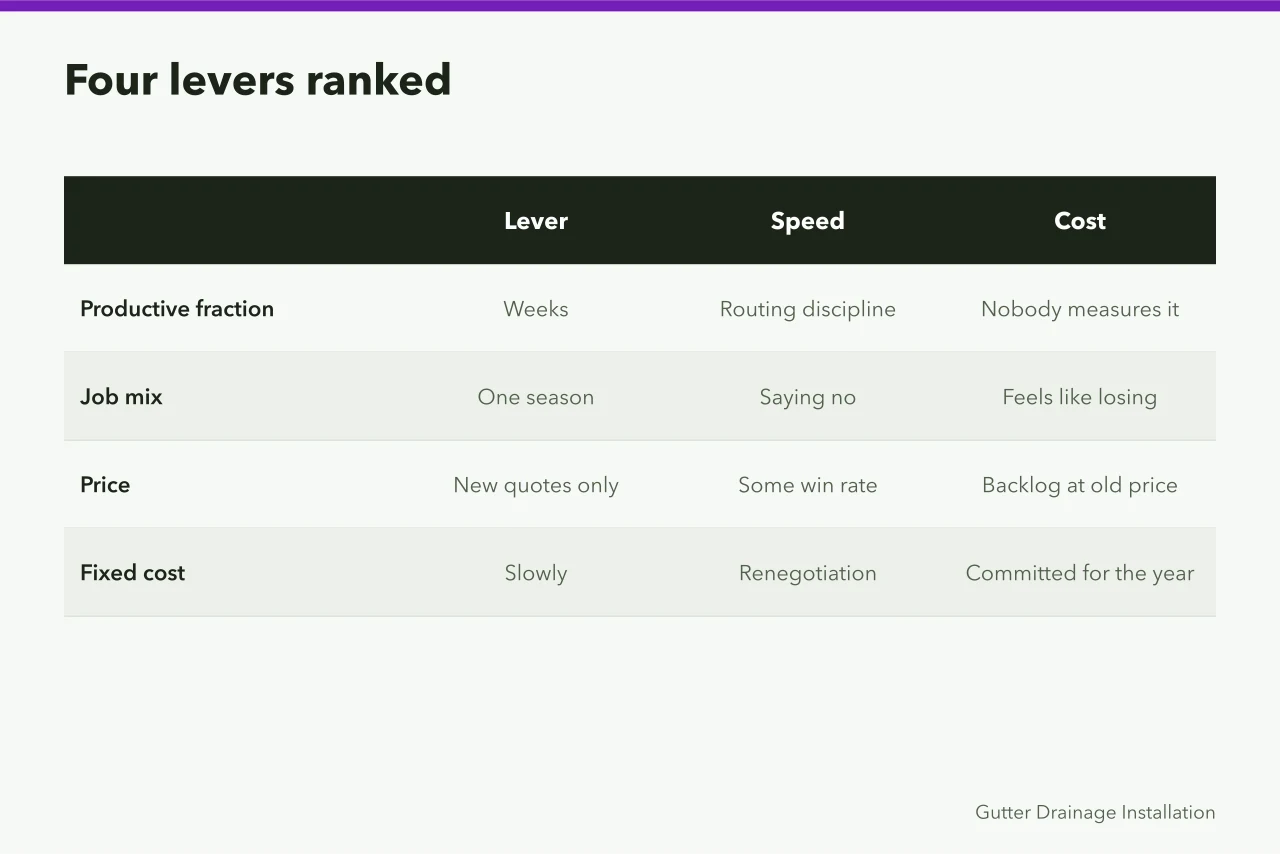
| Lever | How fast it moves | What it costs you | The catch |
|---|---|---|---|
| Productive fraction | Weeks | Routing discipline and preparation | Nobody measures it, so nobody manages it |
| Job mix | One season | Saying no to work you are worse at | Turning down revenue feels like losing |
| Price | Immediately on new quotes | Some win rate | Your backlog is still at the old price |
| Fixed cost | Slowly | Renegotiation, or doing without | Most of F is committed for the year |
The ordering surprises people, because price feels like the obvious lever. It is the third fastest, because it only touches quotes you have not sent yet, and in a seasonal trade the backlog is often most of the season.
Discounting deserves one warning: a reduced or promotional rate must be genuinely available on the terms a reader would understand. The Federal Trade Commission's advertising guidance for small businesses sets out that general expectation.
A discount that only exists to get through the door is a compliance problem on top of a margin problem.
Getting the inputs honestly
W has a public starting point: the Bureau of Labor Statistics publishes occupational employment and wage estimates by area, which tells you what your local market pays a given occupation before you add your own burden. Everything else has to come from your own records.
Job costing, per job, every job: quoted amount, actual hours, material, travel, any return visit and its cause.
The IRS explains what records a business is expected to keep. The file that satisfies a tax record is the same file that produces U and M honestly.
Ask a tax professional about anything consequential in your own year and structure.
Three inputs move for reasons outside the spreadsheet. Equipment ownership decisions change V and the downtime that eats D, which is covered in the equipment and setup guide. Crew capability changes hours per job faster than any other single factor, which is why hiring and training is a margin subject rather than an administrative one.
The rate itself has to be built before any of this is meaningful. That is what the pricing and profit guide is for, with the estimate-side mechanics in how to price a job for a fair margin.
Common questions
What is a normal margin for this trade?
Nobody can tell you that from a page, and a number offered without your cost structure behind it is decoration. What is answerable is your own floor, which the arithmetic above produces.
Should I include my own pay in F?
Yes, if you are not on the crew. A business that only works because the owner is unpaid is not yet a business.
How do I estimate U without months of data?
Time one week honestly. Write down when the crew leaves, when they are actually working, and when they are back. The first week is uncomfortable and it is close enough to start with.
Why does D matter so much?
Because this trade loses days to weather in exactly the weeks demand peaks. A capacity plan built on calendar days will overstate what you can complete by a wide margin.
What is the first thing to fix if I am below break-even?
Look at the productive fraction before you look at the rate. Raising a price you have not yet quoted does nothing for a season that is already booked.