Guides
Gutter service quotes that clients accept: a template with priced examples
A gutter service quote template with three priced examples, the exclusions paragraph, and the fascia contingency clause that stops most client disputes.
What to take away
- A gutter service quote is a scope document with a number attached. Most disputes in this trade come from the scope half, not the price.
- Three blocks prevent almost every argument: quantities, exclusions and the fascia contingency.
- Price the run, the drops and the access separately. A single blended foot rate hides which of the three the customer is buying.
- The three examples below use typical 2026 ranges, not a national rate card. Replace every one with your own rates before the quote leaves your truck.
- Put the discharge point in writing. Where the water ends up is what the customer will judge you on.
Three priced examples
The jobs below use typical 2026 ranges for 5-inch K-style aluminum, formed on site and hung with hidden hangers. They are illustrative, and they show the arithmetic rather than a national market. Substitute your own run rate, drop rate and access factor, and the structure still holds.
| Job | Run | Drops | Access | Typical total |
|---|---|---|---|---|
| Bungalow, 140 ft, level ground, 4 drops | 140 ft at $7 to $12/ft | 4 at $75 to $150 each | Class A, no uplift | $1,280 to $2,280 |
| Two-story, 180 ft, slope and deck, 6 drops | 180 ft at $10 to $16/ft | 6 at $75 to $150 each | Class B, +15% to 25% on hours | $2,900 to $4,700 |
| Century home, 160 ft, soft fascia found, 5 drops | 160 ft at $9 to $15/ft | 5 at $75 to $150 each | Class C, +25% to 35% on hours | $1,800 to $3,150 plus fascia work |
The bungalow is the clean case. Level ground, sound fascia, four drops that all terminate above grade. The number is the run plus the drops, and nothing else moves.
The two-story job carries a Class B access uplift because the crew is working a slope, a deck and a bay window on the same run. Same run length as the century home, different hours.
The century home is the one that turns into a second conversation. The quote covers the run and the drops. Soft fascia is priced separately under the contingency clause, at your schedule rate, with the customer's approval before you exceed the authorized amount.
Fascia board is a second market. Repair of a short section typically runs $3 to $7 per linear foot. Full replacement typically runs $8 to $25 per linear foot, and the spread reflects material, height and how much rot the crew finds behind the old hanger line.
Cleaning and repair quotes price differently from replacement. A single-story clean typically runs $100 to $250, and a two-story clean $150 to $400. Many companies quote $0.80 to $1.50 per linear foot. A repair call, such as resealing a joint or replacing a hanger, typically runs $75 to $200.
Why no single national price per foot exists
A single national price per foot does not exist. Rainfall intensity is regional and sets the system size. Local wages differ by area and occupation. Access difficulty depends on the housing stock you work in. What you may do with discharged water is set by the municipality.
Four inputs, all local, all upstream of the number. The Bureau of Labor Statistics publishes occupational employment and wage estimates by area, which is a defensible local starting point for the wage input. Build the rest from your own rate card, the way the pricing and profit guide sets out.
Materials are easier to check. Suppliers including ABC Supply, Beacon Building Products and SRS Distribution quote coil to account holders, and 5-inch K-style aluminum usually comes in .025, .027 and .032 gauge. Amerimax sells the same profiles in short lengths through retail lumberyards.
Gutter guards change the quote when the customer adds them. Professionally installed systems such as LeafFilter, LeafGuard and Gutterglove typically run $15 to $40 per linear foot. A DIY mesh system from Amerimax runs about $2 to $8 per linear foot.
The quote, block by block
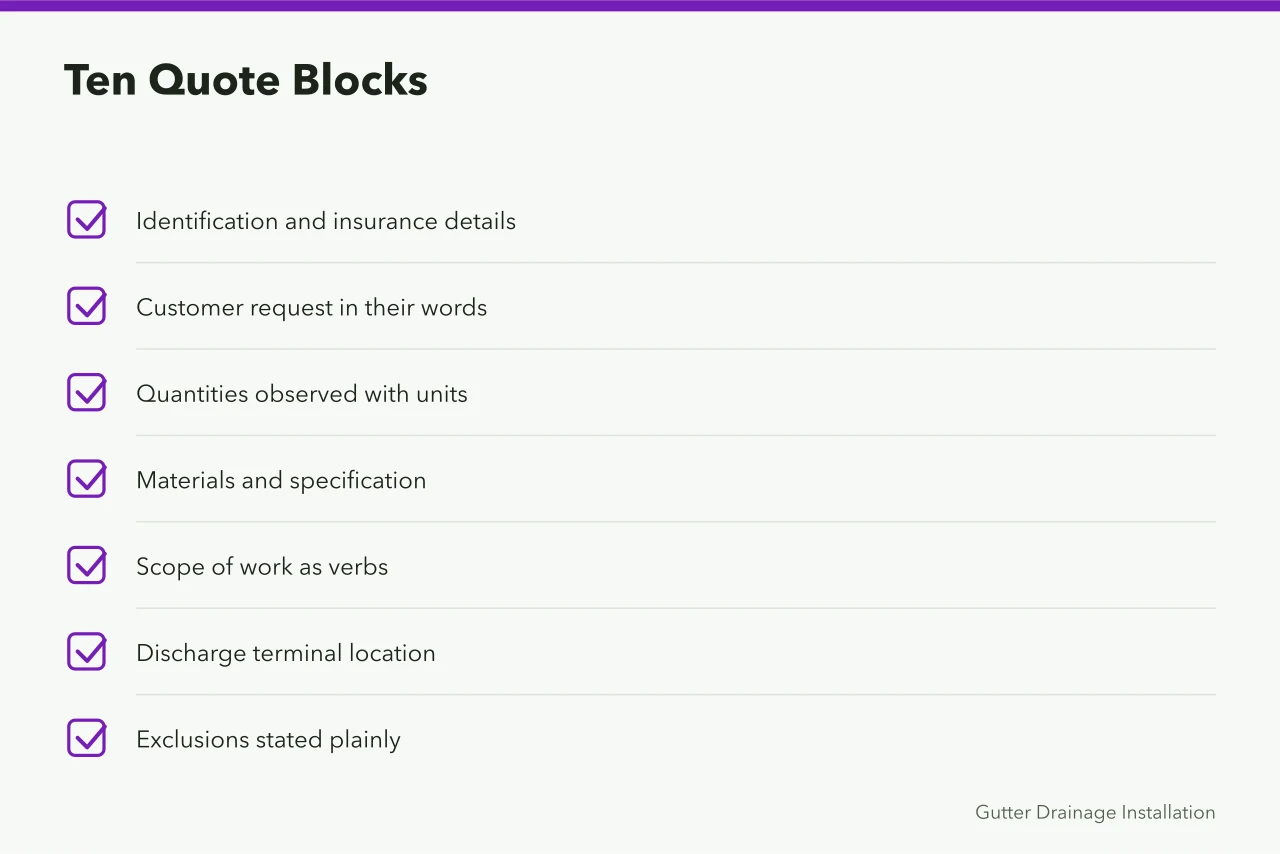
- Identification: business name, state license or registration number where your state issues one, insurance carrier and policy dates, property address. Then the date the quote expires.
- What the customer asked for, in their words. One sentence. It proves you listened and it anchors the scope.
- Quantities observed. Run lengths, corner count, drop count and locations, access class, elevations.
- Materials and specification: profile, metal and thickness as specified by your supplier. Then color, hanger type, fastener type and sealant.
- Scope of work, as verbs. What will be removed, formed and hung. Then what will be sealed, connected and tested.
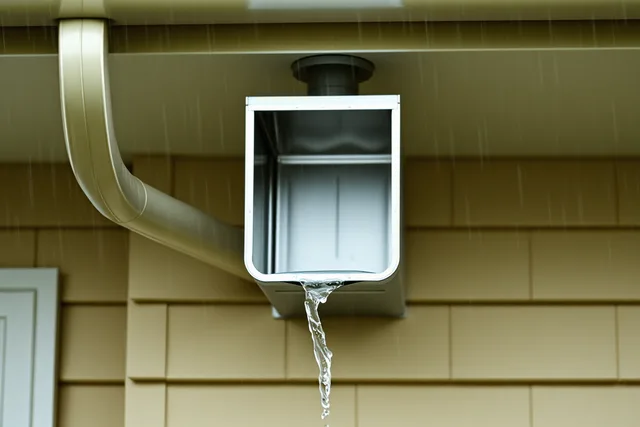
- The discharge terminal. Where each downspout ends and what it discharges onto or into.
- Exclusions, stated plainly.
- The contingency clause for conditions that cannot be assessed from the ground.
- Price, payment terms and schedule.
- Signature blocks and the change-order rule.
Blocks six, seven and eight are the ones missing from most quotes in this trade, and they are the ones that carry the disputes.
A worked example of the quantities block
Write the quantities as observations with units, never as a total. The customer should be able to walk the house with your quote in hand and check every line.
| Line | What you record | On the quote |
|---|
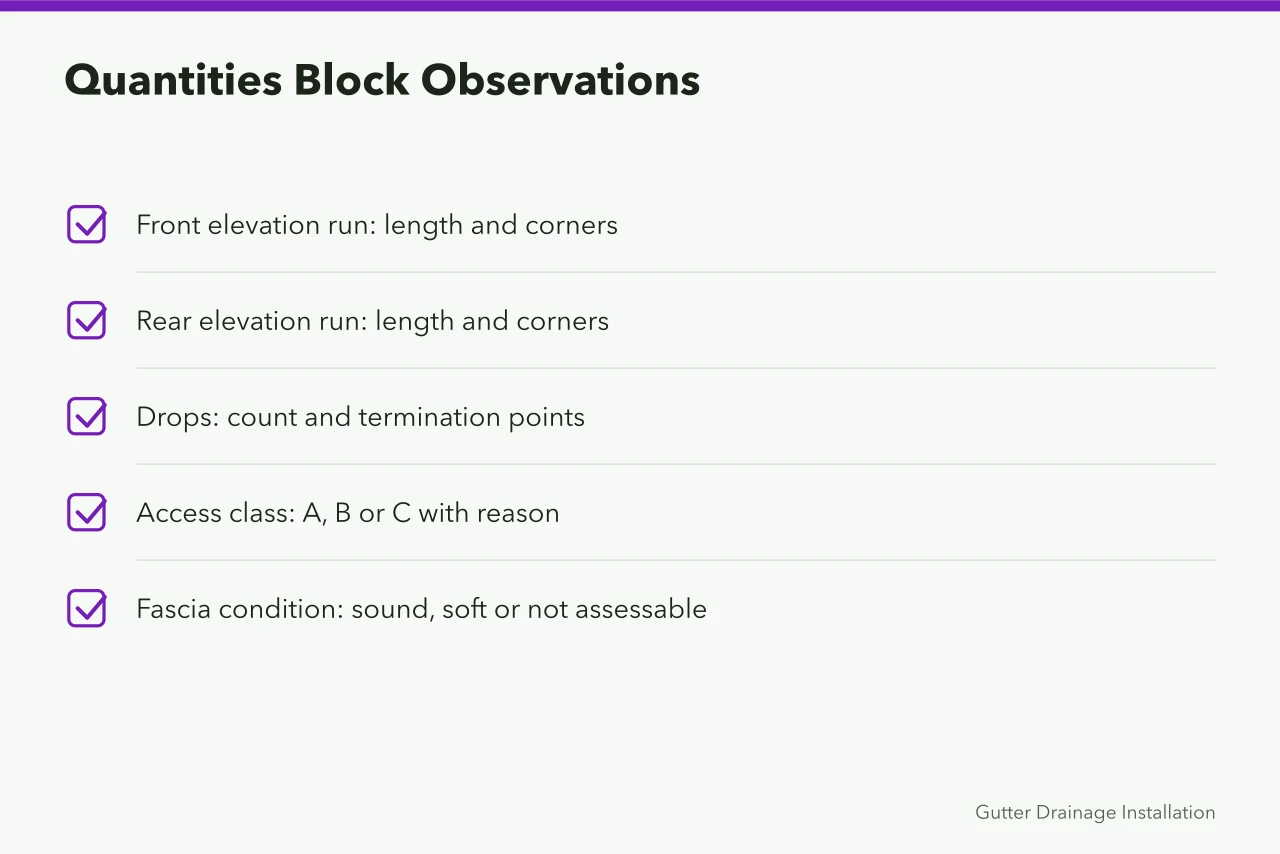
The price line then reads as quantities multiplied by your published rates, plus the drop rate multiplied by N, plus the access factor applied to hours. The bungalow above reads as 140 ft at $7 to $12, four drops at $75 to $150, and no uplift.
A customer comparing two quotes can now see whether the cheaper one counted the same drops. Usually it did not.
The access class line is worth defending. Two houses with the same run length can differ substantially in hours because one has firm level ground and the other has a slope, a deck and a bay window. Grade it into three classes with written criteria so that any estimator on your team produces the same grade.
The exclusions paragraph
Write it as prose, not as a list of legal nouns. Something in this shape, adapted to what you actually do:
This quote covers the work described above. It does not include repair or replacement of fascia, soffit, or roof edge materials. Nor does it include altering any buried drain line, correcting grading around the foundation, permit fees where a permit is required, or work above the access limit stated in our terms.
Where any of these is found to be necessary, we will stop, tell you, and give you a price before continuing.
That last sentence is the one that matters. An exclusion without a stated process is an ambush with paperwork.
The contingency clause, written out
The fascia is the job behind the job. A hanger holds because the board holds. Soft board, old spike holes and years of back-pitched water are common and not fully assessable from the ground.
So say what you inspected, and give a basis for what happens if more turns up:
We inspected the fascia at the low point of each run and at each existing downspout. Where additional deterioration is found once the existing system is removed, replacement is charged at the rate stated in our schedule, and we will obtain your approval before exceeding the amount you have authorized.
Two numbers make that clause work: the rate, and a not-to-exceed the customer signs. The rate is your posted fascia figure, typically $8 to $25 per linear foot. Without the second number, you have written a blank check into your own quote and the customer knows it.
Terms that prevent the three common disputes
The disputes are always the same three, and each has a term that ends it.
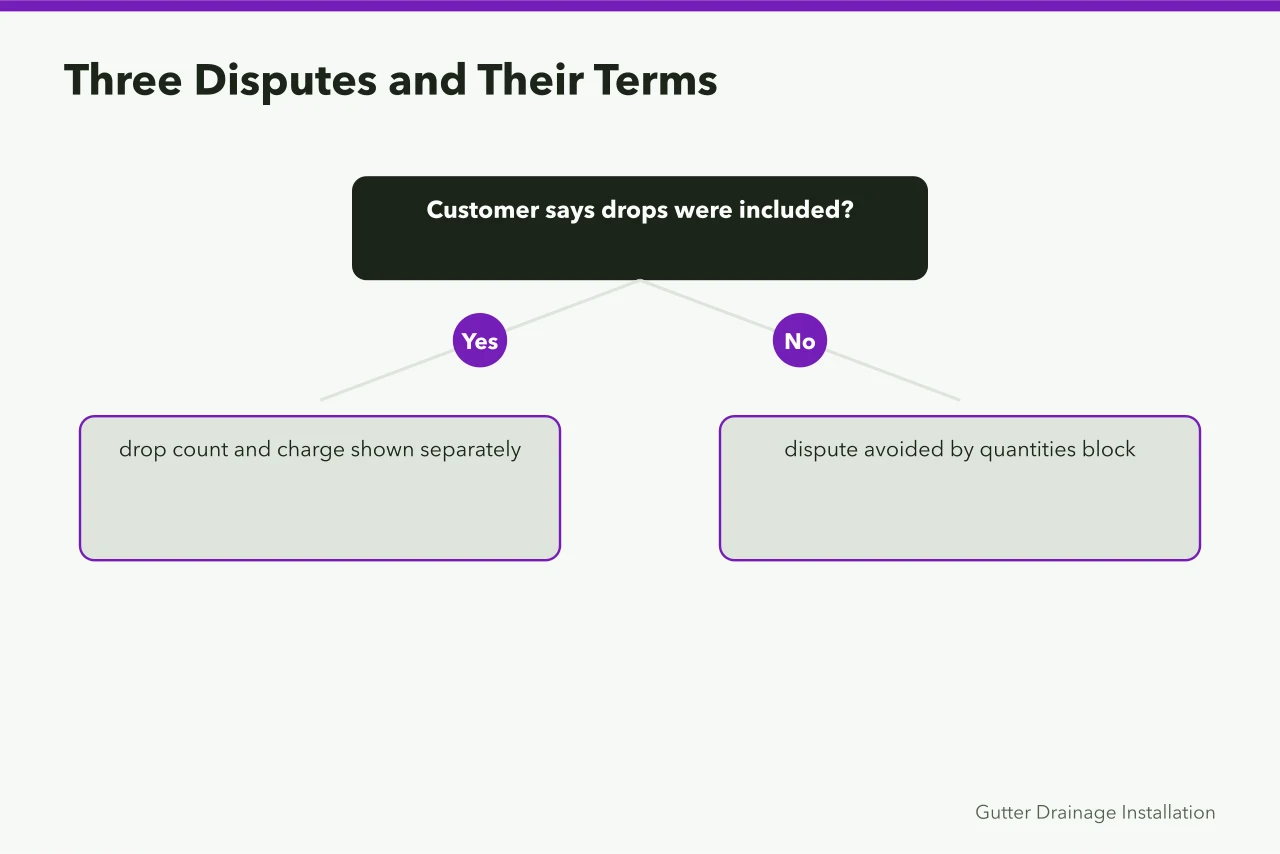
The customer says drops were included. Term: the drop count and each termination point appear in the quantities block, and the price line shows the drop charge separately.
The customer says the basement is still wet. Term: the discharge terminal is described in block six, together with what you did and did not do to the buried line or the grading. Most complaints about gutters are complaints about where the water ended up.
The customer says the price changed. Term: a change-order rule stating that any change to scope is priced and approved in writing before work continues, with the fascia contingency as the one pre-approved exception up to the authorized amount.
Be careful that the advertising the customer saw supports the quote they receive. A headline or promotional rate has to be genuinely available on terms a reader would understand, and the Federal Trade Commission's advertising guidance for small businesses explains the general expectation. A quote that has to walk back its own advertisement starts the relationship badly.
After the job: closing the loop
The quote is the front half of a record. The back half is what actually happened, and the pair is what makes your next quote better.
Record the quoted amount against actual crew hours, material consumed, travel, and any return visit and its cause. That comparison feeds the break-even and margin arithmetic.
The estimate-side discipline behind good quantities is in how to price a job for a fair margin. The IRS explains what records a business is expected to keep; one file serves both purposes.
Confirm color and coil availability before you commit to a date. A formed run is made on site, and a color change is a coil change, which is one of the scheduling consequences described in the equipment and setup guide.
Check that the truck leaves with the small parts. A missing outlet or elbow turns a finished job into a second visit, which is exactly what the equipment checklist exists to prevent.
Common questions
How long should a quote be valid?
Long enough to be fair, short enough to protect you from material price moves. Whatever you choose, print the expiry date rather than leaving it implied.
Should the quote show a rate per foot?
Showing quantities and a total is usually enough. A published per-foot rate invites a comparison against quotes that measured differently, which helps nobody.
What per-foot rate should I start from?
Start with what your own finished jobs cost per foot, then compare it against a common band of roughly $7 to $12 per linear foot for single-story 5-inch K-style aluminum and $10 to $16 for two-story work. Below that band, check the scope before you check your costs.
Do I need a separate contract?
Ask an attorney in your state about what your terms need to contain. What is safe to say generally is that a quote with a clear scope, clear exclusions and a written change-order rule prevents most of what a contract is later used to argue about.
What if the customer wants the contingency clause removed?
Then you are being asked to absorb an unbounded cost you cannot inspect. Explain that, and if it does not move, decline the job.