Guides
Gutter service packages: the parts worth your attention
Gutter service packages: what a package definition must fix, where the boundaries fall in this trade, and three structures compared honestly.
What to take away
- A package is a boundary, not a discount. Its job is to make what is included visible before anyone is on a ladder.
- Four things must be fixed in writing: the scope, the exclusions, the discharge terminal and what happens when the fascia is soft.
- Recurring work and one-time work behave differently enough that mixing them in one package hides both.
- Sell guards as a change to the maintenance interval. Selling them as the end of maintenance is a refund with a delay on it.
What a package is actually for
Customers cannot compare gutter quotes. They lack the vocabulary, they cannot see the roof edge, and the two quotes in front of them almost certainly measured different things.
A package fixes that. It gives the customer a named thing with a described boundary, so the comparison becomes possible and the conversation moves from price to scope. That is better for the customer and much better for you, because scope is where you are actually different from the cheapest bidder.
It is not a discount mechanism. A package built to look cheap by leaving out drops or the discharge terminal creates exactly the dispute it was supposed to prevent.
The four things a definition must fix
Every package you sell has to answer these before a crew is dispatched.
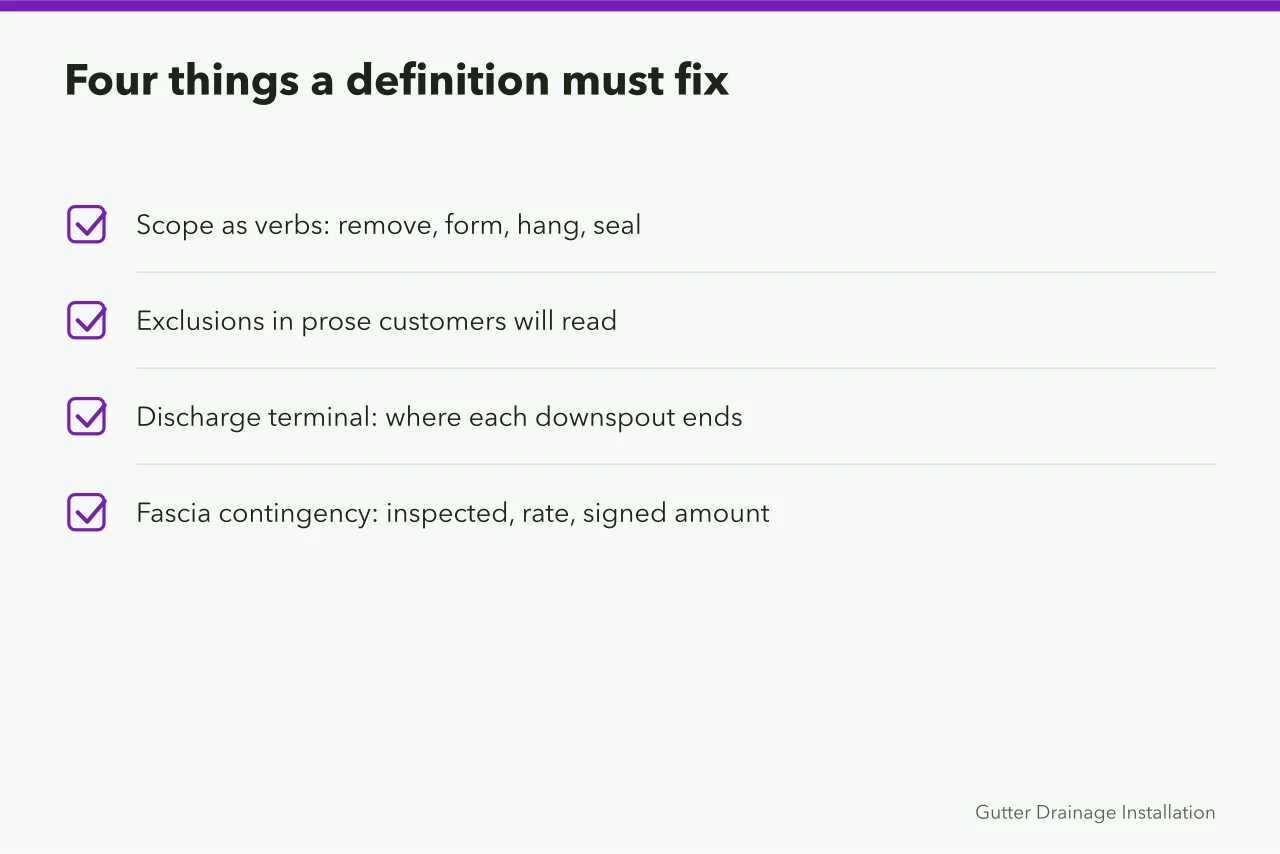
The scope, as verbs. What gets removed, formed, hung, sealed, connected and tested. A noun list is not a scope.
The exclusions, in prose a customer will read. Fascia and soffit repair, roof edge materials, alteration of buried drain lines, grading, permit fees where one is required, and anything above your stated access limit.
The discharge terminal. Where each downspout ends and what it discharges onto or into. This is the part customers judge you on and the part most quotes are silent about, because it is the source of most complaints attributed to gutters.
The fascia contingency. A hanger holds because the board holds, and soft board is common and not fully assessable from the ground. State what you inspected, give a rate for replacement, and get an authorized amount signed before work starts.
Get those four right and most of the arguments this trade has simply do not occur.
Where the boundaries fall in this trade
Some boundaries are obvious and some are learned expensively. These are the ones worth deciding deliberately.
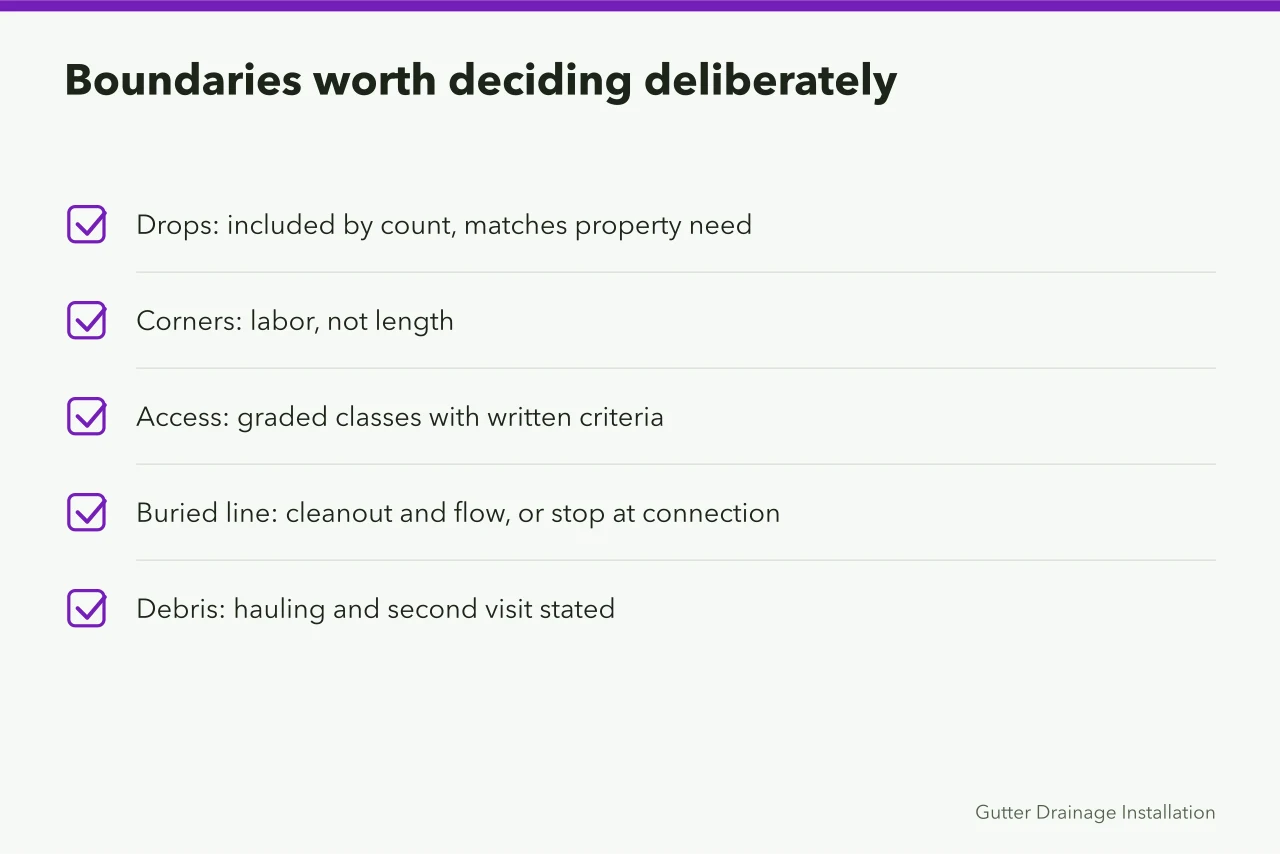
Drops. Are downspouts included by count, and does the count in the quote match what the property needs rather than what it currently has? A house missing a drop will overflow whatever you hang on it.
Corners. Corners are labor, not length. A package priced only per foot will lose money on a house with many of them.
Access. Two properties with identical run lengths can differ substantially in hours because of slope, decks, obstructions and elevation. Grade access into a small number of classes with written criteria and say which class the quote assumes.
The buried line. If a downspout enters the ground, does your package include opening a cleanout and confirming flow, or does it stop at the connection? Both are defensible. Silence is not.
Debris. On cleaning work, is hauling included, and is a second visit assumed or not? Customers overwhelmingly assume it is.
Recurring and one-time work
These behave differently enough that a single package hides both.
One-time installation work is capital-intensive, weather-sensitive and priced on quantities. Its risk is measurement and access, and its cash arrives once.
Recurring cleaning and inspection work is labor-light, route-sensitive and priced per visit rather than per foot. Its risk is drive time, and its value is that it smooths the season and puts you at the property before the installation is needed.
Sell them as separate things, with separate names and separate boundaries. Where you want to connect them, connect them explicitly: a maintenance agreement that includes an annual inspection with a written condition report is honest and useful. A vague bundle that implies future work is included is neither.
Frequency should follow the property rather than a calendar. A house under a mature canopy and a house with no trees over it do not need the same interval, and saying so in the sale is more persuasive than a standard plan, because it shows you looked.
Three structures, compared
| Structure | How it is bounded | Suits | Where it breaks |
|---|---|---|---|
| Quantity-based | Priced from measured feet, drops, corners and access class | Installation and replacement | Needs a real estimate visit, so it cannot be quoted by phone |
| Visit-based | Priced per property visit within a defined scope | Cleaning, inspection, minor repair | A large or difficult property subsidized by the small ones |
| Agreement-based | Recurring visits plus a defined response for problems found | Repeat customers, managed properties | Vague inclusion language, which turns into unpaid work |
The third row is the one worth building carefully, because it is the only one that produces a predictable calendar in a seasonal trade. The failure mode is always the same: language like ongoing support or minor repairs included, with nobody having defined minor. Define it with a time limit, a materials limit, or a named list of tasks.
Guards, packaged honestly
Guards reduce large debris. They do not end cleaning, and the whole commercial question is whether you say so.
Fine material still passes and settles. Some designs shed water in heavy rain because the sheet runs past the opening rather than into it. Some make the trough harder to open when it does need clearing. Where a guard fastens under the roof covering, the roofing manufacturer's own instructions govern, and the roof warranty is not yours to spend.
So package them as a change to the maintenance interval, described in the customer's terms, with the interval stated. That is a sale you can defend at the first heavy rain. The alternative is a customer who was told the problem was solved and now has evidence it was not.
There is a version of this that is simply wrong: selling a guard where the customer's real problem is a back-pitched run, a missing outlet or a blocked buried line. The guard changes nothing and you have taken money for it.
What the advertising has to support
A package name travels further than a package definition. That creates a specific hazard: the customer arrives expecting what the advertisement implied.
If a headline or starting price is out in the market, the conditions that make it achievable have to be clear enough that a reader understands them, and the offer has to be genuinely available. The Federal Trade Commission's advertising guidance for small businesses sets out the general expectation in plain terms.
Three habits cause most of the trouble: a per-foot figure that quietly excludes drops, a cleaning price that assumes a single-story property without saying so, and a promotional rate no crew is ever scheduled to honor. Each wins a phone call and loses the sale at the door, which is the worst possible order.
Costing a package before you name it
A package is only sellable if it is profitable at the quantities it will actually meet.
Cost the job from crew hours, not feet, because access changes hours more than length does. Include travel, setup, teardown, and measurement verification before anything is formed.
In this trade, a remeasure means bringing the trailer back, not making a correction. Then check the labor input against something external: the Bureau of Labor Statistics publishes occupational employment and wage estimates by area, a defensible local starting point before you add your own burden.
Whether the mix of packages suits the market at all is a separate question, and one worth answering before you print anything. Housing stock, tree canopy and rainfall pattern decide what people actually buy, which is the subject of the startup and market guide.
Reviewing a package after a season
A package is a hypothesis about a boundary. The season tests it.
Record, per job under each package: quoted amount, actual crew hours, material, travel, return visits and their causes, and every occasion a customer believed something was included that was not. That last column is the one that improves the definition, and it is the one nobody keeps.
The IRS explains what records a business is expected to keep, and the file that satisfies a tax record is the same file that shows which package is quietly losing money. Review before the next season starts, not during it, because a backlog booked under the old definition takes months to clear.
One boundary should never move for commercial reasons. Work above your stated access limit stays out, whatever the customer offers, because this trade's severe risk sits at the roof edge. OSHA's guidance on fall protection in residential construction puts responsibility for site-specific controls on the employer, not the person who asked.
Common questions
How many packages should I offer?
Few enough that a customer can hold them in their head. Most companies need one installation structure, one cleaning structure and one agreement, with options rather than variants.
Should packages be priced publicly?
Cleaning and inspection can be, with the conditions stated. Installation usually cannot, because the quantities are only knowable at the property and a published figure invites a comparison against quotes that measured differently.
Is a good, better, best ladder useful here?
Only if the differences are real. Where the tiers differ by material specification, hanger type and warranty, yes. Where they differ by adjectives, customers see through it.
What belongs in every package regardless of tier?
The discharge terminal and the fascia contingency. Those two lines prevent most disputes and leaving them out of a cheaper tier is how a cheaper tier becomes an expensive one.
How often should definitions change?
Once a year, before the season. Changing them mid-season leaves you selling two definitions at once and arguing about which one a customer bought.