Guides
Starting a gutter service business: the real startup costs and how owners fund them
Gutter service startup costs run from about $18,000 to $95,000, and the working capital that carries the first slow months is what owners forget.
What to take away
- Startup costs for a one-crew gutter service business in the US or Canada usually run $18,000 to $45,000. A forming machine and coil inventory push that past $95,000.
- Working capital, not equipment, is the line owners forget. Budget three to six months of fixed costs before the first reliable month.
- Money is priced by how long you need it. Business lines of credit typically run 8% to 12% in 2026, SBA 7(a) loans 9% to 12%, equipment finance 7% to 15%, and credit cards 20% or more.
- Deposits are the cheapest money in this trade. Equipment finance is the most expensive way to cover a slow month.
- Insurance for this trade commonly runs $2,500 to $6,000 a year, quoted on payroll and the heights you work.
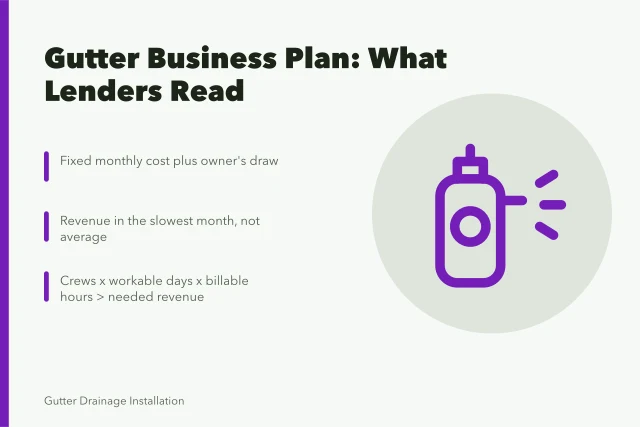
- Ask any lender what the payment looks like in your worst revenue month, not your average one.
The startup cost, line by line
The vehicle is the first line, and it moves most with your location. A used cargo van, say a Chevrolet Express or a Ford Transit, typically runs $8,000 to $25,000 depending on age and mileage. A new half-ton pickup runs past $45,000 before lettering and the trailer.
The second line is insurance costs, quoted on your payroll and the heights you work. General liability for a one-crew gutter operation commonly runs $2,500 to $6,000 a year. Commercial auto adds $1,500 to $3,000.
The third line is paperwork. An LLC filing runs $50 to $500 depending on the state. A contractor registration or license runs $100 to $600, and a surety bond $100 to $500 a year in most states. Some cities add their own business license fee.
A number lifted from another market would be wrong in a way you could not detect. It would also stop you doing the only thing that works, which is collecting three dated quotes for each line. Fill the structure with your own numbers, then test it against the trough.
The outlay in three tiers
Show the numbers
| One: unavoidable | $18,000–$45,000 |
|---|---|
| Two: earned | $9,000–$22,000 |
| Three: committed | $45,000–$95,000 |
Tier one is short, and it is genuinely first. Access gear especially: almost all of this trade's severe risk sits at the roof edge, and OSHA's guidance on fall protection in residential construction puts responsibility for site-specific controls on the employer.
Buying access gear last, or used, is the one economy in this business that is not an economy.
Tier two is triggered by a constraint, not a wish list. A second ground set and a trailer usually run $4,000 to $12,000 together, and field software such as Jobber or Housecall Pro typically costs $30 to $350 a month depending on users.
Tier three is where new owners spend money they lack on capability they cannot fill yet. The trigger for a forming machine is repeated subcontracted forming that delays jobs you have already sold.
A new gutter machine from New Tech Machinery or KWM Gutterman typically costs $9,000 to $22,000, and aluminum coil typically runs $1.50 to $3.00 a pound. That is why tier three tops $45,000 before storage or a second vehicle.
How owning one changes scheduling is in the equipment and setup guide, and the buying order across all three tiers is in the equipment checklist for new owners.
The number nobody budgets
Write it as W, working capital, and calculate it like this.
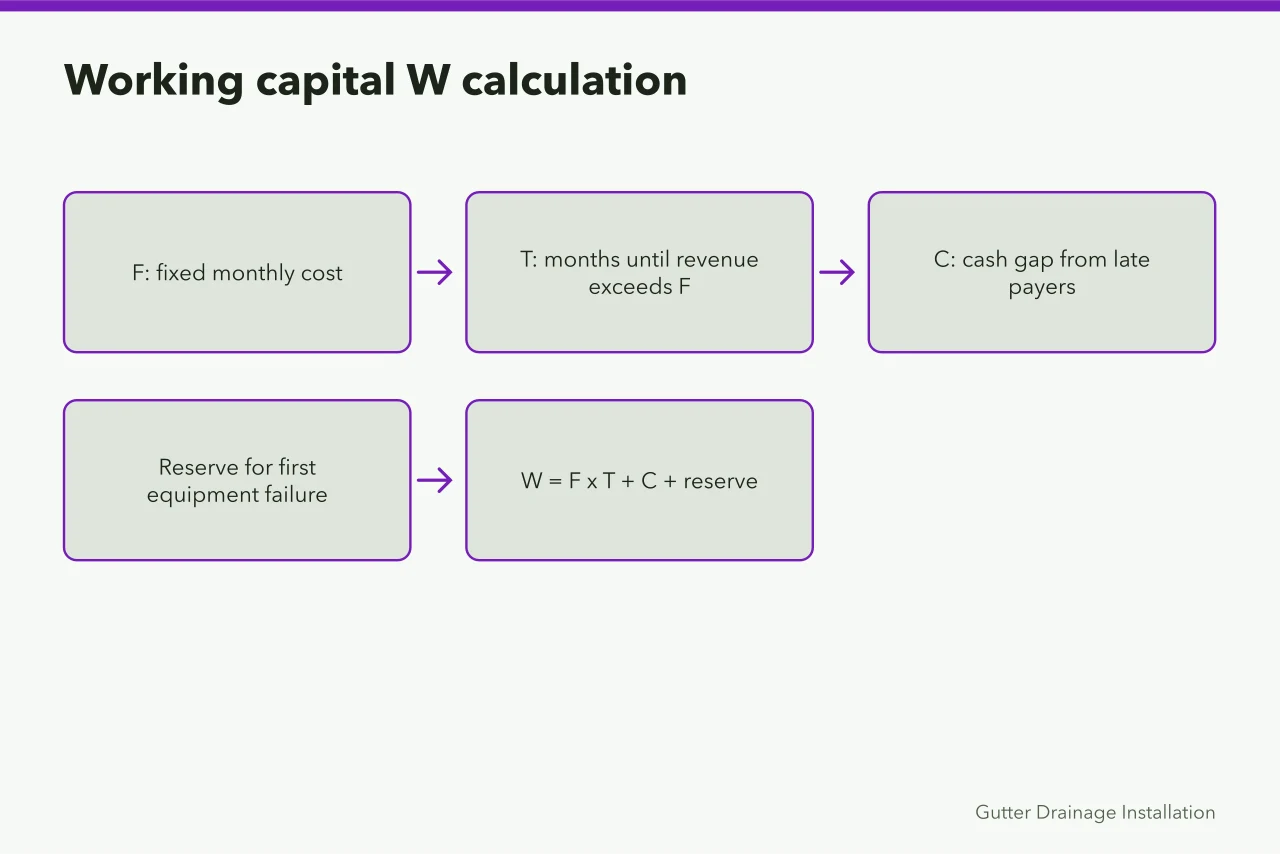
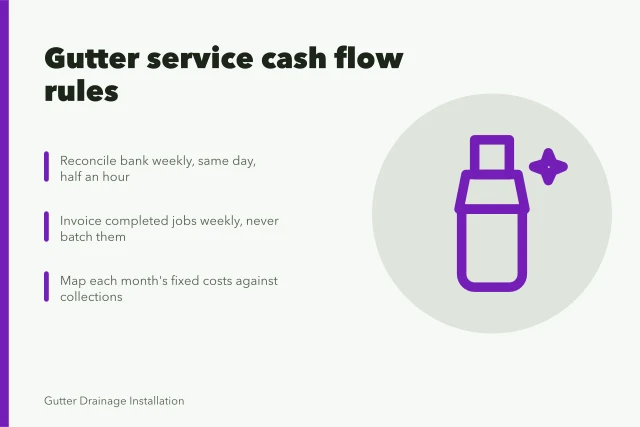
Take F, your fixed monthly cost: insurance, any finance payments, storage, phone, software. A one-crew operation with a financed van usually lands between $1,200 and $3,500 a month. Add your own living costs if the business is your only income.
Take T, the months from opening until revenue reliably exceeds F. Take C, the cash gap from customers who pay after the work rather than before it.
W is F multiplied by T, plus C, plus a reserve for the first equipment failure.
T is the variable owners underestimate, and seasonality is why. Demand concentrates around leaf drop and around the first sustained rains after a dry stretch. Open in a quiet stretch and T runs longer than the annual average suggests. Averages hide the month that empties the account.
C is the one that surprises people who have only ever been paid weekly. A job completed in one month may be paid in the next, and every job in progress is money you have already spent on material and wages.
The startup lines that are easy to forget
- registration, bonding and permit fees in each city you quote in, $100 to $500 a year in most places
- insurance deposits, plus the gap between the quote and the bound premium
- vehicle lettering, typically $300 to $900, which is an asset cost and an advertising decision at once
- the safety program: gear per person at $150 to $400, training time, and the records to prove it
- bookkeeping setup, so you are not reconstructing a year later
- the first supply run's small parts, cheap individually and large together
- a reserve for the first tool that fails in the busy weeks
The last one is not padding. Equipment fails when it is being used hardest, which in this trade is the same few weeks every customer calls.
Funding routes, and what each actually costs
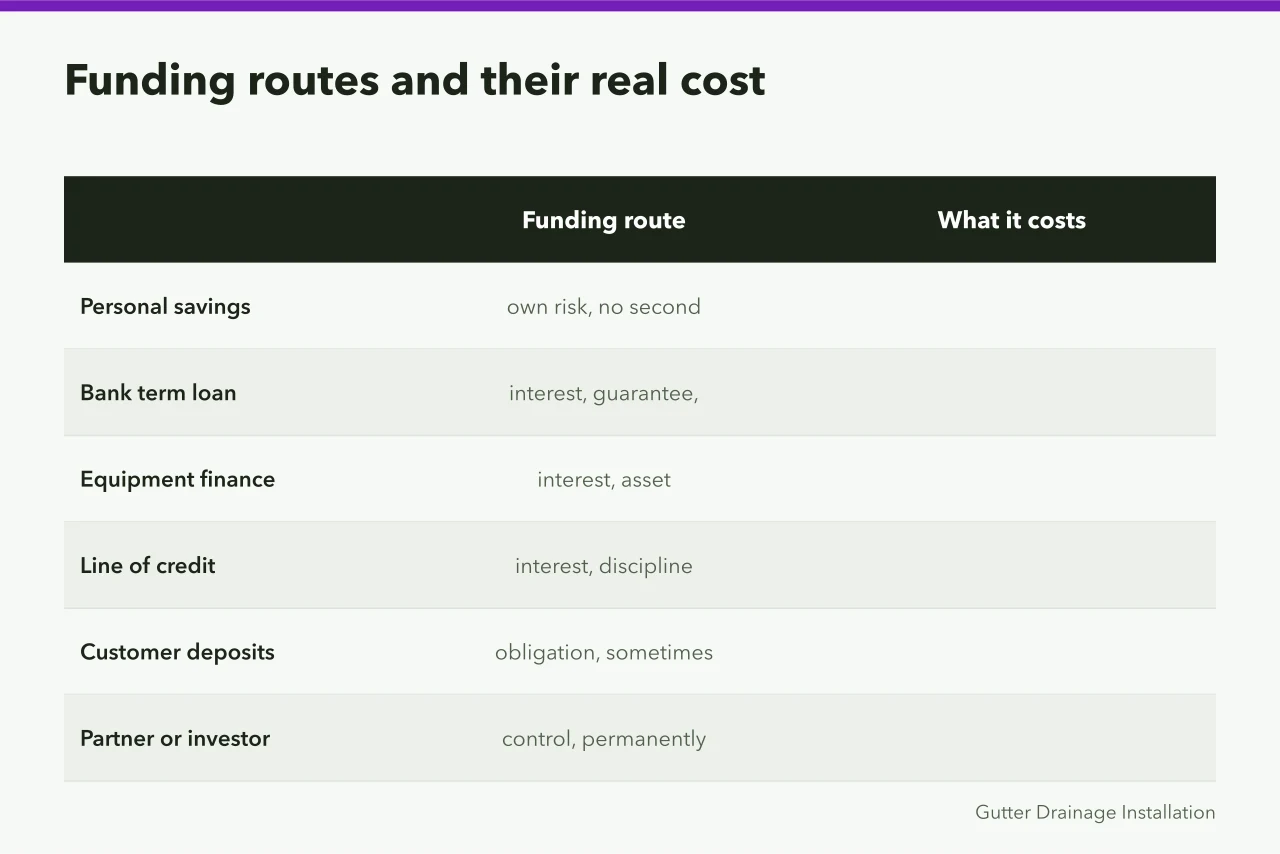
- Personal savings. Cost: your own risk tolerance, and no second attempt if it goes wrong. No paperwork, no covenant, no oversight, which is both the appeal and the danger.
- A bank or credit union term loan. An SBA 7(a) loan is the common version, priced off the prime rate plus a capped spread, which in recent years has put many of them between 9% and 12%. Ask what the guaranty fee adds, because it varies with the loan size. Cost: interest, a personal guarantee in most cases, and a fixed payment that runs through your slowest month regardless of weather.
- Equipment finance or a lease. Rates typically run 7% to 15% APR. A $15,000 machine financed over 48 months at 10% costs about $380 a month. Often the cheapest way into tier three because the equipment secures it, and often the fastest way into trouble because the payment starts before the machine has earned anything.
- A line of credit. Rates typically run prime plus 1% to 4%, which has meant roughly 8% to 12% in recent years. Cost: interest and discipline. This is the right instrument for W, the working capital gap, and the wrong one for a machine.
- Customer deposits. Many gutter companies ask for 10% to 30% up front. Cost: an obligation, and in some places a regulated one. Ask before you rely on it, because rules on holding customer money vary and getting it wrong is a consumer-protection problem rather than a cash-flow one.
- A partner or investor. Cost: control, permanently. The cheapest capital on paper and the most expensive in every other way.
The SBA microloan program runs through local intermediaries, caps at $50,000, and typically prices between 8% and 13%. It suits a first van and a tool set better than a machine.
Match the instrument to the life of the thing it funds. Short-term cash needs a revolving facility, and a machine that will run for years can carry term debt. Funding a trough with equipment finance, or a machine with a credit card, is how a solvent business becomes an insolvent one.
Free advice exists before you commit to any of these. The Small Business Administration's guidance and counseling pages point at local advisers who will read a forecast with you at no charge.
SCORE, the SBA's volunteer mentoring network, offers the same service through local chapters. Reading a term sheet with someone who has seen a hundred of them is worth an evening.
Questions to ask a lender before signing
Ask what the payment is, in the month you expect the least revenue. Ask what happens if you miss one. Ask whether a personal guarantee exists and what it reaches.
Ask whether early repayment is penalized. Ask what the lender requires of your insurance, because a lapse can trigger a default clause that has nothing to do with a missed payment.
Then ask yourself the question no lender will: does this survive a wet October? If the answer depends on a good season, the amount is wrong.
Where the numbers come from
Get three dated quotes per line from suppliers in your own market. Quote insurance on your actual payroll and your actual access ceiling rather than on a guess. Cost the vehicle with the trailer and the lettering included.
Set up bookkeeping before the first purchase, not after. The IRS guidance on starting a business covers structure, identification numbers, tax obligations and recordkeeping in the order they arrive.
A startup purchase recorded properly on day one beats a reconstruction in April. Ask a tax professional how a particular purchase is treated in your own year and structure.
The outlay then becomes the money section of a document somebody else will read, which is what the business plan is for.
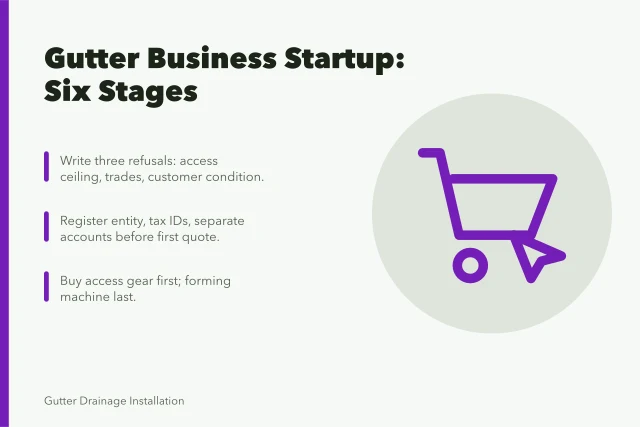
The order in which the spending actually happens is staged in how to start a gutter service business, and whether the market you have chosen supports any of it is the subject of the startup and market guide.
Common questions
What is the minimum to start?
Tier one, honestly quoted in your own market, plus W. In most North American markets that lands between $18,000 and $45,000. Anyone who gives you a single figure is guessing on your behalf.
Can I start with a personal vehicle?
Often yes at the beginning. Check with your insurer first, because using a personal vehicle for business can affect coverage in ways that only become visible after an incident.
Should I finance or save for the machine?
Ask which one survives your slowest month. That question answers it more reliably than any comparison of rates. At 10% over 48 months, a $15,000 machine costs about $380 a month, so the real test is whether that payment clears in your quietest month.
Is a grant available for this?
Be careful here. A legitimate government program does not ask you for an upfront fee to apply, and offers that do are the most common scam aimed at new owners. Start from official sources rather than from an approach that found you.