Guides
The plan behind a gutter service business: what to write down
Gutter service business plan contents: the sections a lender or adviser actually reads, the capacity test most plans fail, and what to leave out of it.
What to take away
- Write the plan for one specific reader. A plan written for nobody reads like a brochure and persuades no one.
- The capacity test is the section most plans skip and the one that decides whether the numbers are fiction.
- Seasonality is the defining feature of this trade. A plan built on annual averages hides the month that will break you.
- Leave out the market-size flourish. A lender wants your route, your crews and your slowest month.
Who the plan is actually for
There are three readers and they want different documents.
A lender or lessor wants to know whether the debt survives your worst month. They will look at the cash forecast, the fixed obligations and the collateral. They will not read the mission statement.
An adviser wants to find the assumption you have not tested. They read the capacity section and the pricing basis, and they ask where each number came from.
You want a document that tells you when to stop, hire or buy. That means triggers and thresholds you wrote down while calm.
Decide which reader before you write a word, and say so on the first page. The Small Business Administration's guidance and counseling pages point at local advisers who will read the draft with you at no charge, which is worth doing before a lender sees it.
The sections, and what belongs in each
| Section | What it must contain for this trade | What makes it weak |
|---|---|---|
| The business | Service mix, access ceiling, the trades you refuse | A description that could be any contractor |
| Market | Housing stock, tree canopy, rainfall pattern, route density | Population and a growth percentage |
| Service and scope | What is included, excluded, and the fascia contingency | A price list with no scope behind it |
| Operations | Crew structure, route plan, one-visit completion rate | A list of equipment |
| Capacity | Crews multiplied by workable days multiplied by billable hours | Revenue targets with no hours behind them |
| Compliance and risk | Licensing answers with dates, insurance, safety program | A sentence saying you will be compliant |
| People | Who does the estimating, and what happens when they are sick | An organization chart for a company of two |
| Money | Startup outlay, monthly fixed cost, seasonal cash shape | An annual average |
The market row is where gutter plans go wrong most often. Population tells you almost nothing. Housing stock, canopy and rainfall tell you the work mix, the job size and the recurring demand. You can observe all three from a car in an afternoon. The reasoning is set out in the startup and market guide.
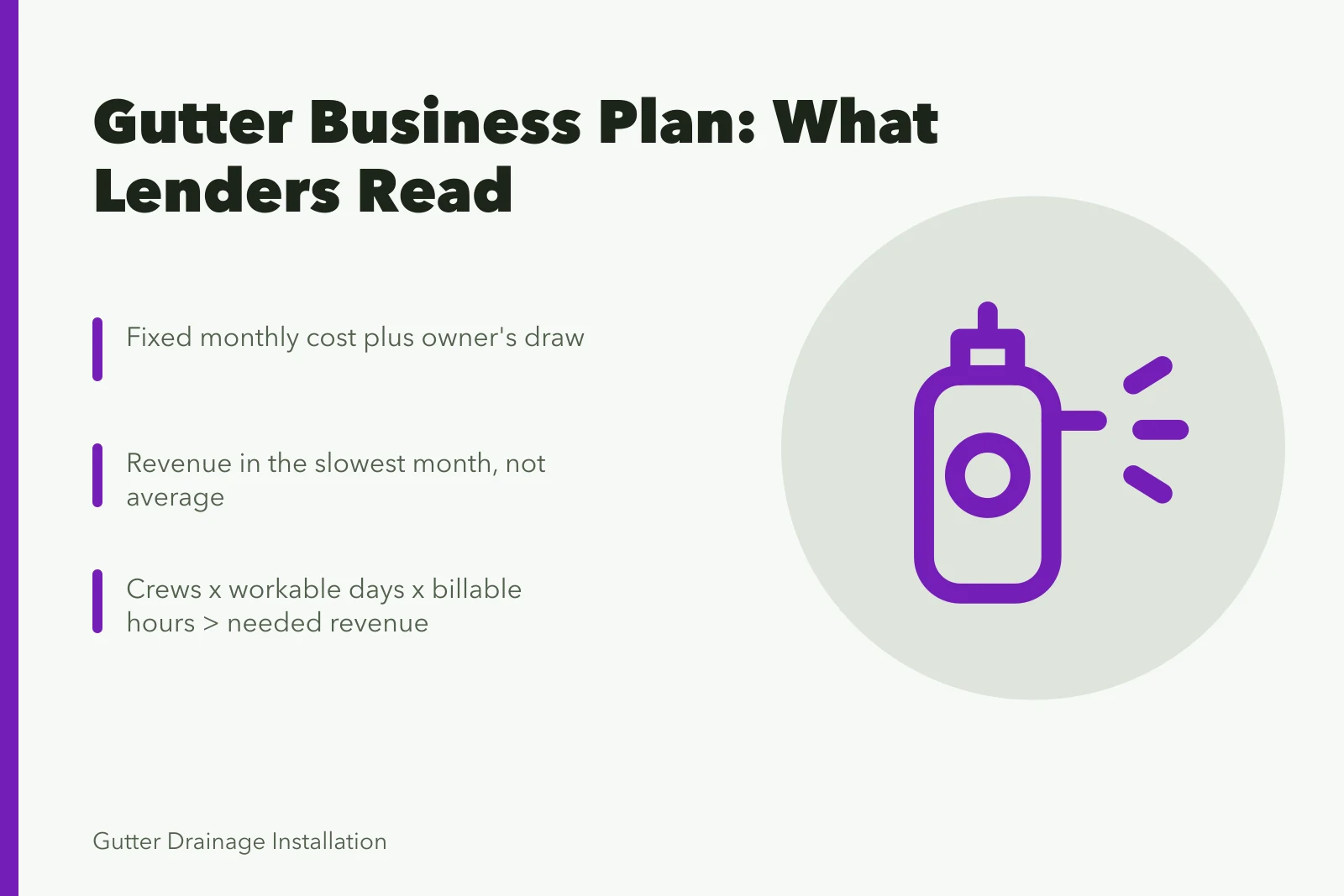
The three numbers a reader checks first
- Fixed monthly cost, including your own draw if you are not on the crew.
- Revenue in your slowest month, from the forecast rather than from the average.
- The gap between them, and what covers it.
If the third number is negative and nothing covers it, no amount of market description helps. Fix the plan, not the presentation.
That trio is also the honest way to size a loan. Borrowing to cover a seasonal trough is a defensible request. Borrowing because the annual total looks fine falls apart under one question.
The capacity test most plans fail
Write it as an inequality and check it before anything else.
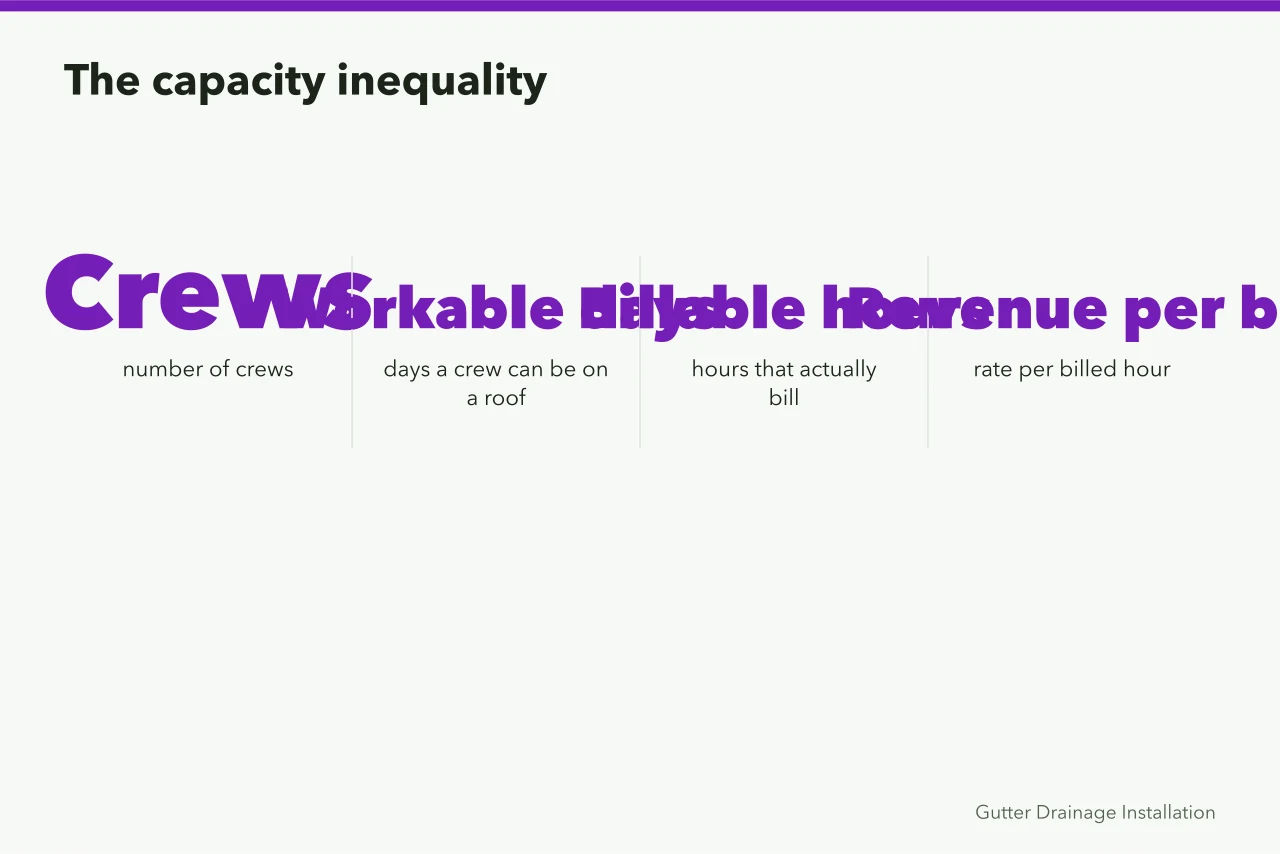
Crews multiplied by workable days multiplied by billable hours per day multiplied by revenue per billable hour has to be greater than the revenue the plan needs. If it is not, the plan is asking for work that cannot physically be completed. Selling harder makes it worse rather than better.
Two inputs are usually optimistic. Workable days: owners count calendar days, not days a crew can be on a roof. Weather costs days in the weeks demand peaks.
Billable hours per day run high, too. Travel, setup, teardown, the supply run and the second trip for a missing part are paid, and none bill.
Get those two honest and the rest of the plan tends to correct itself.
The seasonality section nobody writes
Most templates have no place for this and it is the defining feature of the trade.
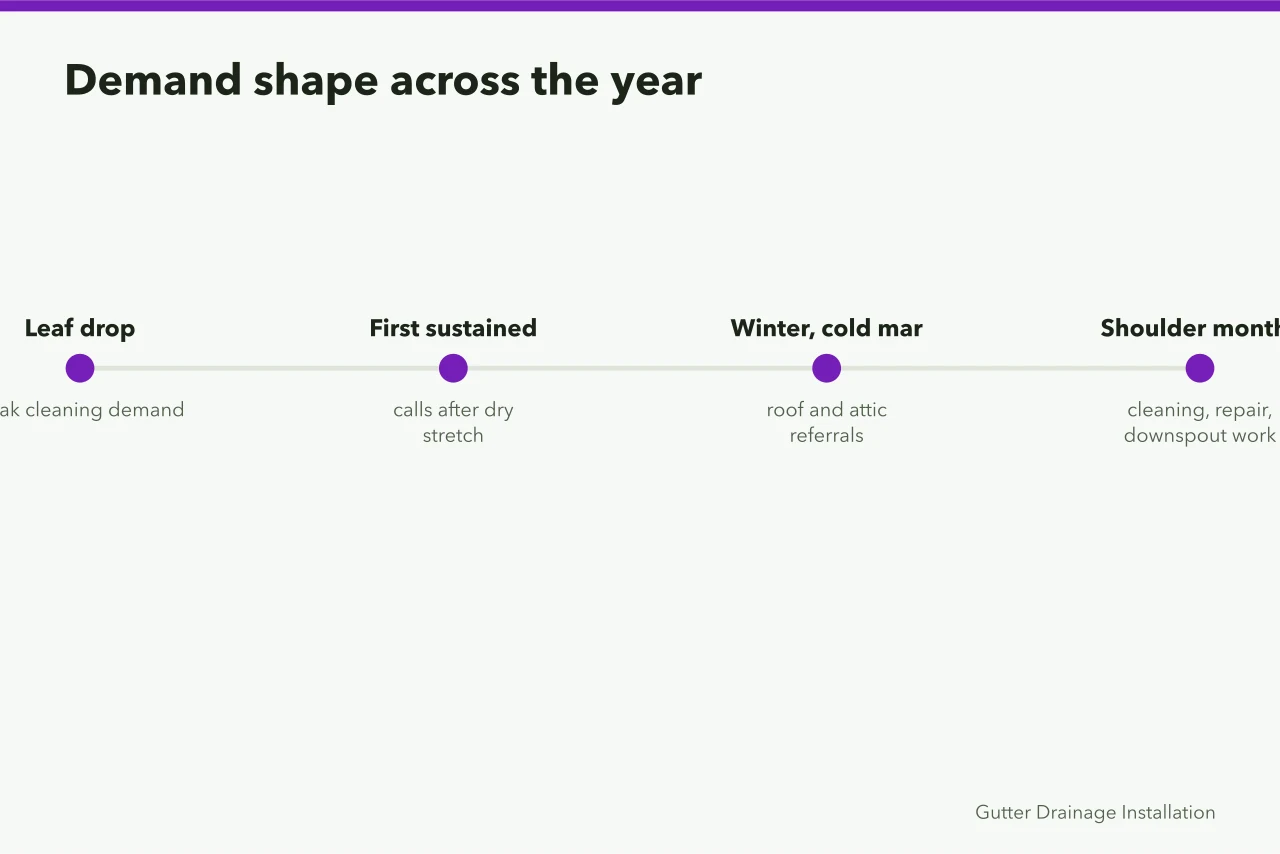
Demand concentrates around leaf drop and around the first sustained rains after a dry stretch, when people discover what has been wrong all year. Cold markets add a third pattern in winter, and most of those calls are about roof and attic conditions rather than about the gutter. That is a referral policy you should have written before January.
Show the shape month by month rather than as a total. Then show what the shoulder months carry: cleaning, repair, downspout and discharge work, which need very little capital and keep a crew employed. A plan that shows twelve identical months is describing a business that does not exist.
What to leave out
Cut the market-size paragraph with a national figure in it. You cannot serve a national market from one trailer and no reader believes you will.
Cut competitor names and any claim about their pricing. You do not know their scope and neither does the reader.
Cut any margin or industry benchmark you did not derive from your own numbers. A figure with no source behind it is the fastest way to lose an adviser's attention, and in this trade the local variation is wide enough that borrowed figures are usually wrong.
Cut the five-year projection past the point where it is guesswork. Two seasons modeled carefully is more persuasive than five years modeled optimistically.
What to attach instead
Attach the things that are checkable.
The IRS guidance on starting a business sets out the structure, identification and recordkeeping steps in the order they arrive. Showing you have followed them is worth more than a paragraph promising to.
Attach your dated licensing answers, listing who told you and when. Attach your insurance summary.
Attach your safety approach. This trade's severe risk sits at the roof edge. OSHA's guidance on fall protection in residential construction describes the methods and states the employer keeps responsibility for site-specific controls.
A lender reading a plan for a business that puts people on ladders will notice whether that section exists.
Attach the equipment list with its costs and its ownership rationale rather than a photograph of a machine. The buying order is in the equipment checklist for new owners, and what owning a forming machine does to your scheduling is set out in the equipment and setup guide.
Keeping it alive
A plan written once and filed is a document. A plan that earns its time has triggers in it.
Set your conditions for hiring, for buying a forming machine, and for dropping a category of work. Review them monthly against what happened. The staged version is in how to start a gutter service business.
The hiring trigger is easier to keep when a training plan exists. That is what the hiring and training guide covers.
Common questions
How long should the plan be?
Long enough to answer the three numbers and the capacity test. For a first crew, that is usually a short document with good appendices rather than a long one.
Do I need a plan if I am not borrowing?
You need the capacity test and the seasonal cash shape. The rest is optional until somebody else is reading it.
Should I include prices?
Include your pricing basis and your rate structure. Publishing a per-foot number in a document that circulates invites a comparison against quotes measured differently.
What if I have no history to forecast from?
Say so, and forecast from observable quantities instead: properties per day, hours per property, days workable per month. An honest bottom-up estimate beats a confident top-down one.
Who should read it before a lender does?
Somebody who will argue with it. A free adviser or an experienced owner in another market will find the assumption you stopped questioning.