Guides
The gutter service business startup playbook: market, model, launch
How to start a gutter service business: six stages in order, each with the trigger that opens it, from the first decision to the first forming machine.
What to take away
- Start by writing down what you will not do. The access ceiling and the trades you refuse are the two decisions that shape everything after them.
- Each stage below has a trigger rather than a date. Move when the trigger fires, not when a calendar says to.
- The first ten jobs are research. Price them properly and record everything, because they are where your rate card actually comes from.
- Buy the forming machine last. The calendar should be forcing your hand before you sign anything.
Stage one: decide what you will not do
Opens immediately. Closes before you take a single call.
Write down three refusals and keep them where the phone is answered.
- The tallest elevation you will accept work on.
- The adjacent trades you will refer out rather than attempt.
- The customer condition that makes you decline the job.
The access ceiling: the tallest elevation you will accept work on. This is a business decision, a safety decision and, later, an answer you gave an underwriter. Leaving it open is how a crew ends up on a house nobody on the truck is comfortable working.
The adjacent trades: roof work is a different trade with different licensing and different risk. Grading and foundation drainage is where a lot of the customer's real problem lives and it needs either a partner or a referral policy. Decide both now so nobody improvises at a door.
The customer you will not take: the one who wants the fascia contingency struck from the paperwork. That is a request to absorb an unbounded cost you cannot inspect.
Stage two: the paperwork that gates everything else
Opens once the refusals are written. Closes before the first quote leaves your hand.
Register the entity, get the tax registrations in place, and separate the accounts from personal ones. The IRS guidance on starting a business walks through structure, identification numbers, tax obligations and recordkeeping in the order they actually arrive, which saves reconstructing a year in April.
Then answer the local questions: Is this trade licensed where you work, and does a permit apply to a replacement or only to a new drainage connection? What does the municipality allow you to do with discharged water?
That last question is not a licensing question and appears on no licensing checklist, yet it decides what your standard scope can promise. Find each answer in the licensing and compliance guide.
Bind insurance before the first job, not after the first quote is accepted.
Stage three: the first truck
Opens when the paperwork clears. Closes when the vehicle is loaded.
Buy in this order: access gear, hand tools, small parts, then everything else. Access gear first is not a slogan. Almost all of this trade's severe risk sits at the roof edge, and OSHA's guidance on fall protection in residential construction puts responsibility on the employer for site-specific controls and for whichever federal or state-plan requirements apply where you operate.
Carry enough small parts to finish a job without a supply run. Outlets, elbows, straps, sealant and extensions are cheap and their absence turns a completed job into a second trip.
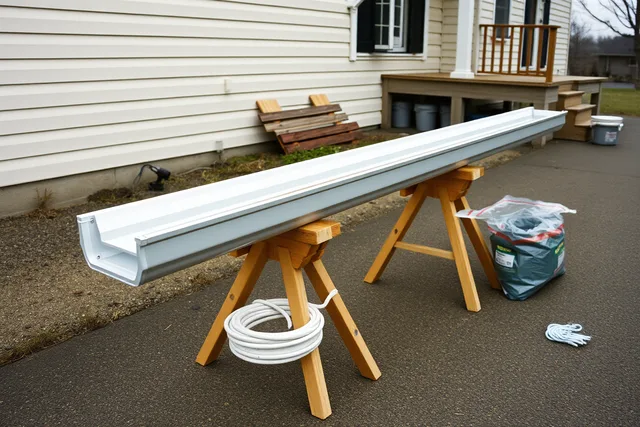
Do not buy a forming machine at this stage. Subcontract the forming or stay on cleaning, repair and downspout work. The reasoning, and what a machine does to your scheduling once you own one, is set out in the equipment and setup guide.
Stage four: the first ten jobs
Opens with the first booking. Closes when you have ten completed jobs on record.
Treat these as research that happens to pay. For each one, record the quoted amount, the actual crew hours including travel, the material consumed, the access conditions you found, the fascia condition and any return visit with its cause.
| What you record | What it becomes |
|---|---|
| Actual hours against quoted hours | The correction factor your rate card needs |
| Access conditions | Your access classes, with written criteria |
| Fascia condition found against condition expected | The basis for your contingency clause |
| Return visits and their causes | Your truck stocking list |
| Where the water was going before you arrived | Your standard scope, and your best sales argument |
After ten jobs you can build a rate. Before ten jobs, you are copying somebody else's, and theirs was built in a different market with different housing.
Price these jobs properly. Discounting the first ten to build a list produces a list of customers who found you on price, and it corrupts the very data you are collecting.
Stage five: the first hire
Opens when you are turning down work you could otherwise complete, for two weeks running. Not when you feel busy.
A second body of rules arrives with the first employee: wage and hour obligations, recordkeeping, postings, and training records for anyone going near a roof edge. So does a genuine question about worker classification, which has real consequences and should go to an employment professional in your state rather than to a competitor's example.
The practical sequencing matters. Hire before the peak weeks, not during them, because a new person needs supervision precisely when you have none to spare. What that training actually looks like is set out in the hiring and training guide.
Stage six: the machine, if the calendar asks
Opens when subcontracted forming is delaying jobs you have already sold, repeatedly, in your peak weeks.
That is the only trigger worth acting on. A forming machine bought before it is forcing your hand is a payment that runs through your slowest month for a capability you are not yet using.
When the trigger does fire, the decision covers coil colors, parts availability, trailer and tow vehicle, and where the work comes from to keep it busy outside the peak.
That is also when your service definitions need tightening. A machine changes what you can promise and how fast, so the packages and pricing guide belongs in the same decision.
What to do differently from everyone else
Two habits separate the companies that keep customers from the ones that keep quoting.
Look at where the water goes. Follow every downspout to its terminal end at the estimate, including any buried line you can open. Most complaints about gutters are complaints about the discharge, and a company that inspects it is answering the customer's actual question.
Photograph the fascia before you touch it and the discharge point after you finish. It costs a minute and it settles the disputes this trade actually has.
Both of those become your marketing without any advertising spend attached, because customers repeat what surprised them. The rest of the demand-building work is covered in the marketing and growth guide.
Free help exists and is underused. The Small Business Administration's guidance and counseling pages point at local advisers who will read a cash forecast with you at no charge.
Common questions
Can I start part time?
Yes, and cleaning and repair work suits it, because the visits are short and the capital is small. Installation is harder part time, because a formed job has to be completed once started.
What is the first thing to buy?
Access gear sized to the ceiling you set in stage one. Everything else can be improvised for a while and that cannot.
How many jobs before I know my prices are right?
Ten completed jobs with honest hours recorded will get you close. One job tells you nothing, and thirty jobs priced wrong is an expensive way to find out.
Do I need a website before I start?
You need a way for a customer to reach you and a way to prove you are insured. A site helps and it is not the gate.
When is it too early to hire?
While you are still learning the work yourself. A new person learns your habits, and habits formed in your first month are not the ones you want copied.