Guides
The monthly numbers a gutter service business owner should watch
Six cause codes for return visits, productive hours measured door to door, and quote-to-win by source: the readings a gutter contractor reviews each month.
What to take away
- Productive-hour fraction is measured door to door. Travel, setup, teardown, supply runs, weather stand-downs and return visits are paid hours and not productive ones.
- Every return visit gets one of six cause codes: measurement, missing part, pitch, discharge, weather, customer change. Counting returns finds the problem; counting causes finds which one.
- Contribution per crew hour is computed per package, never company-wide, or it says nothing about what to sell.
- Quote-to-win is split by source and asked at the door, not inferred from the paperwork.
- Calls answered is tracked weekly through the peak and monthly the rest of the year.
The monthly hour
Same day each month, same order, one hour, with whoever schedules the work in the room.
Read the numbers. For each, say what changed and what you are doing about it. Write one action per reading, or write none on purpose. Then stop.
Owners who review annually find a pricing error after a season has been booked at the wrong rate. The backlog then carries the mistake for months.
Productive-hour fraction, measured door to door
Hours genuinely working on a property, divided by hours paid. Start the clock when the truck leaves the yard and stop it when it returns. Anything else is fiction.
Travel between jobs is paid. Setup is paid. Teardown is paid. The supply run for a part nobody loaded is paid. A weather stand-down is paid. A return visit is paid. None are productive. A crew that looks busy all day can run a fraction in the forties.
The number moves on routing and on how many jobs need a second trip. It also moves on crew composition, because the same house takes very different hours depending on who is on it.
Re-derive your assumptions after any significant change in who rides in the truck, which is why the hiring and training guide is a measurement subject before it is a personnel one.
One-visit completion, and the six cause codes
Jobs finished without a return, divided by jobs completed. A return counts even when the customer caused it. Record the cause rather than excluding the job.
The six codes:
- Measurement. The run was formed to the wrong length or the count was wrong.
- Missing part. A hanger, outlet, end cap or sealant was not on the truck.
- Pitch. Water stands or runs the wrong way after the work.
- Discharge. The downspout outlet, extension or connection is wrong or blocked.
- Weather. Rain, wind or frozen ground stopped a step that cannot be done wet.
- Customer change. The owner moved the scope after the quote.
Measurement causes cost more in this trade than in most. A formed run is made on site, and machine, coil and crew travel together, so a remeasure is a whole trailer trip rather than a phone call.
Loading the truck to a fixed list is the cheapest fix available, and it is what the equipment checklist for new owners exists to produce.
Machine setup, coil handling and trailer layout are covered in the equipment and setup guide.
A sudden rise in one-visit completion deserves a look. It sometimes means the water test and the discharge check stopped happening, and the callbacks arrive a season later instead.
Contribution per crew hour, by package
Revenue minus material minus direct labor, divided by every hour consumed including travel. Compute it per package: cleaning only, cleaning with repair, full replacement, guards, commercial contracts.
Company-wide, the figure hides which package pays and which one only looks busy. A cheap recurring clean that holds a route together can carry a lower contribution per hour than a one-off repair and still be worth keeping. You cannot see that in a blended number.
If contribution per crew hour falls, look at the package definitions before you touch the price. If it rises, reweight marketing toward what is winning, one change at a time.
Calls answered in the peak weeks
Calls answered or returned inside your stated window, divided by calls received. Track it weekly through the peak and monthly otherwise.
This is the one reading where the target is the ceiling. In the two or three weeks when the phone rings constantly, an unanswered call is a quote you never gave. Staff the phone before you staff anything else.
Quote-to-win by source
Jobs won divided by quotes given, split by where the customer came from:
- repeat customer
- neighbour referral
- search
- truck signage
- a property manager
- a storm-driven call
Ask at the door. Inferring the source from the paperwork produces a tidy chart that describes your own assumptions.
When the rate falls, compare the scope against the competing quote before you compare price. Most losses in this trade are scope losses wearing a price costume.
Reading them together
Every one of these can be improved by damaging another, which is why they are read as a set.
Productive hours rise if crews stop doing the checks. One-visit completion rises if you stop counting minor returns. Contribution per crew hour rises if you drop low-value recurring work that was holding route density together. Quote-to-win rises if you discount.
So the monthly question is never whether a number improved. It is whether it improved for a reason you would defend out loud.
| Reading | If it falls | If it rises |
|---|---|---|
| Productive hours | Check routing, then count jobs needing a second trip | Ask whether the crew can absorb another day of work |
| One-visit completion | Count causes, fix the largest one first | Confirm the water test and discharge check still happen |
| Contribution per crew hour | Look at package definitions before the price | Move marketing toward what is ranking well |
| Calls answered | Staff the phone through the peak weeks | Nothing, this is the ceiling you want |
| Quote-to-win by source | Compare scope against competing quotes | Spend more where it wins, one change at a time |
What to leave off
Monthly revenue, job count, average job value and review count. All four are easy to see, all four move for reasons unrelated to whether the work paid, and all four crowd out the readings above.
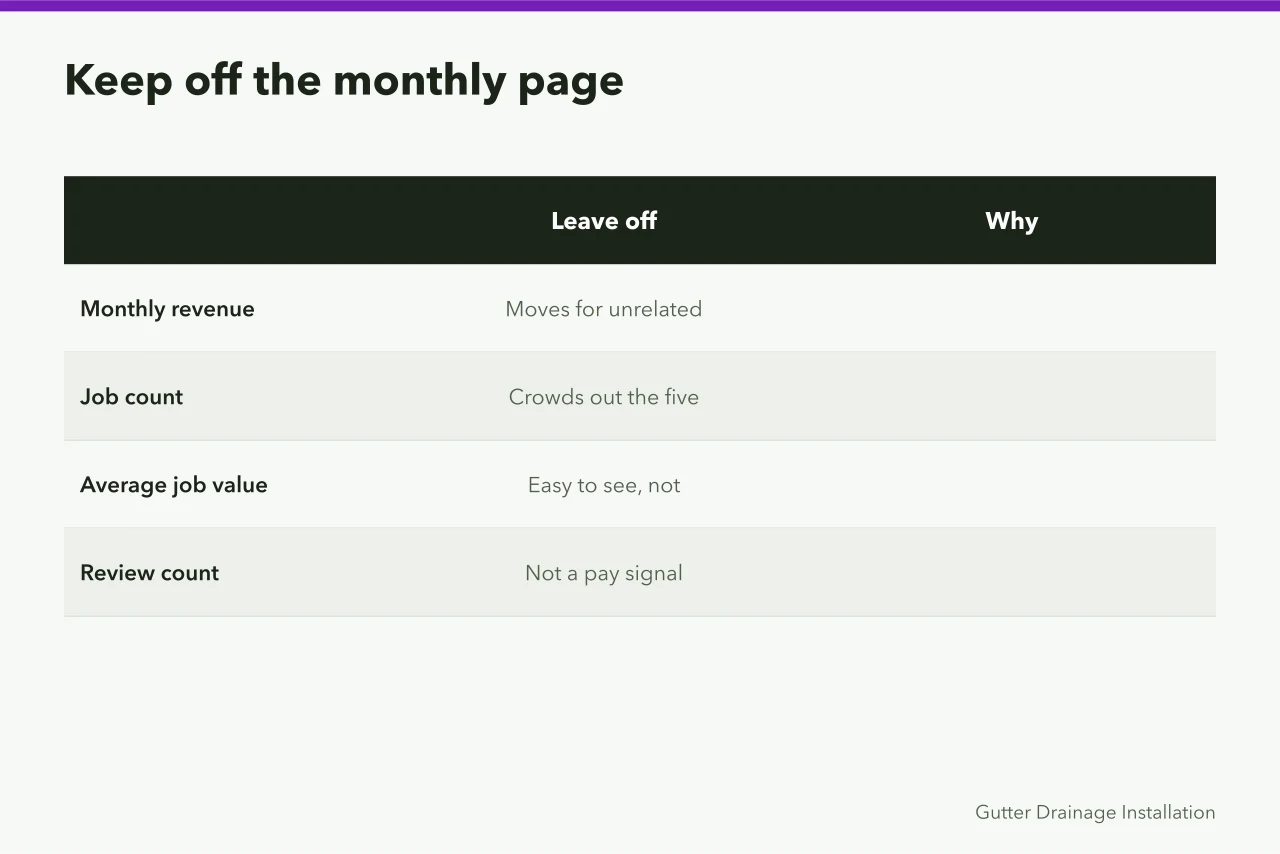
Keep them if you like. Do not act on them, and do not put them on the same page as the five, because the eye goes to the familiar number. The reasoning behind which measures survive scrutiny is set out in the software and KPI guide.
Where the numbers live
The readings come out of the job record: quoted amount, hours door to door, material, return visits with causes, and source. That is the same record a tax authority expects, and the IRS explains what records a business is expected to keep, so one well-kept file serves both purposes.
Add one line to the monthly hour that is not a performance number: confirm the record is backed up and that access is still controlled. A company holding customer addresses, payment details and photographs of people's properties carries a security obligation whether or not it thinks in those terms.
The National Institute of Standards and Technology publishes quick-start guides for small business cybersecurity, and the Cybersecurity and Infrastructure Security Agency maintains material aimed at small and medium businesses. Both are short, free and written for companies with no technical staff.
Checking a backup once a month takes minutes. Discovering it never worked takes a year of records with it.
Common questions
Is five readings too few?
Five acted on beats twenty watched. Add a sixth only when you can name the decision it triggers. A number with no decision behind it is decoration.
What if I only have one crew?
The readings matter more, not less. With one crew, every hour spent badly is an hour you cannot recover elsewhere in the week.
How do I get honest hours from crews?
Explain what the number is for, and never use it to rank individuals in front of each other. Hours used punitively become hours reported creatively.
What if a month is unreadable because of weather?
Note it and move on. A trend across several months is the signal, and any single month in this trade can be dominated by whether it rained.