Guides
Gutter service marketing, channel by channel
Gutter service marketing works best through the free channels most owners ignore, from the truck in the driveway to the roofer who names you.
What to take away
- Gutter service marketing starts with an event, not a campaign. Be findable the week it happens.
- The estimate visit closes more work than any ad you can buy.
- Google Business Profile, review sites, your own site, referrals from roofers and inspectors, and a recurring maintenance list are the channels that carry this trade. Paid search and lead marketplaces fill the gaps.
- Advertised prices, credentials and review requests all have rules under the Federal Trade Commission, and the compliant version sells better.
- Growth is limited by crews and weather, not by leads, so hire before you spend.
The channels that carry gutter work
Nobody wakes up wanting gutters. A storm overflows a trough the owner can see from a window. A dry spell ends and a blocked downspout announces itself. A basement takes water. A roof is replaced and the roofer mentions the fascia. A house goes up for sale and the inspection report names the trough.
Each trigger produces a different caller with a different deadline. The storm caller wants somebody today. The inspection caller has a date and a document. The roofer's referral arrives pre-qualified and rarely asks about price.
That shapes which channels matter. Google Ads can put you in front of the storm caller. It cannot manufacture the trigger. Every channel below earns its place by putting your name where the trigger already happened.
| Channel | What it is | Cost | Best for |
|---|---|---|---|
| Google Business Profile | Free Google listing with photos, hours, reviews | Free | Storm and emergency searches |
| Yelp and Nextdoor business pages | Free profiles where neighbors post and recommend | Free, with paid upgrades | Repeat and neighborhood searches |
| Your own site | Pages for service area, pricing method, maintenance | Hosting, typically $10 to $50 a month | Inspection deadlines, research |
| Referral from roofers and inspectors | Named by the trade that meets the trigger | Free, earned | Pre-qualified, price-tolerant jobs |
| Recurring maintenance list | Customers on a set clearing interval | Free to keep, scheduling software from about $29 a month | Smoothing the seasonal calendar |
| Neighborhood proof | Yard signs, truck lettering, door hangers | Print cost, typically $5 to $12 a sign | Repeat work on one street |
| Paid search and local service ads | Google Ads and Local Services Ads on gutter terms | Per click or per lead, typically $8 to $25 a click | Filling gaps in peak weeks |
| Lead marketplaces | Angi, Thumbtack and HomeAdvisor sell homeowner requests | Typically $25 to $80 a lead, often shared | Weeks when the calendar is thin |
| Direct mail to property managers | Postcards to a managed portfolio | Print, plus USPS Every Door Direct Mail postage of about 20 to 25 cents a piece | Multi-unit and commercial contracts |
Google Business Profile and review sites
Google Business Profile is the first channel to fix and the cheapest. When a homeowner searches the phrase gutter cleaning near me after a storm, the map pack of three listings sits above the ordinary results. Claim the listing, verify it, and fill every field.
Service area, hours, phone, and a description that names what you actually do:
- cleaning
- repair
- guards
- eavestrough replacement
Add photographs of finished runs, not stock images. Use the products and services list for each job type, and post an update when a crew finishes a street.
Reviews carry the listing. Ask every customer the same way, after the work is resolved, and never filter by who you expect to be pleased. The Federal Trade Commission's guidance on soliciting and paying for online reviews sets out what marketers are expected to do.
The commission's rule against fake and purchased reviews took effect in October 2024, with civil penalties that adjust for inflation and ran above $50,000 per violation in 2025. Google's review policy bans paid and gated reviews. Yelp asks businesses not to solicit reviews at all.
Reply to a negative review once, briefly and factually, then offer to continue offline. The reply is for everyone who reads the page afterwards.
Your own site
A gutter site needs few pages and each one answers a single question. Which areas do you serve? How do you price, and on what unit? What does a maintenance interval depend on for this property?
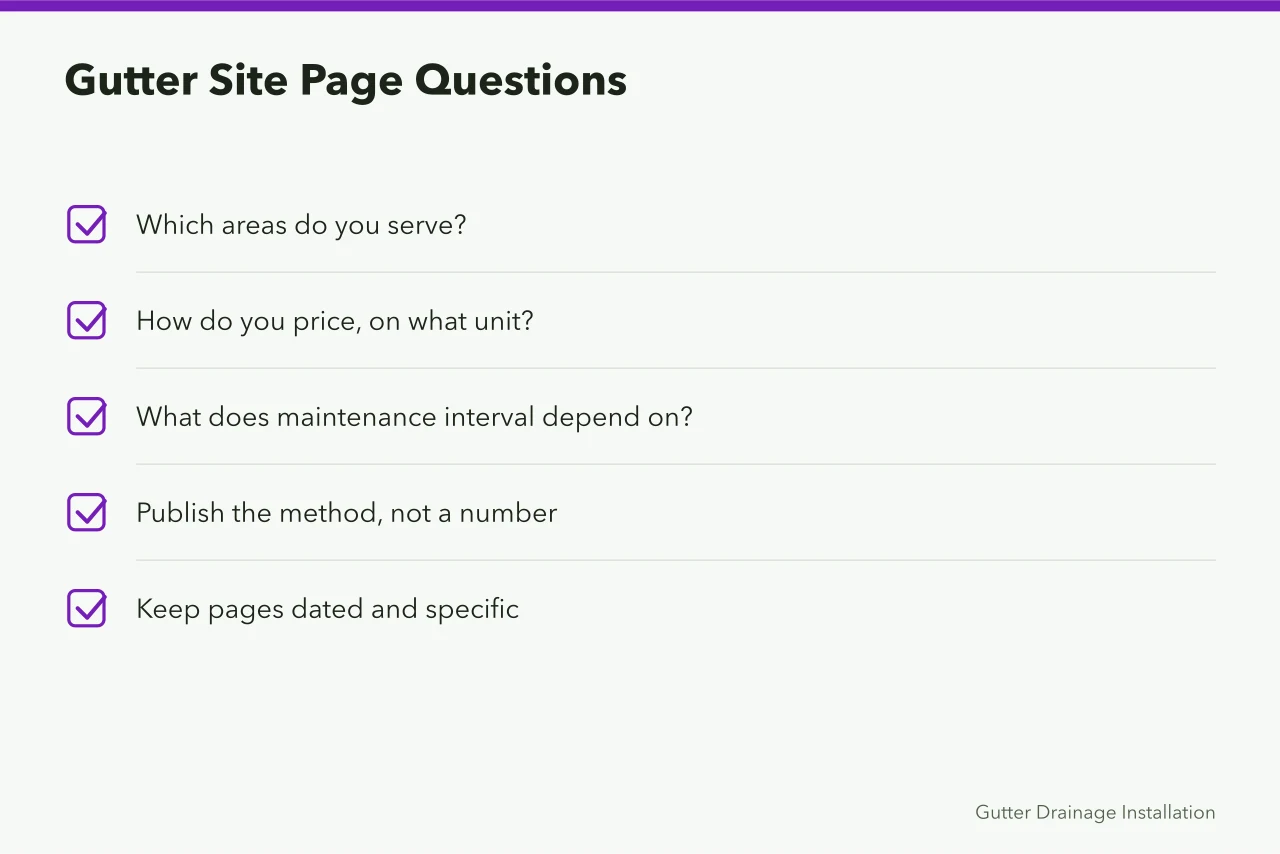
Publish the method, not a number. Say that a run is priced per linear foot and that fascia height, roof pitch, stories and disposal change the figure. A reader who understands the arithmetic stops treating your quote and a cheaper one as comparable.
A WordPress or Squarespace site covers this for hosting of roughly $10 to $50 a month. Google Search Console is free and shows the search terms that reached each page.
Keep the pages dated and specific. A page that names your city, your storm season and your typical canopy does more than a page that names nothing. One page per town you actually serve beats a single page listing forty of them.
Referral from roofers and inspectors
Roofers, home inspectors and property managers meet your customer at the exact moment of the trigger. Being the company they name is the highest-yield channel in this trade and costs nothing but reliability.
Find them where they already gather. GAF Master Elite and Owens Corning Preferred contractor directories list roofers who passed a vetting program. ASHI and InterNACHI publish directories of certified home inspectors and run local chapters. NARPM chapters are where property managers meet each month.
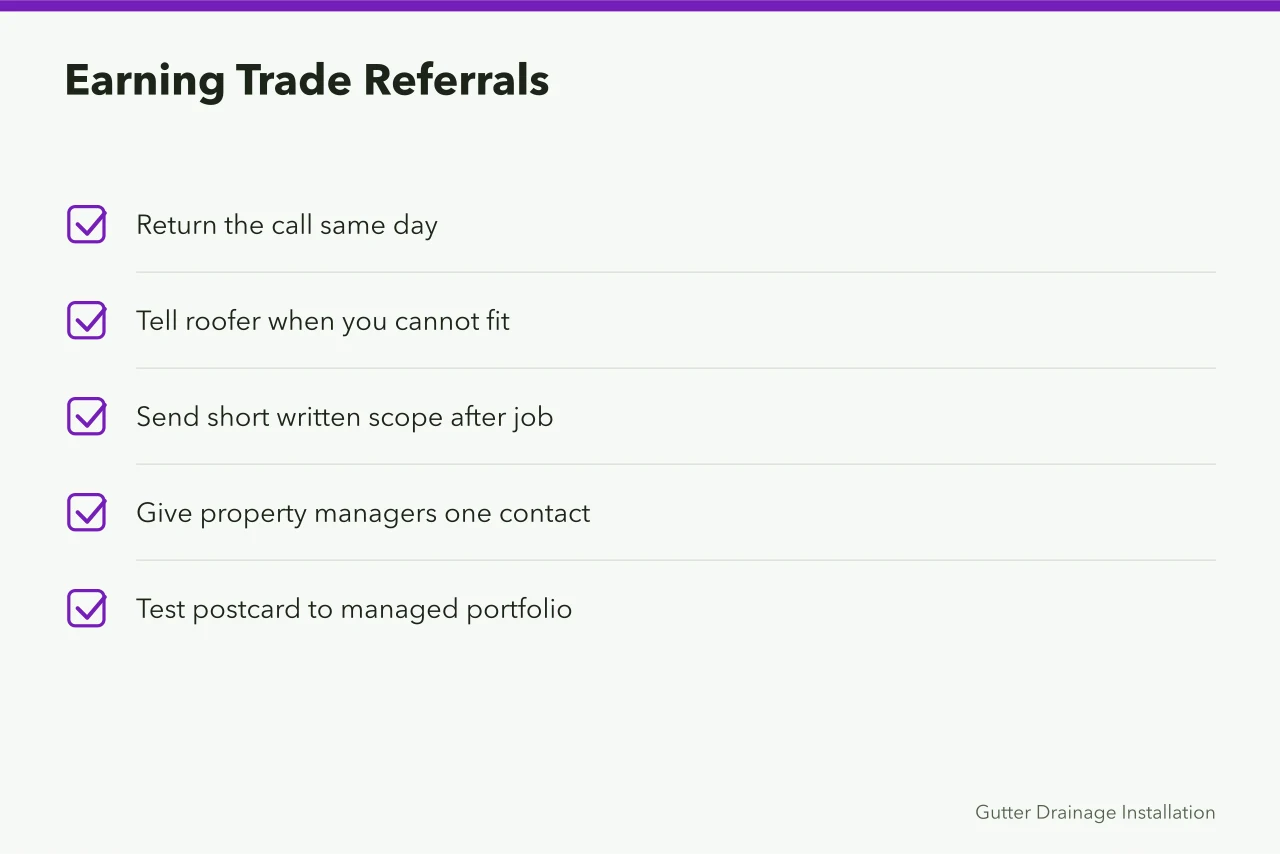
Earn the referral by being easy to schedule and honest about scope. Return the call the same day. Tell the roofer when you cannot fit around their crew rather than promising and arriving late. Send a short written scope after every job so the inspector has something to attach to the report.
Property managers buy differently. They want one contact, a set interval, and an invoice that matches a purchase order. A postcard to a managed portfolio is a cheap test of that channel.
The maintenance list
Recurring clearing is the backbone of a mature gutter company. It puts you at the property before the installation is needed, and it fills the shoulder months when installation work is thin.
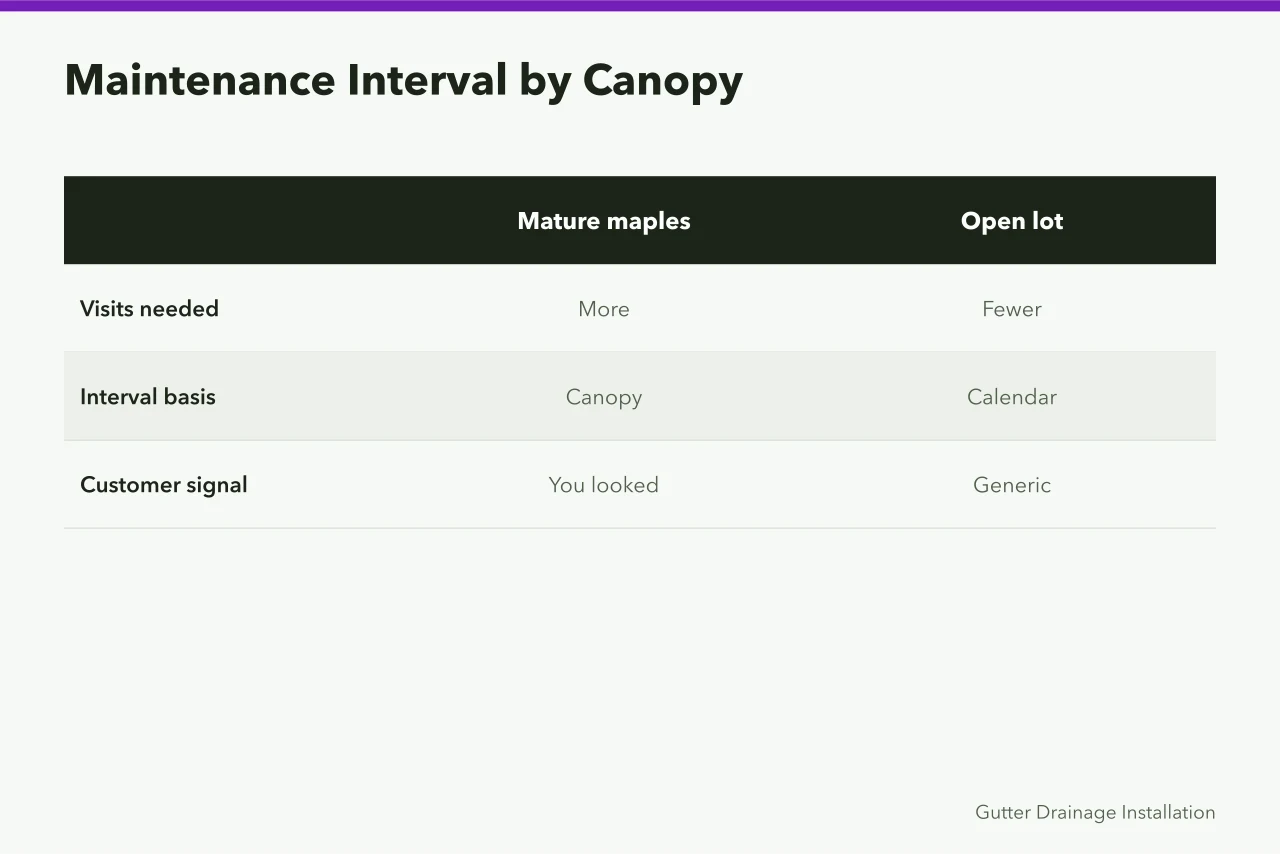
Set the interval by canopy, not by calendar. A property under mature maples needs more visits than one on an open lot, and saying so shows the customer you looked at their house.
Jobber, Housecall Pro and ServiceTitan all schedule recurring visits and text the customer a reminder. Jobber's entry plan typically runs $29 to $39 a month and Housecall Pro's basic plan $79 to $99 a month as of 2026. ServiceTitan quotes custom pricing.
The list also feeds the other channels. The properties you clean are the installations you will quote in three years, and you already know which of them have back-pitched runs and soft fascia. Keeping that history is an operational habit, not a marketing one, and it is covered in the quality assurance guide.
Paid search and local ads
Buy this channel last and measure it first. It works in the peak weeks, when the trigger has already happened and the caller is choosing between the first three companies that answer.
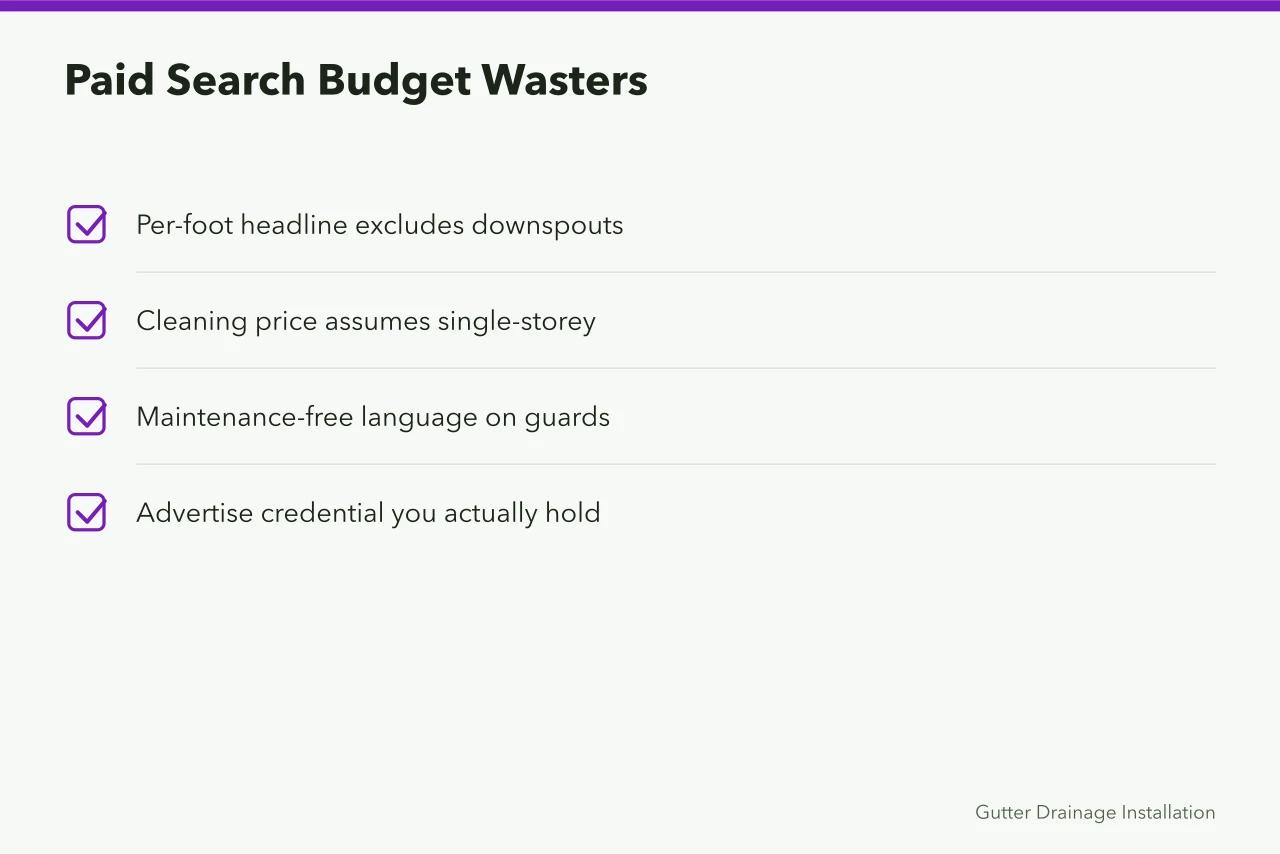
Three habits waste the budget. A per-foot headline that quietly excludes downspouts. A cleaning price that assumes a single-story property without saying so. Maintenance-free language attached to guards. Each wins a click and loses the sale at the door, which is the worst sequence, because you paid for the lead and spent the trip.
Rates move by market and season. In most US markets as of 2026, gutter cleaning clicks on Google Ads typically run $8 to $25. Local Services Ads charge per lead, typically $20 to $60 for a cleaning job, and the Google Guaranteed badge behind them requires a license, insurance and a background check.
Lead marketplaces resell the same request. Angi and HomeAdvisor leads typically cost $25 to $80 and usually go to three or four pros. Thumbtack charges per contact, typically $15 to $45 for gutter work. Yelp Ads sell clicks with a monthly minimum.
If you advertise a starting price or a promotional rate, the conditions that make it achievable have to be clear enough for a reader to understand, and the offer has to be genuinely available. The Federal Trade Commission's advertising guidance for small businesses sets out the general expectation.
Advertise the credential you actually hold, with the issuing body and the number, and nothing beyond it. What counts as a credential varies by jurisdiction, and the method for establishing yours is in the licensing and compliance guide.
The estimate visit as a channel
Most gutter companies are indistinguishable until somebody walks the property. That visit is where the competitive question is settled, and it is the one channel a competitor cannot copy by spending money.
A phone quote is a guess and customers know it. A visit where somebody walks the perimeter, presses the fascia, and follows every downspout to its terminal end feels different from what they are used to. It is also what they describe to a neighbor.
Say what you found, including the parts that are not your work: ground sloping back toward the wall, a buried line that has silted up, a run never sized for the roof above it. Customers can check all of it, and being right about something checkable persuades better than any claim about your company.
Jobber and Housecall Pro build the quote on a tablet in the driveway, with photos of the run attached, and text it before you leave. Rushed visits are the ones that lose to a cheaper number.
That means the visit has to be resourced. If it is rushed because it is unpaid overhead, you have cut the only part of the process that differentiates you. Getting that time into the price is covered in the pricing and profit guide.
Neighborhood proof
Yard signs and lettered trucks are the oldest channel in the trade and still work, because gutters are visible from the street. A finished run on one house sells the next three on the same block.
Print is cheap. Corrugated 18 by 24 inch yard signs typically run $5 to $12 each from BuildASign or Signs.com. Cut vinyl truck lettering typically lands between $150 and $600 for a full-size pickup.
Door hangers work only right after you have worked the street, and only if they name what you did there. A generic hanger reads as junk mail. A hanger that says you cleared the troughs on number 14 and will be back on the street Thursday reads as a fact.
Nextdoor runs on the same logic. A free business page lets neighbors recommend you by name, and its Neighborhood Faves list is voted each year by the people who live there.
Keep the sign in the yard for the days the customer agreed to, then collect it. Signs left for months stop being advertising and start being clutter.
What growth actually needs
Growth here is limited by crews and by the weeks the weather allows, not by demand. Selling more work than you can deliver produces late jobs, and late jobs produce exactly the reviews that suppress the next season.
So the sequence runs backwards from the usual advice. Hire and train first, using the approach in the hiring and training guide. Confirm the capacity is real. Then increase spending on the channels above.
Two other limits bind. What you can promise about timing depends on a formed run being made on site, with the machine, coil and crew traveling as one unit. That setup is set out in the equipment and setup guide.
What you can sell at all is limited by what your service definitions say, covered in the packages and pricing guide.
Measuring four numbers
Four figures, kept on paper, will tell you more than most software.

Calls answered against calls received, especially in the peak weeks. Estimates booked against calls answered. Jobs won against estimates given. And, for every job, where the customer came from, asked plainly at the door rather than inferred.
That fourth number is the whole exercise. Owners routinely spend on channels that produce calls while most of their actual work arrives by referral and repeat visits they never counted.
Review the four before each season and change one thing at a time. Changing three at once teaches you nothing about any of them.
Common questions
Do I need to advertise at all?
In the first year, usually yes, because you have no repeat base. As the maintenance list grows, paid demand should shrink as a share, and if it does not, the problem is retention rather than advertising.
Is seasonal advertising worth it?
Being findable during the trigger weeks matters. Trying to create demand outside them mostly does not, which is why the quiet months are better spent selling maintenance agreements than installations.
How do I compete with a company quoting far less?
Compare scope out loud. Most of the gap is downspout count, the discharge terminal and the fascia contingency, and a customer who understands that usually stops treating the two quotes as comparable.
Which channel should I drop first if I have no time?
Paid search, until the Google Business Profile is complete and the maintenance list is being worked. The free channels carry this trade further than most owners expect.