Guides
Gutter service packages: building options customers actually pick
Gutter service package ideas built from the customer's decision backwards: how to shape the option set, name it plainly, and avoid callback wording.
What to take away
- Build the option set from the decision the customer is making, not from the list of services you can perform.
- Customers are asking three questions, and only one of them is about gutters. Answer the other two and the sale gets easier.
- Two options beat five. A third exists only to make the second one legible.
- Certain phrases reliably produce callbacks. Replace them with a stated boundary and the callbacks stop.
Start from the decision, not the service list
A service list is an inventory. It tells a customer what you own, not what to choose.
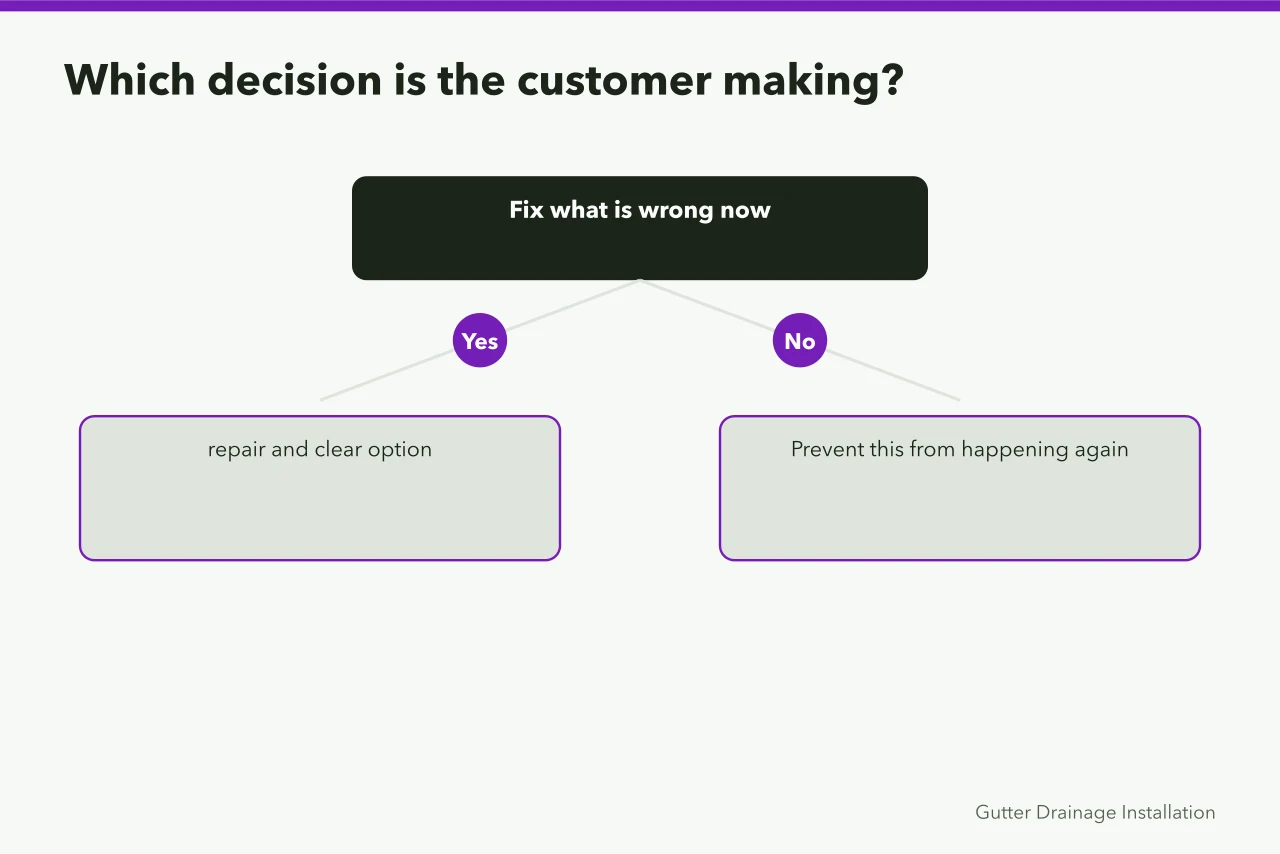
The customer standing in a driveway is deciding one of three things: fix what is wrong now, prevent this from happening again, or get this off my list permanently. Those are different decisions with different budgets and different emotional weight. A package built for one is wrong for the other two.
So write the options as answers to those decisions. Then map your services into them, rather than the other way around.
The three questions being asked
Listen for these, because they arrive disguised.
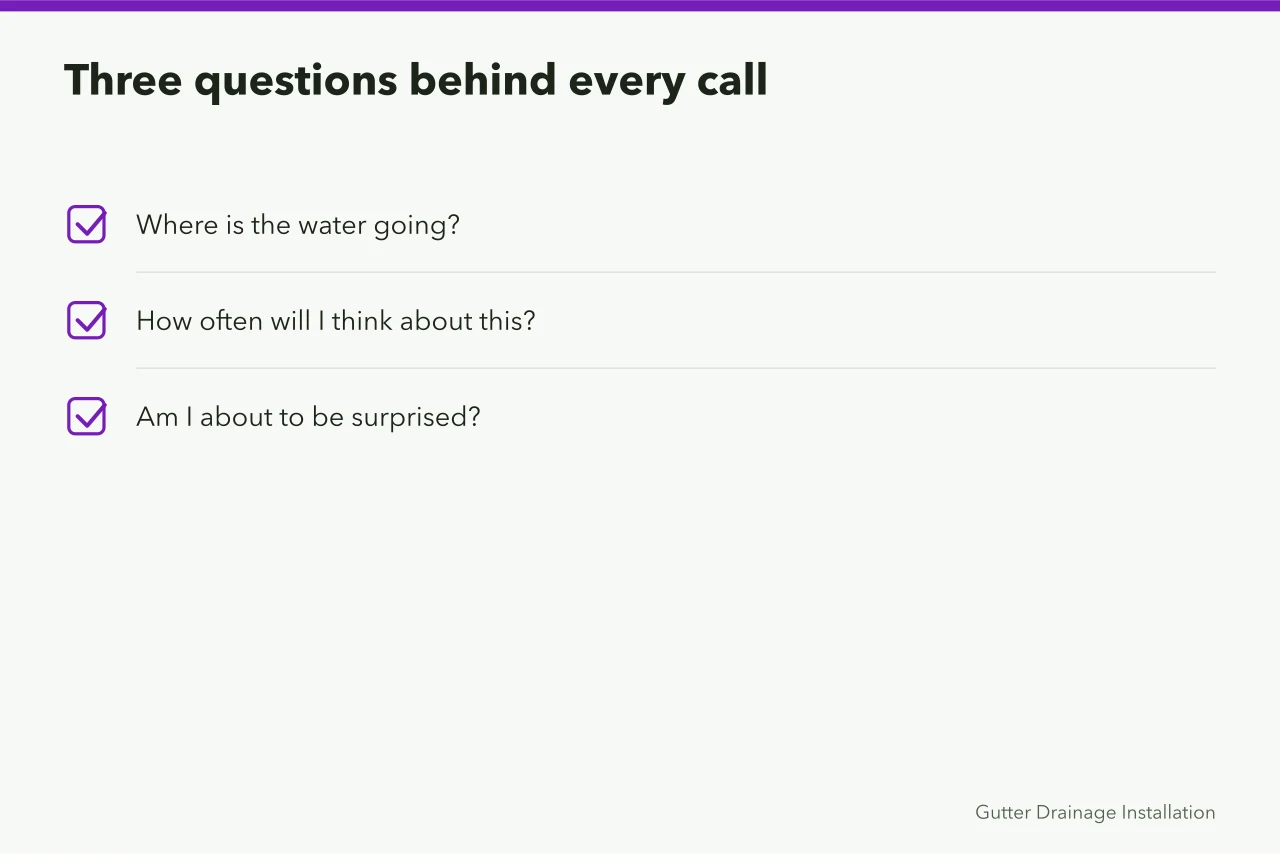
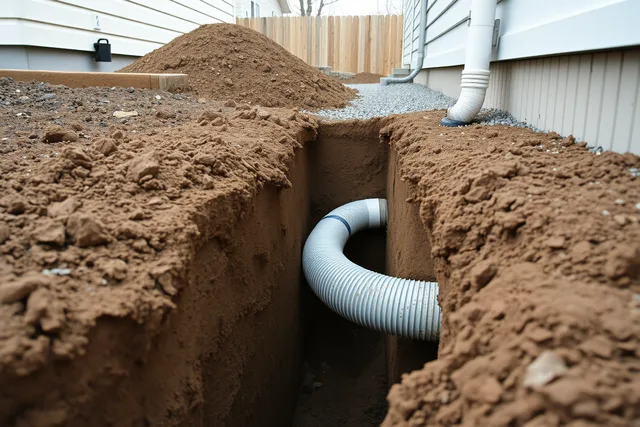
Where is the water going? Almost every call is really this. The customer sees overflow, a wet basement, a stained wall or ice on a walkway. What they want to know is where the water ends up and whether that can change. A package that says nothing about the discharge terminal is not answering the question that generated the call.
How often will I have to think about this? This is the maintenance question, and honest answers win it. Interval depends on the property, above all on tree canopy, and saying that shows you looked.
Am I about to be surprised? This is the trust question, and it is answered by exclusions and contingencies rather than by reassurance. A quote that names what could change the price is more convincing than one that promises nothing will.
Building the option set
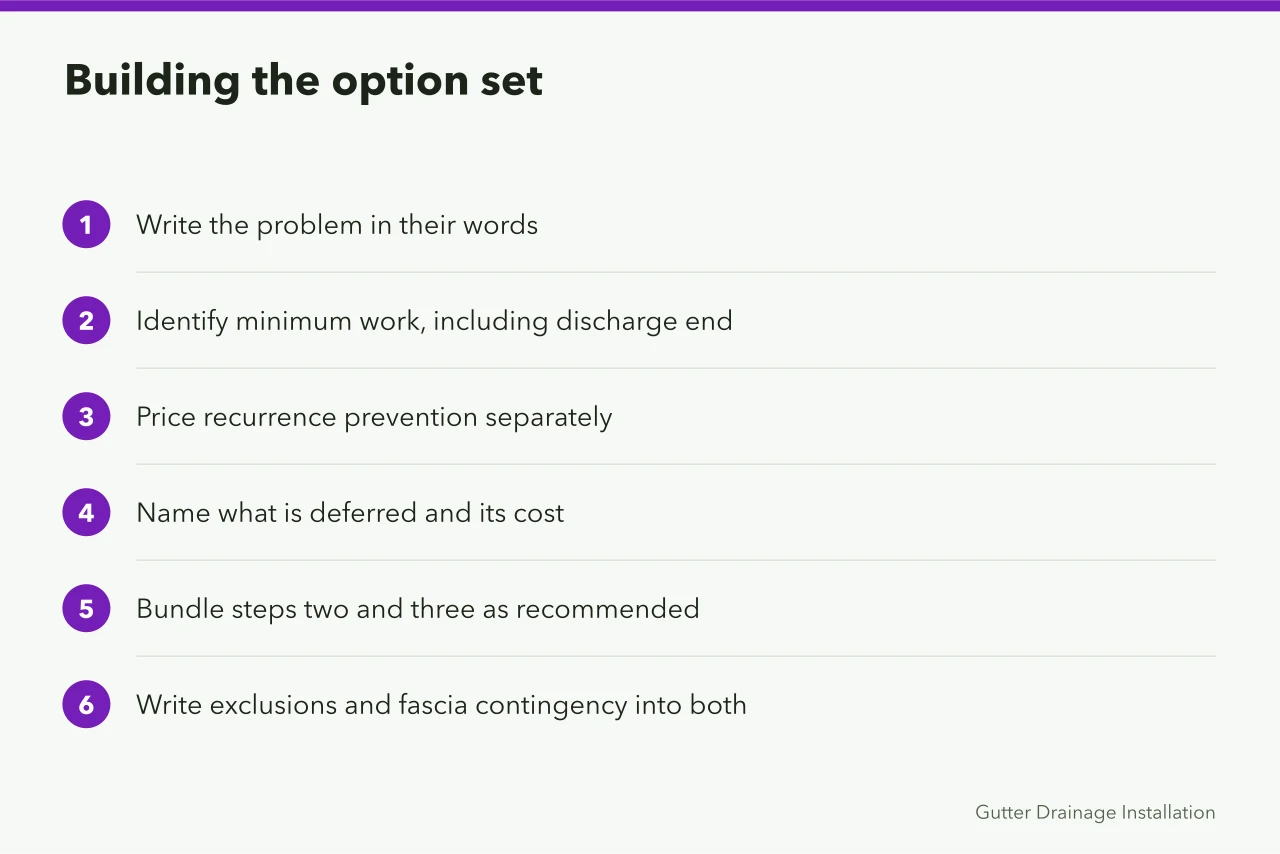
- Write the customer's problem in one sentence, in their words.
- Identify the minimum work that genuinely resolves it, including the discharge end.
- Identify what would prevent a recurrence, and price it separately.
- Identify what is deferred rather than removed, and say what deferring costs.
- Bundle steps two and three into the recommended option, and offer step two alone as the alternative.
- Write the exclusions and the fascia contingency into both.
Step four is the one that builds trust. A customer who is told what they are deferring, and why it is reasonable to defer it, believes the rest of the quote. A customer offered only a full solution assumes they are being upsold.
Step six matters because the cheaper option is where boundaries are usually dropped. The cheaper option is also exactly where a surprise does the most damage.
Naming and describing
Names should describe the boundary, not the quality.
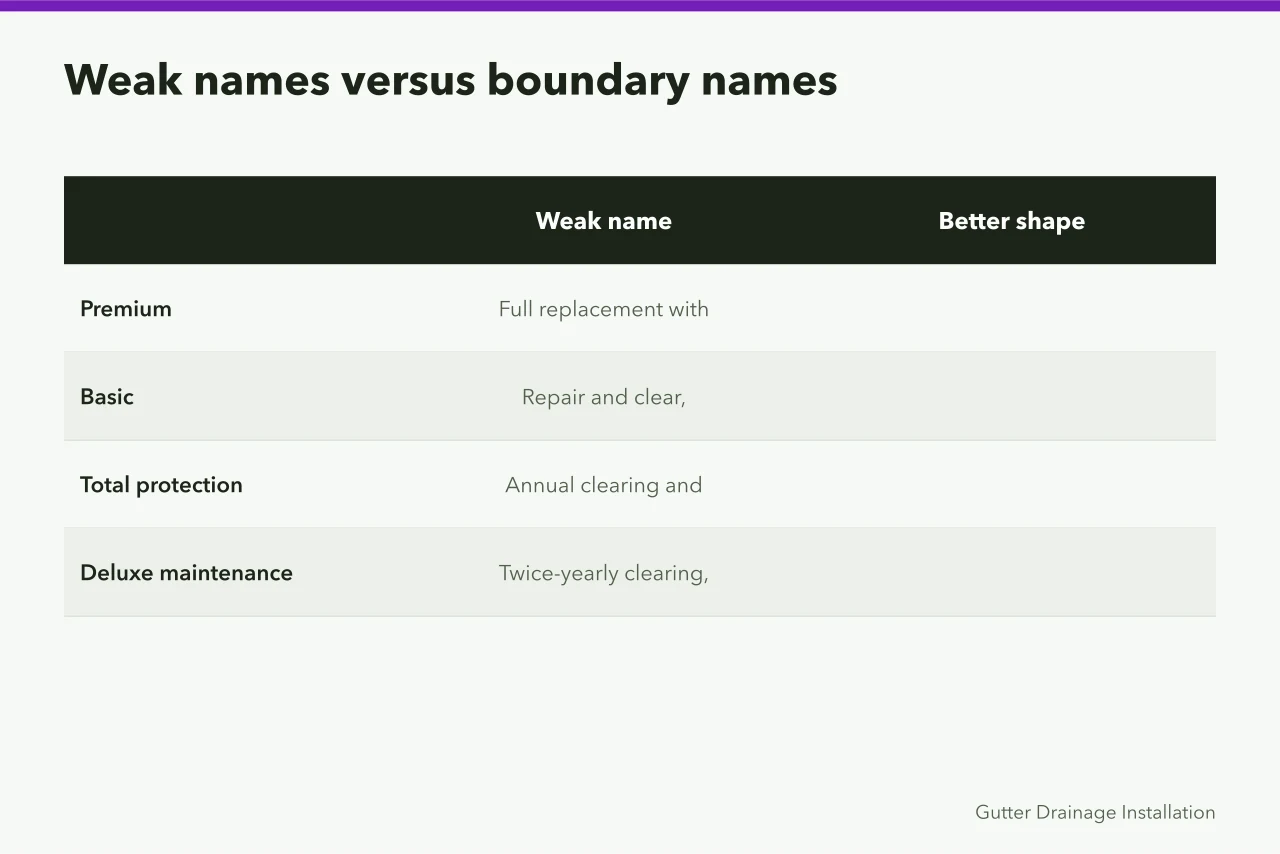
| Weak name | Why it fails | Better shape |
|---|---|---|
| Premium | Says nothing about what is included | Full replacement with drainage terminal |
| Basic | Reads as inadequate before anything is explained | Repair and clear, existing system retained |
| Total protection | Promises an outcome you cannot guarantee | Annual clearing and inspection, condition report |
| Deluxe maintenance | Adjective doing the work of a definition | Twice-yearly clearing, canopy-adjusted interval |
The right-hand column is longer and it sells better, because it can be checked. A customer comparing two quotes can see which one includes the drainage terminal. They cannot see which premium is more premium.
Descriptions should be verbs. What gets removed, formed, hung, sealed, connected and tested. Noun lists read as specification and describe no work.
Presenting two options
Offer two, with a third only where it genuinely clarifies.
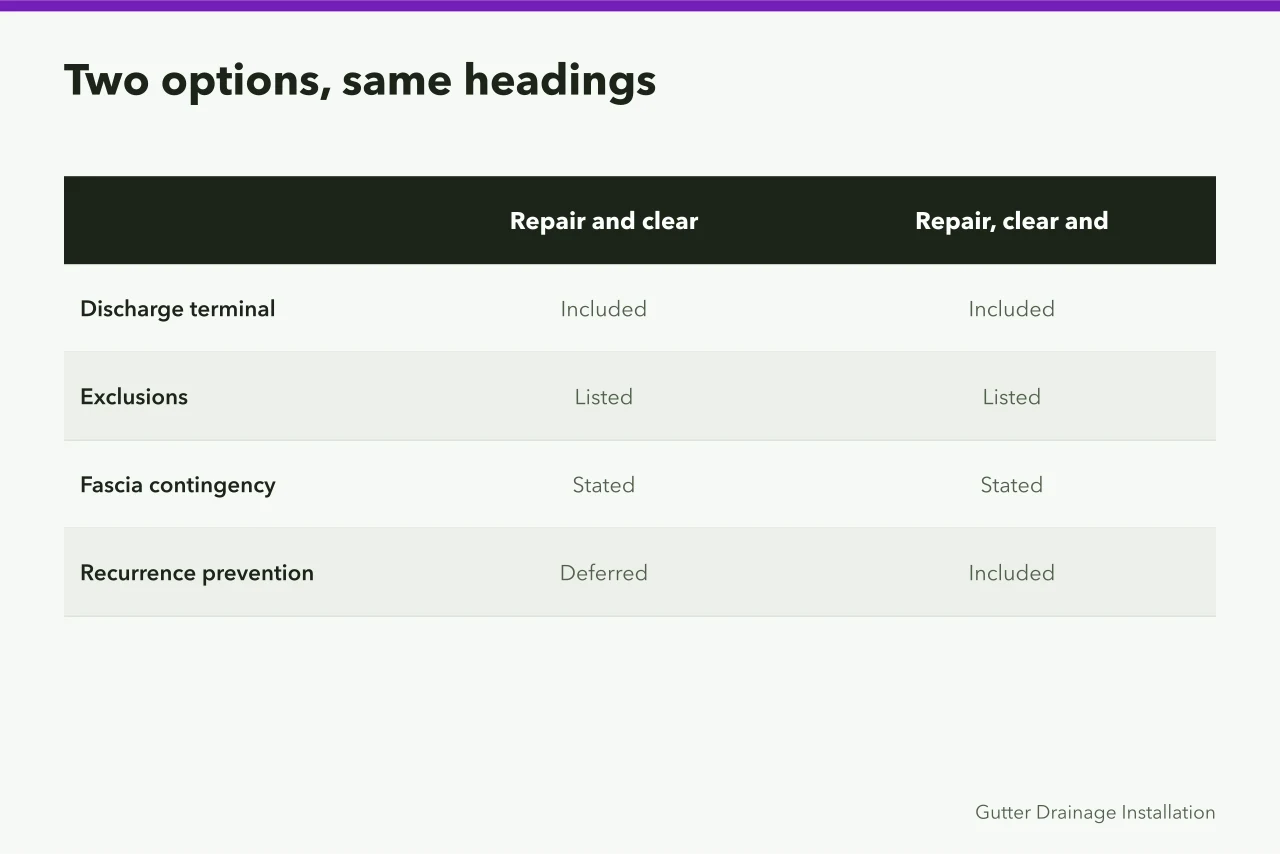
Two options force a real comparison and keep the conversation on scope. Five options move the conversation to price, because that is the only axis a customer can rank five things on quickly.
Present them side by side with the same headings in the same order, so the differences are visible in one glance. Put the discharge terminal, the exclusions and the fascia contingency on both, identically. The customer then sees that the cheaper option is smaller rather than looser.
Then say which one you recommend and why, in one sentence tied to what you observed at their property. An estimator who will not recommend is not being neutral, they are being unhelpful.
The words that cause callbacks
Four phrases produce most of the disputes in this trade. Each has a replacement.
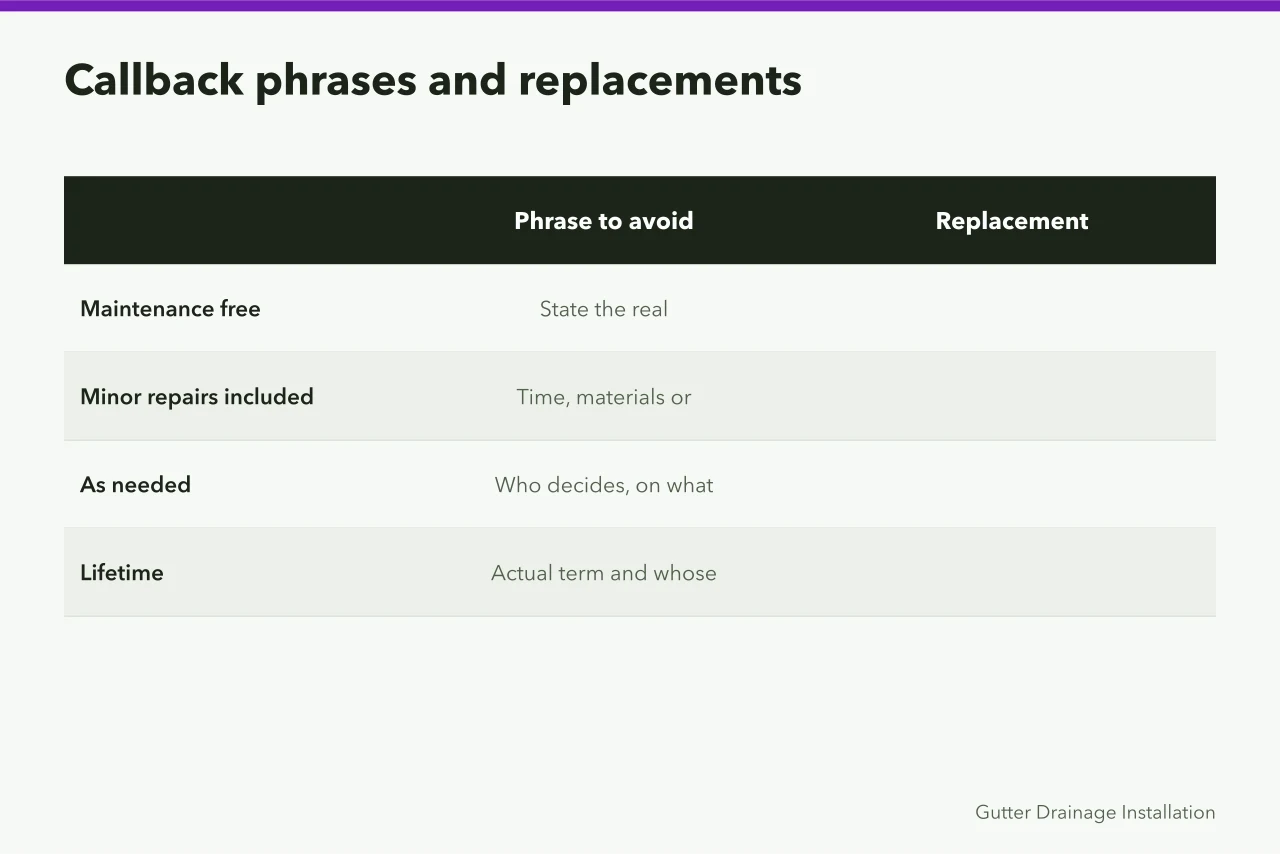
Maintenance free. Replace with the interval you actually expect, and what changes it. Guards reduce large debris and do not end cleaning; fine material still passes and settles, and some designs shed water in heavy rain. Sell the change in interval, honestly stated, and the customer stays.
Minor repairs included. Replace with a time limit, a materials limit, or a named task list. Nobody has ever agreed on what minor means at the moment it matters.
As needed. Replace with who decides, and on what evidence.
Lifetime. Replace with the actual term and whose obligation it is. Where a manufacturer's warranty is involved, say whose it is and what conditions attach, since roofing and guard products commonly have installation conditions that govern.
Whatever the option set says, it has to match what your advertising implied. A headline or starting price needs to be genuinely available on terms a reader understands, and the Federal Trade Commission's advertising guidance for small businesses sets out the general expectation.
Two boundaries that never flex
The access limit is one. A customer offering more money for work above your stated ceiling is offering to move your risk rather than to buy a service. This trade's severe exposure is at the roof edge, where OSHA's guidance on fall protection in residential construction places responsibility for site-specific controls on the employer.
The fascia contingency is the other. A customer who wants it struck out is asking you to absorb an unbounded cost you cannot inspect from the ground. Explain it once and, if it does not move, decline.
Making the next set better
Record, against every option you present, whether it was chosen and what the customer asked about before deciding. The questions are more informative than the outcome, because a repeated question is a gap in the description rather than an objection.
Record what happened afterwards: hours actually taken, materials used, return visits and causes. The IRS explains what records a business is expected to keep. The same file shows which option costs more than it earns.
Rank options by contribution per crew hour, from the most profitable packages piece. Boundary theory is in the packages and pricing guide.
Three practical constraints will shape what you can honestly offer. What the crew can deliver reliably is a training question before it is a sales question, covered in the hiring and training guide. What the truck can complete in one visit depends on the small parts it carries, which is what the equipment checklist is for.
What you can promise about timing depends on one fact: a formed run is made on site, with the coil and the machine traveling as one unit. That is explained in the equipment and setup guide.
Common questions
Should I put prices on my website?
For recurring visit work with stated conditions, often yes. For installation, the quantities only exist at the property, and a published figure invites a comparison against quotes that measured differently.
What if the customer only wants the cheapest option?
Sell it, with the same exclusions and contingency as the other one, and write down what they deferred. That note is what protects both of you later.
How do I handle a customer who wants everything itemized?
Itemize quantities and inclusions. You do not owe anyone your hourly cost, and publishing it turns the conversation into a negotiation about your payroll.
Is a maintenance agreement worth offering in year one?
Yes, and keep it simple. One clearly bounded recurring visit with a written condition report is more valuable than a tiered program you cannot yet staff.
What is the single best line to add to any package?
Where each downspout will discharge, and onto or into what. It answers the question that generated the call.