Guides
How WSIB, WorkSafeBC and CNESST cover Canadian gutter crews
Compare how WSIB, WorkSafeBC, WCB Alberta and CNESST register gutter crews, price premiums, issue clearance letters and enforce fall protection.
What to take away
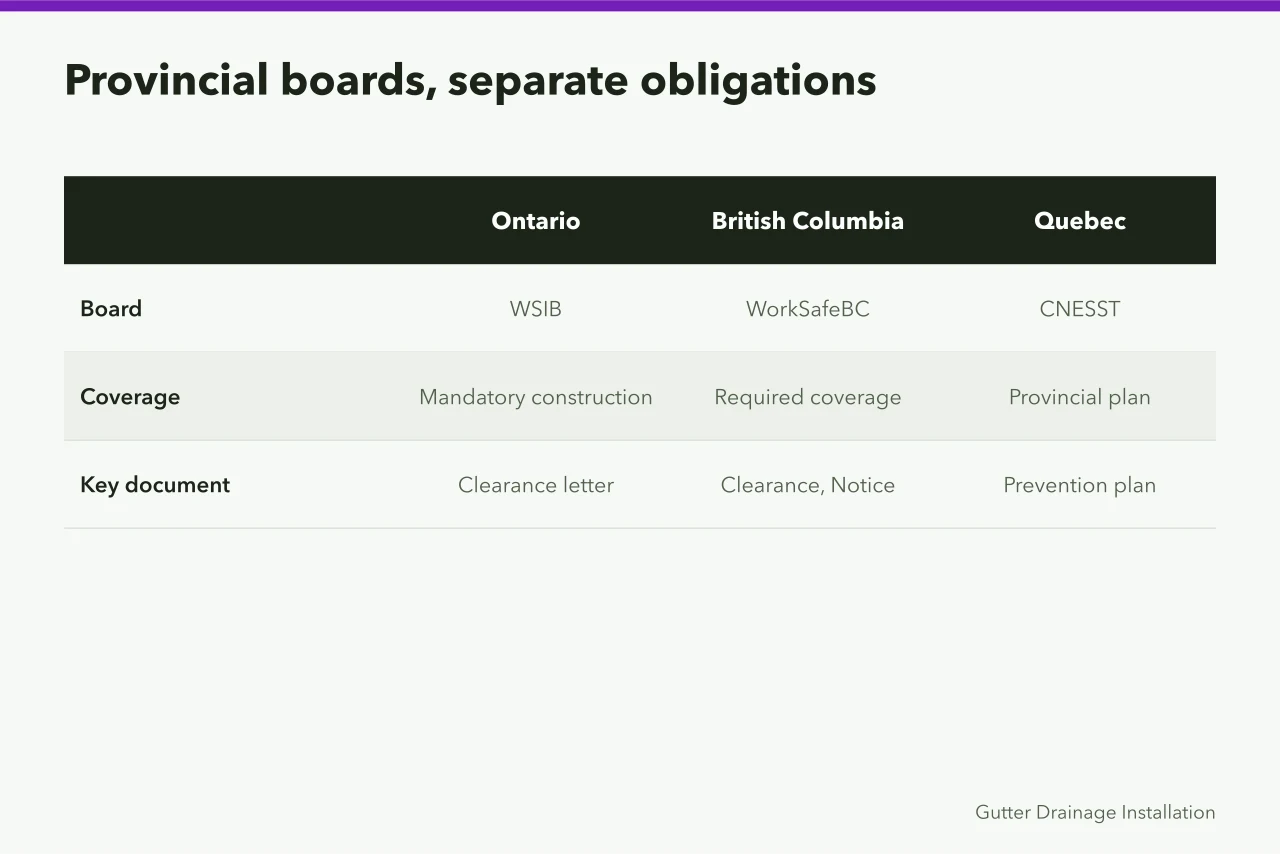
- Workers' compensation is provincial. A gutter crew working in Ontario answers to WSIB, in British Columbia to WorkSafeBC, in Alberta to WCB Alberta, in Quebec to CNESST.
- Registration is triggered by hiring your first worker, not by company size, and each board sets its own reporting periods and penalties.
- Clearance letters prove a subcontractor's premiums are paid. WorkSafeBC expects prime contractors to check them before a crew starts.
- Fall protection is a legal duty on every ladder and roof-edge job, and the training and inspection records are what an inspector asks for first.
- CCOHS publishes free hazard guidance, but the regulation that binds you is the one in the province where the work happens.
Why a gutter crew needs a provincial map, not one policy
Canada has no national workers' compensation board. Each province runs its own scheme, sets its own premium rate, and enforces its own reporting rules. A gutter business that installs in Ontario and crosses into Quebec holds two sets of obligations for the same crew.
Gutter work is classified as construction by most boards. That classification drives the rate, the reporting deadlines and the clearance rules, and it is the reason a gutter installer's premium looks nothing like an office premium.
The trade-off underneath all of it is no-fault coverage. An injured worker claims from the board instead of suing the employer, and the board pays from employer premiums. That is why coverage is mandatory rather than optional.
Operating without it exposes a gutter business to fines, back premiums and personal liability. It also puts the homeowner or property manager in the middle if an uninsured worker is hurt on their property.
Every province and territory has its own arrangement. These include:
- Nova Scotia
- New Brunswick
- Newfoundland and Labrador
- Prince Edward Island
- Manitoba
- Saskatchewan
- Yukon
- the Northwest Territories
- Nunavut A company working nationally needs an account in each jurisdiction where it employs people.
WSIB registration and coverage for Ontario gutter businesses
WSIB covers most Ontario employers, and construction is a mandatory coverage sector. A gutter business registers once it hires its first worker, then reports payroll and pays premiums.
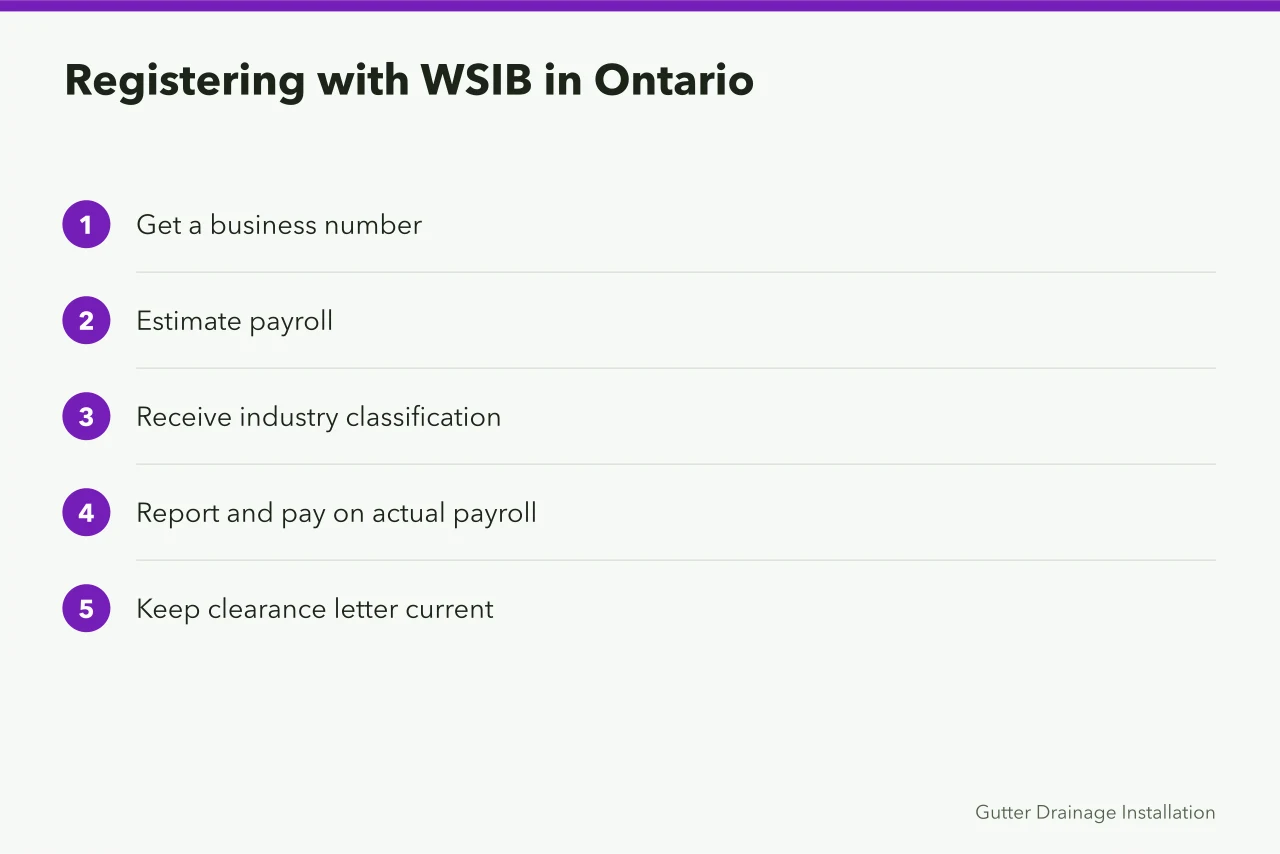
Registration starts with a business number and a payroll estimate. WSIB assigns an industry classification, and gutter installation and cleaning sit in construction rates. Rates are re-set most years, so last year's statement is not a forecast.
Reporting runs on a cycle. Employers report and pay on actual payroll, and a missed filing costs more in penalties than the premium did. Put every reporting date in one calendar.
The insurance side and the health and safety side run together. The WSIB health and safety guidance covers the obligations that apply to a crew working at height, and a gutter business is expected to use it.
Clearance letters matter here too. A general contractor or property manager may ask for proof that your WSIB account is in good standing before your crew steps on site. If the account is behind, the letter will not issue and the job stalls.
Subcontracting adds a layer. Hire another gutter crew for a large job and you may be treated as a principal who must confirm their coverage. Unpaid subcontractor premiums can land on your account. Keep a clearance letter on file for every subcontractor you use.
For a new owner the sequence is register, classify, report payroll, pay premiums, keep the account current. Workers' compensation is a core line in the insurance costs and coverage picture for a gutter business, not an optional extra.
WorkSafeBC coverage, clearance letters and Notice of Project
WorkSafeBC covers employers in British Columbia, and construction is a required coverage sector. A gutter business with employees registers, reports payroll, and pays premiums by rate group.
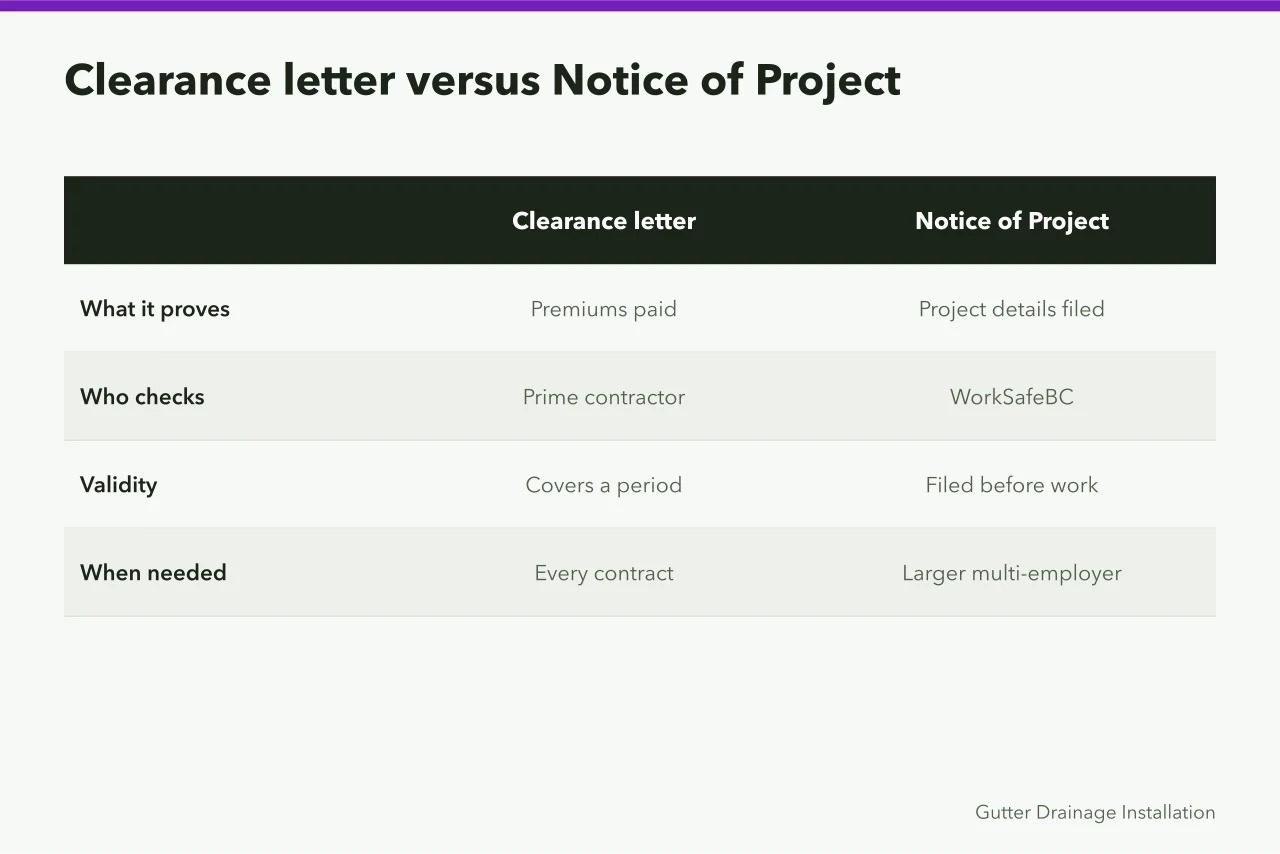
British Columbia runs the most formal clearance letter system in the country. A clearance letter confirms that a contractor or subcontractor has paid the premiums needed to cover the work, and prime contractors are expected to check it before hiring.
The WorkSafeBC clearance letter process explains why builders and property managers ask for the document first. It covers a period rather than a project, so last year's letter will not satisfy this year's client. Order a fresh one when the contract is signed and file the copy.
Notice of Project is a separate filing. Some British Columbia construction projects require the prime contractor to file one with WorkSafeBC before work begins, identifying the project, the parties and the scope. A gutter subcontractor may be asked for details.
Small residential work usually does not trigger a Notice of Project. Larger jobs with several employers on site are more likely to. Ask the prime contractor who is filing.
The provincial rules on ladders, fall protection and roof work live in the OHS Regulation. The searchable OHS Regulation is the reference to read before roof-edge work, covering ladder setup, fall arrest, and the duties of employers and workers.
WCB Alberta and CNESST compared
WCB Alberta covers most Alberta construction employers. A gutter business with workers registers, reports payroll, and uses clearance letters the same way British Columbia does. A subcontractor without a current letter can hold up payment.
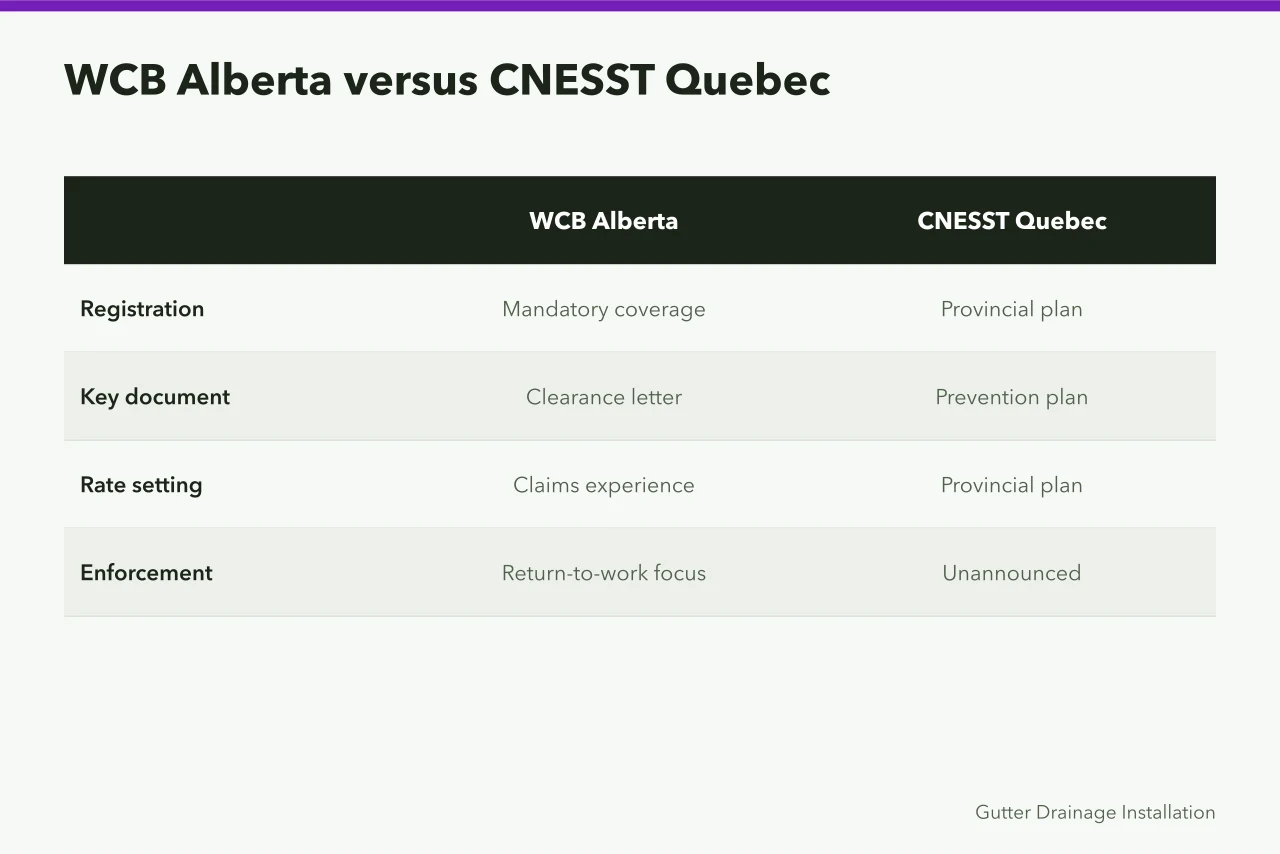
Alberta adjusts premium rates by claims experience. A gutter business with a clean record can watch its rate improve over time, and a bad claims history does the opposite. Return-to-work planning is central to how the board handles claims.
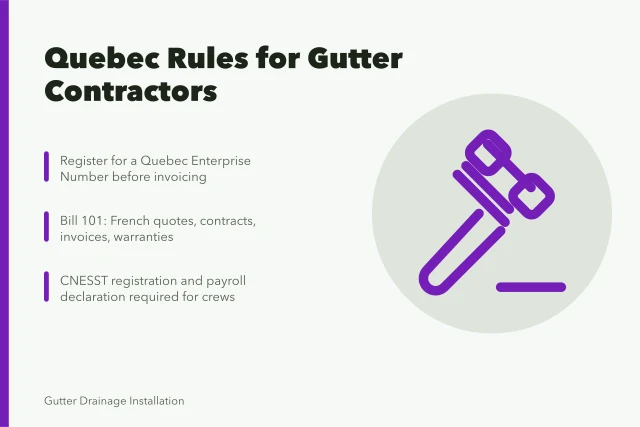
Quebec is structured differently. CNESST administers the province's occupational health and safety regime, handling prevention, inspection and worker rights, and employers register and contribute to the provincial plan.
Quebec leans hard on prevention. A gutter crew working at height is expected to have a written prevention plan where the risk warrants one, and CNESST inspectors can visit without notice.
| Board | Province | Registration trigger | Key document |
|---|---|---|---|
| WSIB | Ontario | Hiring workers in a covered industry | Clearance letter |
| WorkSafeBC | British Columbia | Hiring workers in required coverage | Clearance letter, Notice of Project |
| WCB Alberta | Alberta | Hiring workers in mandatory coverage | Clearance letter |
| CNESST | Quebec | Hiring workers in Quebec | Registration and prevention plan |
Registration is not a one-time task. New hires, new provinces and new subcontractors each create a fresh obligation, and a bookkeeper who tracks them in one place prevents surprise penalties.
Coverage in one province does not follow the crew across a border. The compliance checklist approach is to confirm registration, clearance and reporting for every province where you employ people.
Fall-protection duties on ladder and roof work
Falls are the leading cause of serious injury in gutter work. Every province treats a ladder or roof edge as a controlled hazard with a legal duty attached, not a routine risk of the trade.
Fall protection means a system that prevents or stops a fall: guardrails, travel restraint, or fall arrest with rated anchorage. The right choice depends on the task, the height and the surface, and the requirement is set by the provincial regulation, not by a supplier.
Training is a legal requirement in most provinces. Anyone using fall arrest needs instruction on inspection, fitting and use, and the employer needs records showing who was trained, when, and on what equipment. The gutter service equipment list for a new business should include fall protection before the first roof job.
Inspection happens daily. Harnesses, lanyards, anchors and ladders get checked before use, and a written log shows due diligence after an incident. Damaged gear comes out of service.
Rescue planning is the step crews skip. A fall-arrest system that leaves a worker suspended needs a rescue plan and the means to carry it out; calling emergency services is not a plan. A crew working alone on a roof needs a way to get a suspended worker down fast.
Canadian weather changes the risk. Ice, snow, rain and wind affect ladder stability and roof traction, and a crew that works through winter needs cold-weather procedures and the standing right to stop when conditions turn.
This article does not give working-at-height instruction. Name the authority that applies to your job, WorkSafeBC, CNESST, WSIB or the CSA standard your province adopts, and get certified training before the crew goes up.
CCOHS guidance and the due diligence file
The Canadian Centre for Occupational Health and Safety is a federal agency that publishes plain-language hazard guidance. It does not enforce rules, but employers, trainers and provincial inspectors all use its material.
The CCOHS overview of Canadian OHS acts and regulations explains how federal, provincial and territorial law fit together, which is the starting point for knowing which law applies to which job.
The CCOHS physical hazards section covers falls and working at heights, useful for building a training outline, a toolbox talk, or a hazard assessment for a specific gutter job.
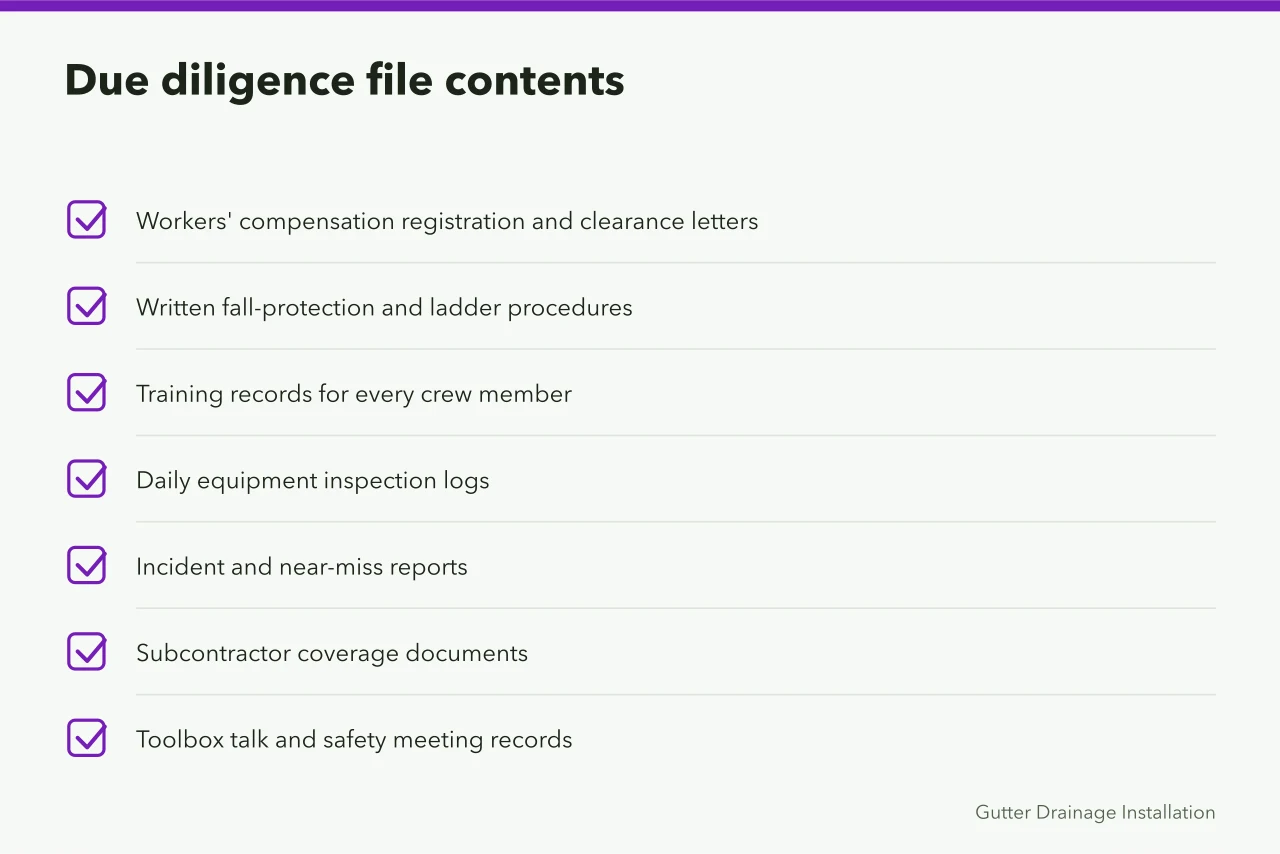
Due diligence is the legal idea that an employer took reasonable steps to prevent harm. In practice it means written procedures, training records, inspection logs, and evidence that problems were fixed.
A due diligence file for a gutter business can hold:
CCOHS material is not a substitute for the regulation that binds your job. Use it to understand the hazard, then check the specific rule in the province where the work happens.
The same pattern shows up in how a gutter business hires and trains its crew. Safety training belongs in onboarding, and the records start on day one.
What a new owner should do first
Start with the province where you will actually work. Register with that workers' compensation board, classify the business correctly, and set up payroll reporting. If you work in more than one province, repeat it for each.
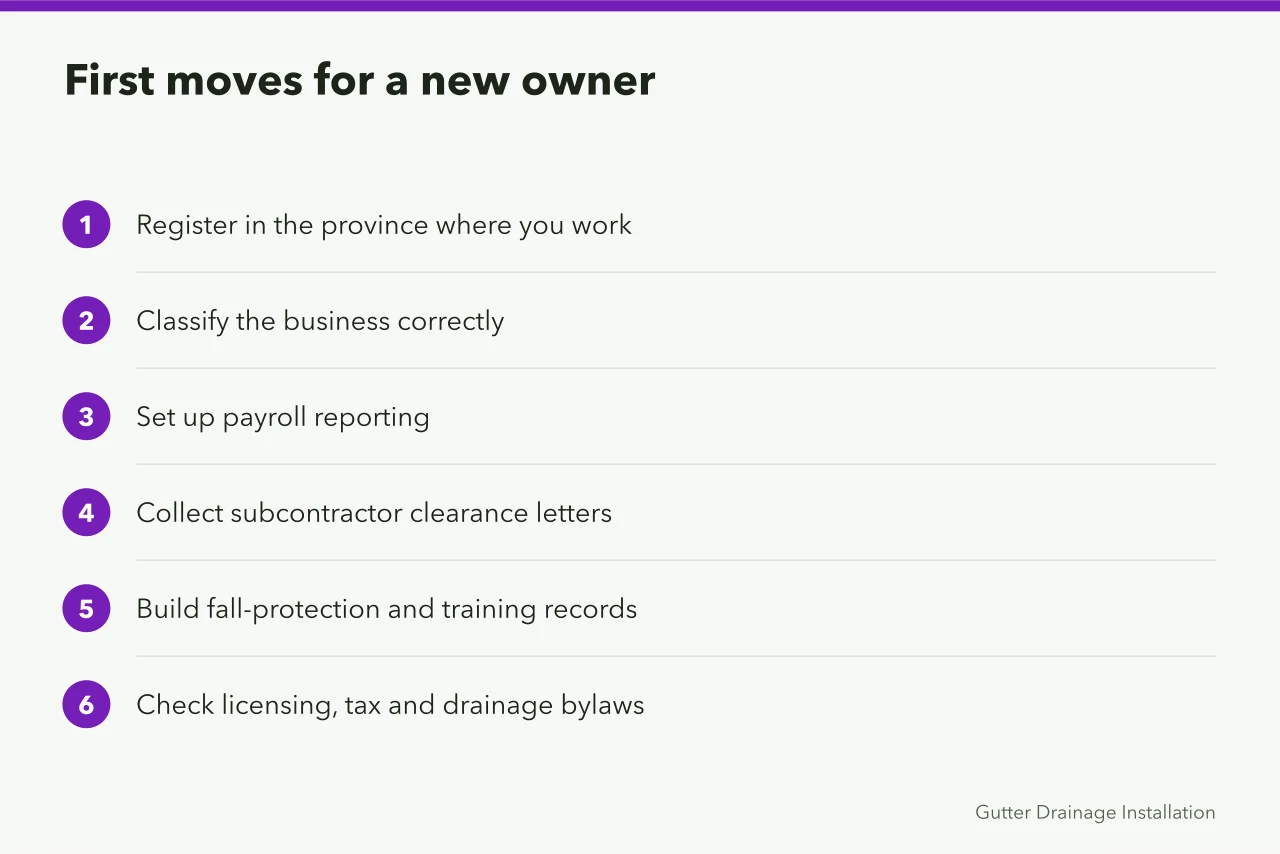
Then confirm subcontractor paperwork. A clearance letter from every subcontractor protects you from inheriting their unpaid premiums, and the letters expire, so keep them current.
Build the safety side at the same time. Fall protection, ladder safety and training records are the evidence that you took the job seriously, and they are the first thing an inspector asks for.
Know the rules that sit alongside coverage. Business registration, GST/HST, payroll deductions, municipal stormwater and drainage bylaws, and provincial building codes each touch some part of gutter work. The operate legally side of the business is broader than a single licence.
Use the free guidance that already exists. Board websites, CCOHS material and provincial regulations are public, and a new owner who reads them before the first job avoids the most expensive mistakes.
Treat coverage as a running cost. Premiums follow payroll, clearance letters follow payment, and training follows every new hire. One calendar and one folder keep the business current.
Common questions
Do I need WSIB if I am the only worker in my gutter business?
In Ontario, independent operators in construction can apply for optional insurance, but coverage becomes mandatory once you hire workers. Confirm your status with WSIB before the first hire, because the answer turns on how the board classifies you.
What is a clearance letter and who asks for it?
A clearance letter confirms that a contractor or subcontractor has paid the premiums needed to cover the work. Prime contractors, builders and property managers commonly ask for one before letting a crew on site, and it covers a period rather than a project.
Is a Notice of Project required for every gutter job in British Columbia?
No. It applies to certain construction projects, usually larger or longer ones with multiple employers on site. Small residential work generally does not trigger it, and the prime contractor decides for the project.
Does CNESST work the same way as WSIB?
Both cover workers and both expect employer registration, but Quebec places more weight on prevention planning and unannounced CNESST inspection. The forms, deadlines and prevention duties differ from Ontario's, so check each province separately.